DD
MM
YYYY

PAGES

DD
MM
YYYY

spot_img

PAGES

Home Blog Page 6801

Way to Wealth: Investment Opportunities for Nigerians

0

By David Alade

Though I have written a couple of times about investing in the equity market, I understand quite well that the dynamics and volatility that drive the ecosystem of stockbroking won’t allow everyone to benefit from the promises it offers. To make up for this inherent limitations, and still help you to grow your wealth, in the following paragraphs, I will be examining “safe” and “less risky” investment opportunities an average Nigerian can leverage to grow wealth no matter how much you have to start with.

Mutual Funds

Many people do not know there is a stress-free way of growing wealth, a mutual fund offers such itch-free, secure and reliable opportunity. Mutual funds are investment vehicles managed by professionals trained to do so. Currently, an average fund in Nigeria returns over 10% per year, the implication of that is when you invest say N200,000, you will expect to cash out more than N220, 000 at the end of a 1-year cycle. When you factor in the principle of compounding, you will realize that 10% yearly is a lot in return.

How much can you start Mutual Fund with?

You can start with as little as N5,000. A lot of fund managers now receive that low as minimum capital. Currently, we have ARM, Cowrywise, StanbicIBTC, and more investment houses playing in this space. Reach out to anyone or more of them to make adequate enquiry about modalities and return.

Treasury bills

Treasury bills (TB) are a way of investing in government activities. Because the government is not rich enough, it tends to always borrow money both domestically and internationally. One of the ways it pursues its domestic borrowing is via TB.

How do TB works?

Unlike any other investment vehicles, TB is one investment vehicle that pays you your interest (return) upfront from day one of your investment. That is, if you invested N1m and the interest is 10%, on day zero of your investment, you will receive N100k as your interest, implicitly, you are only dropping N900k on day zero. On the expiration of the investment, you get your N1m investment back. Don’t worry it’s not that complicated. Good to mention as well is that this investment is regarded as risk free, in other words, it is one thing you can invest in and you can be sure you will get both your interest and capital.

How can you invest in TB?

So far, I-invest App by Sterling Bank is one Fintech solution that has been able to efficiently democratize access to TB investment. You can download it and start using it. You should note that TB on I-invest requires a minimum of N100k as a starting capital. Yes, N100k as minimum.

AgricTech Crowdsourcing Platforms

The rise of technology entrepreneurs has further increased investment opportunities available for an average Nigerian.

Crowdsourcing is a way of aggregating funds from different sources on a micro-scale, targeted towards investment on a much bigger scale than what individual micro fund would have been able to do.

What AgricTech entrepreneurs are currently doing is investing massively in Nigeria agriculture value chain, but these investment opportunities are opened to you and me via their different platforms. Currently, on top of my head, I can mention FarmCrowdy, Farmfunded and ThiveAgric as few of those avenues.

Risk and Return

While so far no one has reported any issue of nonpayment of capital and interest of the invested sum in any of these platforms, the risk of such exists. Please read all terms and conditions before investing and understand what you are putting your money into.

On the flip of the return, it’s probably the juiciest you can find in the market, currently returning sometimes up-to 30% per year on your investment. When you couple this with the fact that there’s not been any default news so far since the creation of the ecosystem, it’s a good thing.

Real Estate

There’s has been some crowdfunding opportunities in this space as well and return can be great if well managed. However, unlike all the above that I’ve talked about whose return can be realized within a 1-year cycle, real estate does not follow the antecedent. Yes, it takes more than a year to realize the value of an investment, but can worth it in the end.

I’m not so familiar with this space, but I’ve had discussions with players in the ecosystem. I caution that for anything you are putting your money into, you must conduct your due diligence yourself, don’t rely on what someone told you.

I have written so far on things you can invest in to grow your wealth, now go and do likewise. Save, invest and grow your net worth.

Improving NYSC Experience – My Proposal for Establishing “National Youth Service Cooperative Society”

0

By David Gani

“But remember this, the sun that shines today is the sun that shone when thy father was born, and will still be shining when thy last grand child shall pass into the darkness”. (The Richest Man in Babylon, 2007:16). Paraphrasing, ‘the hardship corps members suffer today is the same their predecessors suffered, and will still be there when new corps members are deployed’.

Trained to serve ‘in the sun or in the rain’; and in the course of eleven months, our young and educated citizens are  mandated to build a virile nation, and at the same time are buffeted by the need to survive some strange terrain and circumstances – chiefly economic.

As a victim of this circumstance, serving in one of the most rural communities in Nigeria, I will briefly share my experience which will serve as my reason for recommending the establishment of Consumer Cooperative Stores, CCS, in all the seven hundred and seventy-four local government areas (774) of the country for corps members especially for those serving in areas of high level of poverty and little or no access to basic social amenities.

Like every young and patriotic Nigerian graduate, I got the clarion call, and with gusto I responded to the voice of Fatherland to serve in Kurmi ( a Hausa word for forest or bush ) in present day Taraba State located in northeast Nigeria. Kurmi is one of the sixteen (16) local governments in the state. It boarders Cameroon to the south and has a landmass of 4,354km². Just for emphasis, Lagos state is 777km² smaller in size. The geography of Kurmi is abundant with mountains and rocks, valleys and huge water bodies, forests and rugged terrains. Most of the inhabitants are farmers and pastoralists. The basic social amenities we take for granted in the city were all lacking. Not a single bank, no tarred road, no electricity, no pipe born water, no standard restaurant, climbed hills and mountains for phone network. During my service year, 2014/2015, we numbered 130 corps members in the entire local government.

By all standard, city life is expensive vis-à-vis rural life. But on the contrary, the reverse is the case for corps members serving in least developed communities, partly, due to the huge cost of providing city luxuries to rustics; the incentive is not juicy for businessmen. To appreciate what we went through, Table 1 below is a snippet of the cost of living for an average corps member in Kurmi.

Table 1: Prices of Necessities Across Kurmi and Lagos, 2014/’15.

Goods and Services Quantity Kurmi Lagos Difference
Sachet Water 1 bag N200 N70 N130
Egg 1 N40 N20 N20
Trip to Bank 1 trip N2000 N0 N2000
Recharge card 1 card N120 N100 N20
Kerosene 1 litre N200 N140 N60
N2,230

The distance from Baissa, the headquarter of Kurmi to Takum( a local government contiguous to Benue State, the only one that has a bank amongst a cluster of local administrations ) is 98.5km. By comparison, it roughly equals the distance between Maryland in Lagos State to Abeokuta in Ogun State. The only  tarred road on our quest for monthly cash withdrawal and provision is from Sabon Gida Tukura, the last town when leaving Kurmi. The frequency of our involvement in motorbike accidents was worrisome. One time a colleague suffered a broken tibia. On one of my trips the accident I had was terrible. Cause: the bike rider was under the influence of Tramadol and slept off while riding. I suffered a broken rib with deep cuts and grazes that required stitches. To minimize risks, we pooled funds to hire a bus once a month.

You may be thinking, ‘it is normal for manufactured goods to be expensive in such a place, and local produce should compensate’. Nay! In the market place, the locals, though nice and accommodating, transacted with us under the false assumption that we had fat purses. When we asked, ‘Why is your palm oil this expensive?’ The response was always, ‘Are you not a corper? You have money. The federal, state, local governments, and your PPA all pay you.’ Trying to convince them that only the federal government paid us and our PPA gave us monthly kerosine stipend of N1,000 will not yield much. A few corps members depended on monthly subsidies via transfer payments from home.

In the light of the foregoing, and with gladness at the adoption and the implementation of my earlier proposal to the government on the need to create NYSC Farms in the six (6) geopolitical zones and start posting corps members to be productive https://guardian.ng/features/nigeria-agriculture–and-nysc. And https://m.Facebook.com/officialnysc/photos/a.9713654) I therefore use this medium to make a second recommendation to the government on the need to create the National Youth Service Cooperative Society. I am aware of the recently upward review of corps members monthly allowance from N19,800 to N30,000. I commend President Muhammadu Buhari for his empathy and swift consent to the bill. Sadly, as we all know by economic trend, soon the general price level will rise and swallow up the expected real positive effect on disposable income. This is because our productivity lags behind inflation growth. Since the wage upgrade, the polity have been debating the market value of N19,800 and N30,000 with respect to purchasing power parity, PPP: the determination of exchange rates between currencies in the long run by the  amount of goods and services each can buy. Please do not think that I have digressed from my theme, I am heading somewhere. Follow me…

Using the PPP concept, I will show the basket weight of goods and services the former wage of N19,800 demanded in year 2011 when it came into force, and also, how much it can buy in 2019 just before the raise with respect to the new wage of N30,000. Please be mindful that the PPP is not limited to the comparison of the market worth of two or more currencies in a particular period, it is also used to compare the relative values of a single currency in two or more periods. See Table 2 below.

Table 2: Purchasing Power Parity of Old and New Minimum Wages for Corps Members.

Variables 2011 2019 Before 2019 After
Wage (N) 19,800 19,800 30,000
Dollar:Naira 1:150.5 1:360.6 1:360.6
Exchange ($) 132 55 83
50kg of rice (N) 7,500 15,000 15,000
% Cost of Rice 38% 76% 50%

From the table, a corps member in 2011 used 38% of her allowance to buy a bag of rice. Before the wage increase in 2019, 76% of the same allowance was used to buy a bag of rice. After the raise to N30,000, a bag of rice is valued at N15,000, that is 50% of the new wage. Thus, we can authoritatively infer that, the 26% improvement in corps members wages from N19,800 to N30,000 should be the singular reason for jubilation in the service corps. But this excitement would be considered as “money illusion” when we come to terms that the market value of N19,800 in 2011 is 63% higher than the value of N30,000 in 2019, dollar-wise. My purpose for this little analysis is to prove that the gains of the new minimum wage is unsustainable in the long run. The economic future will be harsh and can only assume a desirable form based on what policy makers do today. If they see value in my proposal, then the following gains would be reaped.

The first benefit of the ‘Corpers Consumer Cooperative’ is a direct improvement on their standard of living. Located at each local government headquarter, corps members who live far off can take advantage of their monthly Community Development Service, CDS to get provisions at whole sale prices through cash and electronic means and even benefit from credit sales. They can also borrow cash. This will eliminate the risks of traveling to a distant town for financial transaction and shopping.

Second, it will address the shortfall in the allocation of corps members to non urban settlement occasioned by requests for redeployment to places of better opportunities. The need for corps members in rejected places can be compared to the demand for technical know-how and expatriates in the construction of railway, dams and airports for the country. There is a village in Kurmi called Bente Gilead. This community has tried to get corps members posted to their community for some years without success. Finally, we gave them two. And they danced for joy. ‘At last, our children have gotten teachers!’, they exclaimed. I later visited seeking the welfare of the duo, and confirmed, truly they were the only teachers in a ramshackle school.

There are abundant opportunities for wealth lying untapped in the least developed regions of the country. When highly skilled and knowledgeable aliens from industrialized countries migrate to Nigeria, they usually command the best economic benefits because they are not at par with our indigenous labour. Nigerians who emigrate to these countries end up doing odd jobs rejected by the citizens of the host country due to labour differential. The Corpers Cooperative will be a bait and assistance to corps members to not only serve but prosper in the bush. There are portions in the NYSC Act that provides for economic tendencies. Section1 subsection 3d: to enable the Nigerian youth acquire the spirit of self reliance by encouraging them to develop skill for self-employment; subsection 3e: to contribute to the accelerated growth of the national economy; subsection 4f: that members of the service are encouraged to seek at the end of their one year service, career opportunities all over Nigeria, thus promoting the free movement of labour.

“Life consists of a number of opportunities and great opportunities do not come knocking on people’s doors. Whoever wants such opportunities should grab them when they arise for his people and for himself.” (Rashid Al-Maktoum, Mohammed. My Vision, 1st ed. Motivate Publishing, 2012 ). I guarantee you that waiting after service to seize an opportunity will be unwise. The Corpers Cooperative will assist its members with soft loans and other assistance to be gainfully employed before rounding up service and graduating into chronic unemployment that will hit 33.5% by next year, 2020. This fact was from the lips of the former Minister of Labour, Dr. Chris Ngige.

The society will create more commercial farmers, increase, and improve our exports in the long run as more fallow lands would be cultivated by corps members serving in villages. Back then I had a few colleagues that got plots of lands on which they farmed vegetables and sold on market days. They used the proceeds to cushion the high cost of living. Can you imagine the returns to scale these dudes would have had if the Corpers Cooperative had existed? They were willing to settle down in Kurmi but the allowance had stopped coming and no access to loans to specialize.

Again, a nationwide Corpers Cooperative will decelerate the geometric growth of unemployment and accelerate the arithmetic growth of employment in the economy. Because Nigeria’s employment statistics induces migraine, I will not quote much here. The average number of graduates churn out by Nigerian universities each year is said to be 500,000. The number is greater when we add foreign schooled. Out of that number, the NYSC temporarily employs 300,000 and after one year they join the over 30 million unemployed. If you are a serving, prospecting corps member, and undergraduate reading, do not be apprehensive about the future, the government has its economic hat on. The Central Bank Bank of Nigeria recently disclosed its plan to start providing loans to corps members after service. A lofty initiative! Seminal when compared to the tinkering of extending the service to two years, postponing the evil day. I strongly advice the CBN to look at the possibility of starting now by adopting the Corpers Cooperative model because ‘Opportunity is a haughty goddess who wastes no time with those who are unprepared (Clason, George S., 2007).

The Society will be a panacea to the problem of rural-urban drift and simultaneously encourage urbanization. Humans behave like ants. Wherever you drop sugar, in no time an army of ant will migrate to that location. The regions in this order of development Southwest, Southeast, South south, Northwest, North central, and Northeast attract corps members in varying numbers. If well equipped economically, they will be able to catalyze the speed at which the last three zones race to develop. They will be able to attract awareness and investment as they explore the hinterland.

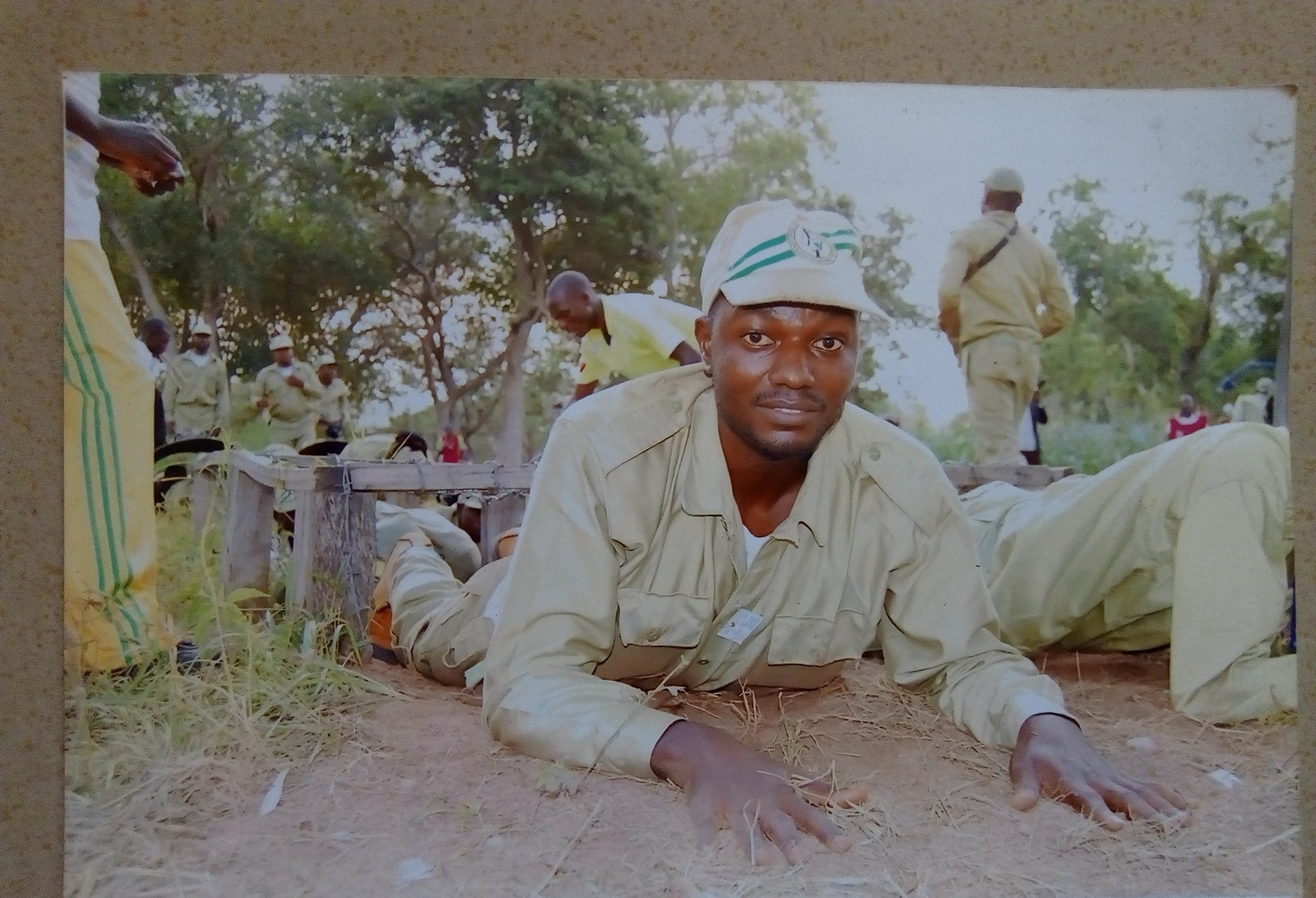
NYSC logo

The final but not exhaustive benefit is that corps members would inspire the next generation through CDS. The CDS as a major tool of the Scheme is instrumental in the execution of social and infrastructural development programs in host communities. Projects are executed, traditional system, processes, and practices have been improved. But by my evaluation, the greatest CDS corps members bequeath are dreams, hopes, and faith through role modelling. Reason. During my time I realised that most of the youths in the community cannot pass external examinations like JAMB and WAEC despite several attempts. Many become parents before finishing school. The ones who dream do not go beyond the State. The most intelligent and teachable are those in JSS 1 to 2; but as they advanced through the classes their minds regress forcing them to graduate into subsistence farming, commercial motorbiking, carpenters, etc. Corps members are the change agents that can reverse this ugly trend through appropriate guidance. But they shy away from wherever they are needed due to personal need for survival. A Corpers Cooperative is needed to sustain these catalysts. Therefore, the greatest legacy for any corps member is to accept to go to the hinterlands and inspire these kids early. Let them know they can be you –  an economist, a lawyer, a doctor, a pharmacist…the president.

I will draw the curtain in the next few paragraphs on the structure and operations on the envisaged Corpers Cooperative. The society will not demand much from the government’s limited resources; it’s designed to work on the principles of volunteerism, and the channeling of the existing provision of the CBN through the National Cooperative Development Fund, NCDF to the Corpers Cooperative. The structure should take the shape of the NYSC hierarchy where the National Cooperative Coordinator would be domiciled in the Office of and reports to the NYSC DG.From here, supervision flows down to zonal coords to state coords to local government inspectors and to the owners, corps members.

To kick start, each local government will provide a store in a good and safe location in its headquarter. Each state will provide a state warehouse where provisions would be temporarily stored before distribution to individual local governments. There will be six warehouses in each zone to supply the states in the respective regions; and a very large warehouse in Abuja to supply the regions in cases of emergencies. Each store will stock only essential commodities and offer financial services and investment opportunities like shares for corps members to become owners. Initial endowment to be provided through a presidential luncheon where good spirited enterprises, philanthropists and citizens, the CBN and concerned public enterprises. Major logistics companies will volunteer once a month to move the goods from point A to B. The NNPC will provide free fuel to vehicles conveying the society’s goods, and security will be  provided for consignments.

Each store is to operate like a standard retail store selling to all categories of customers with preference to corps members in the areas of credit sales but not free goods, etc. The monies realized from the initial stock endowment will be used for replenishment and reinvestment.

At this point, I guess my proposal rings a bell about the Nigerian National Supply Company, NNSC, a monopoly buyer in the 1980s and how it failed. It was established to stabilize prices of essential commodities to the man on the street. Its failure was on the account of interference with market forces and corruption of its officials. This should not make one sceptical about the feasibility and viability of this proposal.More about it, see Ewa and Udu ed. New Systems Economics 11th ed African FIRST Publishers Limited, 2005.

The Corpers Cooperative will not toe the part of the NNSC because it is different in scope and operation, and also, it would be handled by one of the most disciplined and least corrupt institutions in the country, the NYSC. On a final note, my motivation for proposing the Corpers Cooperative is born out of the economic, social and physical challenges we faced and are still facing in hinterland of the country. Since I could not achieve this in Kurmi, I humbly disclose it to the government through the NYSC. I hope the government sees value in it.

Yours in service to Fatherland.

David Gani

 How Oil & Gas Companies Can Run More Effective Corporate Social Responsibilities in Nigeria

0
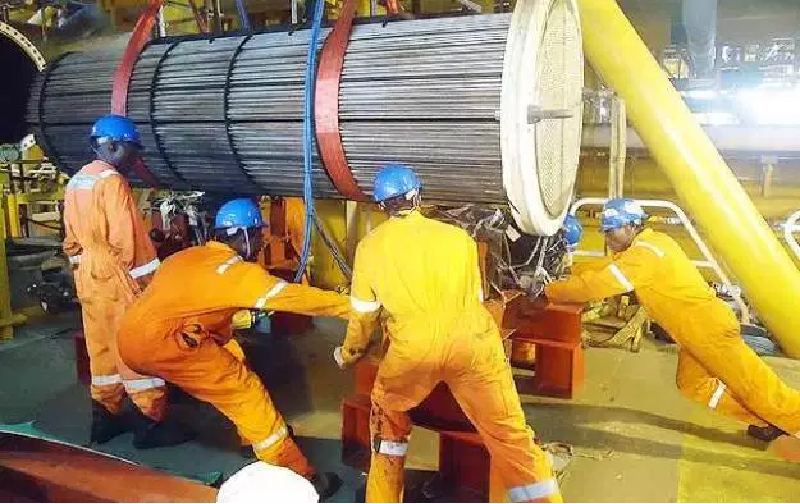
Oil workers

By Jola-Michael Samson

Social responsibility is an assistance or help rendered by an individual or firm to the people directly or indirectly in the locality of the individual or firm.

To perform social responsibility is not mandatory but it is necessary and strategic especially for a firm within its locality to achieve a specific organizational goal.

A good numbers of firms in the country have embarked on performing social responsibilities; many had constructed tiled road, many had given scholarships to the children of the indigenes of their localities to study abroad, many had also built good hospitals for the community where they are located. All these were done to maintain good relationship with the residents of their immediate localities in order to allow smooth running of their businesses.

Nonetheless, all the above mentioned social responsibilities provided have failed to achieve the goals for which they were created when reviewed. Some organizations especially in the oil and gas sector are still being faced with issues of vandalization of pipes and kidnappings to get ransom.

Therefore, I deduced that social responsibilities performed without influence on the intellectuals and emotions of the indigenes have an expiring date; and once it lapses, it naturally calls for more help.

Oil and gas business is perceived as a lucrative sector, its downstream sector is unavoidably peculiar with pollution problems on water, land and air that usually torment mostly the indigenes in their localities.

Technology can help to improve the ecosystems of these domains by doing the right things.

Recently, I read about Bioremediation which was described as a process used to treat contaminated media such as water, soil and subsurface materials by altering environmental conditions to stimulate the growth of microorganism and degrade the target pollutants (Wikipedia). The process involves planting of some species of plants to control pollution.

Therefore, my suggestion is that oil and gas firms should establish a “Bioremediation Technical School” around the community where they are located. The school should be tuition free for indigenes, sponsored by the firms. It should be boarding school with specialized equipment that will enable achievement of Bioremediation with experts (practical-oriented) as teachers. The duration of the program taken in the school will be determined by the extent of what are to be learnt.

The admission to the school should be 80% indigenes and 20% outsiders. The major requirement for admission into the school should be at least primary school certificate. Since there will be several responsibilities required to achieve a system of Bioremediation; all the students will be grouped based on their levels of intelligence and certification to study various aspects of the procedures.

The major reason for establishing Bioremediation Technical School is for the graduates of the school to become employees of the oil and gas firms taking care of the polluted environments where the firms are located and being paid accordingly.

At the end of the thorough training from the school, the graduates should be segmented and deployed to begin implementation and application of knowledge gained in the polluted environments under the supervision of Bioremediation professionals to ensure goals are achieved.

If this suggestion is adopted and implemented accordingly, the Oil and Gas firms will be the largest employer of the indigenes after the government, the polluted environments will be seen to be attended to and farmers and fishermen would be hopeful of returning to their normal businesses.

Another suggestion is that a standard “Skill Acquisition School” for the handicapped (especially those whose legs were amputated or paralyzed) and illiterate should be established by the firm that wish to perform social responsibility in the operating locality.

The school should focus more on skills that will enhance participants to have production (non-consumable items) mindsets. I will suggest skill of making leather materials such as belts, bags and shoes. The firm should also make available a standard production factory that will accommodate the graduates of the school and regular supply of needed raw materials for production should be done.

The firm should also teach the elite among them online marketing and various ways their products can be sold.

During this learning period, the selected handicapped people will have their welfare and their family members (for those that are married) taken care of by the firm.

The idea is that the handicapped persons should be transformed into productive people, according to their abilities, with their overall wellbeing enhanced.

All these will usher peaceful environments for everyone in the community.

Stop looking for Jobs like a Gambler

6

By Chinedu Junior Ihekwoaba

Job Search is not gambling.

A gambler always lives his life on luck. He has no clear understanding of his journey. He only has one belief: “throw out everything you have and expect an angel to smile at you.”

A gambler stands 1/10000000 chance of winning. Without wasting much time, you can definitely rate his chance of success.

Now back to job search, how can you rate your chance of success?

Do you still apply for every available opportunity and praying for your luck to shine?

Two years ago, I applied for over a hundred positions but got nothing. Despite my prayers and fasting, nothing worked. So I conclude:stop looking for a job like a gambler!”

Yes, I did make that mistake. Sending numerous messages to recruiters and connecting with only CEOs, applying for everything applicable irrespective of the role, job description and the paycheck.

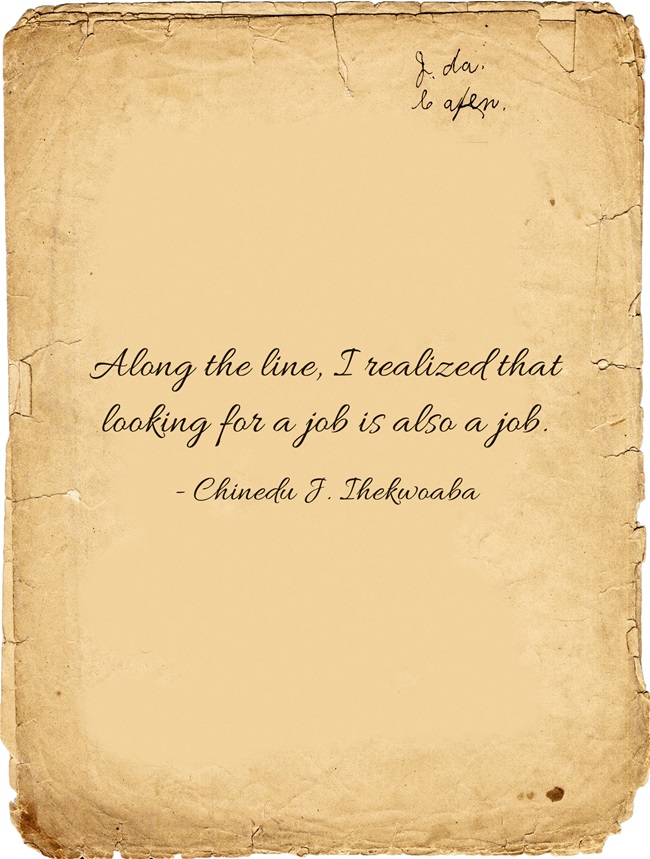
It wasted my time, energy and resources. It also drained me emotionally. Along the line, I realized that looking for a job is also a job.

Here are ways you can find a job with ease:

  • Be strategic

Strategy always wins. You can’t apply for everything because your job determines 80% of what you’ll become in the future.

Your strategy should include the type of job you want, your personal goals, and ambitions, your strengths and weaknesses, and the type of companies you would love to work with.

  • Networking

Networking is king. When I say networking, it’s not restricted to the Internet only. There are amazing events you can attend that will boost your morale and confidence. Most importantly, you’ll meet amazing people.

Remember, people recommend and hire people they know faster. What makes networking interesting is that it can be done through social media platforms.

For example, I know Sarah and I’m interested in working at ABC, I will connect with her on any social media sites I can find her, engage her posts and contribute.

I will send her a message like, “hello Sarah! I’m a fan of your contents and it’s amazing how you contribute to this platform. I’m honoured to be connected.”

She will definitely appreciate my words and respond. But if she doesn’t, I’ll try a few more times or look for another person working at ABC.

That’s the joy of networking. You’ll connect with the world in your comfort zone.

  • Volunteering or Internship

Sometimes, you have to show the world what you can do by offering your service for free. I know many egoistic job seekers would feel turned off by this part. But it doesn’t change the fact that it is the truth.

Opportunities are very hard to come by, but you can get yourself one by volunteering or going for internships. The advantage you will have over others is that you’ll be a favourite during the recruitment exercise. Also, you’ll have added experience which enriches your CV.

But be very careful with the type of companies you want to volunteer or do internships. If it doesn’t align with your values or goals, don’t bother to waste your time.

  • Join a recruitment agency

These days, there are agencies that can help you with your job search. They even train you on how to attend interviews. Find them and work with them.

Stop wasting your time looking for a job like a gambler. Be strategic, network, volunteer or do internships, and join the recruitment agencies.

Of course, it takes time. Be patient.

If it’s worth doing, it’s worth doing well.


Detailed Approach To Solving Unemployment In Africa

0

By Ajayi Joel

The future is now! If we don’t know what it should be like, we wouldn’t create it.

In a previous post, I talked about the people responsible for the blame of unemployment in Nigeria, and I will like to say that I wasn’t actually done. I had this all planned to discuss. Matter of fact, I really love the intellectual discussions and comments on the thread in LinkedIn. A lot of which pointed to the fact that I was leaving the government out of the whole blame game. The purpose of that post was achieved which is that many are now aware that the unemployment problem doesn’t just rest on the government alone, as opposed to the common notion of a lot of Nigerians, and Africans in general.

You must have seen how you as a parent, teacher, counselor and even the school system play a role. Unemployment issue has a lot of branches and for it to be totally addressed, we must identify them and cut them off.

Now, the big question: What is the role of the government in this?

Well, I’d love to say that I had to stay up all night reading through all your comments a second time to really analyze your different angles, and views, and I must say that you all have very salient points, and they have not in any way contradicted my own stance. I mean it’s the government; they rule us, we put our hopes on them, we believe them to provide security for us and other necessities of life. Jobs are part of the necessities of life and a key factor in determining economic growth, so they must not be left out. Matter of fact, I am writing this article hoping that eventually it will get to the table of the president. What I want you to do is to share with your family members and political friends as well as your media friends. It will be a long read as well because I will analyze the problems in details and provide solutions.

Giving a quick background of myself, I will say that I decided to tackle this unemployment issue for about two years now, and fix the deficient educational system. A mission I began two years ago which led me to found a company that I have bootstrapped so far. During the course of this mission, I have met with over five hundred youths ranging from dropouts to graduates, and even working class to ask series of questions, and I mean physical interactions. I cannot recall the number of those online I have had to discuss with. I needed to delve into the root of the cause, and I got a lot of insights from a lot of them.

I will say that youth of these days – a lot of them – do not believe in the educational system anymore and they have very salient reasons which I will write a different piece on. I have had to mentor graduates, NYSC corps members and working class on how they can prepare for the future of jobs, and also how to quickly navigate the murky waters of unemployment and scale through. Matter of fact, I cannot recount the number of under-employed who have reached out to me to get pieces of advice on what exactly they need to do to scale up or switch jobs, and which skill they will need to learn where.

I had to give my background so you will know that I am not cooking this up from some book or posts I have read somewhere. Matter of fact, I have traveled 6 campuses across Nigeria just to interact with students and get to gather information from them. I have created several Google forms on different topics, different questions as well just to accumulate data and know where exactly the root cause of unemployment is, how we can fix it, where we should begin, and how we can structure out a plan for it. Now that I’m about to delve into it, I will want you to pay attention, and you can reach out to me to discuss further.

So who exactly should fix unemployment?

Well, it’s the government! In one post of mine, I addressed the fact that while we may think we can fight the battle for African development even if the government isn’t doing anything, I literally spoke about the fact that we will have limitations if we exclude them from this mission to rescue Africa.

If we want to address unemployment, we need to focus on these different angles and I will explain each of them with deep insights.

The Educational Disgust

In my last post, I talked about how rotten the educational system is and how the school system is not preparing the young ones for the future of work. Hence, if the young ones are out there unemployed, then we will have issues with the economy.

The question now is how we can fix education and can it be an individual effort? I have seen so many edutech start-ups arise because of this challenge, and they are really trying to come up with unique solutions for this. However, I do not think there can be unique solution if the government is left out. Personally, I have been working on coming up with the perfect solution for almost two years and each time I think I don’t need the government, I will always see a need for them. Now follow my analysis keenly;

Education is defined as acquiring knowledge that makes you relevant for the world of work. I have defined this in a previous post but I need to define it so we can analyze this together. We should start for the university education. How many graduates were prepared for the world of work based on what they learnt in school? I am not talking about personal development; I mean based on the knowledge gotten in school. How many graduates can come up with solutions to move Africa forward based on what they all learnt in school?

The answer will be negative. Before we come up with a solution and see how the governments can play their roles, let me point out the problems to you from my one full year researching on the problems and seeking solutions.

Learning environment is not flexible: How can a student confidently choose student as a profession when writing down profession in a form. You might want to argue that they are expected to write that because that is what they were sent to do. To learn, right?

What are they learning and who are those teaching them?

What a lot of them do learn isn’t practical. A school shouldn’t be a place for abstract or theories alone; practical should accompany it. However, since it is not the case and I don’t see this fixed anytime soon, then there should be room for flexibility in learning. What exactly do I mean by flexibility?

How can a student go to class for good eight hours in a day from Monday to Friday, then Saturday and sometimes Sundays? It’s ridiculous! What are they learning? Here’s my point: since we “all” know that the knowledge being delivered is almost all outdated in several courses, the learning environment should be flexible to encourage students to involve in other activities aside schooling. On campuses, you will discover that a lot of students have been boxed by the four walls of school, and do not know what is going on in the real world.

So what’s the problem? Lack of flexible learning structure!
Do I have a solution? Of course! The learning structure should be made flexible. There are lots of courses that are not relevant which are still being taught. The educational environment should be specialization-based and not just some wide accumulation of irrelevant knowledge.

If a student needs to study physics, then everything he needs to study physics should be taught. Such a student doesn’t need to learn music, agriculture and all. Who can implement these? The government will pass the bill to the educational body and let work begin to commence on that. As simple as it sounds, I don’t think it can happen in a decade time.

Lack of updated lecturers: Well, we cannot leave the advancement of lecturers to be a personal development. There needs to be a structure in place for them to get advanced knowledge. I will quickly say this: the educational system will keep having issues if there’s no connection between the teachers and the real world. We must first agree that most lecturers only teach theories and they are not aware themselves how it applies to the real world.

Simply, there needs to be a connection between these teachers with the activities of the course they do in real life. Believe you me, there should be some measures taken to ensure this, else it would not be effective. We have seen countless meetings held, and lesser effect it has.

My solution: The use of technology comes into when teachers or lecturers are required to take specific courses from those on the field, and there’s monitoring. Also, there should be a physical connection between teachers and those active on the field.

Lack of the use of technology: The world has advanced; every other system has advanced with the world. The banking system has, from the use of tellers, to ATM, to online transactions, and now the invention of blockchain. The educational world has refused to do anything about advancing. We live in digital world and anything learnt should revolve around the digital world. Learning should take this route. A lot of universities have not encouraged the use of the internet. Do I have a proof? Yes!

I have interviewed hundreds of undergraduates who don’t know what YouTube is, what it is used for, and the fact that it is a major tool for learning. Let’s not talk about the numerous online platforms available. If you learn actively online, kudos to you but believe you me, students should be exposed to the usage of the internet. When I mean using the internet, I mean advantageous use of the internet. I cannot over emphasize this. The problem is: how will it be imbibed as a culture amongst students when the teachers do not know it’s huge benefits. A good example is the engagement I had with a lecturer of mine over a particular issue. We had a course that was basically about knowing conversion of units. I raised up my hand in the class one time, to ask the lecturer why a course will be devoted to learning and memorizing conversion units, when we have the internet.

I could travel to China and not bother about the conversion of naira rate in my mind. I could buy food stuff and convert the units through Google, time zones and all. I have had reasons to chat in different languages using Google Translator. The internet should solve this problem. How do I get to become familiar with the conversion? Practicals!! And these are not taught.

What’s my solution: School should partner with edu-tech start-ups like mine where undergraduates can learn any skill knowledge to complement whatever they’re learning in school. All campuses should make internet accessible and almost free.

Lack of Research and co-hubs: Firstly, I will say that Nigerian universities do not have standard research centers for those who do. When I say standard, I mean African standard. There are few co-hubs instituted by the school where students can collaborate to solve problems, and come up with ideas. Matter of fact, it will be a good source of income for the school. However, how do we expect a student who spends most of his time in class to come up with an innovative idea? Is there any ground for collaboration? Where’s the space for a medicine student to partner with an engineering student to solve a problem, build a product, found a company?

There is a huge gap for development of minds in school and collaboration. Well, I’d say that phase is changing and it’s impressive. However, it’s not all schools.

My solution; School should partner with more institutions. I mean private organizations that are focused on self-development and skill development. Government should also focus on research centers, standard ones. A biologist should be able to go to a center to learn in those old rusty labs. Lastly, school should be able to partner with companies and recruitment agencies to help their students get access to internships as well. I must also emphasize that learning at this stage should be development driven, not instruction-driven. What I simply mean by that is that you should study medicine not only because you want to insert injections into people but because you want to really think of ways to advance medicine. A lot of students who turn out to be graduates have this instruction mentality, where they wait for jobs that will be all about what they need to do, rather than come up with new ways of doing things.

Now, before I will move to the next point, I will say all these can be achieved by an external company to include schools using a digital means. My startup has been focusing on this for about two years, and we will see how all these solutions can be integrated and implemented digitally.

I will explain on this more sometime later. Hopefully, I get an opportunity to speak on channels on how my startup will solve this.

Infrastructural Rottenness

Now that I have addressed education and pointed out places where the government needs to play its own parts, I will still say that a lot of the aforementioned points in education will not be accomplished if some things are not in place. I will address this part from two angles;

  1. How infrastructural rottenness is causing unemployment
  2. How it is affecting our economy

Nigeria seems to be a place with poor infrastructural setting, and by infrastructure, I mean basic amenities that will help development. If there are some key infrastructures that shouldn’t be toyed with in this century, it should be electricity, internet and good roads.

If the federal government is not aware of that, maybe we should draw a statistics of mobile phone users between the age of 15 and 35; it is huge both n Africa and Nigeria. This means that smart phone penetration is becoming interesting. If phone penetration is increasing and people as young as this can now afford a good smartphone, don’t you think internet should be prioritized seeing the huge benefits it will bring to youths.

Now the reverse is the case in Africa; tariff plans and extra charges are being placed on internet usage. This is not a good move in any way. Internet subscription is expensive as much as it is not still readily available in a lot of areas. Does this contribute to youth unemployment? Yes! I have had cases where I lost jobs due to internet issues. Let’s not even talk about power supply. What do you charge your mobile devices with? We are in the digital age and one of the factors that will drive the development of youths is power supply.

Talking about economic growth, we have seen that most businesses are centered around the internet. However, because the government has not prioritized this, we see major start-ups leaving the borders of Nigeria which means there will be lesser jobs available. If a company or business cannot expand because of these setbacks, then there will be fewer job opportunities available for those who are in the labour market.

Well, we can say that there are many logistics start-ups arising; however, how well have they scaled in spite of the bad roads that we have. I am not talking about how much they have raised but how much they have made and the rate of growth. While we may be optimistic with what is going on so far, we will keep facing these challenges if the infrastructures are not fixed.

Do we have start-ups trying to solve individual solutions? Yes! I earlier said I’m working on solving education and reducing unemployment through it.

However, we still have a long way to go if we’re all thinking we can thrive without the government.

My next point will be on TAXES and the death of dreams.

Taxes And The Death Of Dreams

The higher the taxes, the more the revenue for the country; I think this is a very interesting point, right? While it may sound logical, it is not practical and I’d explain how this is also affecting the economy and in turn causing unemployment in the country.

Amazon paid zero tax in 2018 in the United States and they were able to provide hundreds of thousands of jobs, can we balance that? One thing to consider here is balancing. Government wants Amazon to create jobs; there’s a huge lesson the Nigerian government needs to learn from them.

  1. Do we need more businesses to stabilize the economy
  2. Can SMEs scale with the current tax policies
  3. Can huge companies expand with the current tax policies?

Now let’s take it one at a time.

  1. Do we need more businesses to stabilize the economy?

Does this sound like a question to you? If it does, it shouldn’t be however. Every economy needs more running and profitable businesses to keep the economy active. However, for businesses to function effectively and focus on making profits, infrastructures need to be in place which I talked about in the previous point. Is that all? Definitely not. In a continent like Africa, ripple effect in scaling is almost impossible due to several limiting factors in the continent; businesses need to run on low as much as possible to be able to keep the company afloat from bankruptcy.

What our government needs to realize is that by depending on taxes as a huge source of revenue, they are killing other huge channels that could create revenue. Should companies pay their taxes? Well, yes. That’s not what I’m saying. At this stage in Africa, Nigeria especially, if there’s anything that we need to focus on, it’s on economic development, and economic development will only occur if businesses are thriving. How will a fruit company expand to become an agricultural company, and then cover their logistics if the taxes being accessed on them are rather huge?

More so, if these companies expand, it is a good thing to more jobs entering into the space.

  1. Can SMEs scale with the current tax policies? Well, I don’t this so; I earlier clarified that above there.
    My suggestion: There should be a direct flow of money between small businesses and investors. That’s a huge problem we have. There’s a big gap between small businesses and investors and I’d say I’m impressed that some things are being done to address them. However, drastic actions need to be taken if we really want to address unemployment.
  2. Can huge companies expand with the current tax policies? Sorry, no.

While it’s also good that we are being given aids by foreign bodies, it’s also a huge harm to our structuring. It’s not wrong to be given aids; it’s however wrong to be a country that has depended on aids for so long.

In summary, if these points are addressed, I think so far so good, we’re on the path to fixing unemployment.