DD
MM
YYYY

PAGES

DD
MM
YYYY

spot_img

PAGES

Home Blog Page 6819

UNN Makes Nigeria’s Tesla Electric Car: Lion Ozumba 551 (Photos)

13

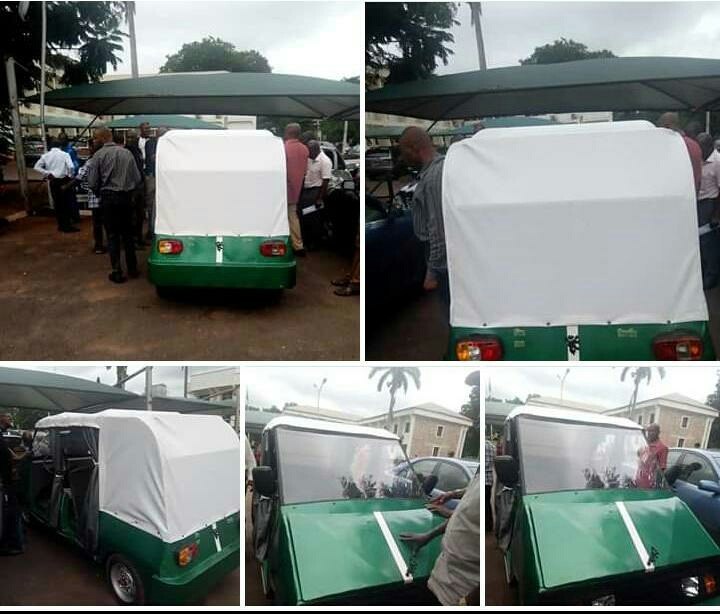
University of Nigeria Nsukka (UNN) has created Nigeria’s first electric car. Yes, the Nigerian version of Tesla. It is called Lion Ozumba 551. UNN graduates are Lions and the Vice Chancellor under which the show ran is named Ozumba.

Yet, UNN should not over-celebrate this. In 1968 during the Biafra War, UNN students and professors produced military-grade vehicles and one of the most sophisticated indigenous bombs in modern Africa (Ogbunigwe). In Okigwe, they built a refinery to refine crude oil when all the axes were closed. So, UNN should chill, this is not a big deal when you look at the history of UNN. Nigeria had done all these things more than 50 years ago and used in warfare.

Sylvester Akalonu,Gordian Ezekwe, Benjamin Nwosu, Willy Achukwu, Okezie Confidence and other members of the highly elite Research and Production Organisation of Biafra accomplished what Raytheon and Boeing could not get closer. How? They worked with nothing to achieve great engineering feats including designing, testing and mass producing the Ogbunigwe within months!

Do not take my words; visit Umuahia and you will see those equipment. Sure – congratulations to the students. Yes, congratulations to UNN. Let’s get them to the market.

Mr Jelani Aliyu, the Director-General of National Automotive Design and Development Council (NADDC) has commended the University of Nigeria, Nsukka (UNN) for being the first institution to produce electric car in the country.

Aliyu made the commendation in Nsukka on Monday during the unveiling of a five-seater Electric Car, named ‘Lion Ozumba 551?, produced by the Faculty of Engineering in the university, NAN reports.

He urged other universities in the country to emulate UNN in giving serious attention to issues concerning innovations and technology in order to move the country to the next level.

He said: “NADDC on Feb. 6, invited UNN, University of Lagos, Usman Dan Fodio University and Metrological Institute and urged them to prepare a paper design on how to produce electric car in the country.

“The council is happy that UNN is the first to prepare a paper design and produced electrical car that has been unveiled and test-run today in the university.

“We urge other universities and higher institutions in the country to emulate innovation and technology spirit of UNN.”

The NADDC boss, who was represented by Mr David Oyetunji, Director Finance and Account in the council, hoped that the growth in automobile industry in the country would help to create more employments and save the nation’s foreign reserves spent in importing cars into the country.

“NADDC commends UNN, which recently produced the first gasification plant that used organic waste to generate electricity and today the same university is unveiling first electric-built car in the country,’’ Aliyu said.

In a remark, Prof. Charles Igwe, the Vice Chancellor (VC) of the university, who was visibly excited, said his administration would continue to give innovation and technology the highest attention in order to move the university to the next level.

Igwe expressed appreciation to the immediate past VC of UNN, Prof. Benjamin Ozumba, who, he said, laid the foundation for innovation and technology in the institution.

“I feel happy that I inherited strong institution from Ozumba and I promised I will consolidate on his numerous achievements.

“I commend the Engineering Faculty for making the university proud and naming the car after Ozumba, who ignited the fire of innovation and technology in the university.

“I also commend NADDC for its encouragement as well as giving UNN a chance to show its potential,” Igwe said.

Source of Press Release is Breaking Times
LinkedIn Comment on Feed

Interesting indeed. But personally I think they could have done better on the body work of the car. The shapes are not great at all. When. Sth is to be done it should be done well.

Response: Thank you [] I serve as the Vehicle dynamics sub-team lead on this project, I formulated the mathematical model and also designed the transmission system. so I think I’m in the best position to respond to your comment.

I totally agree that the general aesthetics of the vehicle is quite poor but this is due to the fact that the vehicle was fabricated in the poorly equipped engineering laboratory with no CNC machines, 3D printer or any advanced manufacturing process. Also the project is part of students project and thus there is limited funds. We initially wanted to design, simulate and then contact any good manufacturing firm to produce a mold for us to cast a carbon fiber shell/monocaque but the cost is outrageous. So we decided to stick to the traditional method. And I believe no team anywhere in the world will be able to do better under same condition and funding.
Thank You

Forerunner of Facebook Libra, South Africa’s Wala Goes Bankrupt

2

South Africa’s Wala, a decentralized financial system for emerging market consumers, has gone bankrupt; it was unable to raise follow-up funds. This was a company which wanted to do what Facebook Libra is promising Africa: get underbanked and unbanked into the formal financial ecosystem. Through Dala, its cryptocurrency, Wala did make efforts. But it was not enough. The problem was not technology but the very fact that Wala relied heavily on the banks, exchanges and the very institutions it was trying to eliminate! It is common sense: if you expect to help a man that does not have a bank account, and you are required by law to get money from him through the banking institutions, you already have a problem. Simply, you cannot do without banking because without the banks you cannot be in business!

The collapse of a blockchain payments startup looking to serve the “unbanked” doesn’t bode well for other companies with similar plans, like, well, Facebook.

In late 2017, the South Africa-based Wala rolled out its cryptocurrency in developing countries across Africa, where it hoped to eventually substitute the local, volatile currencies for its own cryptocurrency, Dala.

But on June 24, after nearly two years, the company went belly up, laying off the majority of its 100 staff and announcing in a Medium post that it had failed to raise a second round of investment. The cause was clear: Wala was unable to disentangle itself from the banking system it hoped to exist apart from and, eventually, replace.

[…]

“Whether it was exchanging money, or enabling our users to purchase goods and services,” he added, “we weren’t able to completely remove reliance or connection to the incumbent infrastructure.”

This is my call: the easiest way to get underbanked and unbanked into the formal financial ecosystem is through the current institutions like banks. Why? The rules have already decided that anyone that wants to fix any of these issues must work with banks in Africa. So, if everyone must work with the banks, the best deal is simply to revamp the banks and make them better. If you do that, job is done.

No fintech can advance faster than the banks in this space since ALL fintechs depend heavily on banks to operate and function in Africa. The Central Bank of Nigeria may not be wrong when it felt the banks can get it more users at scale.

Yet, while Wala was a forerunner to Facebook Libra, the size and scale of Facebook along with the resources mean that the comparison may not be fair. So, that Wala failed does not mean that Facebook Libra cannot thrive.

The Rise and Fall of 2GO

9

By Iselowo Kolawole Kehinde

2go is a free mobile social networking application developed by 2go Interactive Ltd in Cape Town, South Africa. 2go supports over 1,500 different devices, including feature phones, in addition to Android, BlackBerry OS and BlackBerry 10 smartphones. The solution has the following features:

  1. 2go also had a gateway that enables users chat with friends on GTalk, Mxit, and Facebook, two unique features that was one of their main selling features.
  2. Flexibility in Chat Rooms: 2go has the ability to send friend request and also kick users out chat rooms (Which I took pride in engaging at).

There used to be a time when 2go was very popular, even ahead of Facebook in Nigeria. But that is now history. How then did 2go crash? The crash of 2go could be affiliated to that of BBM. BBM- short form for BlackBerry Messenger – which could be attributed to one thing: “Lack of Innovation and Inability to Adapt to Changes”.

  • Lack of Innovation and Inability to Adapt to Changes: According to a great biologist “Survival is neither of the fittest nor strongest, but for those who are able to adapt to changes in their ecosystem”. When 2go launched, it was the talk of town in no time as no one was used to a mobile chat platform except the Yahoo Messenger for Desktop. People enjoyed it back then; you wouldn’t be wrong to say it was the perfect replica and replacement in mobile form to Yahoo Messenger. One unique selling point feature 2go had similar to that of the Yahoo messenger was the ‘joint room feature’. However they took this on a whole different scale with the explicit features allowed in the chat rooms. The star rating was however one more unique feature, as I remember people actually going overnight without logging off just to increase their star ratings.
  • 2go failed to uniquely adapt these two features – Data Usage And Push Notification – as it took them 3 years after the launch of Whatsapp to employ the Push Notification feature which utilized very little amount of data after Whatsapp had already taken a bolt lead in the race of innovation. Push Notification was one of the main selling points of Whatsapp.
  • Data Usage: if we all could recall back then, 2go consumed a lot of data with telcos operators even creating special data plans for it with you having access to as low as 5mb. Not solving this problem became a major spoiler for them. Then the advent of Push Notification by Whatsapp and the ability to work with it using Very Little Amount of Data which 2go never put into consideration or felt wasn’t important.
  • Monetizing Policies: major feature that could have killed Whatsapp was the monetary yearly subscription of just $1 which they quickly took off because they had very smart minds working with them. This was a feature 2go never considered working on by not removing the buying of credit (Go Credits) to enter certain rooms and chat, knowing fully-well that we Africans love freebies. The amounts dropped active participation in chat rooms.
  • Recovery and Retention Policies: This one feature was what made me to lose my love for 2go due to the inability to update the phone number used in registering, so you had limited access to some features, and had people creating new accounts instead of just logging into their new accounts. They should have considered lost of line or damage to line.
  • Compatibility: Another main hurdle 2go failed to cross was the problem of cross multiple platforms functionality, as their application was supported mainly by Symbian Phones and a select few Java Phones. This was a feature WhatsApp put into consideration early enough.

It is simple; to survive you must put two things in mind:

  • Ability to adapt to behavioral changes and patterns brought about by your competitors in your ecosystem.
  • Average artist creates, great artist steals and improves on the stolen work.

The Fledgling Unicorn – “Keep It Simply Stupid (KISS)”

2

By Iselowo Kolawole Kehinde

Today, I would be giving insights on why most Nigerian start-ups fail. Largely, the basic reason is that most of them want to achieve unicorn (start-ups, usually tech-enabled with valuations of at least $1 billion) status the very minute after product launch. I will break all under these.

1.) “Haste to Nowhere”: Most Nigerian start-ups are always in a haste to achieve full blown Unicorn status the very minute they go live. It takes time to achieve full traction even after working back-end to ensure failure is farfetched. I always tell people you can test-run your beta-version for as long as possible, and as long as you know you would get the desired results on the long run. Don’t be in a haste to make massive revenue the first day, though monetizing your startup as early as possible is very important.

2.) Complexity: Most Nigerian start-ups are to complex, from just one start-up you can coin out up to 10 different full scale startups. The golden rule here is to “Keep It Simply Stupid (KISS)”, and then look for ways to add more features after you have tested your modules properly, and ensured full functionality. Many times, the most stupid start-ups are the ones that end up doing well big time and generating all the big bucks.

3.) Expenditure: Most Nigerian start-ups end up spending on the wrong things. I once heard inside story of a Nigerian start-up that managed to raise just a little above $1 million through equity funding, and the CEO ended up spending over $200,000 to pimp/beautify the office, placing plasma TV’s, and other facilities that were not immediately needed for productivity in the office. To me, I felt that was money that could have been re-invested into staff welfare/training or elimination of recurrent expenditures like switching from the epileptic national grid to a more efficient solar UPS back-up system. Learn to work on the short term goals while having long term plans.

4.)  Teammates: To me, this is one of the most important factors to consider when starting up: always try to get the same people that share the same path and vision as you. Make them see reason that money shouldn’t be a motivating factor; but let’s face it, it is definitely a motivating factor. You can scale this hurdle by offering them possible future stakes, and top level positions in the company when the company achieves full scale.

5.) Failure to Adapt: Facebook should have been out of business a long time ago, if not for the intuitive nature of Mark Zuckerberg, the founder. You must be willing to adapt to changes and technological trends derived from markets insights and researches in order to survive. It’s simple, I always tell people this: average artist creates, great artist steals. I mean Mark’s Facebook could have been possibly challenged if he didn’t steal and incorporate most of Snapchat’s features.

When Do You Become a Unicorn?

According to Ventures Capital Valuation, for a company to be valued at $1billion valuation, you need to make yearly revenue of at least $100 million. Another way to determine the valuation of a startup, and place it at unicorn level is to give it 10x of its total funding. Yes, if you have a startup raising a total funding of $10 million, that places it at a valuation 10x that amount, equating to $100 million. Similarly, if we have a startup receiving funding of $100 million, it means 10x that amount places it at $1billion valuation mark.

How to Sell Heating Appliances and Forest Mowers in Sahara Desert

0

By Ajayi Joel

It is the purpose of firms – sell things to as many people as possible. Yes, I’m aware that a lot of companies face the challenge of locating customers, getting them to listen, and be converted as paying customers. This process involves three phases within the nexus of inbound marketing strategy. Let us get started; here are the steps to consider:

  1. Attention
  2. Engagement
  3. Conversion

ATTENTION

Now, it may seem complicated but I’ll try to make it simple. Attention – it is actually very easy to get attention. Yes, it is easy to go to the market and sit at the center of the road screaming to get everyone to look at you. Yet, getting attention is hard if we’re talking in the real context of attention when monies have to be exchanged for a product or service, in Nigeria.

Here’s what I mean: ride a Mercedes-Benz G-Wagon to Silicon Valley. Nobody is going to notice you because there’s nothing spectacular about having a G-Wagon in Silicon Valley. It’s not strange. So nobody will notice you, except if it’s on fire though.

So, is getting attention really easy or hard, and why is attention the first part? If you want to talk about attention in its real context, you should be talking about what the attention is for.

Now, let’s go back to the market and meet the man sitting at the center of the road. He has gained attention. Fine, everyone is looking at him. But what was the attention for?

Was it to show people that he has new clothes he’s selling, or that he needs money, or that he’s contesting for his village association treasurer, or just showing that he’s alive? If it’s to show that he’s alive, then he’s stupid. That’s because the news that he’s alive doesn’t change a thing to anybody; doesn’t give anybody any thoughts to hold onto.

It’s more like a mad man in action. Simply, the attention was stupid, and that’s why it’s going to be short-lived. People will forget and overlook within seconds.

Well, he could also use it to show that he’s alive and yet not be stupid! But that’s if he has the intention of returning some other time. More like to get attention for attention sake for the first time with the plans to return, and not be a total stranger to those set of people.

Nevertheless, there’s still a purpose to that than just screaming. So here’s the point: getting customer attention is not easy if you don’t know what it entails. It’s only easy if you don’t have a plan. But if you have a plan, then it becomes difficult.

Now let me simplify it. If there’s a purpose for getting the attention, then you need to begin to consider many other things. The consideration of other things is what makes it hard. It’s no longer about the getting of the attention alone, but what the attention will do. That’s what makes it hard

If I want to sell clothes, and I go to the market to begin to ring bells, what if those passing by are saving to buy chicken for Christmas, or to buy shoes instead or simply government has not paid them for months. Perhaps, I wanted to sell for 1,000 naira but someone was already on ground selling for 200 naira. What if everyone was looking at a politician who is doing rally? Or they are waiting for another politician to share 5,000 naira.

Can you see that it’s becoming difficult because you’re already having a plan for the attention you want to get? In getting attention, you need to have a purpose. The purpose will determine the plan.

Getting attention is easy if you have no plan for the attention. However, if there’s a reason for getting the attention, then there’s a whole lot to worry about, a whole lot to work on and all.

Picking the example above, it gets difficult if you want to go to the market to sit at the center of the road to get attention either because you want them to know that you’re alive and that you’d be returning or because you have a product to sell.

There are so many things to consider: what if there are five other people in the market on the road currently? And what if that same day was a day where the government has promised to arrest people who create scenes in the market? What if there was a fight in the market while you’re ringing your bell?

Remember this analogy applies to anything you want to do. I am just using the man in the market as a case study. If you get the idea well, you can sell home heating appliance in the Sahara and also supply forest mowers to the residents. Now, you are thinking! But it will be hard if only attention is where you stop.

I’m sure you’re quite aware that you cannot throw products at people; you cannot throw ideas at people. You cannot push contents at people if you don’t have their attention. You cannot bid for a project if you don’t have their attention. So, I’d give three different steps in getting attention:

  1. What is your Purpose for Getting the Attention?
  2. Who are the people you want to get their attention?
  3. How do you get their attention?

These three steps are all linked together. However, I’ll begin with the first.

What is your purpose for getting attention?

Before you think of running to the market square or opening that social media account or running to the radio or television station to make the noise, what is your purpose for the attention? People dress nice probably because they want someone else to notice them or because they want to go apply for a job, or they do not want to be mistaken for a pauper or to impress others.

You can choose to get the attention for attention sake. More like for recognition sake. It’s not a bad idea. Some brands do that. They do not have a product yet. However, they sponsor an advert just to create awareness that they are existing or that they are planning something.

It can be to create awareness or sell a product or to disrupt a trend, or go showcase a skill. Whichever one, the main thing to have in mind before you make a move is to note the reason for planning to get attention. Once it’s known then, you can move to the next step.

Who are the people you want to get their attention?

Now, it becomes more difficult and requires more strategy when you get to this point. Why? Your purpose cannot be for the world. Otherwise, you will not scale.

Here’s the point: if you want to get attention just because you want to be recognized so that you will return some other time and not be a stranger, it has to be to a set of people who your purpose is targeted at.

So you must have a set of people you want to get their attention. Is it the doctors or lawyers or aliens or unborn babies? Or you want to get their attention of mutants and the government – whichever one; you need to have it in plan after you have defined your purpose.

Your purpose is what will determine this. Here’s an example: My reason for getting attention is because I want people to know I can write. Definitely, aliens from Mars cannot be the sets of people I plan to reach.

The next step to take after writing down the purpose of your idea is the reason behind why you want to get attention. The fact remains that humans are the ones you want to get their attention and not drumsticks.

So your purpose will definitely be to get the attention of humans either directly or indirectly and the category will definitely differ based on your purpose.

As straightforward as it looks, you shouldn’t make the mistake of going to farmers or going to firefighters to get attention of doctors. That would be lame.

I believe you must have nodded your head with what I just said, the truth remains that people still fall into this mess; this ignorance. You need to know who your purpose for getting attention is directed at.

If it’s sportswear, if you’re writing contents, if you’re an architect, you need to know who exactly your contents are for. You need to make research. What you have in mind might not exactly be what you will discover.  Simple, to get the right attention, you need to know those who you want to catch their attention. Are they a perfect match for your purpose? If there’s no correlation, then you need to keep the searching.

Continue reading here to finish the piece