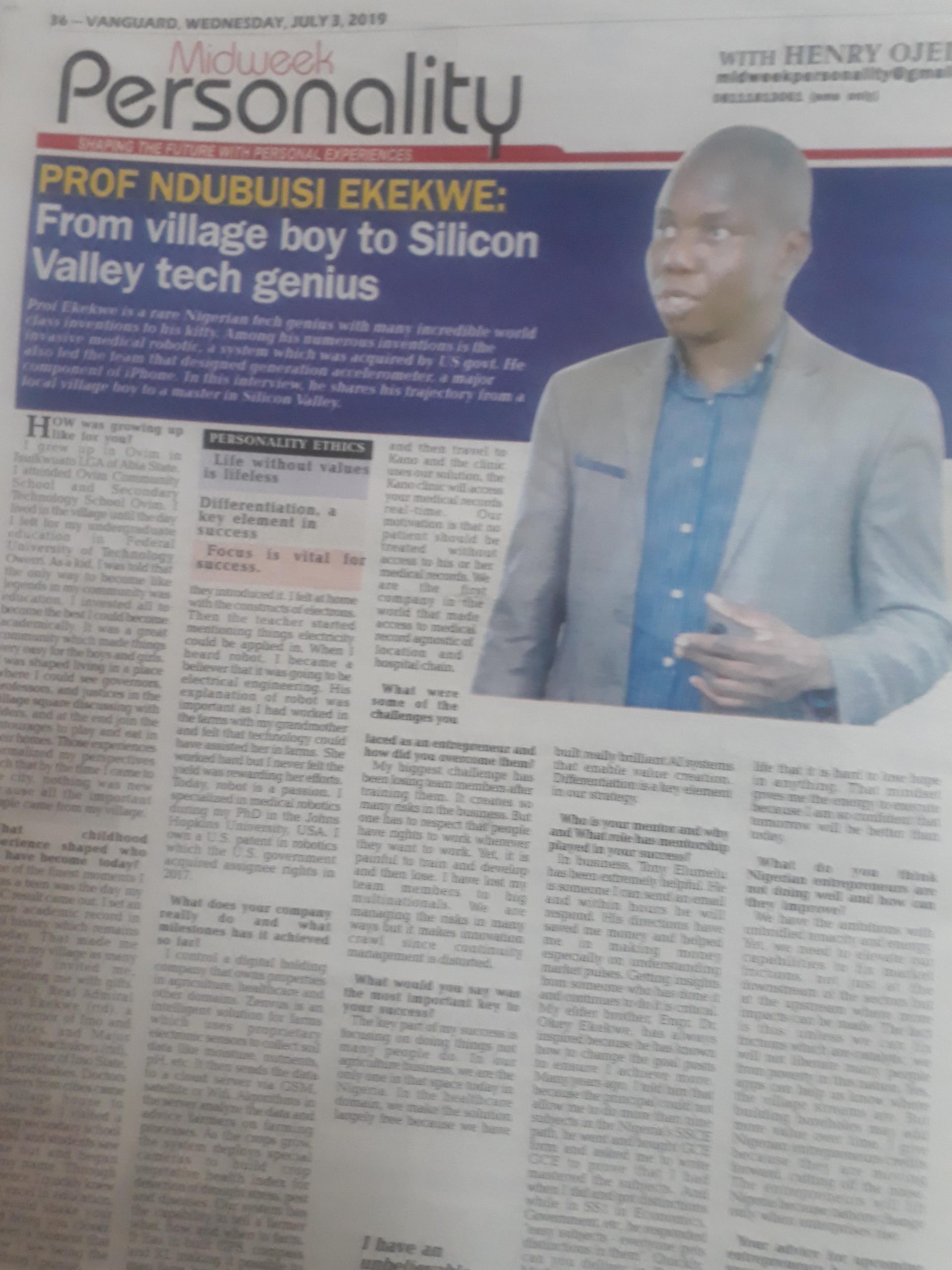
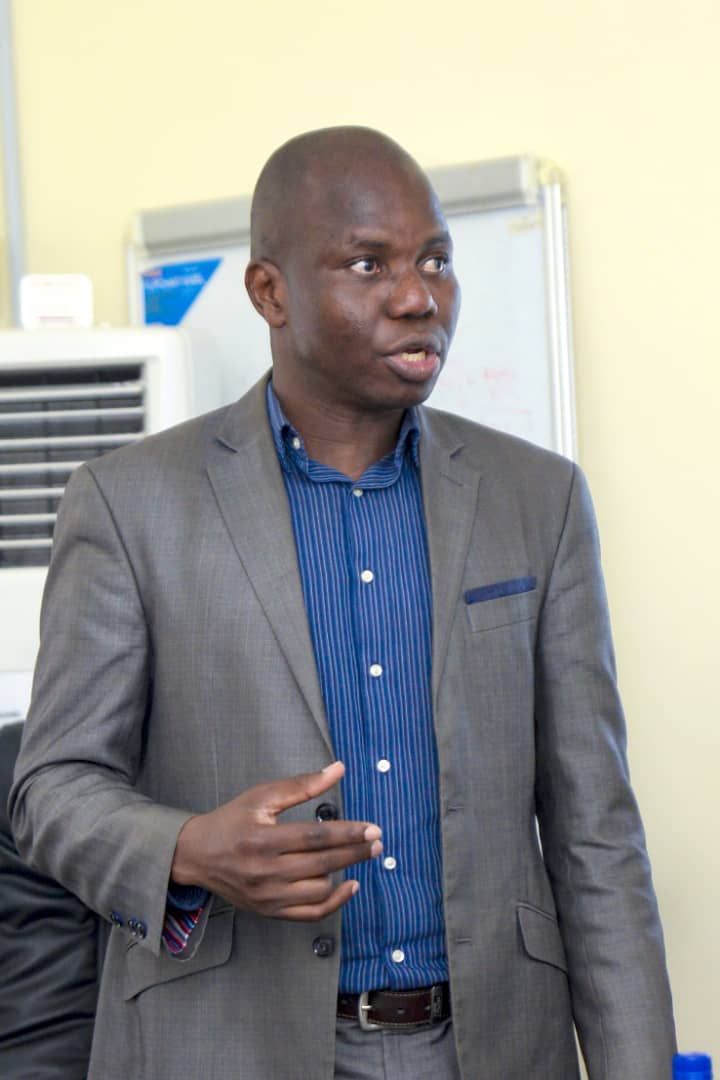
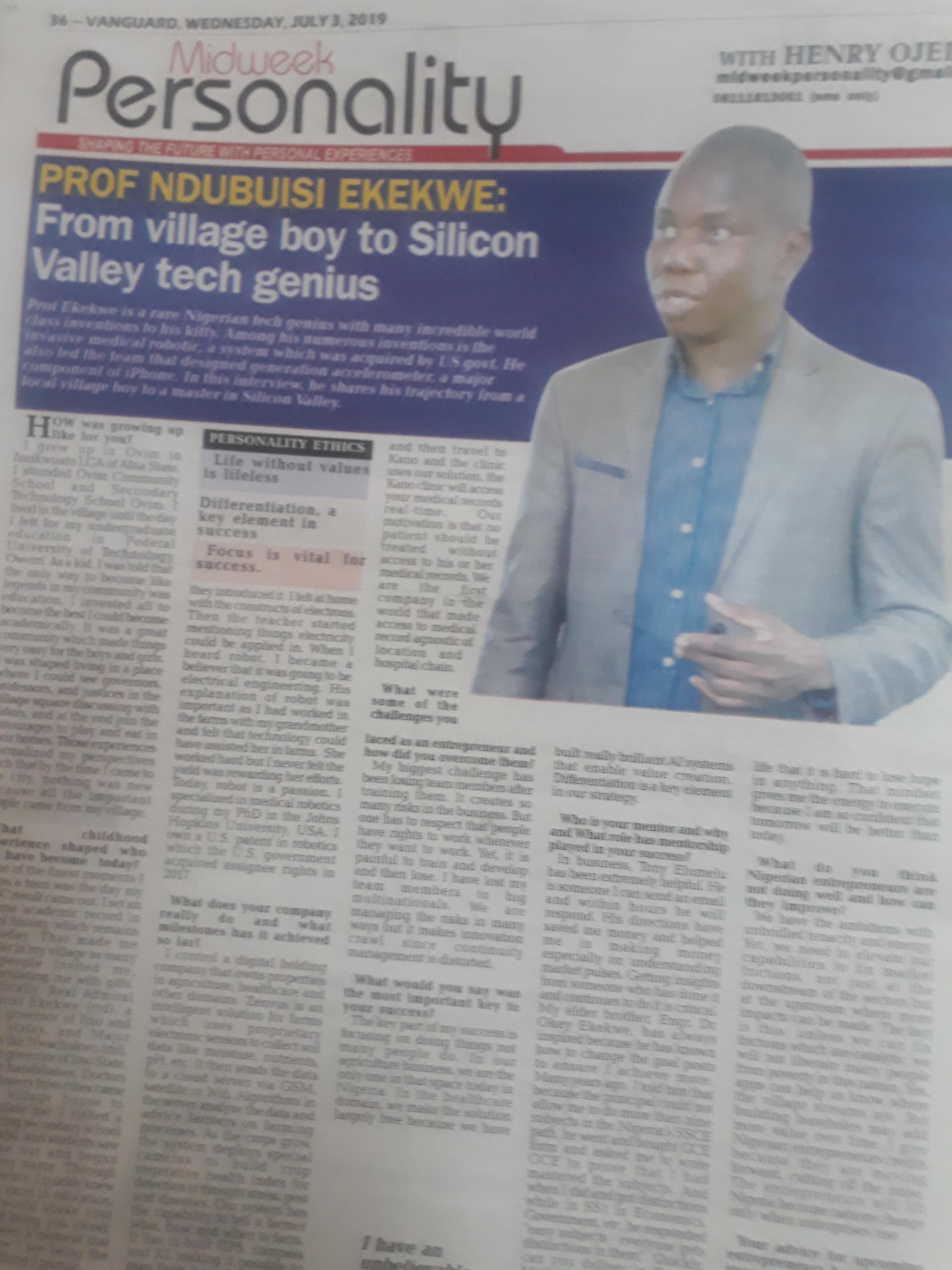
Prof Ekekwe is a rare Nigerian tech genius with many incredible world class inventions to his kitty. Among his numerous inventions is the invasive medical robotic, a system which was acquired by US govt. He also led the team that designed generation accelerometer, a major component of iPhone. In this interview, he shares his trajectory from a local village boy to a master in Silicon Valley.
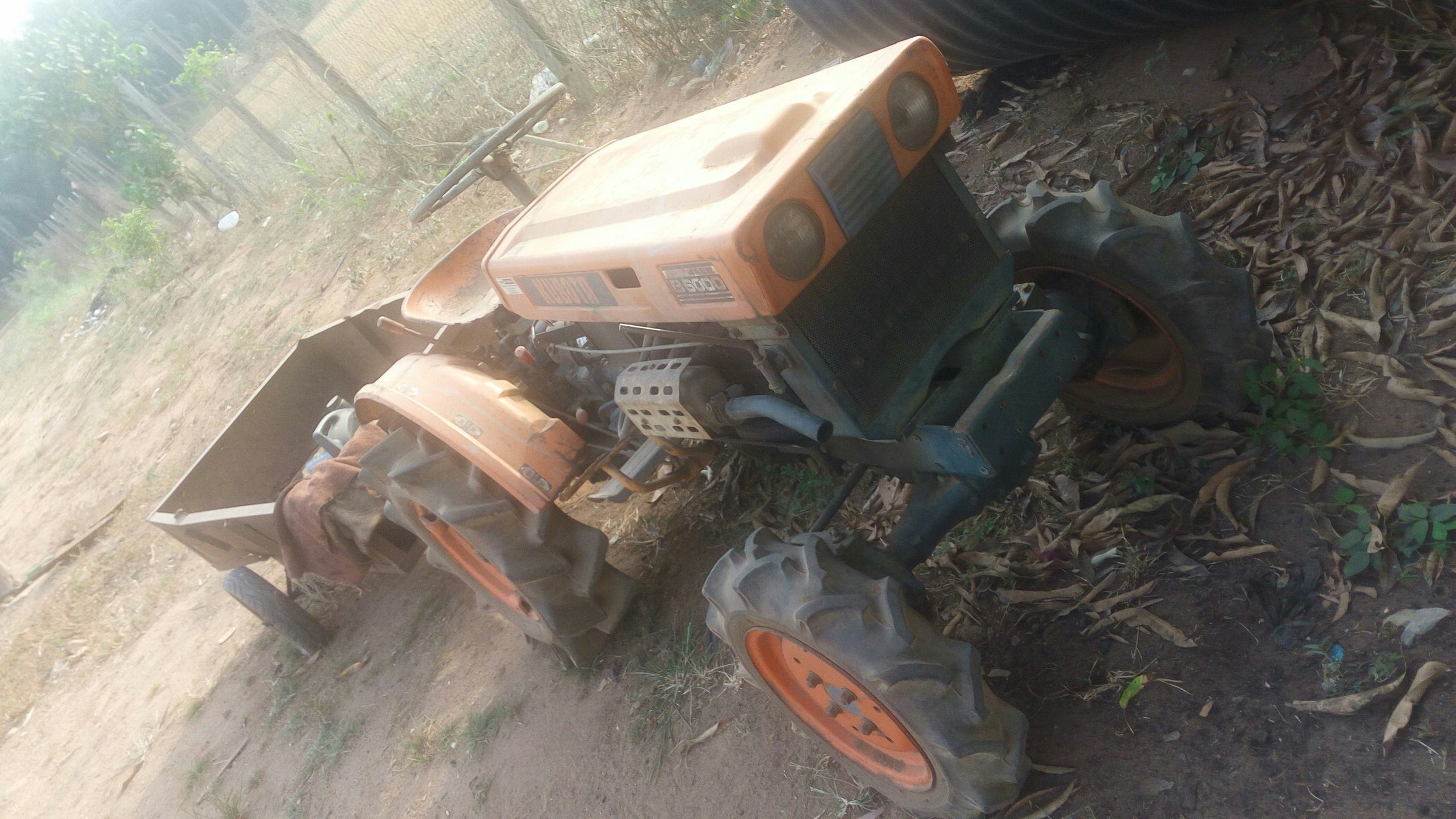
FarmHire is an AgTech startup company that is fully mechanising agriculture in Nigeria. It works to boost farm productivity through farmer to farmer equipments and job hiring, agro-ads posting and online farmers forum. FarmHire is aggregating farm equipment and inputs in the country and using artificial intelligence to provide farmers with the cheapest and best equipment around.
FarmHire.ng is Nigeria’s number one website providing an online platform for farmer to farmer equipments and job hiring. Equipment owners and government agencies can add their equipments and hiring price to connect with farmers that need to book them. Also, any agricultural related job an be easily posted to get qualified professionals to apply.
JOB DESCRIPTION
We are currently recruiting field officers (agents) to:
1. Source farm equipment and inputs around location for upload.
2. Aggregate demands for farm mechanization services around location and place order
3. Drive engagement of local farmers on the portal
4. Monitor field activities for optimal results
REQUIREMENT
1. An interest in agriculture
2. A good interpersonal relationship
BENEFITS
1. Profit compensation on equipment booking order or referrals
2. Several performance-based bonuses and commissions.
3. A chance to change the world.
HOW TO APPLY
Send your CV and location to careers@farmhire.ng
Few days ago, an online friend reached out to me that he wanted me to mentor him over the next step to take after school. He had graduated a few years ago. So I simply asked where he worked presently and if he sees himself working there in the next 5 years.
He hurriedly said no, and explained that where he worked gave him no chance for his life. It was stressful, boring, not creative, and doesn’t seem to have a spontaneous promise to financial increase. I quite understand.
I mean I listened with rapt attention, and I weighed everything also, and I figured out that quitting his job was the perfect move. Remember I also gave an advice that if you have a job where after working from 8 am to 6pm, you hardly earn anything of value, it is better to start searching for another and quit as soon as possible.
You obviously cannot continue like this all your life because such cycle is difficult to break from. You also don’t have a chance of being promoted to the position of earning well.
So I had to run through some questions with my friend. “Fine, since you are no longer working, what do you intend doing”?
After some questions, I discovered he had a passion since childhood and I know that profession is actually very lucrative. I mean very lucrative. It is part of the most needed skills in this age.
This profession however can never be learnt via reading. It has to be learnt either one on one or via video courses. One on one learning trumps online learning when it comes to the quality of the interaction. However, most people do not know online learning even exists.
We made some rough thoughts about how much it would cost him to learn in a physical location. Well, I know for sure it would cost him a few hundred dollars. That’s huge, and he wouldn’t want to spend that amount seeing he also needs to maintain himself as a young man.
So I recommended that he takes the course online. UDEMY teaches the same course he would learn offline for $1000 for just $10.
$10 is just N3,600 in Nigeria.
Fine, like I said there are lots of differences between online learning and offline learning.
However, purchasing a course for $10, there is so much you can gain and still have money in the pocket. It is a process. A steady learning process and you get to learn from a professional who has prepared the course.
If you have a course you wish to learn and you need to learn from professionals, online is a place to consider. Don’t hesitate to make best use of the little fund you have. You can acquire great skills through online learning. The following are good online resources:
More than two thousand years ago, the Roman orator, belletrist, thinker, Stoic, manipulator-politician, and (usually) virtuous gentleman, Marcus Tullius Cicero, presented the following story. One Diagoras, a nonbeliever in the gods, was shown painted tablets bearing the portraits of some worshippers who prayed, then survived a subsequent shipwreck. The implication was that praying protects you from drowning. Diagoras asked, “Where were the pictures of those who prayed, then drowned?”
NASSIM NICHOLAS TALEB, The Black Swan (2007).
Nassim Nicholas Taleb, the iconoclastic author of The Black Swan, wants you to spend more time in the graveyard. Not literally, although that wouldn’t also be a bad idea. Nothing scares most men more than a visit to the cemetery. Nothing reminds them more about their morality and how they have less time to accomplish all their dreams than they think.
Although the Author, Taleb, isn’t precisely pointing you in that direction. Hitherto, the author is trying to outline how we as humans like to seek answers and allude evidence to only the achievements or success of people or things. That is, we ignore all the failure, effort and travails of those who came close but never close enough. This is why the graveyard has a remarkable and unmatched silence when compared to the bevvy of noise and applause that is synonymous with award ceremonies.
Furthermore, Taleb tries to point out how dead men get to tell no tales, either about their tribulations or trials. It is only those- the few of us – that somehow manage to hold success by its grip that are celebrated or sought after for advice, guidance and mentorship. Isn’t it ironical that we learn more from our failures, but yet success has the most friends? Therefore, if knowledge is truly what you seek, perhaps you should spend less time at award ceremonies and more time in graveyards – whether or not you choose to interpret this metaphorically of literally is entirely down to you.
Most writers, historians and journalist tend to work with success in reverse. While only highly successful people get to ever have great biographies, documentaries or are more favoured for any form of analysis or study, they often share a specific trait that is said to be at the core of why they rose to the heights that they did. Similarly, it is generally assumed that if you also adopted some of these desirable traits, you too would likely attain the heights that they did.
In Nigeria, we tend to exhibit some of these traits, however, maybe not exactly in the context that Taleb postulated. This could be the reason why we continuously aim to celebrate or commiserate with other nations when they are in joy or grief but hesitate to do so when something similarly befalls us. Could it be that we are drawn to the cheers and jeers in the award ceremonies than the silence and failures that lies in our graveyards?
Are we quick to hide under the guise of religion or ethnicity when it comes to helping or consoling one another? Are those our “failures” that we have refused to identify with? While we are still on the matter of religion, the two major religious groups in Nigeria – Christian and Islam – has never compelled anybody to take up any arms on its behalf or shed any blood for the good or furtherance of it. Both religions clearly state that every man would face the end or judgement as one person and not as a group, tribe, clan or family. We would eventually be judged based on the aggregate of all our actions or inactions while we lived. Therefore, who are we to blindly go to war for either God or Allah? Where have we been instructed to do so?
Our religiousness does not stop us from stealing or killing each other. It hasn’t prevented us from taking advantage of each other and oppressing the poor amongst us. However, we have somehow found inspiration in shedding blood and causing havoc under the religion umbrella. As a people, isn’t it crystal clear that even if we all adopted one religion, we wouldn’t really be any different from what we are now? And that our actions come from our individual thoughts and not necessarily to the groups we belong to.
Nobody explicitly came into this world and picked a group or religion that they wanted to belong to. Nobody chose a country nor tribe in the same country. In the North-West people are being slaughtered, families are being displaced, and the picture is as grotesque as you can think of. Yet, we play the fool and pat a blind eye to all the atrocities that are carried on there on a daily basis, simply because we are not directly affected, or we do not identify with the dominant tribe in the region. This same attitude is exhibited across the board, regardless of the part of the nation in crisis, the other parts seem to pretty much ignore them.
Alas, we are quick to commiserate with happens thousands of miles away from us. While we should also extend our condolences to people suffering in any part of the globe, we should not be hypocritical about it. A saying comes to mind; Charity begins at home. Why are we playing to the gallery, impressing those that are not impressed by our antics? We have to learn to take care of home before impressing the streets.
We also have politicians that are hell-bent on furthering their individual purposes as they shamelessly hop from one political party to the other, brazenly displaying their lack of values and morals. Rogues and charlatans find their way into political offices because we do not seek to elect people with a solid track record and clean reputation. In the end, we all pay the price for our actions or inactions.
Our failure to visit our ‘graveyard’ means that our failures and trials will continue to hunt us. Our love for the noisy ceremonies where real lessons cannot be learnt or taught is pure folly that will eventually lead us nowhere – at least not any place that we would like to be.
Be it as it may, to begin to solve our plethora of problems we must look to those that we have handed our country to and demand that they give a fair account of their stay or time in office. Better still, we must ensure that we hand over the affairs of our country to trusted hands that have demonstrated the pedigree to proudly and intelligently lead people. We must say a big no to senators that will reconvene when they please and not place the interest of the nations first. We must say no to overnight politicians with no track record or those riding to power on the back of political godfathers.
It continues to remain an insult on the intelligence of over 180 million Nigerians that wake up very early in the morning and set out to work many hours for meagre wages that are not enough to sustain 80% of the population. Never again should 180 million individuals seat back and allow a few run the nation like a circus, subjecting every one of us to circus clowns that are merely regarded as objects of entertainment rather than people to serve and defend. We must stand firm and say Never Again to modern slavery. This is the time to retreat to our graveyards and wallow in the silence of our misfortunes, with the goal of avoiding the mistakes of our past. We must awake from our slumber and say good morning to a new dawn!
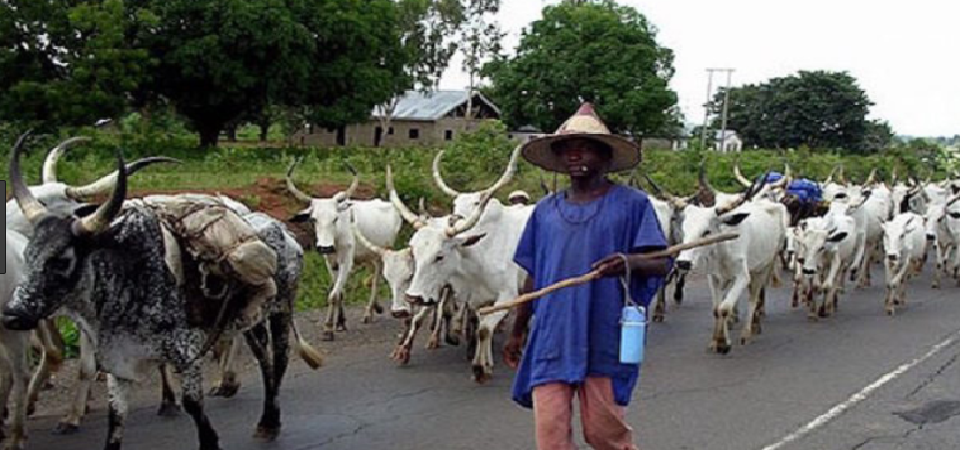
The Rural Grazing Area (Ruga) settlement initiative by the Federal Government of Nigeria (FGN) is bringing more chaos than the supposed tranquility. Many Nigerians have taken to social media to register their displeasure over the development with hashtags such as #SayNoToRuga and plan to take to the streets on Friday. There are so far three types of Nigerians involved in the sagacious development.
Those in support of Ruga
Those not in support
Those who don’t know what Ruga is. Upon this triad, the Ruga row rests. But the third category beckons the responsibility to explain.
What is Ruga?
About a week before the Federal Executive Council (FEC) handed over, precisely on May 19th, it sat and discussed Ruga settlement for herdsmen in the 36 states across the federation. In the end of the meeting, multi-million naira contracts were approved in favor of the Ruga settlement. In defense of this decision, the ministry of agriculture issued a statement saying that Ruga is part of NLTP (National Livestock Transformation Plan).
In 2017, when the Nigerian vice president, Prof. Yomi Osinbajo was serving in the capacity of acting president, he used his office and position as the chairman of National Economic Council (NEC) to seek a solution for the incessant crisis between farmers and herdsmen that has resulted in loss of so many lives and property.
To achieve his aim of lasting peace, he started making wide consultations with service chiefs, governors, and whoever has something to offer. It lasted for about two years, and then in 2019, his efforts gave birth to a plan named National Livestock Transformation Plan (NLTP).
So when the ministry of agriculture attached Ruga to NLTP, that is evident of its headship by the vice president, it drew outrage and regional condemnations. The wobbling table holding the implementation of Ruga got messier when the association of cattle breeders, Miyetti Allah, added voice to the statement of the ministry of agriculture, that “Ruga is part of NLTP,” forcing the vice president to refute the claim, stating that Ruga is never part of NLTP.
(The NLTP has 5 pillars that clearly identifies what its plan and strategies of executing them are. The 5 pillars are:
Conflict Resolution
Justice and Peace
Humanitarian Relief & early Recovery
Human Capital Development
Cross Cutting Issues.
Ruga is not in any way mentioned or attached to these pillars of priority areas. The main goal was to foster federal support in implementing the transformation of the livestock sector through the establishment of ranches, improved fodder production, economic investment into associated value chains, and importantly, compensating those affected by the violence for their losses.)
Unprecedented uproar ensued, with the South-East and South-South Governors vehemently refusing the Ruga settlement plan, those in the South West were divided, and so it is in the North. This is one of the reasons: According to the land use act of 1977, all land in a state is the custody of the Governor on behalf of the people. Apart from few areas where the FGN has exclusive jurisdiction over, areas like lands for rail line, seaport, airport etc. In view of this, the Ruga settlement seems more like a land grabbing invasion by the FG, which is instigating curious concerns.
The words on the streets and social media were that the FGN is on nepotistic land grabbing mission. A “misconception” that the FGN tried to clear through the issued statement that explained what Ruga is all about and how the governments plan to make it happen. According to the statement, ‘Ruga settlement’ is a provisional rural settlement for migrant pastoral families. Its aim is to provide them with basic amenities such as schools, hospitals, road networks, vet clinics, markets and manufacturing entities that will process and add value to meats and animal products.
In the light of the insecurity and threat posed by open grazing, the FGN sees it as a means to achieve peaceful coexistence between herders, farmers, and their host communities. The statement also added that participation by state governments is voluntary. So far, there have been 12 states that indicated interest in piloting Ruga through the Federal Ministry of Agriculture, and that’s enough to start with.
Although the statement explained so many things about Ruga, it didn’t calm the protests. There were suspicious loopholes, and it didn’t take a while to figure them out. For instance, Benue state has for long distanced itself from any programme that requires giving out land for cattle rearing, but to everyone’s surprise, it’s one of the 12 states said to have indicated interest. In fact, the FGN, through the Federal Ministry of Agriculture, has contracted Clear Sky Broad Band Ventures Limited to execute the Grazing Reserve Project at Otobi road, Oturkpo, before the Ministry of Agriculture wrote to the Benue state government seeking approval for the project.
source: provided by author
More to that, the opinion that has strongly opposed the Ruga development is that Cattle Rearing is a private venture just like every other privately owned business that runs in Nigeria. And it’s wrong for the FGN and states to spend taxpayers money funding private business, especially when there is no provision for that in the budget. The funding depends on the volunteered states and FGN. Each of the states is expected to provide N5billion and the FGN will match up the money. So for the 11 states that have volunteered so far (Benue excluded) N55 billion is expected. The more states indicate interest, the more funds the Ruga settlement plan will have.
What the presidency failed to explain in its statement is where Ruga emerged from. Since evidently it’s not part of NLTP that the vice president and NEC approved, or if the presidency is abandoning the well-articulated NLTP all of a sudden to embrace Ruga without consulting NEC. NLTP was developed through wide consultations involving all the 36 Governors and every stakeholder that matters. For about 2 years, the vice president, Prof. Osinbajo got everyone on board, discussed parts and parcel of it, and in the end, everyone nodded in agreement, prompting the Governors to make provisional budgetary allocation for NLTP in their respective states. This is the ranching deal that Nigerians know about and expected to be implemented. There is belief that the FG has reneged on NLTP, trying to play smart on NEC and the office of the vice president.
The sudden emergence of Ruga is stoking a lateral polity that may eventually set gloom precedents. Disorderliness in the presidency is one of them, lack of trust in the government is another, and more dangerously, the tendency of corporations or business associations constituting a menace just to get the government to dance to their tone.
The office of the president through FEC and the office of the vice president through NEC seem to be in disagreement regarding the best way to solve the farmer/herder crisis. And they are washing their dirty undies in the public.
The people are seeing more reasons to cling to their space of distrust in their relationship with the government. “Don’t believe anything they tell you” is a common sentence with a bitter meaning among Nigerians. It connotes the belief that there is a coated evil in every of government’s plans. Therefore, they should not be trusted even when there is an explanation to their actions.
Most Nigerians believe that the federal government is being economical in the way it’s handling the herder/farmer crisis to the favor of herdsmen. A few or no one has been brought to book, even though the crisis has taken thousands of lives. In 2018 alone, about 2000 deaths were attributed to Fulani herdsmen, and the number keeps counting even in 2019. While the government is yielding to the yearnings of the herdsmen, from funding to settlement, it appears that the government is negotiating its way out of a hostage situation: a predicament with a negative futuristic precedent. The premonition tendency that any other business group or association may violently force the government to bend to their wishes cannot be ignored. If the antecedents are not curtailed, it will become a detrimental norm that the future will hold against the present.