DD
MM
YYYY

PAGES

DD
MM
YYYY

spot_img

PAGES

Home Blog Page 6838

Why Nigerian Banks Cannot Lend You Money Below 14%

4

The Reserve Bank of Australia, i.e. Australia central bank like Central Bank of Nigeria (CBN), has cut interest rates to a new record. The banks’ bank lowered the cash rate by 0.25% to 1%. That news has sent shares up in Australia since the cost of capital will be lower, possibly boosting investment and the overall economy.

Australia does not have to worry on many challenges Nigeria’s central bank deals with daily. Our inflation remains a critical factor which continues to drive monetary policy. That inflationary element is the reason why the central bank cannot lend to banks at 1%.

But just imagine if CBN can lend at 0.25% to our banks, great things will happen (keeping the bad things constant). Yes, the implication is that after banks have added buffers for NDIC (deposit insurer) and profit, our banks can be lending at 4% to Nigerians.

But when our banks begin at say 11%, it makes it challenging for any to lend below 14% since they have to cover costs, insure the money and also make small profits.

So, stop saying that Nigerian banks are not helpful because they cannot lend you at single digit. Largely, no bank can do that in Nigeria because they receive money from CBN at 11%. Unless the fund is coming from a special source, going below 14% will be lack of fiduciary responsibilities to their shareholders.

Besides, the banks are not open to lend for long tenor since Naira loses value in months. There is no way they can take that risk since N20 million in 2010 is not the same, on purchasing value, in 2019 even though the face value is the same. Our inflation is legendary making it harder for anyone to take risk on the Naira for a long period. Yes, they cannot fund that airport because by the time you pay back, the Naira you will ship back to them may not cover up to 20% of the effective purchasing power of the money loaned.

Our challenge is huge and we need to walk out of them. CBN cannot do magic. The banks cannot do magic. Unless we have an economy on equilibrium where we produce more in Nigeria, it will be a long harmattan. The hope is the evolving entrepreneurial capitalism which can redesign the economy so that we make more things in Nigeria. Oil has never been part of the solution – we need to make entrepreneurs to rise in Nigeria.

Ndubuisi Ekekwe is Vanguard Midweek Personality

4

I am Vanguard Midweek Personality. They select about 40 people yearly for that in Nigeria. Get a copy tomorrow. 

Few hours ago, I finished a long interview with the Vanguard. Get a copy on Wednesday (July 3rd). It is a very detailed interview that would take a full page.  You will read about the beautiful Ovim, my village in Abia State, which does not leave any child behind. Our legendary farm road (Agbongele Ugwunta) where any person can visit, harvest anything and enjoy, but never take any home. I planted a pear there while in the village to ensure the tradition continues. It is the community’s last strategy to ensure no one sleeps hungry! Then the typical – sharing the kinsmen kola nuts with former governors, making success very common. Then, more – Pick a copy.

Like I always tell people, I am yet to see any sensible World Bank policy that a village in Africa has not enacted. In U.S., they have this policy of sending food or money for food to poor people. I read in newspapers where Nigerian experts are proposing that we need to do same in Nigeria.

I always laugh because if you go today in Agbongele Ugwunta, Ovim, of Abia State (Nigeria), villagers understand that anyone can harvest anything there, eat right there, but never take any home. By making sure you do not take home, they prevent people from reselling the produce.

As you grow up in the village, elderly ones will take you on a tour to explain the family that planted this fruit and nurtured it. You want to ensure you have something there. The boys in the village have the responsibilities to clean the area, and then twice yearly all males would visit to check the trees making sure they are in good shapes.

As they work on that, they have designated some strategic fruits as community plants irrespective of the land where they are: no person can own udara, ukwukwa , etc. By designating them village assets, it means anyone can have access to them even when in your land. At the end, the goal is to give buffers to everyone.

Sure, it is not advanced but the model can be expanded:  “let us process the produce and make sure anyone that needs food comes to the factory to pick free food”. My point is that the concepts are there. Africa’s problem is that we have abandoned our traditions instead of finding ways to improve and scale the good ones.

These are contexts in my conversation with Vanguard. Get a copy tomorrow. 

Ndubuisi Ekekwe’s Vanguard Interview Out on Wednesday

4

Few hours ago, I finished a long interview with the Vanguard. Get a copy on Wednesday (July 3rd). It is a very detailed interview that would take a full page.  You will read about the beautiful Ovim, my village in Abia State, which does not leave any child behind. Our legendary farm road (Agbongele Ugwunta) where any person can visit, harvest anything and enjoy, but never take any home. I planted a pear there while in the village to ensure the tradition continues. It is the community’s last strategy to ensure no one sleeps hungry! Then the typical – sharing the kinsmen kola nuts with former governors, making success very common. Then, more – Pick a copy.

Vanguard and Punch are special to me. Both published an open letter I wrote many years ago just out of secondary school. I had enrolled in FUTO but before matriculation I was told that UNN had effected for me to move to UNN. I had never applied to UNN and was happy with FUTO’s three degrees in one in EEE with option in ECE. I was among the top JAMB scorers that year and UNN felt I belonged therein.

UNN made a strong case but gave up after Vanguard and Punch published my open letter.  So, talking to Vanguard brings that memory of the power to help a small boy.

Nigerians In Search of Transparency, Legal Rights for Rape and Ruga

0

By Mutiu Iyanda

In the last few days, rape and Ruga have been trending in Nigeria. They remain two issues that have polarized Nigerians along ethnicity and religion lines. At the same time unite Nigerians who believe that the two issues are threats to the female citizens and security across the country. Rape is not a strange crime in Nigeria. The country has been repeatedly ranked as one of the countries with the highest number of rape cases. It has also been ranked as one of the countries with the high level of insecurity due to the incessant terrorist attacks, and herdsmen and farmers crisis.

The idea of Ruga, planned annexation of land in states for cattle colonies, is to end the crisis between herdsmen and farmers, according to the Federal Government. From the southern region to the western region, it has appeared that the government’s position is not tenable, especially in states where the crisis has resulted in loss of lives and property. Groups in the two regions have alleged that the government is shopping for lands on behalf of the herdsmen, which could further heighten the insecurity in the country.

On the two issues, Nigerians are expressing their feelings and accusing the key actors. The Presidency and state governors in the southern and western regions have been under severe criticism, while Pastor Biodun Fatoyinbo and Bukola Dakolo have not been spared from various lashes. As the criticism continues, analysis indicates that Nigerians are making sense of the issues through the Internet with a view of receiving information capable of reevaluating their previous knowledge towards informed discussions.

Making Sense of Ruga and Rape

On Sunday 30th June 2019, analysis shows that Nigerians sought information about the two issues using YouTube, image and news sections on the Google Search Engine. Within 24 hours, rape was searched most using the two sections than Ruga. From the result, it is obvious that Nigerians did not have much interest in Ruga. They deployed their resources towards understanding issues around the alleged rape case. This could be linked to the protests which were held in Lagos and Abuja. The more they used YouTube, image and news sections on Google Search Engine, the less they employed the sections for understanding the proposed Ruga settlements across the country, analysis reveals. One percent of using the three sections diminished the use of the sections for Ruga by 62.4%.
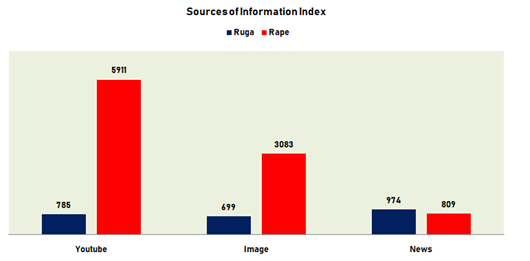
Source: Google Trends, Infoprations Analysis, 2019

Throughout the hours, Nigerians developed interest about Bukola rape, Coza Pastor rape among other top searches than Ruga’s top searches such as Ruga meaning and Ruga in Nigeria. The top searches for the rape issues were mostly from Rivers, Delta, Ogun, Oyo, Edo, Lagos states and Abuja. For the Ruga, people in these states and FCT in addition to Abia, Benue, Akwa Ibom, Anambra, Enugu and Imo states had an interest in the top searches. It is understandable that people in these locations sought information about the two issues.  These states have recorded a significant number of rape cases. They also have been experiencing a series of herdsmen attacks since 2016. In 2016, Lagos state recorded 162 rape cases. Four years before, report indicates that more than 1,200 girls were allegedly raped in Rivers State. Three years later, governmental official said “not less than 10” girls are raped everyday in the state.

What is missing?

The two issues revolve on transparency and legal rights. From the public criticism trailing the proposed Ruga settlements, it is clear that governments and people of the southern and western regions expect transparency in the programme. As long as cattle rearing are peculiar to the northern region, annexation of lands should also be restricted to the region. To the protesters and public activists, the rape victims must get justice. However, Nigeria’s poor ranking for transparency of government policymaking in the last 4 years is likely to prevent the transparency in the proposed Ruga settlements some groups and states are craving for.  According to the Global Competitiveness Index, a yearly publication of the World Economic Forum, between 2015 and 2018, Nigeria’s average rank was 116.5 for the transparency of government policymaking, while a legal right was 32.75.

When these were analysed along with the top searches for rape and Ruga, the results indicate that the Ruga’s top searches connected with transparency of government policymaking by 70%. This confirms the earlier position that people and groups want the Federal government to be fair to every region on the Ruga settlements.  Analysis further reinforces the position with one percent interest in Ruga’s top searches decreases transparency of government policymaking by 56%. This suggests that the Federal Government cannot avoid fairness principle, while addressing the issues on the programme. The story is quite different from the rape issue. The first analysis establishes that rape’s top searches and legal rights connected negatively (-83.9%), signifying a higher interest in the searches than the legal rights.  However, there is hope for the victims as the second analysis reveals that one percent interest in rape top searches increases legal rights by 51.1%. This suggests that as the public continues expressing their feelings on rape cases, it is likely to lead to prosecution of the offenders.
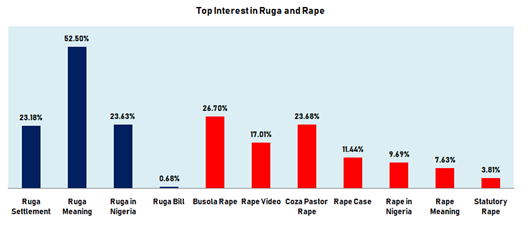
Source: Google Trends, Infoprations Analysis, 2019

The Breakout Season Is Coming for African Startups

0

By  Ajayi Joel

There has never been a time in the history of Africa that Africans seem more concerned about their continent. Perhaps, not since I was born.

Here’s what I mean; if you’re a keen observer of trends and economy and all, you would discover that Africa is at the point of a break out.

Break out from what? Before I answer that question I asked myself, I would first like to make some points.

The first point I would love to make is that things are quite very tough at this moment on Africa. I did not say “things are tough for people”, I said for Africa. What this means to me is that something is actually pulling the roots of Africa for an upgrade.

One thing I have been hearing from people over the last one year is that Africa is a tough place to do business. Well, if anyone disputes that fact, such person is blind.

But that’s not the end of the story, I will also say Africa is the best place to start a business or think about starting a business. Foreign investors are rushing down; foreign companies are seeking where to pitch their tents.

Back to my point and I really want you to take this serious if you’re really considering starting a company, Africa is at the point of discovering itself!

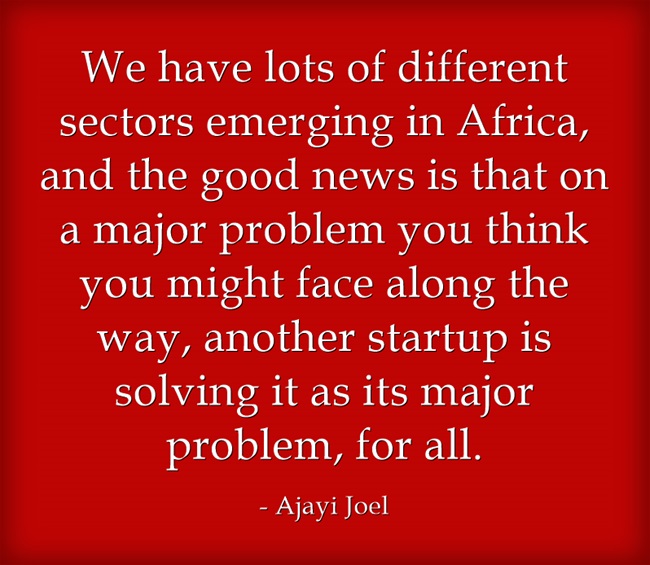
How do I know? We have lots of different sectors emerging, and the good news is that on a major problem you think you might face along the way, another startup is solving it as its  major problem, for all.

I see a phase where there’s a linking in the whole industries of Africa, and to crown it all, we now have the internet!

Wait, did I just mention the internet? Yes! The internet has been in existence for a long time; fine, and its relevance is becoming more evident. Now look at this closely. Perhaps you will see what I’m seeing.

The internet as useful as it is still has huge setback. But guess what, I’m aware that lots of start-ups scattered around Africa are working towards a better internet.

Now who’s going to fund them? Wait a minute – there are lots of venture capitalists also coming up, from both home and outside who are seeing reasons to push their money into Africa.

I’m not saying we’ve gotten it all right but there’s a pull here and there. The major problems you feel you’d face, some others are solving them. It is a virtuoso cycle.

So what exactly is Africa breaking out from?

Well, Africa is breaking out from its shell and it’s getting ready to be ripe. Get yourself positioned for the future; someone had predicted 2022. Do not lose this new boat ride. Listen to the video and get insights on how this redesign will happen.