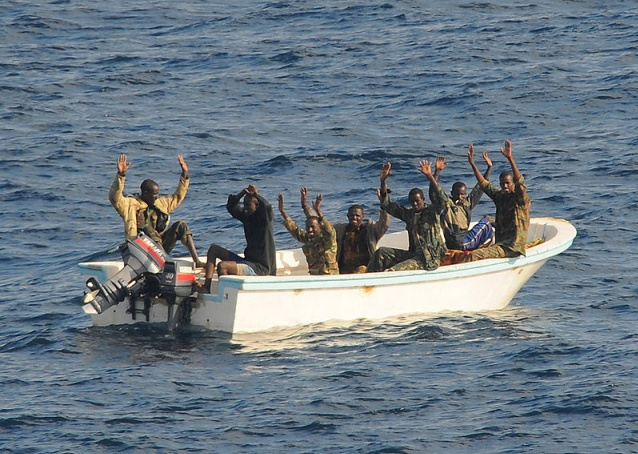
Nigeria has once again recorded the highest number of piracy attacks on vessels in the first quarter of 2019 in global statistics with a total number of 14 attacks.
According to the report released by International Maritime Bureau, IMB, on piracy attacks on vessels in the Q1, January – March, 2019, it shows that a grand total of 38 attacks occurred globally with Nigeria leading the chart with 14 attacks, followed by Venezuela with 4 attacks; while Ghana, China and Indonesia recorded 3 attacks each as other countries recorded 1 attack each.
The report further show that there is reduction on piracy attack on Nigerian vessels compared to Q1 2018 which recorded 22 attacks within the same period in 2018.
It also revealed in the report that a total of 14 piracy attack on global vessels occurred in January, while February and March recorded 12 attacks respectively.
In regional incidents, the report showed that Africa recorded the highest number of attacks with 22 incidents, America with 8, South-East Asia with 4, East Asia with 3, and Indian sub-continent with 1 attack.
According to the report also, a total of 6 actual attacks took place on boarded Nigerian vessels with 3 anchored and another 3 steaming, with zero highjack, 1 attempted attack and 7 fired upon with 4 incidents occurring in Lagos Sea alone.
The decline in piracy attacks has been influenced by the efforts of Nigerian Maritime Administrative and Safety Agency, NIMASA, in collaboration with Nigerian Navy, NN, to end piracy operations within the Nigerian waters as federal government procured security gadgets for fight against piracy and other illegal activities on the countries territorial waters.
Recall that DG, NIMASA, Dr. Dakuku Peterside recently expressed the Agency’s desire to work with other stakeholders and hasten the action on the passage of the Anti-Piracy and Other related Crimes at Sea into law to enable Nigerian vessels have free movement at seas.
He also stated that Nigeria’s unwavering commitment to its leadership role in the war on piracy and maritime crimes will be extended in all the region of Gulf of Guinea, an area wholly considered the global challenging maritime crime base in Africa.
Despite the efforts to stabilize the swift movements of trucks in and out of wharf in order to improve the ease of doing business in the maritime sector the situation is still getting worse as the securities of Nigerian Ports Authority, NPA, have been accused of collecting bribe and promoting favoritism against the ethics of call-up system.
In an exclusive chat with Vanguard Maritime Report, a stakeholder of Association of Maritime Truck Owners, AMATO, Goddy England, disclosed that NPA security personnel don’t welcome the idea of call-up number system as it prevents them from collecting bribes from truck owners.
According to Goddy, “NPA security department don’t welcome call-up number as they are collecting bribe up to N5, 000 from creek road to the gate.
“Some people pay their way to go without call-up. They don’t check their manifest because of the bribe given to them. Once they give them some huge amount of money for the truck to go, the following day the truck will get delivery. You will see some people indulging in forgery and still make their way to the port at the end of the day.
“But we that follow the normal procedures will be there for three to four weeks so we are losing. My drivers are complaining because they will be on the road before getting to Apapa. Now they are in Lilypond since two weeks as it has not come to their turn because it has not being stamped and signed but some people will go in today and get it today. The thing supposed to be normal process, first come first serve.
“With the huge amount of money we are spending now, N50, 000,- N60,000 for container, at the end of the day the truck will still be three weeks waiting for stamping. They have points, if you get to this point you pay, before you get to Apapa you will spend up to N30, 000.
“If really they are working, all the trucks will enter Lilypond and from there pick off”, he added.
In addition to this, one of the truck drivers, Geoffrey Nwosu also told Vanguard Maritime Report that it takes up to 2-3 weeks before getting their trucks cleared from Lilypond due to delay in the call-up number.
“There is always a delay in call-up number and it takes us 2-3 weeks before gaining access in Lilypond”, Nwosu complained.
On the issue of sticker, Goddy England lamented on the N11, 000 fee charges for minimum standard sticker by the Nigerian Ports Authority, NPA, which adds no value to their truck business as they are always harassed by NPA security agencies.
In his words, “we pay N11, 000 for sticker for over two years now. What is the safety of the sticker? They claimed it is for minimum standard but we can’t see anything standard about it as we keep on suffering from the harsh conditions within and outside the port.
“You can calculate the number of trucks with this sticker and see the huge amount of money they are collecting from us you will be surprised”, he concluded.
A group of seafarers in the Nigerian maritime industry have expressed their dissatisfaction over injustice and unnecessary extortions they encounter in the hands of Nigerian Maritime Administration and Safety Agency, NIMASA, as it limits them from having access to proper benefits meant for seafarers.
The protest which took place inside the premises where NIMASA was commemorating the seafarers’ day celebration 2019, showed the protesters with placards indicating their highlighted interests.
Speaking to Vanguard Maritime Report, the group’s spokesperson, Mr. Ayodele Adeshola said that NIMASA is charging them fees comparing their counterparts in other nations which prevent them from getting their outright benefits as seafarers.
According to him, “we are the seafarers. We are the grassroots for the seafarers, the Ratings. We are suffering. The way NIMASA treating us Ratings is unfair; they have not been carrying the Ratings along because in terms of welfare, it is so low compared to other of our colleagues internationally.
“Our wages is so low, the way they treat us on-board through act of discrimination among Nigerians and foreigners.
“Also, some other policies introduced by NIMASA affecting us is the endorsement of discharge as they collect N3, 650 unlike in High Court which collects N500 for the same endorsement.
“And we can’t get the endorsement in court because of our profession requires a body like NIMASA to endorse it as they are in control of the seafarers while court is for the public.
He further disclosed that the group is not happy with the awful treatment they are getting from NIMASA concerning their medical certificates which is very essential before gaining entrance on-board.
“In terms of medical, our medical fee is so high, NIMASA collects N30, 000 for medical and without the medical you can’t go on-board and sometimes the medical certificate is not available even after going for the medical therefore denying you the seafaring privileges in so many ways.
“At the same time, they have introduced so many things that are depriving us to go on-board such as watch keeping. Watch keeping exam, they are writing it quarterly instead of monthly and if you eventually miss this exam because of one issue or another, you will pay another fee for it.
“All these things are affecting us and they are part of our agitations today.”
He however, pleaded for NIMASA’s intervention through dialogue for the issues to be resolved.
“Today is a seafarers’ day in which we need to deliberate on the affairs of the seafarers, but NIMASA has taken over the day.
“This celebration is a mere political gathering as the real seafarers whom should be celebrated are being sidelined by the agency.
“We are soliciting for them to reduce all these prices and dialogue with us Ratings so that they will know what we are passing through on-board and understand what our pain is”, he concluded.
The Executive Secretary, Nigerian Shippers’ Council, NSC, Mr. Hassan Bello, has weighed the importance of National Fleet to the nation’s economy as something beneficial with exponential boost to the economy if implemented.
Speaking at an event in honor of the World Seafarers Day 2019, organized by Nigerian Maritime Administration and Safety Agency, NIMASA, with the theme: “On Board With Gender Equality”, recently held in Lagos, Bello said that the country having realized a total sum of $9 billion between foreign ship owners as freight on dry and wet cargoes in 2015 alone, can surpass the figure if the national fleet will be authorized.
According to Bello, “Nigeria for example in 2015, bring a total sum of $9 billion as freight on dry and wet cargoes between foreign ship owners, imagine what it could have been if we have the national fleet.”
He praised NIMASA’s effort in making sure that the pending project sees the light of the day through the collaboration with the National Committee on Fleeting.
“I am happy that NIMASA is collaborating with the national committee on fleeting to ensure that it is conformed.”
Also while speaking particularly on the theme of the event; Mr. Bello urged all Maritime sectors in Nigeria to acknowledge the importance of seafarers as over 60 percent are from 10 nations like Philippines, Indonesia, China, Turkey, Russia, India, United States, Ukraine, wales and Japan, while the remaining percent are from the rest of the world.
In his words, “Over 60% of the world seafarers are supplied by 10 nations, Philippines, Indonesia, China, Turkey, Russia, India, United States, Ukraine, wales and Japan.”
He agitated for the promotion of gender equality by eliminating all forms of discrimination and social vices which affects women in seafaring activities as their number is highly insignificant.
“According to International Transport Workers, ITW, only about 2% of the world’s 1.25 million seafarers are women. Seafaring is therefore a male dominating profession.
“Most of these women, 94% work under the titles of persons such as in boats and ferries, only about 6% of women work on cargoes
“According to International Maritime Organization, IMO, generally, women work as hotel staff or passing the ships, of this group, 5.1% of women are from The Organization for Economic Co-operation and Development, OECD, countries, 23% from Europe, 13.7% from America, and sadly, only 1.7% are coming from Africa.
“The reason for the low percentage of women in the seafaring is the harsh working environment from the sea to other issues such as harassment, gender disparity, violent harassment and inappropriate comments.
“For instance, over 18% of women seafarers globally have complained about sexual harassment by their male counterparts.
“And according to 2015 survey, jointly carried out by Women International Shipping and Trade Association, the International Maritime Organization and the International Seafarers on the fierce network has handed cognizance to the issue, this otherwise is pending on the profession”, he concluded.
Editor’s note: This post was shared by Amaka U (note: that could be a pseudonym)
I had just got into an Uber after standing for over two hours under the rain and sun to get a five minutes biometrics for my visa application to Australia. I have survived being shoved around, and a possible accidental discharge from roaming armed security, and noise from an angry crowd. Hmm, it’s either Nigerians love to travel or they are all gradually migrating to other countries. I can’t even reason it or google it. I am exhausted. My feet ache. I smell of sweat.
“Why do people not speak up?” I murmured to myself.
As I kept thinking about it, I picked up my MacBook and started to make this list.
Shame. As in the recent case of Pastor Biodun Fatoyinbo where the people who spoke up were ridiculed.
Stigma. What happens after I have been heard? Even if people sympathized with me, how will I cope now that the society knows and discriminate against me because I spoke up?
Loss. What happens if I lose my job, my relationships, my life, my money, my family, my visa, or anything that matters to me in the course of speaking up?
Judgement. What happens when people judge me based on my past mistakes or attack my person, as against focusing on the issue I am speaking up for; or question my motives for speaking up?
Intimidation. What if I get threats from the people I speak up against?
Acceptance. Maybe whatever happened isn’t worth speaking up for. Its okay; God dey. Wetin you want make I do? Na that wan I go chop? Abegi, leave it. Is it your issue?
I evaluated the consequences of speaking up. The experience was harrowing. I was harassed more than I have ever been in a while. I have heard friends and colleagues complain about the experience of getting their biometrics done or submitting their visa applications, but have never thought that it would be like this. Talk about wearing the shoes to see where it pinches!
I made some videos, listened to people volunteer suggestions on how to make the experience better, and made some enemies as well. I decided to record the experience. I thought seeing the video would be more reflective and bring life to my story. Making that video took some courage. It was the first time I would record a public discontent.
I am a corporate employee and not an activist, my friend and colleague told me when I recounted my experience.
“This could impact on your employer’s brand. And how would potential employers view this? You are not cut out for this,” he said, short of saying that this was beneath me.
“Social media activists who do this make a living out of this. You are not even on social media, so how would you share this?”
Well, I can find an evangelist. I just need someone passionate about social issues to read my story, visit the site to validate it, and then push it. From the “#metoo” movement, to the recent local “#stepdownbiodun”, we have seen the power of social media bring about change.
He had good intentions. I am an employee. My stance could impact negatively on the brand like the case of Nike’s employee on the HK protest . But at what point do I draw the line between expressing myself as an individual and maintaining silence as an employee? If a social issue impacts negatively on me and I want to speak up, do I have to do that anonymously so long as I have to put food on my table? Would a potential business with a vendor stop me from speaking up if I were directly involved in a social issue?
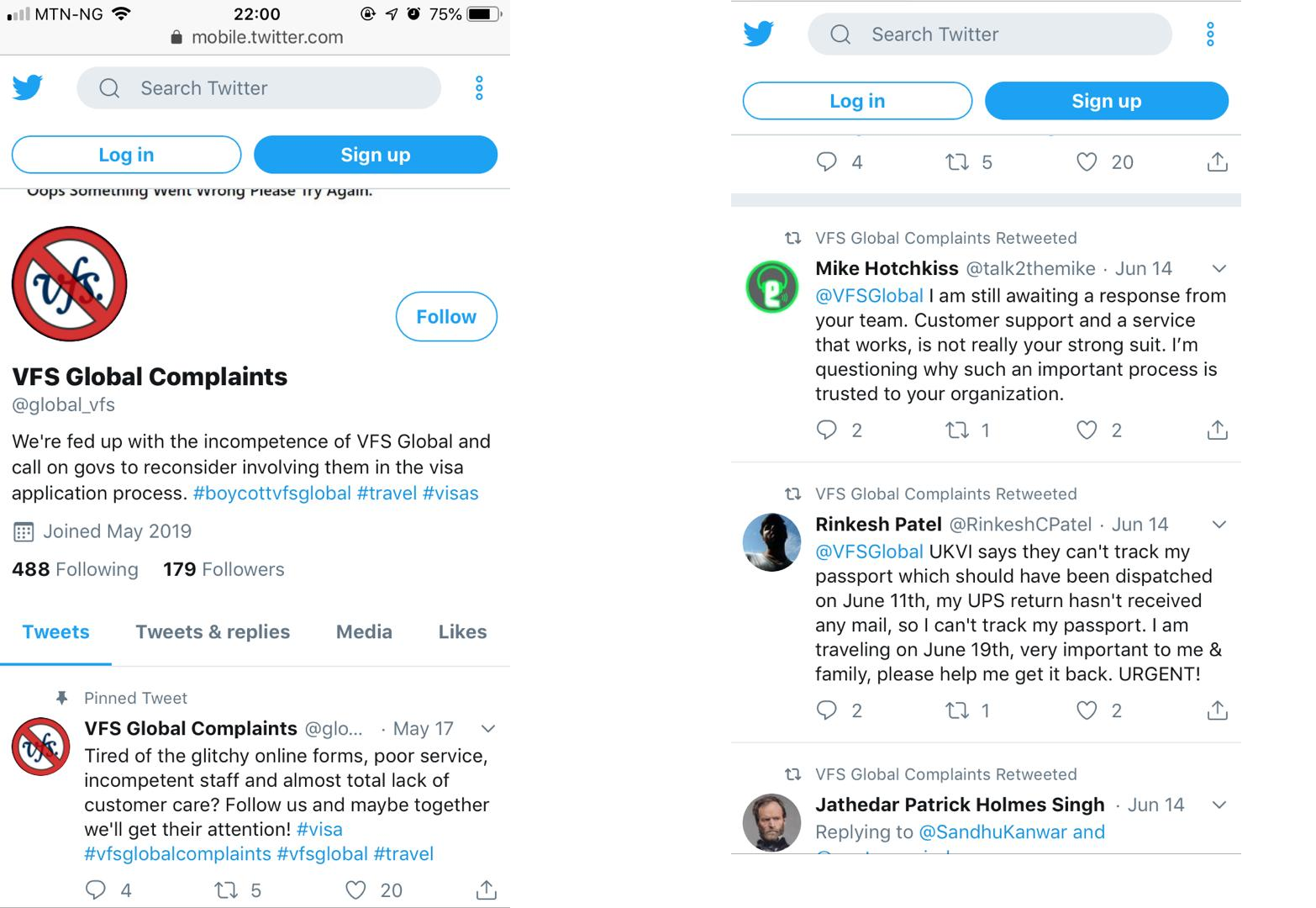
VFS Global has problems everywhere
“This is really hard,” I finally answered myself.
Maybe the legal people are already thinking about this, or who knows, they might have figured it out. But I have to google that another day. Today, I have to finish my story.
Endless evidences abound of changes that emanate when people damn the consequences and speak up. I have come to find out that in Nigeria, especially for social issues as against personal issues like rape/incest and political issues, people choose not to speak up because of reasons No. 5 and 6 above. We live in a society where the rich intimidates the poor, the military intimidates the civilians, the strong intimidates the weak, so I can relate.
While I was courageously making the video, a mobile policeman (MOPOL) approached me and asked why I was videoing him and other applicants. I looked at him boldly and smiled. I have learnt not to argue with any armed person. It’s only this life that I have. Australia can wait. Some people on the queue also attacked me. My phone would have probably been snatched from me or broken if I hadn’t held it firmly when one irate woman hit me on my hands and demanded that I stopped making the video. The person behind me casually asked to ignore her. He said it’s a misdirected anger. Her anger should be at the people who have exposed us to rain and sun and shoves and harassment over the past two hours with no end in sight.
“Their anger is justified,” he said. “It’s just misdirected at you.”
I smiled in agreement. I did not talk back at them. I only “munched up” and frowned back. Silence, sometimes, is a display of strength. No one got close to me again until I made another video.
I finally got in. I barely survived being squashed into the wall, holding tightly to my bags and standing strongly on my six-inches block heels as I pushed through the tiny space in the gate created by the MOPOL to allow people on the queue get into the compound while blocking applicants trying to jump the queue. I did make it inside in one piece.
I said a silent prayer and was looking forward to getting into the business of the day (getting my biometrics done) when two applicants started exchanging words. It was remaining just a little spite before they started to fight. There were already shoves and derogatory words like “prostitutes” and “criminal” being exchanged. The culprits were male and female. The female accused the male applicant of being a criminal because he jumped the queue and got in behind her. The male called her a prostitute for calling him a criminal. Then other applicants dared to intervene by asking the male not to call a female such a derogatory name.
Tempers were flaring just in time for an Indian VFS employee to intervene by requesting that they exit the building to continue their quarrel. What an intervention!
Then she saw that I was recording. And she turned to me. “You have to delete that video,” she said. “Or we won’t attend to you.”
I faced the camera on her and asked, “So you mean I won’t be attended to because I am capturing this experience?”
Before I knew it, the head of security came, introduced himself and asked me to follow him.
“So, he is the head of security,” I thought. I have watched in amazement as he threw orders around at MOPOL officers and the security guards as soon as he got in earlier in the morning.
“Who parked that G-Wagon in the compound?” he asked, with some air of importance.
I thought he owned the building. But even if he did, couldn’t other tenants drive their vehicles into the compound, I thought. He has to move the car immediately, he snapped. He gave more orders and then got in. That encounter was so consuming that I only remembered to record him after he had finished demonstrating.
“Where are we going?” I asked him as I found that we were about to climb the stairs.
“To my office,” he answered.
“I heard you have videos. You have to delete them,” he said with an intimidation that did not frighten me.
This time, I answered by daring him, “Oga, you have to get a gun and shoot me, then break into my phone and delete the videos that I already uploaded online. In fact, why am I even following you upstairs? Let us discuss here to the full glare of everyone. I don’t feel safe going upstairs with you.”
Now he looked at me again and saw that his plan of inflicting fear had failed. He asked me, “What is your name?”
I answered, and he said in my native dialect, *“Kedu ihe obu?”
I responded, “I refuse to be treated like this. I would not be subjected to this inhumane treatment because you have to take my biometrics. This is not right, I ended.”
This time, an Indian employee came out and offered me water, then he asked the head of security to leave as he would take it up from there. He pointed me to the direction of the Australia biometric center.
Long story short, it took less than five minutes to take my passport photograph and my thumbprint. Before that, the teller asked that I pay N8,500 with my card, then give him a copy of my passport data page.
“And in case you are not here with a copy of your passport data page, you can go into the hall to make a copy for N30,” he advised.
While I inserted my card in the POS terminal, I mentioned that it was not stated on the appointment portal that I had to pay so that I could plan for it.
“So, if I didn’t come with money, I will go back to get it, abi? Do you know what it took me to get in here?” I asked as I took my receipt and scribbled my name behind it at his request.
Then the security lady at the door came to me and said, “Madam, you are not supposed to enter the biometrics room with your bag. You have to go and drop it at the business centre.”
“Oh yeah,” I said blankly. “Did you people forget to state this on the appointment portal so that people can plan themselves?” I internalized.
Biometrics done, the lady took my passport to the teller point, copied it and gave me. They had a copier. I thanked her and left.
Outside, I met two Indian VFS employees waiting for me. One was the lady who wanted to intimidate me at the gate; the second was probably in charge of the Australian session. They apologized for my experience, the lady exited and the man asked if I made a video.
“Yes,” I said. “Because this has to stop. You see, my parents might come to apply to visit my sister who resides in Australia, and God forbid that they go through this. Nigeria is hard, I know. But I can’t lose my parents over biometrics. Imagine if in the course of squeezing us in, the MOPOL gun discharged bullets accidentally and a life/lives is/are lost? I saw a newborn baby being squeezed and suffocated. I couldn’t get in to get a video. This is not right. Could this be a capacity problem?” I asked.
He explained how the French Embassy wouldn’t let them create an appointment schedule for their applicants while mandating them to accept only 150 applicants daily. Applicants seeking French visa are more than 500 daily. How can we bring all these people in and then tell them we cannot accept more than 150? “Can this happen if it were TLScontact processing the visa application”? I asked.
I saw reasons with him yet I pushed him to explore an effective queuing system. “Push hard on France. See how it affected my Australian biometrics? Send them a video of this mess.”
Then he said, “Last week, applicants beat up our security. They also vandalized our gate.
I asked him, “Should we wait till they kill your security before we do something? I can see some shade here,” I pointed to the side of the compound that was not exposed to the sun.
“Mount a canopy, put some seats. Get people to come in order and sit according to the time of their arrival and then take it from there. Even when everyone can’t get in at once, there is a comfort for those outside that the system is fair and that it would get to their turn. This can be done. There should be a deliberate attempt to ensure that people are treated decently. You can allow the French visa applicant come in the morning and reschedule other applicants for afternoon or evening. Something has to give. My parents would faint in the condition that I was subjected to. I saw old people there. They might not be my parents, but has our culture of respecting the old died? Or does the respect end when they come to get their biometrics or drop off their passport for a visa?”
VFS executive or official driving into the compound through the whole chaos. With their windows wound up.
Then, the subtle threat, “Since you won’t delete your video, I would write to the Embassy to say that you contravened the policy of–”
“It’s fine,” I cut him short politely.
“It’s okay if I don’t get the visa,” I said.
“How do you see your sister then?” he asked.
“She will come back na. She is also a Nigerian citizen. Do your job,” I said. “There is also an online feedback portal, so I will give my feedback and upload my videos. Someone has to speak up,” I thought to myself as I bade him good-bye.
If I do not get an Australian visa but my story and video get VFS Global to modify their visa application processing, that’s a plus. My need for change is greater than my fear of not getting the Australian visa.
Back to the reason why people don’t speak up. Right now, I am not concerned about shame, stigmatization and judgement. I can’t be sure how all of this would play out; but who knows? They can wing it. Irrespective of how it all plays out, I refuse to be subjected to inhumane treatment because I need a visa.
Nigeria is hard, people are migrating in droves, but we can demand a decent treatment from vendors, especially when we have paid for it. Here is to social good!