IBM had and continues to have a great history. But it is evident that IBM is not seen as one of the most innovative and dominant technology companies of this era. When you discuss great tech companies, you imagine the likes of Google, Apple and Samsung despite the fact that IBM is as great as them, if not technically greater, in some domains. Yes, this is not really about technology but customer perceptions and imaginations. For example, IBM has spent years working on AI for different applications but the AI solutions many of us experience in our homes and pockets are coming from Amazon Alexa, Google Assistant and Apple Siri. IBM may be doing great in the enterprise world, but its impact remains abstract to many people. Yet, there is something IBM has in abundance for us: technology history to learn.
Great companies tend to have alluring stories to explain their origins: a charismatic founder, an innovative idea, or a product or technology that goes on to become part of the culture of America itself. IBM’s story isn’t like that. As explained in a new history of the firm by former IBM executive James Cortada, the company’s beginnings trace to the financial ambitions of New York businessman Charles Flint. He had a talent for cobbling together companies to reap rewards through public stock offerings, and in 1911 he stitched several firms into a holding corporation called the Computing-Tabulating-Recording Company…
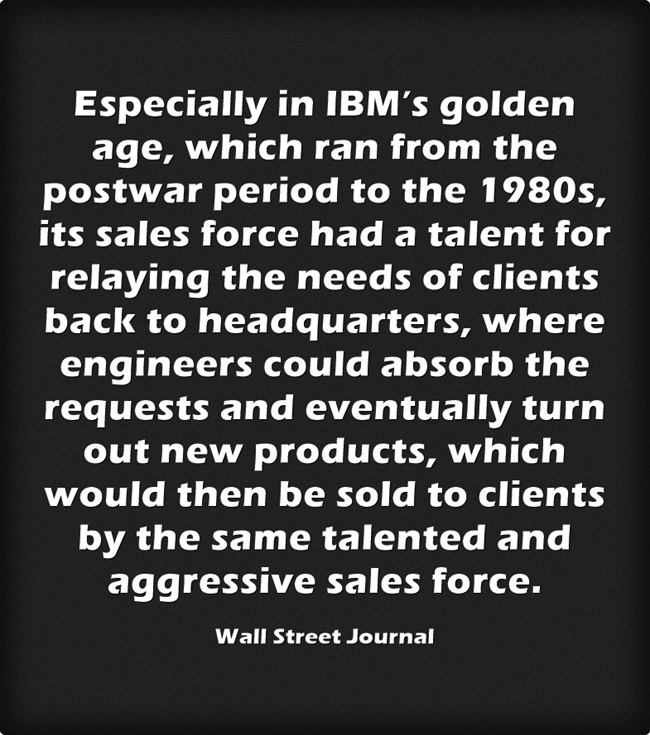
Simply, you can get into the mind of the IBM salesman, and how the salesman communicates the needs of the customers to the engineer. And the engineer meets those needs through products and solutions, and then returns back to the salesman for him to sell to the customers. It is an amazing part of IBM triumph for decades. This quote explains it cleverly.