The thoughts in this piece emerged from the interview conducted with Abdullah Oladipo, Project Team Lead at Green Facilities. Before joining Green Facilities, Abdullah has previously worked with Savvy Capire Partners Limited. At the Green Facilities, he currently leads team managing soft and critical facilities at Egbin Power Plant located in Ikorodu, Lagos State.
Tekedia: Already, Nigeria and her people, including businesses are a facing potential threat to economic growth after exiting recession a few years ago. What is your take on Coronavirus Outbreak in line with economy and industries performance so far?
Abdullah: COVID-19 has affected the entire world, most businesses are suffocating, factories are shut down, hence it makes demands to be more than supply. Human being is a natural social being is now asked to keep social distance. The effect of the pandemic is enormous. Therefore, I am afraid if this go on for another 6 months, the world might experience another great global recession. We do business with people and not animals, and the slogan of the world now is social distancing.
Tekedia: Facilities Management industry is one of the emerging industries. With the lockdown of Lagos, Abuja, Ogun and some parts of the country. How would you describe the future of the industry considering the fact that a significant part of the first quarter has been impacted by the virus?
Abdullah: Yes, the significant part of Q1 has been impacted by the COVID-19, funny enough, it’s only had little effect on FM. Most essential company still works online; wastes are still generated and life keeps running. FM is all about people. Therefore, wherever the people go, Facilities Management follows, some company adopts different strategies in managing their facilities and assets. Some locked down the company and its maintenance team to ensure business continuity. Some operate virtually, when issues arise, they mobilize to the location and fix the issues. This tells us the importance of big data, IoTs, and CAFM in the business operations of the FM. Any company that has deployed those 3, will work seamlessly during this period with high returns on investment. They will also be efficient and meets whatever Key Performance Indicators the clients might give them. This is the time to really look into that, and turns all buildings to smart ones.
Tekedia: You are managing a facility that has a lot of people and critical and soft facilities. Can you tell us the strategies and tactics you are deploying for continuous maintenance of the facilities and deliver the needed value?
Abdullah: There is state lock down, which affects people’s movement and enjoys social distancing. FM is half way on site and half way off site. Therefore, we need to have some of our team onsite. We locked them now for all essential services such as management of Power Plant and facilities at hospital. They will operate and live within the facility for the entire period of lock down. Also, for important sub contractors. We can bring them in to fix issues if it’s very important and very urgent. They go directly to the place of work, execute the work then move them out immediately.
Tekedia: Is it imperative for the players in the industry to reengineer their solutions delivery processes and standards in the face of disruption that has affected operational activities?
Abdullah: Of course, this is key, Post covid-19 would change a lot of things. This is the time companies should start looking at real technology integration. Like the use of robots instead of men or women as technicians, use of drown for inspection instead of physical inspection and use of IoT and sensor for energy management will change the dynamic of the business.
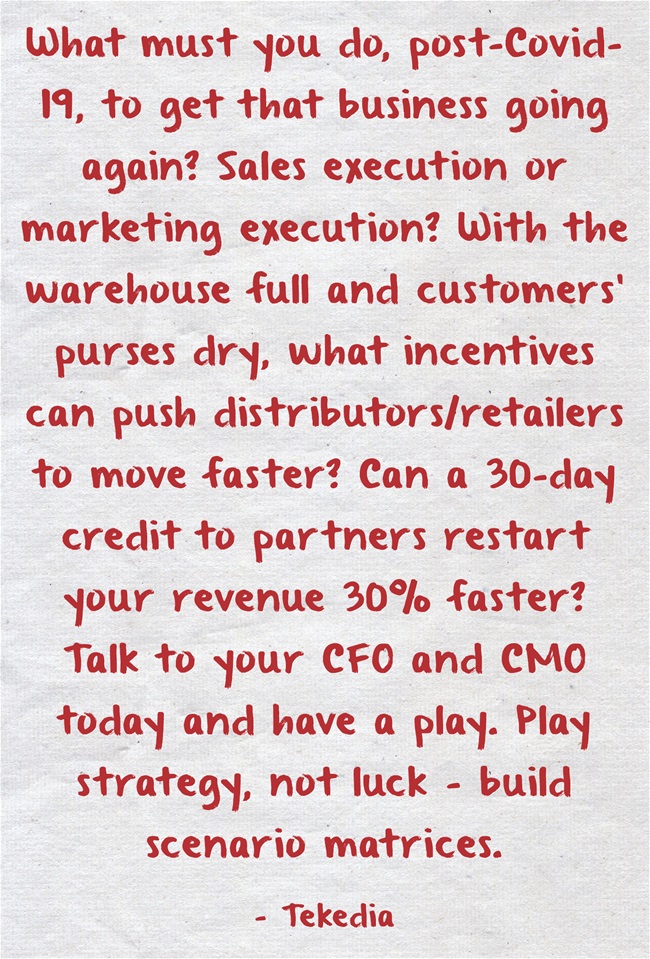
What must you do, post-Covid-19, to get that business going again? Sales execution or marketing execution? With the warehouse full and customers’ purses dry, what incentives can push distributors/retailers to move faster? Can a 30-day credit to partners restart your revenue 30% faster? Talk to your CFO (chief financial officer) and CMO (chief marketing officer) today and have a play. Play strategy, not luck – build scenario matrices.
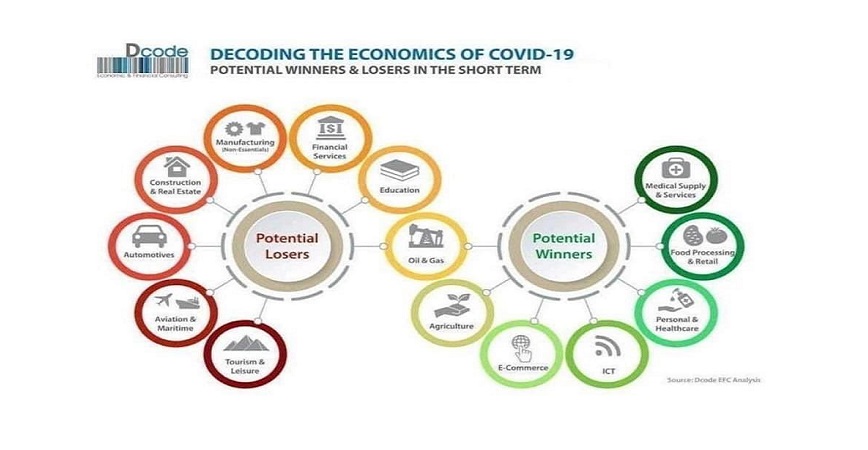
Understand where your sector is on this figure, and what your company needs to do, as you plan ahead to restart your company once the lockdown is over. Develop your plan, and do not rely on luck. If you are in leisure and tourism, talk to your Chief Financial Officer on what a 30% discount can do to the business. Because purses are emptying and priorities have been reshaped, you need to offer something big to bring the customers back. If you are in the green zone, think on how you can keep the market share Covid-19 has just given you. #Plan4Restart
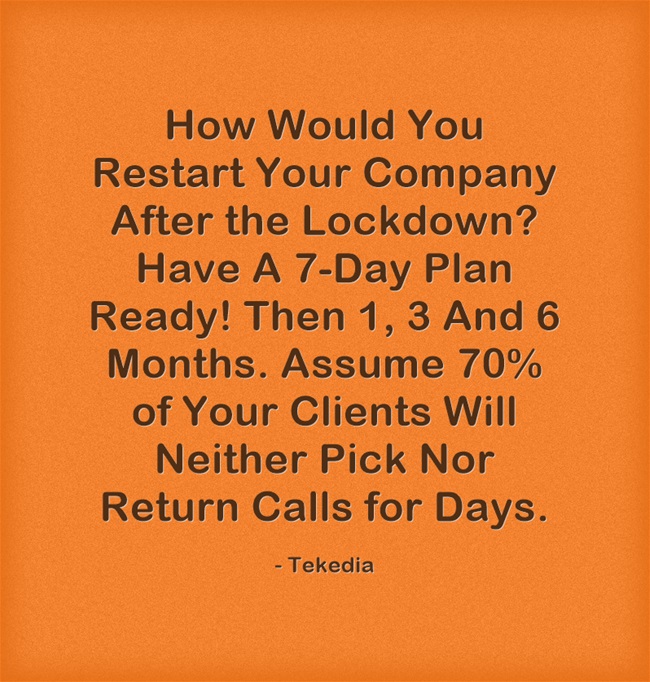
How Would You Restart Your Company After the Lockdown? Have A 7-Day Plan Ready! Then 1, 3 and 6 Months. Assume 70% of Your Clients Will Neither Pick Nor Return Calls for Days.
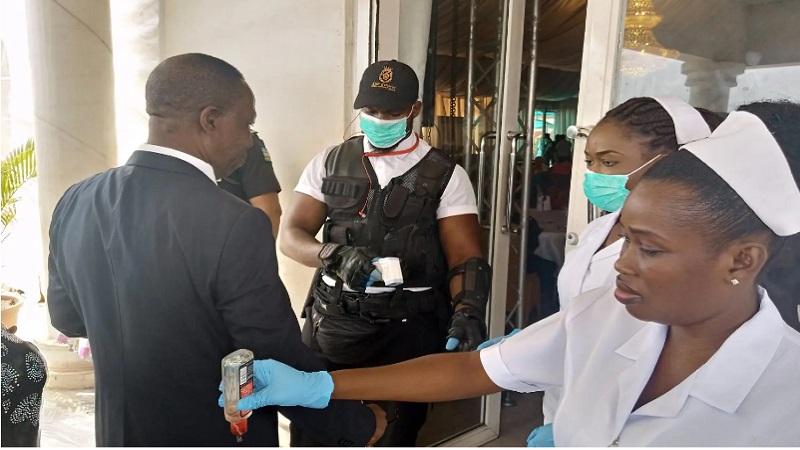
The global Covid-19 pandemic has within the past few weeks proved to be a disruptive element more than anyone could have imagined. From football stadiums to work places, almost everything is now shut down save for those providing essential services. The government started from the reduction of gatherings to not more than 50, but now, that number has been reduced to 10 in some states while some other states have been placed under a total lockdown. But, with much surprise or maybe not, Nigerians have been disobeying these measures despite being told the serious effects the virus could have and how contagious it is. So, the questions really are: are Nigerians just simply unreasonably disobedient? Or perhaps there are justified reasons to be suspicious and distrustful?
In the early days of the virus break-out in Nigeria, concerned citizens, public health advocates, and the government hammered on the need to stay at home and stay extremely safe. But, no one ever really listened. Mosques and churches still opened for business as usual, as many of them either dismissed the reality of the virus or they placed their faith over the porosity of the virus. Another reason on the part of an average citizen was that the virus is a ploy for the government to siphon funds. The problem here exactly is that many people genuinely believe so. From the inception of the virus, there have been several claims that it is a conspiracy theory to loot public funds. For instance, a middle aged respondent told reporters with Legit.ng that Nigeria’s weather is so harsh for Coronavirus to survive… there is no trace for the so-called confirmed cases…it is an opportunity to steal our money. Similarly, Nigerian investigative journalist Damilola Banjo stated that Nigerians at the grassroots, where the majority live, think coronavirus is a ruse or even a ploy by the government to steal more money. In fact, a recent survey by NOI polls suggests that 26% of Nigerians believe they are immune to coronavirus. This is a worrying percentage. With all this, it then becomes understandable why many people take the virus with a pinch of salt.
Despite the assurances by the government on their readiness to tackle the virus, Nigerians continue to remain doubtful. But, given the Nigerian context, these doubts – even though potentially dangerous – are not unfounded. The doubts were firstly fuelled by the government’s sluggish and shady behaviour towards the virus. Isolation centres were not set up as early as necessary. For instance, in Abuja, there weren’t testing centres earlier on and even the one available, as sadly noted by the Senate President, Ahmad Lawan, was in a sorry state. These unnecessary delays in taking preventive steps easily spurred doubts on the sincerity of the government in tackling the virus.
On the 19th March, 2020, a Punch Newspaper reporter, Ralph Ede, reported the death of a seventy year old woman who was quarantined in a state facility, but died a day after being discharged. Although the woman tested negative to Covid-19, her family members established their utmost displeasure at the absolutely horrible state of the medical facility and the treatment she received. This is, however, no big news. Nigeria is a country where only the rich can risk having terminal illnesses and genuinely nurse hopes of survival. In such a country, the reality of the common man is very terrifying. Public healthcare is in a bad shape in Nigeria and the average man has all the incentives to doubt the government. For instance, in his undercover investigation titled Cancer is the Disease and Nigeria’s Health System is the Killer, Fisayo Soyombo noted how the lack of functioning radiotherapy machines across federal hospitals in Nigeria is impeding the treatment of cancer patients and aiding its spread from one parts of the body to another, thereby leaving many of these patients stranded in their treatment and at the mercy of the killer disease. This – and similar public healthcare calamities – is the day-to-day reality when there wasn’t a pandemic. How much more now?
Years after years of unfulfilled electoral promises, insensitive governance, high level of corruption, and unsustainable policies, Nigerians have invariably gotten to that point where individual responsibility – the placement of self-interest above collective responsibility – is all that matters. And it’s terrifying when a people have degenerated to this level, because it becomes difficult to know when the government is being genuine and when it’s just business as usual. Given the nature of Nigerians, since government has proved irresponsible over the years, the automatic default is God. It is why when the Coronavirus broke out, many Nigerians were found saying things such as “it is not my portion”, “I am covered by the blood of Jesus”. It is why preachers could leverage that instance to propel their sermons at the expense of the stay-at-home policy.
In a widely circulated video across social media platforms, we witnessed Pastor Innocent Kingsley, the General Overseer of Bible Believing Mission, dismissing Covid-19 by stating: “that thing cannot survive in Nigeria. What do you mean by coronavirus when there is corrosive anointing” Today, Nigeria officially has over 200 cases of coronavirus with fears that the numbers may actually be way higher than that. Similarly, reacting to government’s directive on the closure of all gatherings, Bishop Oyedepo asserted that shutting down churches would be like shutting down hospitals. This intersection of religion, science, and politics has also been a conflicting area enabling disobedience of citizens towards policies. There was a similar trail of events during the outbreak of Ebola and this won’t be the last.
Policy implementation is perhaps the major area that suffers the backlash of public distrust. That’s when you realize majority of the populace have no regard for the government. Clearly, entertaining doubts on the reality of the Covid-19 pandemic can be a leeway to a severe humanitarian disaster. However, even while not appropriately justifiable, the experience of Nigerians with the government is enough enabler of disobedience. Two of the foremost promises of this administration were to fight corruption and to tackle terrorism. This same government has been an agent of witch-hunt with the corruption radar specifically on persons of the opposition, rather than fighting corruption wholesomely. Similarly, some 6 months after resuming office in 2015, President Buhari declared that BokoHaram had been “technically defeated”. However today, with several bomb blasts, killings, abductions, and video evidences, it is very clear that this Bokoharam sect is otherwise growing in numbers and capacity
As such, to ensure nothing impedes their daily survival, the average Nigerian – such as market-women, taxi drivers and petty traders – is quick to dismiss the reality of Covid-19. Even if these people genuinely believe in the existence of Covid-19, the next problem they are faced with is how to not stay hungry while staying at home. Again, the Nigerian government has not demonstrated efforts in this regard. So, if an average Nigerian – who lives under a dollar per day and who survives based on what he or she makes daily – is to stay at home, how does hunger not kill them while doing so? This question is largely left unanswered and, with no definite governmental relief fund in sight, the stay-at-home policy is bound to face serious obstacles.
Case in point is a middle aged man in a video interview by LegitNG (below). In his words: how can I stay at home unless they (government) provide something for us… America gives money to their citizens during this period. That is a government that cares for the citizens. Nigerian government doesn’t care for her citizens. Similarly is the viral video of a middle aged woman, lamenting that just within two days of lockdown, her pot of soup already got stolen: we cannot continue like this, she said.
Realities like this pose challenges to the stay-at-home policy, because giving the status of the virus, no one can say for how long the pandemic will last. So, for a government that does not have a track-record of caring about its citizen, where is the safe space for the common man. If nothing happens in time, these people will, out of resort, revert back to their markets and hope the holy-spirit protects them since the government can’t. And no, this will not be the first time public distrust will occasion policy gaps.
In 2011, during the Jonathan administration, the government made a move to remove the expensive petrol subsidy program. To this end, the government explained that the subsidy program had been used to siphon about 6.8 billion naira meant for importing petroleum products. Further analysis estimated that the removal of subsidy would reduce the cost incurred by government, as 1.3 trillion naira was allegedly being spent on petrol subsidies. However, regardless of all this analysis and alternative measures sought by the government, citizens and trade unions still protested the elimination of the subsidy program – an action which largely stemmed from the distrust level in the country. A similar case happened in 2016 when the National Electricity Regulatory Commission sought to increase electricity tariffs. Despite the explanation by the Minister of Power that this step is needed to incentivise investment in the power sector for better power supply, citizens still met this action with total resistance.
So, are Nigerians just naturally belligerent? That doesn’t seem to be the case. Rather, the case is that our trust level in the government has degenerated to nothingness. No one wants to trust that the government is trying to take a citizen-oriented step, especially if it will affect the citizens’ current way of life. Years of governmental failure have conditioned Nigerians to be suspicious of the government. This is not exaggerated, it’s the reality. A Pew Research Centre poll in 2016 revealed that Nigerians do not consider the political and economic system to be fair. And why would they? Is the political and economic system actually fair?
The Nigeria government commands a very low level of trust from her citizens and this is not an appealing reality. While the status of Covid-19 is terrifying, it has somewhat further helped us to see how wide the trust gap between the leaders and the people is. In the early days of the pandemic, concerned persons and public health advocates clamoured for the government to shut her borders to foreigners or, at the very least, ensure an immediate quarantine of travellers. None of this was done as early as required. Had it been recent travellers had been quarantined, the Covid-19 could have been contained in Nigeria before we started worrying about the spread. This initial absence of a sense of urgency is worrying and more worrying is the fact that it has almost always been like that with Nigeria.
This problem of distrust didn’t start today and can’t be brought to an end suddenly. It’s going to take deliberate efforts and intentional good governance. But, while this pandemic lasts, the government needs to do more. Truth be told, they have done some things well such as clarifications on who can be tested and provision of information on isolation centres. However, more levels of transparency are needed. There are still cases where powers that be are covering up positive Covid-19 patients. Also, the general public needs unbridled information about the capacity gaps Nigeria is facing in tackling this problem. The government should also work on making relief funds available to those who are deeply affected by this new work reality – those whose daily incomes are largely what they live on. This should also be properly monitored to avoid cases where these funds do not reach the target people. We should also have regular updates on how the money donated by several donors is being spent. These are few of the things that can be done to alleviate this situation.
One thing the Ebola experience showed us was that a high level of community trust in authorities helps in the fight against any pandemic. If trust was not lost in a day, it cannot be regained in a day. But, while this pandemic persists, the government has to do more in guaranteeing a more successful implementation of policies. The strength of a policy, just like a chain, lies on the strength of the links. In this instant, the people are the link. And a quality synergy of the two is how we can beat Covid-19.
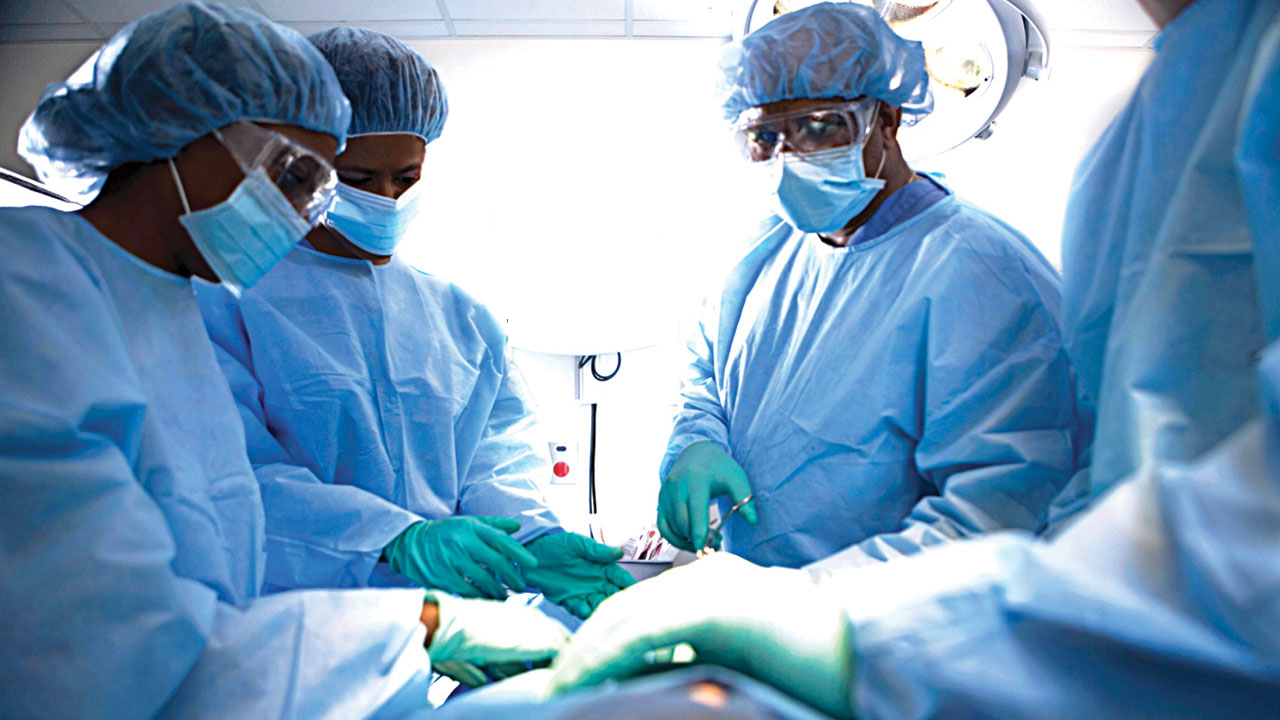
News filtered in that some Chinese health workers are coming to Nigeria to team up with their Nigerian counterparts in the battle against COVID-19. According to the Director General of National Orientation Agency (NOA), Garba Abari, the 18-man Chinese medical team is coming to Nigeria to share their experience with the Nigeria Centre for Disease Control (NCDC) on how China handled and subdued COVID-19 epidemics. According to him, these Chinese experts are not coming over to Nigeria to take over the jobs of Nigerian health workers.
This announcement came as a shock to Nigerian health workers. It was instantly criticised and rejected by Nigerian Medical Association (NMA) and Nigerian Association of Resident Doctors (NARD). According to the NMA president, Dr. Francis Adedayo Faduyile, the intention of the federal government (FG) to invite Chinese medical officers is an embarrassment to NMA members and other health workers that are in the frontline of the battle against COVID-19.
Dr. Faduyile said that FG did not consult the association before taking that decision and as such, failed to take cognizance of the law regulating the practice of medicine in Nigerian as enshrined in the Medical and Dental Council Act. He also asserted that the members of the Chinese medical team, if at all they come into the country, will not be allowed to have access to any Nigerian patient unless they are certified and authorized by the Medical and Dental Council of Nigeria. Dr. Faduyile insists that either FG withdraw its invitation to the Chinese health workers or the NMA will review the participation of its members in the fight against COVID-19.
The stand of NMA may be seen as bordering on self-esteem and the desire to be acknowledged. It is quite unfair that the FG failed to notify the association of its intention to bring in foreigners to work side by side with the members. This is truly an oversight by the FG though it could be resolved immediately if necessary actions are taken. But then, the stand of NARD threw more light on why Nigerian medical workers are uncomfortable with working with the Chinese team.
According to Dr. Sokomba Aliyu, the NARD president, the following are cogent reasons why the NARD members stand against Chinese medical teams being allowed into the country:
Health Hazard: According to Sokomba, it is suicidal for FG to open Nigeria’s international borders to Chinese nationals. He said that Italy made that mistake and it “proved socio-economically suicidal” for the country. He did not go further on how this could happen but further reasons given by him could give one a glimpse into what he meant.
Unreliability: Sokomba said that the “crafty Chinese scientists” could not be trusted because they “unreliably and covertly” managed information around the disease from the onset. He said that the Chinese refused to release information on the origin, characteristics and other virulent features of the virus, which could have helped other nations to prepare themselves very well to battle the epidemics when it hits them. For this reason alone, Sokomba insists that Chinese scientists and medical professionals cannot be trusted to come near Nigerian patients.
Conspiracy Theories: As Sokombo asserts, one of the conspiracy theories flying around holds that COVID-19 is “a tool for both socio-political and economic manipulation and dominance”. When one places this theory side-by-side with the Chinese refusal to release much needed information before this disease became pandemic, one could not but wonder if the Chinese health workers could be trusted truly.
Unemployed Health Workers: Sokombo insisted that Nigeria has a lot of unemployed health workers that could be hastily employed by the FG so that there will be more professional hands in the battle against the ailment. He said that most countries battling this disease accelerated the graduation of their final year medical students and did not seek for help from the Chinese health workers. He said that it is insensitive for the FG to import health workers from China when there are Nigerians that could do the work perfectly well, if given the opportunity.
Suspicion: Sokombo expressed his suspicion towards the intention of the FG in bringing in the Chinese when the Nigerian health sector has not yet been overwhelmed. He said that if the FG had recruited all available health workers and there is still need for more, bringing in Chinese to fill the gap wouldn’t have been suspicious.
Considering the arguments given by the FG, the NMA and the NARD may make it difficult for ordinary Nigerians to take a stand right now. Everyone knows that COVID-19 spreads like wildfire when it runs out of control. For that reason alone, Nigerians wouldn’t mind if their medical officers obtain professional advice from experienced medical officers that have combated the disease and won. But thinking about the arguments given by the NARD president is enough to send fear down our spines. The question that is hard to answer now is, “What if these Chinese professionals came and accelerated the spread of the disease?”
Of course it may just be fear from the conspiracy theories flying around that is making us hold back. Or it could be our suspicion because of how China denied the whole world information on the disease. Whatever the reason might be, there is nothing wrong with the medical practitioners in Nigeria being pensive about the coming of this Chinese medical team.
It will therefore be to the best interest of all if FG could find a common ground between their invited guests and Nigerian health workers so as to avoid a face-off between the FG and the Nigerian health workers or between the Nigerian and the Chinese health workers. The experiences of the Chinese health workers are needed but they mustn’t come to Nigeria to share it. They can do that through Global MediXchange for Combating COVID-19 (GMCC), a platform opened by Jack Ma for medical practitioners to compare notes and share knowledge about Coronavirus. Besides Nigeria does not have a severe case of COVID-19, and the Nigerian doctors are managing the existing cases very well. In other words, Nigeria is not yet in dire need of these Chinese professionals.
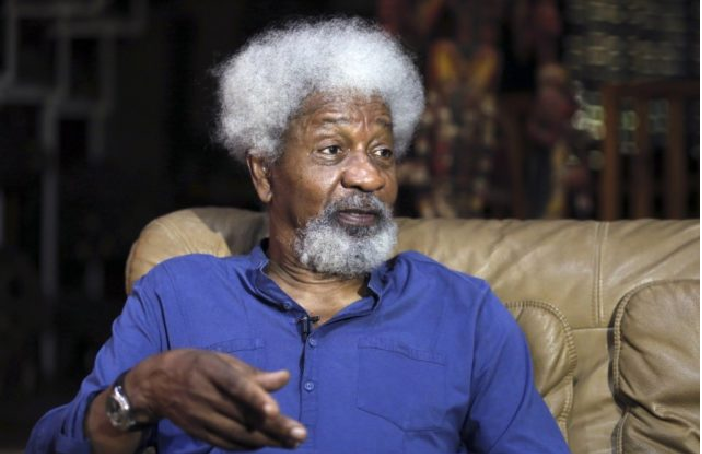
Nigerians have been sharply divided across camps in the recent spat between Nobel Laureate, Prof. Wole Soyinka and Senior Special Assistant to the President on Media, Mallam Garba Sheu. Prof. Soyinka had earlier condemned the presidential directive to Abuja, Lagos and Ogun States to totally restrict movement of people and business activities in order to curtail the spread of the novel virus. Soyinka in a statement had said the presidential directive is illegal and unconstitutional. He said “The worst development I can conceive is to have a situation where rational measures for the containment of the Corona pandemic are rejected on account of their questionable genesis. He further noted that “this is a time for Unity of Purpose, not nitpicking dissensions. So, before this becomes a habit, a question: does President Buhari have the powers to close down state borders? We want clear answers. We are not in a war emergency.”
In his reaction, the SSA to the President on Media and Publicity, Garba Shehu, has said “Yesterday, the esteemed Nobel Laureate, Prof. Wole Soyinka made comments on the legal status and description of 14-day lockdown announced by President Muhammadu Buhari. Professor Soyinka is not a medical professor. His qualifications are in English Literature, and his prizes are for writing books and plays for theatre. He is of course entitled to his opinions- but that is exactly all they are: semantics not science. They cannot- and should not- therefore be judged as professional expertise in this matter in any shape or form.”
In reacting to the spat between the Nobel Laureate and the SSA on Media to the President, Nigerians have been divided on whose side to stay. While many believed that Mallam Garba overstepped his boundaries, others were of the opinion that Soyinka should not have queried the government decision. In responses monitored on Facebook, Nigerians were neither here nor there. In a Facebook post by Dr. Abdulkadir Oba Laaro, a lecturer at the Department of Mass Communication, University of Ilorin, an attempt was made to mediate between Garba Shehu and Prof. Wole Soyinka. The don wrote :
Garba Shehu overreached himself. That release of Prof Wole Soyinka is over. Some language should be below presidential engagement. Though, Prof Wole Soyinka too needs some discretion in his intervention on national issues
Responding to Laaro’s assertion, one of the early commenters, Kunle Akogun, in support of Garba, wrote: “Some people should stop playing God even in matters about which they know nothing. Indeed, Coro is science not fiction! And fiction writers should stop politicising and trivialising the government’s effort to stem its spread! I’m with Garba Shehu on this.”
In a counter response on this and in an apparent support of Soyinka, another Nigerian, Naeem Balogun, opined “I believe Garba Sheu is not that knowledgeable to know and understand that those who write fiction really have to study the real knowledge before adding their actual expertise. He ought to have understood that, this is not journalism that “framing” is required to take people in another direction. Even though the fiction writers are not left out in that aspect. Knowledge, fiction and reality work hand in hand. My assertion.”
A counter narrative also emerged from another participant in the discourse. The commenter, Olatunde Oketumbi who argued “ Let’s call a spade a spade. Soyinka goofed in his criticism of the government lockdown order when he, in his supposedly superior wisdom, did not suggest a more practical alternative action that the government could take to combat the Coronavirus pandemic in our collective interests. I’m therefore totally in support of Garba Shehu’s rejoinder to Wole Soyinka. After all, Shehu’s freedom of speech is no less guaranteed by the same constitution that guarantees Soyinka’s.”
In her own response, Chinedum Ikogwe faulted Garba for his comment. She said “Hahahahaha.he only displayed the arrogance that the APC Central Government is known for since 2015. So, please leave Mallam Shehu Garba alone. Joseph Kay, in a seemingly angry tone posited that Wole Soyinka got what he deserved. In his own post, he said “Wole Soyinka got what he deserves. He should know better with his exposure. Other countries are taking stringent measures. The French Parliament passed a law to enable the Prime Minister rule by decree for two months. In the Philippines, President Rodrigo Duterte ordered the security agents to shoot down anyone that defies the stay at home order. More and more countries are locking down cos that is working at the moment…”
Karounwi Adini agrees with the post but did not accept the fact that Soyinka should exercise discretion. He probed “ I agree with the post, except the side of Kongi having discretion on his statements. Which discretion exactly with this Government?
As the argument goes back and forth, with people taking sides, it is instructive to note that the president in his special broadcast to Nigerians earlier in the week has said “In Nigeria’s fight against COVID-19, there is no such thing as an overreaction or an under reaction. It is all about the right reaction by the right agencies and trained experts.” This should have been the bedrock of Garba Shehu’s response to the erudite professor’s concerns.