DD
MM
YYYY

PAGES

DD
MM
YYYY

spot_img

PAGES

Home Blog Page 6857

Intersection of Digital Lending with Solar PV for SMEs in Nigeria

0

By Olumide Durotoluwa

The Nigeria technology and innovation domains have been attracting significant interest over the last few years. In 2018, according to the Nigeria Start-up Funding Report, the total amount of investment in technology companies in the country within the periods starting Q1 to Q3 2018 stood at $118,463,785. Of this sum, 73% was invested in the Fintech sector. Also, according to the data released by WeeTracker’s Venture Investment Report 2018, the Fintech sector received the highest funding in Africa with $284.6million. This was followed by the CleanTech, with $143.5million.

To add this, 80% of the FinTech market in Nigeria, is made up of Digital Retail Payment (36%), Lending (25%) and Payment Infrastructure (19%) firms. In the last few years, global non-bank lenders using digital platforms are fundamentally redesigning the consumer loan sector by restructuring the lending standards. The concept, which initially started with individuals has extended its offerings to include smaller SMEs, retailers and to the rest of the over 3 billion adults globally without access to credit.  Massive opportunities exist in this digital lending market and it is now increasingly favoured over traditional lending models.

With the introduction of the Bank Verification Number (BVN), many of the challenges facing Peer-to-Peer (P2P) market in Nigeria including trust, national identity system, obsolete legislation has been addressed. The growth of the sector has been premised on the increasing penetration of smartphones, internet usage and consumer’s data accessibility. It has been estimated that mobile phone penetration is expected to rise to over 96 million by 2020.

The report of a study conducted by Efina in 2014, further showed that about 7 out of 10 Nigerian traders surveyed own a mobile phone. 74 percent of them are ready to learn a new technology, while over 30 percent of them have not accessed credit facilities from a financial institution. The study further revealed that 56 percent of the traders surveyed source funds from family, friends and unions and over 60 percent require funds less than N30,000.

Another factor stimulating the growth of the digital lending companies, is the increased crowding-out of private sector access to credit. Financial intermediation, which is the process of matching savers with borrowers, a primary function of the banking sector, has been largely impeded by government borrowing. While access to credit facilities is critical in boosting economy growth, the CBN is not expected to lower rates in the near term, particularly with inflation, well above government targets. If significant domestic borrowing by the government continues, the interest rate will not come down soon, and one can assume that commercial lending by banks will hardly exist and if it does, it will be at an unfriendly rate.

Aside poor access to soft loans by SMEs, which the digital lending companies are fixing, another major challenge faced by SMEs is access to a regular supply of electricity, to power operations. The World Bank ranked Nigeria as the second largest country in the world after India and the first in Sub-Saharan Africa with the highest number of people deprived of electricity. According to the International Monetary Fund (IMF), the lack of access to reliable electricity costs Nigeria an estimated $29 billion annually.

To this end, renewable energy, especially solar, has received untold attention. While it’s commonly believed that solar PV doesn’t compete with the National grid, it can largely phased out diesel and petrol generators.  Many Nigerians however, are yet to be dissuaded from the falsified narration that solar is substandard and cannot power heavy equipment. There is also a concern on the expensiveness of solar. However, the falling cost of solar components and the increasing cost of diesel and petrol makes the sector attractive in Nigeria.

Based on pricing, off-grid solar PV is already cost competitive on a lifetime basis, costing an average of N73/kWh as opposed to diesel generators N110/kWh and petrol generators over N219/kWh. However, due to the high upfront cost of solar PV, customers are yet to come to terms with the long term benefits of using it. An illustration is given in the next paragraph.

A low capacity (0.9kVA) petrol powered generators, used by many households and SMEs in Nigeria, requires an initial capital expenditure of between N30,000 and N40,000. It requires a daily expenditure of about N500 – N1000 for fuelling, depending on the usage pattern. The OPEX can amount to N182,500 – N365,000 annually. Adding this to the average cost of generator maintenance which is about N30,000 – N40,000 per annum, sums up the annual expenditure of running a petrol powered genset to N212,500 – N405,000.

On the other hand, Solar offers a competitive pricing when compared to generators. First, solar operators are not likely to oversize energy requirements, like it is traditionally done. A stringent energy auditing process is usually conducted prior to deployment, to know the required energy utility. This alone, can significantly reduce initial upfront cost.

To procure a solar system, an initial one-off CAPEX of between N350,000 (for a 400W solar system) or N850,000 (for 1.4KVA solar system) is required. This is usually followed by largely zero OPEX and future expenditures. Battery components may need to be replaced 5-10 years later, depending on its quality, but other components such as solar panels, inverters, cable, can last as long as 20 years.

Some innovative financing techniques have been adopted by renewable energy companies to increase customers’ adoption rates. One of them is the Lease-to-Own model, where the customers pay a relatively small initial capital followed by recurrent monthly expenditures, until full ownership is earned. While this model looks attractive, it can still be very unappealing to many Nigerians.

This offers an opportunity for Fintech companies, especially digital lending companies, to provide asset financing, a more flexible financial instrument, to SMEs who want to transit to solar PV. The key driving force will be to leverage on the technical expertise of the renewable energy industry players, to create a win-win financial model for all parties.  Fintech, characterized by an efficient credit risk assessment,  rich customer experience, operational efficiencies, shorter disbursement cycles and low cost models, has made the lending process faster, easier and more convenient. This propensity can be transmitted to the renewable energy sector, which has been prospected to contribute 30% of the 30,000MW national electricity by 2030.

As stated in the opening paragraph the CleanTech sector is rightly behind the FinTech in terms of investment received, in 2018. A strategic intersection of this two booming sectors can result in a huge opportunity.  It is recommended that digital lending companies should design financial products, specific to the renewable energy sector that will be bankable, as well as attractive to the SMEs. This will stimulate the base-of-pyramid quick adoption of solar PV.

All together

The federal government’s continued reliance on the domestic market for financing, has diverted huge funds away from the private sector, towards government securities, which offer a risk-free rate of as much as 15%. This has made it increasingly difficult for traditional banks to give enough attention to micro-financing. Digital lending companies are tackling this challenge, and can significantly redesign financing techniques for SMEs, to catalyse the adoption of renewable energy.

I Shared His Story, Then Came An Apology

0

By Kalu Ndukwe

Combining work and study can be very hectic in itself. One of the things you wouldn’t want to experience however is to contact a colleague in order to get information, but got a sustained cold treatment that leaves you feeling embarrassed and humiliated. This was exactly what happened to a colleague of mine recently. The person and I had met. In the course of our conversation, he told me this story.

“I had completed a draft of my thesis proposal. And in a bit to get an insider information about the situation of things in school, I contacted one of us, who I suppose should be within the school environment, the fellow hooked up but cut the call on me before I could finish saying “Hi, good afternoon “. I called back on the assumption that the call ended due to network problems. But that call was busied. I tried the third time and the receiver busied my call also. Having reasoned that the receiver was busy, I sent an SMS introducing myself and requested to speak with him when he was less busy (this was for formality sake. The person concerned and I have exchanged calls in the past.)

“Days passed and there was neither a return of my calls nor was the SMS acknowledged. Shocked as to what was the problem, I even felt afraid that the person I’m calling may be unwell which could be why I couldn’t get a response. In a bit to know exactly what was the problem, I sent him a whatsapp message requesting an understanding for the unexpected silence. That too was buffed. I couldn’t figure out the meaning of all that crap of a behavior, nor was I able to understand the cause of it.

We’ve never had any quarrel in the past. That’s never happened. I was only shocked to see posts by that fellow in our Class Group handle.  And I was like ”So the guy is alright and not too busy anyway? Thank God he’s fine. ” (emphasizing) I hold no brief for him in any way. I don’t give bunks, that’s why I chose to talk about the guy in the anonymous. It’s been over three weeks. I am yet to hear from him. Ain’t even thinking anymore about it though. I had since contacted two other persons, and got a piece of relevant information from them.”

I shared the story with the following note:

It is high time professionals had realized that it is not easy, all the time, to separate professional behavior from personal attitude. At one point or another, any personal attitude that is not nice might really show up in one’s professional life. If this is considered from long term perspective, it will be seen that it might affect one’s career, I am sorry, perhaps negatively. Those who are in a position to make a decision that may influence one’s professional progress are watching everyday. It is not possible to know all the persons who could be in such position. But when such occasion comes it’s very clear that what will be decided about one will be based on what is perceived of one.

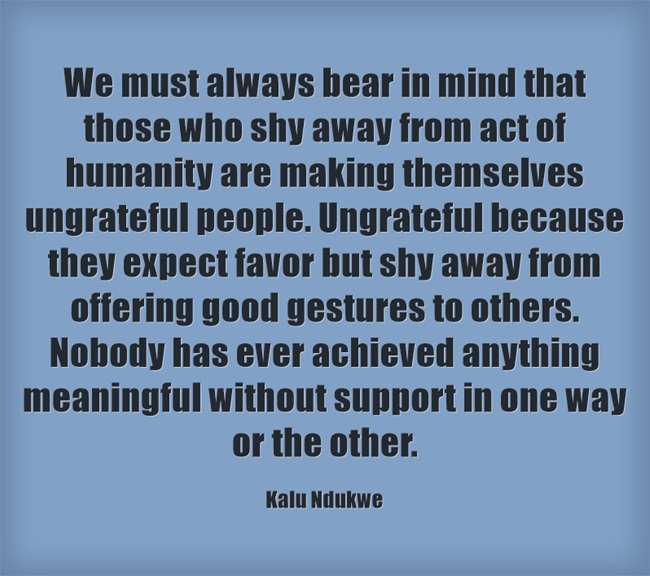
For the sake of emphasis, no one has ever lived a day without the input of others in their lives. Nobody has ever achieved anything meaningful without support from others in one way or the other. Every one living today is benefiting from the benevolence of something or someone ( such as Providence, parents, siblings, relatives, friends, bosses or superiors, neighbors and sometimes, even strangers). If you think what you are getting from those is your right, can you have this smart rethink that, it’s equally the right of those benefactors including Providence not to grant your wishes?

Kindness is not always about the big things done than the little gestures overlooked. If you have followed the story carefully, you’d have realised that what made that experience ugly for the dude was not that he couldn’t get the information he needed. What made that experience a “bad day” for him was that he felt demeaned by the embarrassing manner he was treated by a colleague. To me, that unsavoury handling was seriously uncalled for. His pain and sense of loss was that after spending moments of his time to make those calls, send those messages, he got crap in return.

My point is that wherever we may be,  may we always bear in mind that those who shy away from act of humanity are making themselves ungrateful people. Ungrateful because they expect favor from others but shy away from offering good gestures to other people. Isn’t that unfair? And may we please remember that if we have any personal reason why we’re unable to do something nice for someone, may we find a polite way to tell the person to try elsewhere.

The following day, there was an apology!

Becoming A World-Class Professional

0

By Ajayi Joel

If you’re developing a product that solves a problem in your community, you are on a mission. For doing just that, you have an element of problem solving skill, and you are a professional. If you do that effectively and efficiently, I will call you a world-class professional.

Here is what I call world class professionals, and “WE” are not so many in Africa: if you’re studying engineering and you can relate with your environment to fix frictions, you are there. It’s not necessary for you to be in Silicon Valley to work. All that matters is that you can come up with a solution that solves your community problem using engineering. For that, let us consider a bold idea. Yes, let’s say building air conditioners with wood that doesn’t use electricity for a village. That’s what I’m talking about!

As you do that, it does show that you really understand engineering because you have used your knowledge of engineering and your immediate environment tools to solve a problem with engineering. This shows that if you go to the moon, you can still solve the same problem even if there are no woods on the moon. Yes, you can still build an air conditioner with the resources on the moon.

Note that I didn’t say “work on world class projects”.

Why we call folks world-class professionals outside Nigeria is because they used their knowledge to solve a problem in their area, and local community. That means when they come to Nigeria, they can still solve the same problem even if the resources available are different.

Why? They understand the problems they are solving. Understanding the problem you are solving is different from understanding what you are learning.

There are many graphic designers, software developers, marketers, and writers who only understand what they are learning, but do not understand the problem what they are learning solves. Those people can never be world-class professionals.

For example, if as a graphics designer, you do not understand that probably graphics designing solves the problem of perception, you cannot rise to that elite professional domain, called world-class professionals. Yes, you can blend colors together and collect payments and feel you’re doing fine. But if you travel to a war-ravaged community, and they say make a design for the new president that will help him win election, you cannot just mix colors just like every normal graphic designer. If you do not understand that graphics designing solves the problem of perception, you will just blend colors and fail even with good graphics!

This reasoning applies in other fields and domains. As an architect, can you build smart houses that will reduce electricity needs in homes? Those houses will be affordable for pensioners, will use space effectively, and will be eco-friendly. Or are you the type that puts typical instruction and design. If the latter is your mindset, you cannot be a world-class professional.

That is why in my posts, I challenged people to learn a skill to solve a problem. That is one way to fix many frictions in Africa. Simply, we need world class professionals in different fields for Africa to move forward!

All Together

To become a world-class professional, it does not mean you have to travel to U.S. or France or China. To become one, you just have to solve problems in your local community smartly in ways that improve the utilization of the factors of production. That means you bring innovation, reducing costs even when improving efficiency – that is disruption. You can be in Osogbo or Kano or Aba, and still be a world-class professional if you elegantly fix a local friction. World-class professional does not mean you are working or solving American or French problems; world-class problems are agnostic of locations. Simply, you are solving problems anywhere with great quality.

Comment from LinkedIn Feed

  • Terminology is not arbitrary. Use the words that already have definitions properly. A dictionary or other references should be used. A professional whose skills equivalent to the top 3-5% of the professional population. Basing it on solving local problems is misleading especially if the problem does not meet the qualified difficulty or complexity.
  • Good move connecting the Chief Critic that makes everyone better here. I do think it is a mindset. Perhaps, it has to be outside my home, city or village to be world-class. That is what Joel is pushing there, from my understanding. I think there is a balance here. If someone comes to my village and solves the problem of malaria, I will be very happy: he is an eminent world-class profession even if they have none in Western Europe and US. The classification of the top 3-5% may not really matter to me.  I am not sure Microsoft would have hired Mark Zuckerberg since he was not even eminent in his computer class in Harvard. Yet, to his schoolmates, he was a legend – connecting them. What Ajayi is saying makes sense: you can be a top 3% fixing problems in a different domain but in another place, they can have their own top 3%. Interestingly, you cannot be a top 3-5% if you have not solved a local problem. In context, they do connect even though dictionary meaning may deviate. Every global World-Class Professional is also a local world-class professional because that person has done something that validated him or her in school, work, community, etc.
  • I think that is what he meant. But, that is not what he wrote. The writing should be clear and unambiguous.

The Nigeria’s Individual Governments

2
generators Nigeria

By Sani Nahuche

In the normal sense of things, if a government existed within another government, one would ultimately seek to oust the other. Politically, it can be described as running a parallel government – where one government aims to concurrently run alongside one in a state or country.

The fundamental role of any government is to promote the welfare of the state. This role can be assumed in various ways and forms, some of them include monitoring the economy, business, security, providing basic infrastructure and so on. However, where the government has been grossly incapable of carrying out their most basic functions, do they still serve as the government of the people?

Albeit, the contrary is the case in Nigeria. The government has basically failed to provide anything remotely close to what any normal government should. Nigeria amidst its massive earnings from oil still lacks basic amenities like electricity, good roads, housing, and water. This sad trend has ultimately forced the people to assume the job of a government that they ironically pay tax to.

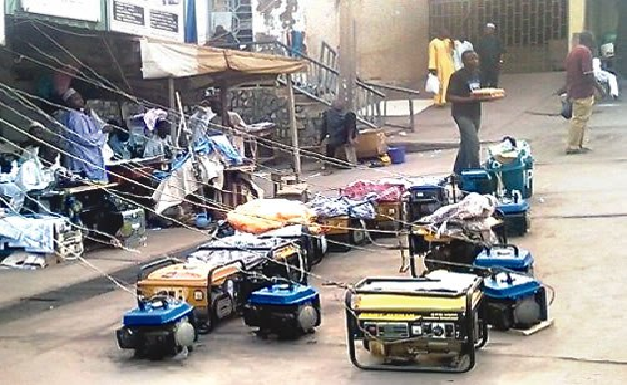
In Nigeria today, the average citizen is saddled with at least 65% of the normal function of the government. Citizens are forced to provide their own electricity – this is on the back of the phantom 16 billion dollars that was said to have been invested in the nation’s power grid since 1999. Most Nigerian homes and businesses are forced to buy a power generating set and fuel it themselves. Imagine running a successful business or industry without a reliable power supply.

The security situation in the country has steadily worsened over the years. Politicians now seem to draft a battalion of the country’s security operatives to themselves and their families. The average citizen is left with no option than to hire and pay someone to secure their premises/business. The saddest part of the nation’s security state is that the government uses these security agencies at will to oppress the citizens, rather than defend them.

Recently there has been a clamour for the restructuring of the nation’s security agencies due to misuse of power, harassment, bribery and assault, but these vocal complaints have been matched by an equal amount of silence by the government. Nigeria is a country where only the rich – the politicians and celebrities – are entitled to any form of decent security.

The same harsh fate awaits our roads and water supply. The average Nigerian has to drill a borehole with their own money to gain access to sustainable drinking water. Our roads are bereft of any sort of coordination, maintenance or infrastructure. This sorry picture is the same for education, housing, and economic policies. In a country where the government taxes its citizens and yet grossly fails to provide the most basic of amenities, can the country still be thought to have a working government?

A country where the majority of those in government would prefer to send their children abroad to study, rather than upgrade its educational institutions, a country where those in government shamelessly travel abroad for medical treatment rather than fix their hospitals, a country where the citizens are forced to provide their own security, power, water, education and basic infrastructure, can be likened to a country without a functioning central government.

A ‘supposedly’ developing country running one of the most expensive democratic systems in the world, at the expense of its majorly poor citizens that are ultimately forced to provide their own basic needs. A country where 70% of the youths are either underemployed or unemployed – wasting away its youthful population. A country where its leaders comfortably conspire and connive to loot the commonwealth of the nation without pity or fear of authority.

Small and medium scale businesses – the heartbeat of any economy – are currently struggling to break even. Interest rates are astonishingly high, ease of doing businesses is ludicrously difficult, people are forced to provide their electricity, water, security and other necessities, at the expense of the little profit they make from their businesses. Ultimately, most businesses in Nigeria are folding up, relocating or retrenching their staffs, the government’s economic policies are poorly thought, and it’s just too expensive and unprofitable to adequately run a profitable business in Nigeria.

Corruption has always been the Achilles heel of the most populous black nation in the world. The citizens have also failed to treat those in authority with as much disdain and vocal criticism as they maybe should have. When politics and power are seen as a tool to steal, oppress and undermine the will of the people rather than diligently serve them, the result is a society where impunity, stealing, corruption and lethargy is the order of the day. The average Nigerians  each as governments of their own.

The time has come for the citizens to start voting in the government of their choice and holding them accountable to their every actions. A government that would be made up of people that are actually willing to assume the role of a government and lift the heavy load that now rests on the weary shoulders of most Nigerians.

Nigeria is the sad tale of a nation where a good number of over 180 million citizens have to largely provide their power, education, water, security, health care and general welfare from their own impecunious pockets, despite the existence of a central, state and local government. A country where a central government exists and these many flaws are apparent can only be likened to a country with over 180 million individual governments and ineffective central, state and local governments.

To aptly describe this unfortunate situation, Nigeria is currently a country of various governments, a country where every citizen is a government of  its own, a country where the central government has monumentally failed to carry out even the most basic duties to the people they claim to serve. A country where you, I, and the next man are walking governments of our own!

I Expect Uber to launch Uber COPTER in Lagos – Eko Hotels to Ikeja Airports

2

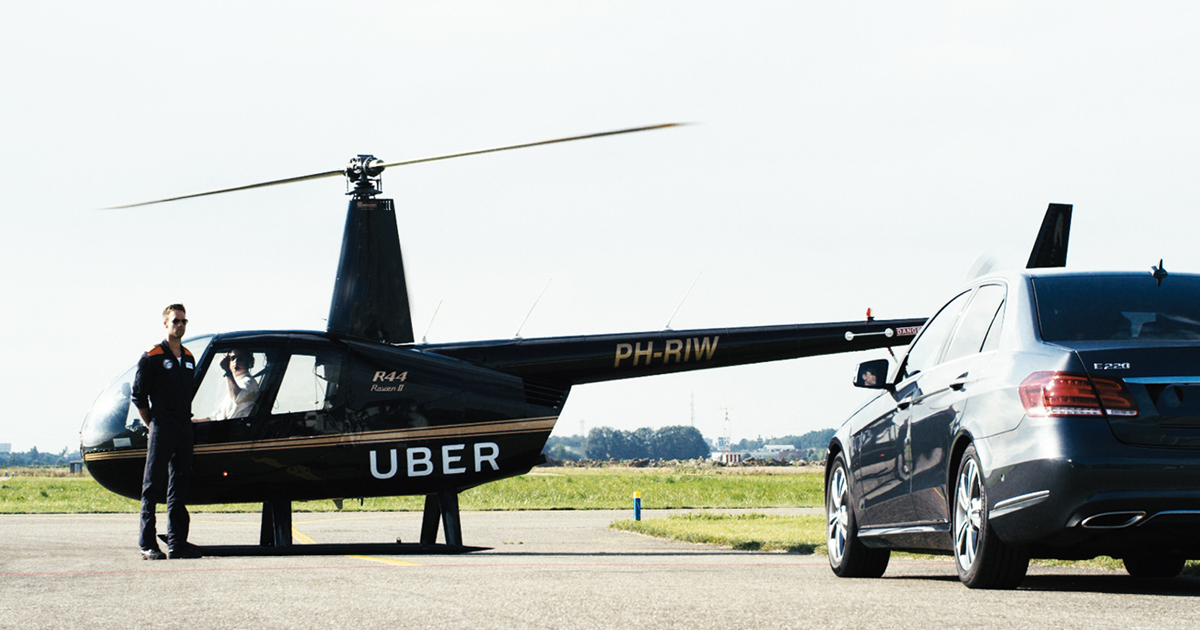
Uber announced that it would be launching UberBOAT in West Africa this week, and markets responded favorably. I expect Uber to unveil Uber Copter in Lagos for helicopter operations. The best routes would be Eko Hotels to local/ international airports at Ikeja, and Festac to Ikeja airports. Uber can charge $300 and people will pay; the Lagos traffic will make that $300 a good deal! Uber is already in the helicopter business; the Lagos one should not be different. Watch out –  Uber Copter will be flying by Q3 2020 in Lagos, Nigeria. Of course local companies like Gokada and Max can offer that service if they raise more money.

Starting July 9th, Uber will offer helicopter rides between JFK airport and Lower Manhattan that can be booked on demand through its app. Uber Copter, The New York Times reports, will offer eight minute flights between the city and its major airport, with prices typically costing between $200 and $225 per person. Flights can be booked up to five days in advance.

Uber Copter’s launch comes almost three years after Uber launched its flying car project called Uber Elevate, which was an ambitious plan to offer flights using a network of lightweight, electric aircraft. Since then the company has continued to offer one-off marketing stunts where it gives people helicopter tours of big events like CES, but nothing that will actually get you from point A to point B.