It must have been a brilliant speech: Andrew Nevin, Chief Economist at PWC, outlines the critical frameworks to accelerate economic development in Nigeria. He gave the talk at a birthday dinner for Pascal Dozie, founder of defunct Diamond Bank. Here are some great lines picked from the diaspora portion (not in this order).
If this applied to Nigeria, it would mean that diaspora remittances would be close to $40 billion and more than 3 times the USD the government receives from oil
Nigerian Americans already earn more than the average American, an incredible accomplishment for such a new immigrant group
Nigeria is not an oil economy and our biggest export is not oil … Our biggest export is Nigerians. What it also means is that the only thing holding up the economy is the Diaspora; if we didn’t have this massive flow of remittances, I am pretty sure the economy would collapse
What is confusing to me is why this is not discussed more … official figures keep repeating that oil is our biggest export when it is not true. We have a flow of almost $40Bn that is not discussed much … very difficult for me to understand how someone can claim to be analyzing the Nigerian economy when they don’t look at the biggest item
Besides diaspora, he provided four other enablers to take Nigeria to the mountaintop: “branding” the nation, deepening informal sector & self-organizing institutions, improving public sector and modernizing the real estate sector. The full talk courtesy of Business Day.
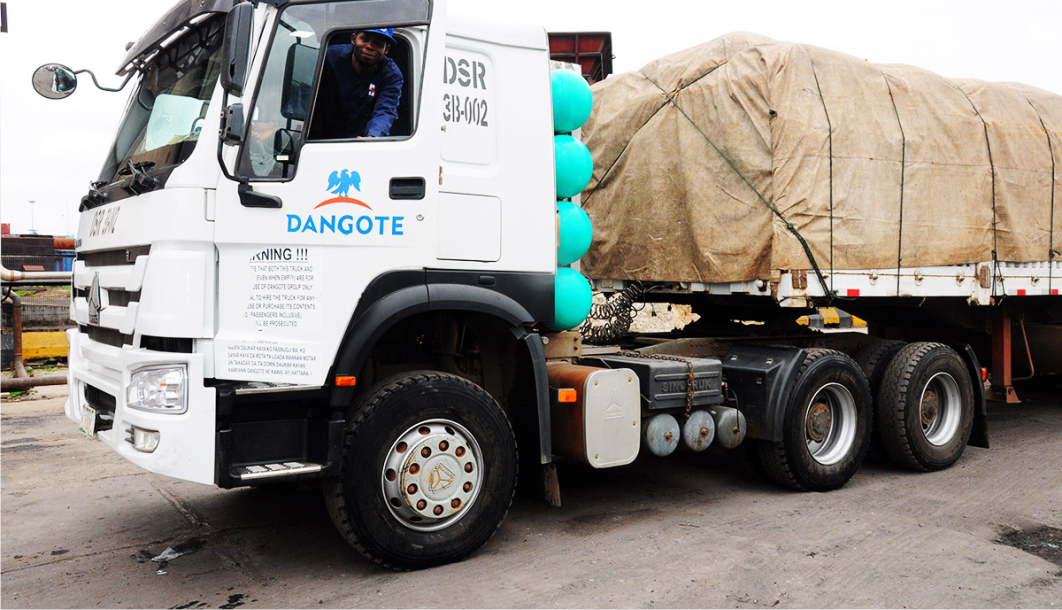
The logistics business is arguably one of the most critical sectors in agribusiness.
Just like many other developing countries, Nigeria’s agricultural value chain is majorly informal, comprising of smallholders in rural areas who produce at a very small quantity, and middlemen who purchase, and aggregate these products which are then sold to the end users.
In addition, due to the extreme different wide varieties of vegetation distribution across the nation – the mangrove and swamp rain forest in the south and west, Guinea and Sahel Savannah in the north, and the Montane vegetation in some parts of middle belt – what can be produced at one part of the country may not grow very well at the other. Consequently, there is a need for different distribution systems to accommodate the variances.
Largely, the transportation and logistics systems play a major role in the value chains as the product will have to pass through different handlers before it can get to the final consumers.
However, the only functional transport system that can effectively cater to the distribution chains of agricultural products in Nigeria is the road transport system. Thus, if we must have an effective supply chain that can cut down the cost of logistics for agricultural products, reduce food loss along the chain, and ensure faster delivery of the products, then our road industry must not only be effective but thoroughly efficient.
Unfortunately, though one of the biggest industries in Nigeria that’s critical for agricultural revolution, our road transport industry is one of the most poorly coordinated.
Hence, an idea, technology or policy that can cause a massive disruption in the Nigerian road transport industry, and offer a more coordinated, efficient and effective system will not only make a profitable business venture but will also cause a major revolution in the food and agricultural sector. It will aid reduction in food loss along the supply chain, time of delivery, logistics and enhance overall availability of safe, sufficient, nutritious and affordable food.
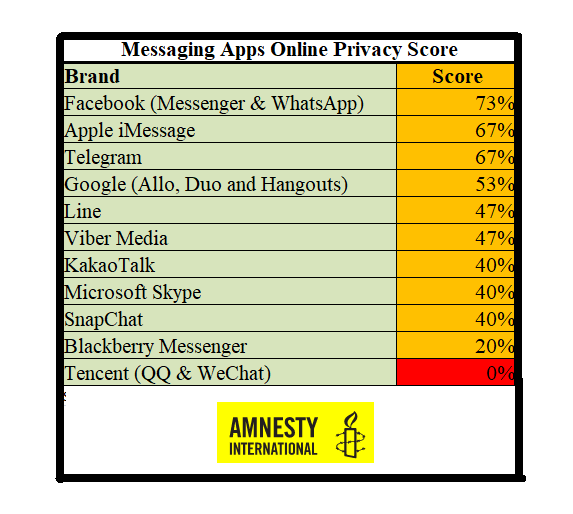
I read a piece that cited this: online privacy of leading messaging apps. It is largely old but since they have not updated the report, I will use it as it remains the current one. Check out the score of WeChat – 0% on privacy and human rights protection! Amnesty International is always fascinating!
We’ve ranked 11 companies that run the world’s most popular messaging apps – including Skype, Snapchat and Facebook Messenger – on how well they’re using encryption to protect your online privacy.
In particular, we’ve looked at whether they apply end-to-end encryption – a way of making your photos, videos and chats unintelligible to anyone but you and the people you’re talking to.
Please note that this is an assessment of each company’s key policies and practices in relation to encryption. We have not assessed other privacy aspects of the apps or their overall security. If you’re a journalist or activist, or if you believe you might be personally targeted for electronic surveillance, you need a comprehensive digital security plan. Please consult a digital security expert and do not rely on any one app to protect your information.
The U.S. government decision to ban Huawei is already having a huge impact on the company: the firm will sell 40 million – 60 million fewer phones outside China this year. Already, leading France telcos have dropped plans to distribute Huawei Honor phone.
Huawei Technologies Co. is preparing for a drop in international smartphone shipments of 40 million to 60 million as the Trump administration’s blacklisting hammers one of the Chinese tech giant’s most important businesses.
Yes, this pain on Huawei will not be one-directional. Many U.S. companies need China to be in business. They could be the ones that will help Huawei out of the paralysis. WSJ has cleverly documented the pains these small firms could feel if the trade war is not managed. The summary is this: two elephants are fighting, they will be fine – small injuries. The problem is that I do not know about the grass (the world economy).
But in a letter to Trump on Thursday, hundreds of US companies large and small, including retail giants Target and Walmart, warned Trump the new tariff round could cost two million jobs and cut US GDP growth by a full percentage point.
So far, Trump has imposed tariffs on more than $250 billion in Chinese goods but this has spared most consumer items from major price increases.
From generation to distribution, Nigeria has not had it good in terms of sustainable electricity for economic growth in the last two decades. Despite various reforms since 1999, Nigerians and businesses are still struggling to power their electrical equipment through the national grid. Power infrastructure and capital paucity were the two challenges pinpointed and ensured privatization of the Power Holdings Company of Nigeria (PHCN) after the liberalization policy of the government.
More than 5 years of the privatization, the identified issues remain unsolved. The public expectation that the estimated billing of the PHCN will not surface after the privatization seems difficult to disentangle by the stakeholders. Since January, 2019, media reports have shown that Nigerians in Imo, Enugu, Abia, Edo, Delta, Lagos, Abuja, Anambra, Kogi, Akwa Ibom, Oyo, Osun, Rivers, Kwara, Bayelsa, Ondo and Ekiti are not happy about the outrageous bills being issued by the electricity distribution companies in their territories. In cities such as Lagos, average estimated bill for residential consumers is N44, 000 monthly while medium and large companies are paying N1, 250,000.
Across the country, the inability to get the prepaid meter has been the significant factor contributing to the monthly estimated bills. Reports indicate that the DISCOs are playing sharp practices. These practices range from overcharging the consumers to delay in delivering the meter to the customers who have paid. A house or company that possesses a prepaid meter will only pay for energy used. This is the main benefit to the consumers, which electricity users have seen as the main threat to the bottom line of the DISCOs and core reason for not making the meter available to the users. It is like using airtime on a prepaid mobile line. Electricity users will control what they use.
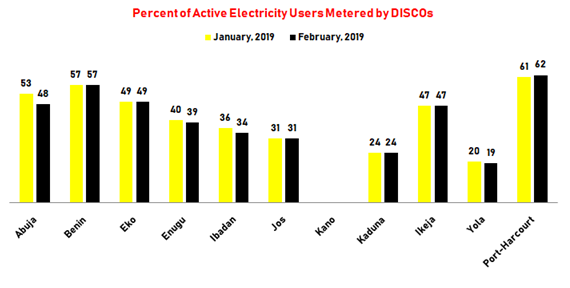
In November 2013, DISCOs vowed to close the metering gap and set a target of supplying 4.92 million meters within three years. More than 5 years of making the commitment, only 3,547,129 out of 7,973,867 registered active electricity customers have been metered. That is a shortfall of 4,426, 738 meters. As the outcry on the estimated billing rages on, the Nigerian Electricity Regulatory Commission has been conducting public consultation in select cities since 29th May, 2019 with a view of getting public inputs towards capping estimated billing.
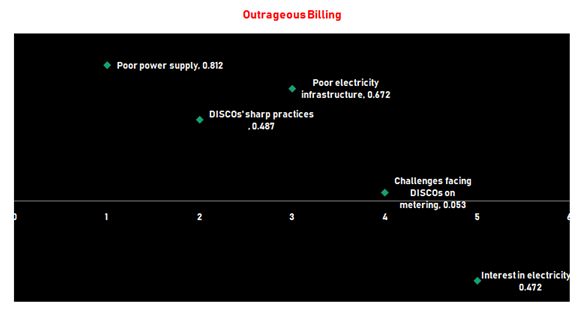
However, capping the estimated billing does not mean that consumers will not continue paying for what they do not use. The capping regime will only have minimal impact on the estimated billing not total elimination of the problem. By capping, consumers without prepaid meters and DISCOs will agree on the specific amount to be paid every month. Instead of capping regime, the NERC and DISCOs need to address poor electricity supply, sharp practices of the DISCOs on the delivery of the electricity meter such as overcharging the consumers and poor electricity infrastructure in most DISCOs’ coverage territories. Analysis shows that the poor power supply since January, 2019 connect with the public interests about sustainable electricity generation and distribution by 54.5%, while the outrageous billing link with the interest about electricity bill defrayment by 61.4%. Analysis suggests that electricity users want to know factors preventing GENCOs and DISCOs from providing electricity and the reasons for paying the outrageous bills despite the poor power supply.
The more the emerging issues, the more public interests about electricity diminishes. This is an indication that electricity users do not have faith in power sector, especially getting power supplies through the national grid. On the metering, the argument from the 11 licensed electricity distribution companies that demand is higher than the supplies from the electricity meter manufacturers seems not to be acceptable to the consumers as analysis shows that the challenge and others being communicated to the public by DISCOs from January, 2019 do not dissipate public outcry over the estimated billings across the country.
The kind of capital investment we need in the power sector is huge, so the major challenge there has to do with capital, everything else is just cosmetic.
The distribution network is largely dilapidated or obsolete, requiring massive upgrade; DISCOS don’t have the capital.
The transmission has its challenges, and it’s inadequate to evacuate the current generating capacity, huge capital is needed there.
The generation end of it has two issues: that of capacity and gas pricing regime that is not competitive, that needs to be addressed too.
No amount of talking and stakeholders meetings can guarantee regular power supply in Nigeria, until we do the needful and then start pouring in the billions of dollars needed there.
Investment in that sector is not for the faint-hearted, we must be very realistic and act responsibly too.