DD
MM
YYYY

PAGES

DD
MM
YYYY

spot_img

PAGES

Home Blog Page 6883

Passion Incubator’s 20.9 million and Tekedia’s 32 million Niche Addressable Market in Nigeria

0

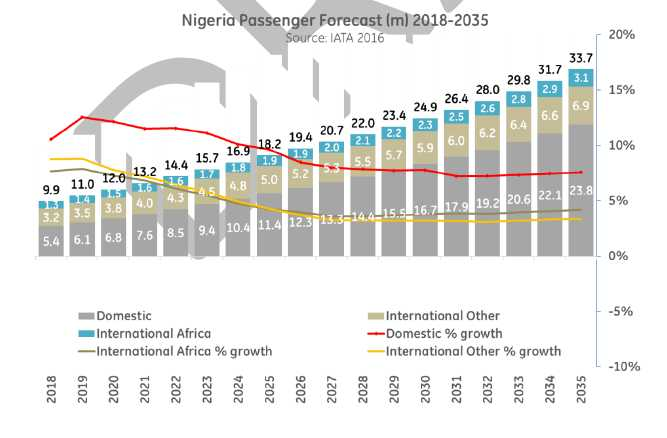
IATA, trade association of airlines, has released the number of projected air passenger travelers in Nigeria till 2035; its 2018 was different from the one provided by Nigeria’s National Bureau of Statistics [it’s fair to choose NBS data here]. It expects 11 million air travelers in Nigeria this year for both domestic and international travels. Looking deeper into the projection, the growth does not really look great. Of course, if you have only 30 million addressable market size, using my model, you do not have much rooms to grow in the aviation sector.
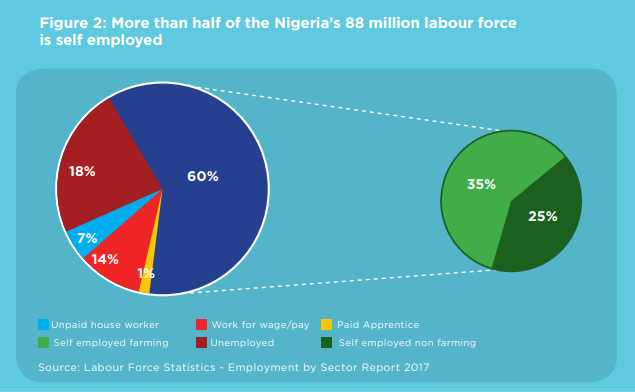
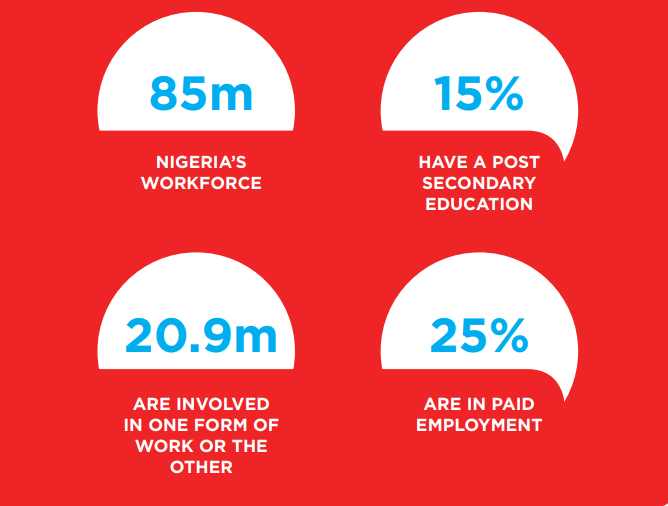
Yes, I have postulated with secondary data that in most sectors only about 30 million Nigerians earn income to pay for anything. You may have 200 million people in the nation but you have to convince just only 30 million to open their wallets. Interestingly, from Passion Incubator report this morning, it concluded that its data shows that only 20.9 million people are in paid employment – i.e. about 25% of the total workforce in Nigeria.

Someone sent me an email for explanation on this apparent discrepancy between my 30 million and what Passion Incubator has. I am yet to read the Passion Incubator report in details but it is very possible we are saying the same thing.

In Nigeria, only 17 million people were paying taxes when I first put my piece [it is now 19 million using latest data]. I believe the informal sector players do earn income even though most do not pay taxes to government – I estimated the non-paying tax number to be 13 million to arrive at 30 million. Also, if you look at the number of bank accounts in Nigeria using the bank verification number (BVN), you will be in the neighborhood of 35 million. While not everyone that has a bank account earns wage, there is a very huge overlap that the 30 million makes sense.

The Nigerian government has disclosed that 19 million citizens are now paying taxes from the 65 million economically active people who “are not tax compliant”.

Kemi Adeosun, Nigeria’s minister of finance at a meeting with a World Bank Mission of 10 Executive Directors led by Patrizio Pagano, said the country’s taxpayers’ base has risen from 14 million in 2016 to 19 million in 2018, an additional five million people.

Yet, my model is not really about the number of people on paid employment, rather the cohort within the addressable market for mostly non essential items. So, food and medicine will always have the full population of 200 million as target market while non-essentials like movie streaming can only attract from the 30 million. With government bringing extra 2 million people into the tax-fold, I can update that 30 million to 32 million people now.

Back to Passion Incubator report, it is possible it estimated the total pool of non-taxpaying citizens but earning income to be about 2 million which when added to this 19 million tax payers (which indeed are on paid employment) gave it 20.9 million. My model was larger as I used secondary data like BVN to arrive that the cohort could be more across the nation.

 

Do Not Neglect The Dumb Business Ideas

0

As the week begins, go around Nigeria and find “dumb ideas” and build businesses around them. A stranger sleeping in your house (Airbnb) is totally dumb. Posting your CV online (LinkedIn) is immodest. Giving a ride to a stranger (Uber) is terrible. But those are gone dumb ideas! Providing affordable wheelchairs in Africa is a dumb idea; but make good ones – glory awaits. Many dumb ideas abound in Nigeria; execute them, and you will be surprised!

Please visit this thread for a deeper insights on this.

In Nigeria, “only 25% of the workforce is engaged in paid employment” – Passion Incubator Report

0

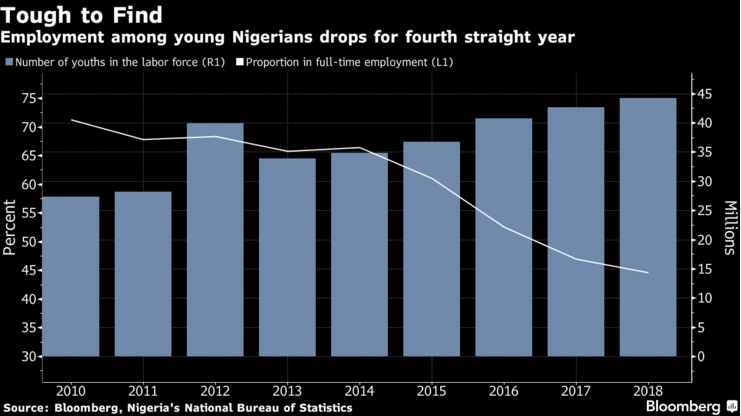
In a new report titled Future of work (PDF), Passion Incubator, an Abuja-based technology accelerator, came to the same severe trajectory as the one I had reported few days ago from Bloomberg and National Bureau of Statistics: in Nigeria, “only 25% of the workforce is engaged in paid employment”. The Bloomberg/NBS focused only on youth – this one focuses on all segments of the workforce.

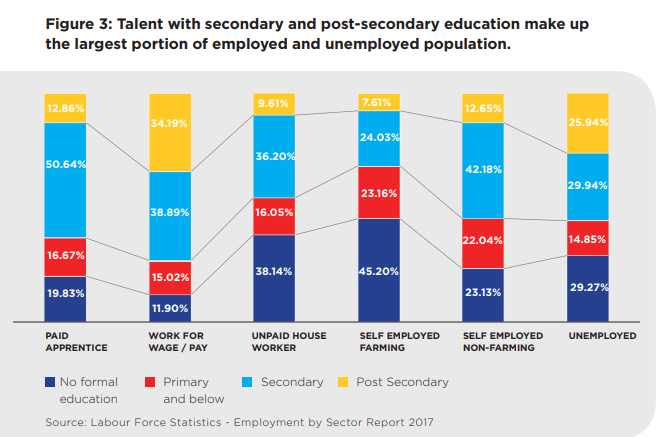
(Read with low voice – if you do not have post-secondary education in Nigeria, you may not make the unemployment database even though you have no job. Yes, people do not really see a guy with only primary school education but without a job as being unemployed. He has not done enough to qualify for job.)

Simply, if Nigeria does not deal with our unemployment paralysis, we may not even have a nation to talk of future work!

With a workforce of 85 million, Nigeria is home to an enormous labour market. However, this resource is characterized by low levels of skill and educational attainment – just 15% of the labour force has a postsecondary education.

About 11.1 million out of the unemployed 20.9 million are involved in one form of work or the other with most of them involved in small and medium scale enterprises in the agriculture and small scale retail businesses. Overall, only 25% of the workforce is engaged in paid employment while half of the workforce has either just primary education or no formal education.


5 Ways China Can Hurt Apple If It Retaliates on Huawei “Entity List” Ban

0

As China-America trade battle rages, we will see new moves like a chess game. The U.S. has largely cut-out Huawei from the supplies of critical components. China will surely respond. I expect Apple to be the main target if that Huawei ban is not reversed or softened: “But China does have a game move available: if you restrict it from component supplies because of the “entity list”, companies like Apple, maker of iPhone, may pay the penalties”. Fortune Newsletter chronicles the possible scenarios through which China can harm Apple as follows:

  1. And yet this month’s sharp deterioration in US-China trade relations should give pause to even the most die-hard Apple bulls. Analysts are waking up to the fact that Apple can’t escape consequences of the next round of US tariffs. Morgan Stanley estimates those duties will increase the cost of an iPhone by $160.
  2. The Huawei ban takes trade hostilities to def-con 4; Fareed Zakaria calls it China’s Sputnik Moment. If fully implemented, the ban would cripple China’s leading tech manufacturer. Chinese officials have decried the measure as a “cynical” act of “bullyism,” and charged Trump with mobilizing the full force of the state to crush a Chinese firm. If Beijing sticks with its current policy of “tit-for-tat” retaliation, Apple would seem an obvious target for reprisal
  3. On Wednesday, analysts at Goldman Sachs, while stressing that “we are not assuming restrictions on iPhone production in mainland China at this point,” nevertheless estimated such a ban or “some other restriction on Apple products” could drag Apple’s earnings down 29%.
  4. Even if Beijing doesn’t go after Apple directly, it can inflict pain in other ways. The Street.com suggests a Chinese ban on rare earths would be a huge headache for Apple.
  5. Beijing could also encourage a nationalist backlash against Apple products among Chinese consumers; there’s some evidence that’s already happening.

As I have said, this is not an asymmetric warfare – yes, both China and America are largely evenly matched even though U.S. has a light upper hand, in this trade war. You may win but you might have been better off not fighting!

Yes, do not count out the possibilities that some Chinese firms which are traded in the New York Stock Exchange will start delisting, joining the nation’s leading chip maker.

China’s biggest maker of semiconductors is to withdraw from the New York Stock Exchange, citing low trading volumes and burdensome costs – a move that ends its 15-year US listing as the trade war with the US spills over into the technology sector.

Semiconductor Manufacturing International Corp (SMIC) said on Friday evening that it had notified the NYSE of its intention to apply on June 3 to delist its American depositary receipts (ADRs) from the bourse.

Amazing Nigerian Shoppers – Practical Feedbacks On TAP Receipted Cash Payments

0

Small shops which are using TAP (Touch and Pay Technologies) technology to collect payments, removing the paralysis of revenue leakage from unscrupulous workers are getting all supports from their fellow citizens. TAP, among others, makes it possible to provide electronically generated receipts on cash transactions. It turns out that Nigerian shoppers are extremely committed to see that shops thrive and do well.

So, all your comments on the videos like “What if your salesperson chooses not to use the device?”, “What if the salesgirl refuses to issue receipts”, etc are well taken care of.  Our recommendation remains: put this note [many variants] on the wall of your store so that customers can see it as they pay:

“Insist on a receipt; otherwise ask for your money back”.

‘If you do not get a receipt, it means this service is free”

“If the associate does not give receipt, demand one”

“Where no receipt is given, this service is unpaid”

As customers see these notes, many do ask for receipts. We see Nigerians demanding for receipts knowing that is how they support the shop owners. We estimate more than 95% compliance especially when the customers can read.

If you do not have TAP solution, it is time to stop revenue leakage and get one. Yes, that your auntie’s restaurant or salon may be leaking revenue, get TAP device as your support to her!