DD
MM
YYYY

PAGES

DD
MM
YYYY

spot_img

PAGES

Home Blog Page 6884

The End of Blackberry Messenger (BBM) is a Case Study of Creative Destruction

0

By Nnamdi Odumody

On Friday, May 31 2019, Blackberry Messenger (BBM), the chat messaging solution from Blackberry (formerly Research In Motion), was shut down, after 13 years of operation. BBM was a category-king in the chat messaging solution after disrupting Yahoo Messenger as customers focus shifted from the web internet to mobile. Its rival in mobile chat messaging was the Nokia Instant Messenger which ran on the defunct Symbian Operating System.

The decline of the Blackberry started two years ago after the release of the Blackberry Storm which is supposed to be Blackberry multimedia phone. Just two years ago, Blackberry and iPhone were the players seen to be fighting for number one, not android and iPhone. In late 2008, RIM released the Blackberry Storm (without wifi). It was this device that was supposed to be the iPhone killer. An Engadget review of the Storm notes that Verizon, Storm’s partner, was Apple’s first choice for the then soon-to-launch iPhone, “Verizon refused and Apple took its multi-billion dollar ball to AT&T. But software glitches and lackluster reviews like that from Engadget killed the Storm, people simple didn’t like the product, and a high return rate likely worried Verizon.

Owning a Blackberry mobile device which was a symbol of prestige in its era of dominance came with a customized PIN for access to communication. With unique features as BBM stickers which set the foundation for emojis on all social media chat platforms, Blackberry failed to pay attention to the ecosystem Apple and Google were creating, by making their mobile operating systems iOS and Android open to developers around the world to build applications.

As iOS and Android grew, other ecosystem evolved. WhatsApp was devastating to Blackberry, and that was compounded by the ban on BBM by governments in Asia and the Middle East due to the inability to access citizens’ data in the platform.

Blackberry would later adopt the Android operating system for its mobile devices and put its BBM as an application on the popular platforms but by then it was too late. The world will remember BBM as a case study of creative destruction at scale.

According to Schumpeter, the “gale of creative destruction” describes the “process of industrial mutation that incessantly revolutionizes the economic structure from within, incessantly destroying the old one, incessantly creating a new one”. In Marxian economic theory the concept refers more broadly to the linked processes of the accumulation and annihilation of wealth under capitalism.

LinkedIn Comment on Feed
“Father, Touch the Heart of President Buhari to Move Faster On Forming New Government”

0

One simple prayer today in churches and I hope people did same on Friday in mosques:

“Father, touch the heart of President Buhari to move faster and prioritize the formation of a new government. As Nigerians, we do sincerely believe that political appointees working on unofficial capacities after the expirations of their terms on May 29 will not serve us well.

Touch him to move faster to avoid a repeat of 2015 where severe 6-month senior leadership vacuums took Nigeria into recession. Open his heart to see that 11 days are more than enough to make at least one appointment. As you used India’s Modi who was ready in 24 hours with a new cabinet, use your son Buhari.

Open his mind to appreciate the urgency of this moment. Teach him, your son, to understand that without Strategic Leadership, tactical and operational leaderships go on stasis. Bless him to appreciate that without these leaders, especially many that do not even require Senate confirmations and untenured, Nigeria’s critical productivity systems will stall.

I pray for him and do seek favor that you will bless his heart to understand that the destinies of millions of people depend on how he acts. With 55% youth unemployment and security paralyses, forming a team requires the fierce urgency of now. Bless him to lead – and move faster on forming a new government, with the right people, that will take Nigeria to the mountaintop.

Amen”.


*Nothing political here or intended. Just pray he does same – fast.

Pelebox Wins 2019 Africa Prize For Engineering Innovation

0

By Nnamdi Odumody

A 31 year old South African electrical engineer, Neo Hutiri, is the winner of the Royal Academy of Engineering’s 2019 Africa Prize For Engineering Innovation first prize of 25,000 pounds for his solution Pelebox, a smart locker system for dispensing drugs to patients suffering from chronic health conditions. Pelebox is used at public healthcare facilities in South Africa and has helped in reducing the number of patients on long queues thereby easing pressure on the healthcare system.

Pelebox is a simple wall of lockers controlled by a digital system. Healthcare workers stock the lockers with prescription refills, log the medicines on the system, and secure each locker. It then sends patients a PIN which is used to open their locker to access medication. Patients access their medicine within 36 seconds which is quicker in contrast to the average 3.5 hours it takes in other healthcare facilities. This is significant considering the fact that South Africa has the world’s biggest antiretroviral therapy programme with more than 4.7 million patients receiving monthly treatment from public healthcare facilities.

As a result of mentoring received from the Africa Prize For Engineering Innovation, Hutiri and his team made a redesign from product development to manufacturing. Also, they have obtained a trademark for Pelebox.

Three runners up received 10,000 pounds each, and they include:

Kaoshi by Chukwunonso Arinze and Princess Oti from Nigeria. They have a peer to peer currency exchange designed for African banks to enable their customers send money out of Africa in a cheap and convenient way.

Smart Havens Africa by Anne Rweyora from Uganda which builds sustainable smart homes from affordable and appropriate technologies designed to make home ownership more accessible to African women.

Sign-IO by Roy Allela from Kenya. The solution is a mobile app with smart gloves that tracks and translates sign language movements into speech and text in real time.

Pelebox is an innovation which will go a long way in fixing a friction associated with the African public healthcare system.

Samsung’s Market Share in China Drops from 20% (in 2013) to 1%

0

Call it huge competition – Samsung’s market share in China drops from 20% (in 2013) to 1%. The South Korean giant has been priced out by local competitors. Consequently, the company is cutting jobs and production at its last remaining plant in China, moving production to Vietnam and India where it sees more opportunities. Yet, the company will continue to build a multi-billion dollars semiconductor plant in China. The reality is that most of the local smartphone makers rely on Samsung chips – a situation I have called the double play strategy.

Samsung, the world’s largest smartphone producer, is cutting jobs at its last phone manufacturing facility in China, reflecting slowing sales and heating competition in the No.1 smartphone market, Caixin learned.

The layoffs at Samsung’s plant in Huizhou, Guangdong province, are being carried out on a voluntary basis. Employees agreeing to leave with compensation will need to sign up by June 14, according to a company document seen by Caixin. It is unclear how many people will be affected by the job cuts.

Samsung faces rising costs and stiffer competition in China. Meanwhile, the global smartphone market is slowing after years of rapid expansion. In 2018, worldwide shipments of smartphones declined 4.1% to 1.4 billion units, according to market information provider IDC. Shipments by Samsung dropped 8% to 292 million units, although the company remained the largest smartphone vendor in the world.

In Africa, Samsung has lost out to Transsion, the makers of Tecno, Infinix and itel, as the #1 mobile device brand in the continent. But do not weep for Samsung, provided these entities continue to order its memory chips and components, the company will be just fine to a certain level.

The WeChat Police of China

0

This is simply unbelievable on how WeChat, China’s superapp, can execute such at scale. This is from Fortune newsletter (apologies for posting at scale here). This implication is simple: WeChat can become SSS, Police and agent of commerce at the same time. Read below, especially the bolded section.

I’ve written a lot about the wonders of WeChat, the multi-functional “super app” operated by China’s Tencent Holdings. I’m not alone in considering WeChat one of the world’s most innovative digital platforms. Launched in 2011 as a messaging service similar to WhatsApp, WeChat has emerged as China’s dominant messaging app and rapidly morphed into an all-in-one platform for social networking, mobile payment, money transfers, ride hailing, food delivery and much, much more.

In February of this year, Tencent announced that WeChat had amassed more than 1 billion monthly active users. As CEO Daily readers who have visited China recently will know, WeChat (or Weixin, ??, as it is known in Chinese) has become an indispensable part of everyday life in modern China. It’s been called China’s “one app to rule them all.”

But WeChat has a creepy dark side—one explained simply and clearly by a recent blog post from BBC Beijing correspondent Stephen McDonnell. Earlier this month, McDonnell travelled to Hong Kong to cover a candlelight vigil marking 30 years since the People’s Liberation Army was ordered to open fire on student protesters in Tiananmen Square. The event drew a record crowd this year, with some estimates ranging as high as 180,000 people. McDonnell took photos of the event with his mobile phone and posted some on his WeChat Moments account.

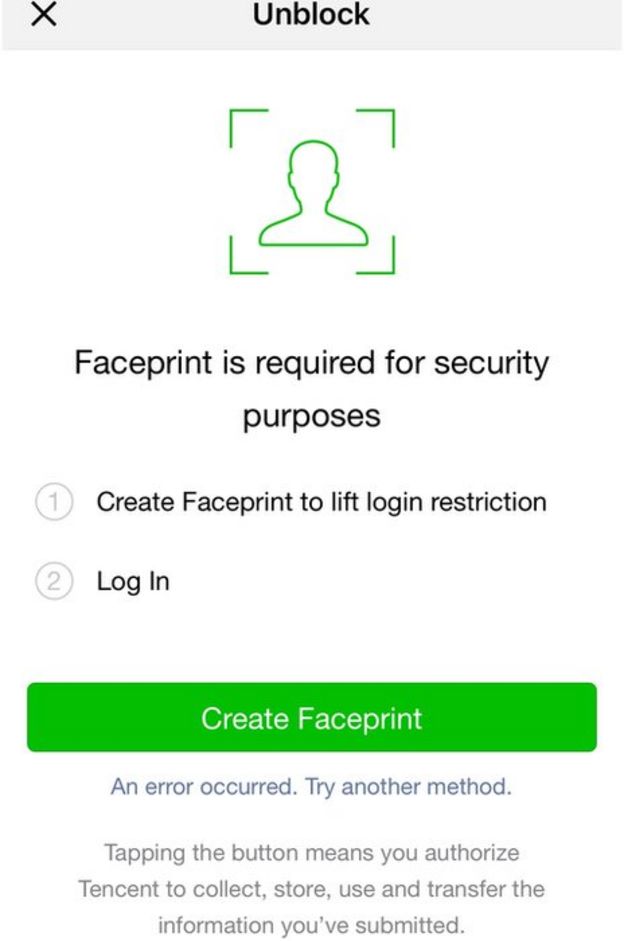
McDonnell waited a day for his WeChat privileges to be restored. When he next tried to log in, he was instructed to tick an “agree and unblock” box confessing that the reason he had been blocked was for “spreading malicious rumors.” He agreed, and was then instructed to hold his phone up, take a photo of his face, and read a series of numbers around in Mandarin. After his face and voice had been successfully captured, he received a big green tick confirming that his request to regain access to WeChat had been approved.

A recent study by the University of Toronto’s Citizen’s Lab found WeChat is not only capable of filtering keywords and but can detect and block images deemed sensitive without users’ knowledge. The prospect that WeChat can not only recognize such images but then force users to add themselves to a database of suspicious users is a terrifying one—and not only for journalists. I know many senior IT executives at large financial institutions in Hong Kong who adamantly refuse to download WeChat even though (or perhaps because) they travel regularly for work on China’s mainland


WeChat notifcation