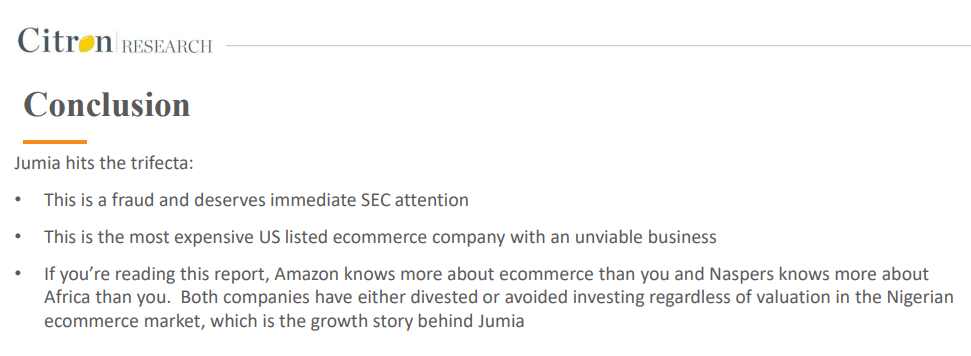
From the comments and emails, many are still confused what the real deal is with regards to the “fraud” accusation against Jumia. As I have noted, Jumia is not a fraud – the short-seller is doing what they do well which is largely legal in America. However, Jumia might have made the BIGGEST typo that could cost it $3.9 billion as recorded on its first day of trading.
Yes, the discrepancy on the 2017 Active Customers and 2017 Active Merchants to (confidential) private investors and what it had on the SEC F-1 form is the smoking gun. For the customers, Jumia allegedly inflated the number by 600,000 people. In the merchant, extra 10,000 merchants were allegedly added. Because these presentations were prepared in Oct 2018 (private investors) and April 2019 (public investment in NYSE) on Dec 31, 2017 numbers, the mistake will be hard to explain out. You did not catch the error in Oct 2018 but you picked it in April 2019?
From the report
Then, if Jumia claims typo, SEC will ask it to copy its email server and handover for investigation. They will dissect the server to see if there were plans to manipulate the numbers. That one can take many people to jail if they find out.
Smoking gun is never good – it typically leads to bad things. If Jumia cannot address the discrepancy, it has lost even before it begins. Simply, they will not believe anything about this company, ever.
The problem now is that Jumia has suddenly become a Nigerian company, not a German company as was postulated on the IPO day. Germany celebrates wins, Nigeria picks the scandals. Very unfortunate!
I have explained the biggest issue in the Germany’s Jumia “fraud” accusation. Despite what they are writing, making Jumia now a Nigerian company, the people who produced that report are Germans, in Germany. Germany cannot win IPO and Nigeria now to pick the scandals: it will not happen. Germany, take your company – the IPO and the “fraud”. (LinkedIn summary)
It is getting to 24 hours since the bombshell accusation that Jumia is a “fraud”. Yet, as I write, Jumia is yet to put out a statement. People, this is America where making money is also entertainment. You cannot have equities in the market and not have your investors’ relations unit ready to go to war.
Jumia has been brutally “attacked”, it needs to return with thorough explanations. If it delays more hours, U.S. Securities & Exchange Commission (SEC) can take severe actions on it. I do hope it is already talking with SEC as the lawyers are gathering: “”We’re focused on investors’ losses, whether the matters raised by Citron are correct, and whether investors may have been misled,” said Hagens Berman partner Reed Kathrein.” Yes, the adverts are out and soon, it will be class action! American trial lawyers cannot see a better target!
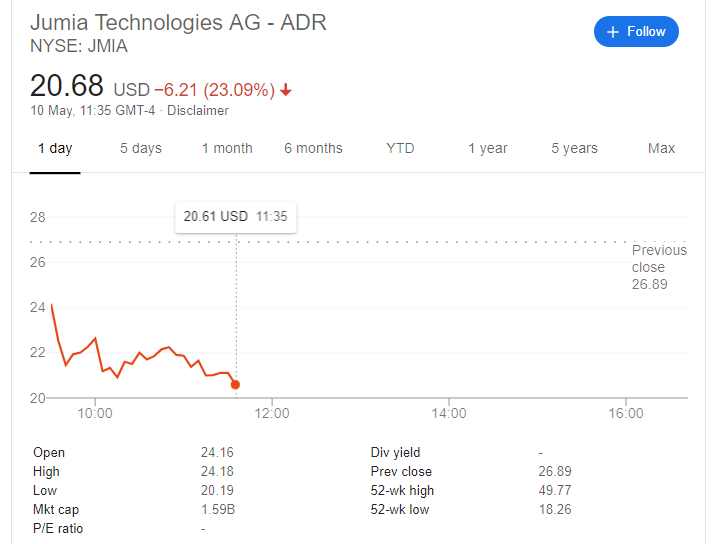
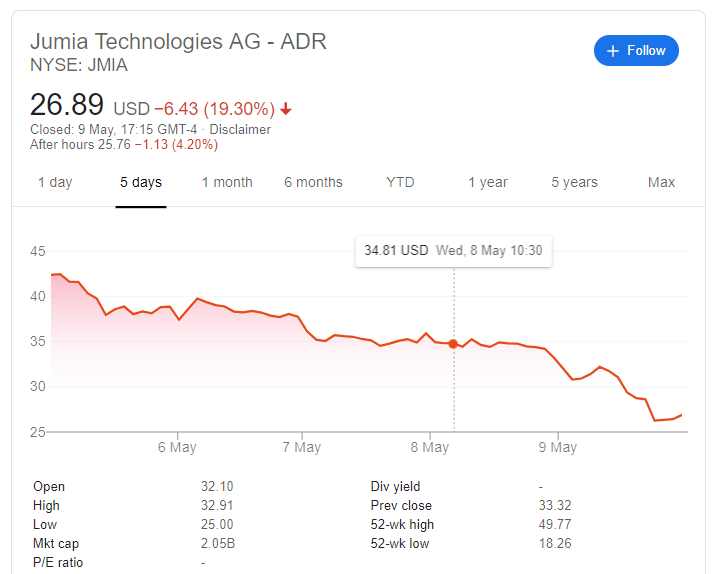
Jumia has lost 25% of its value so far today. Broadly, it has lost more than $2 billion since the IPO closing number: from total market cap of $3.9 billion to $1.59 billion now. Yet, it began from $0 and rose to $3.9 billion. Nothing has happened – we must wait to understand its trajectory after the next two quarterly earnings.
SAN FRANCISCO, May 9, 2019 /PRNewswire/ — Hagens Berman Sobol Shapiro LLP, with nine offices in eight cities around the country and 80 attorneys, alerts investors in Jumia Technologies AG (NYSE: JMIA) to the firm’s investigation into possible disclosure violations.
If you purchased or otherwise acquired Jumia securities before May 9, 2019, suffered losses, and wish to learn more about the investigation or have knowledge of facts that may assist the firm’s investigation contact Hagens Berman:
[…]
On May 9, 2019, Citron Research published a report questioning data contained in Jumia’s April 2019 IPO materials versus data contained in an October 2018 confidential presentation. The report accuses Jumia of (1) overstating certain financial metrics in the prospectus, and (2) omitting adverse information about the number of returned, undelivered, or canceled orders from the prospectus. In response, the price of Jumia ADSs significantly fell on May 9, 2019.
“We’re focused on investors’ losses, whether the matters raised by Citron are correct, and whether investors may have been misled,” said Hagens Berman partner Reed Kathrein.
Whistleblowers: Persons with non-public information regarding Jumia should consider their options to help in the investigation or take advantage of the SEC Whistleblower program. Under the new program, whistleblowers who provide original information may receive rewards totaling up to 30 percent of any successful recovery made by the SEC. For more information, call Reed Kathrein at 510-…] or email […]
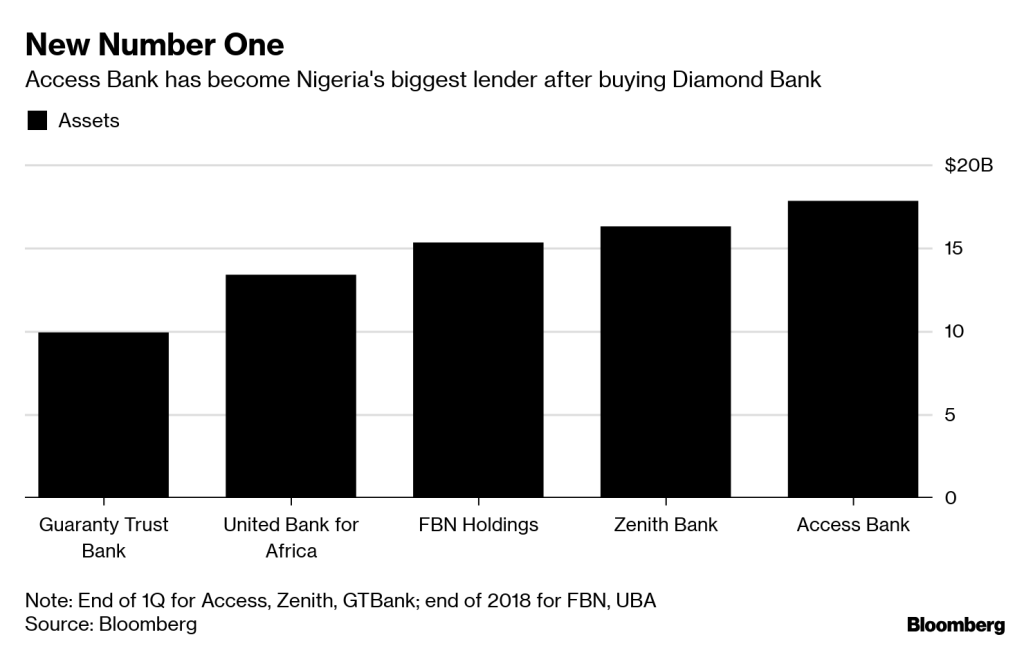
Access Bank Plc is now Nigeria’s biggest lender, post-Diamond Bank acquisition. It has overtaken FBN Holdings Plc and Zenith Bank Plc as its assets accelerated 31% to $18 billion. But if you want profitability, GTBank (Nigeria’s finest bank on efficient utilization of the factors of production with industry-leading cost-to-income ratio that will put Wall Street to envy) wins. Zenith Bank is also huge on making money.
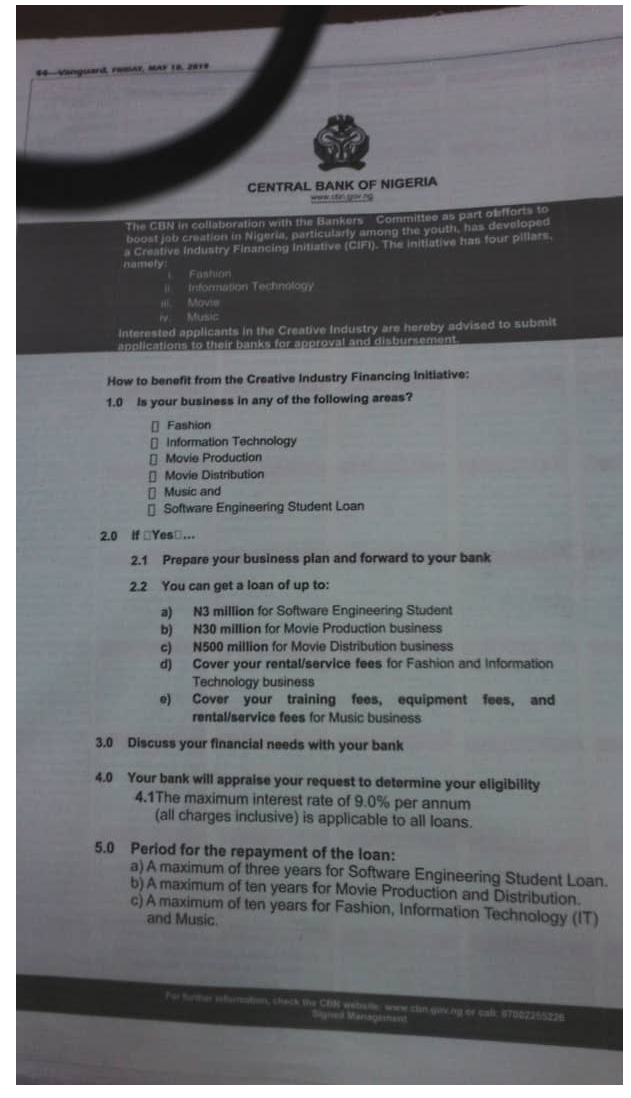
The Central Bank of Nigeria has adverts in some national newspapers on the Creative Industry Financing Initiative. They have movie production, movie production, software, etc sectors for different financing packages for young people. You can get a loan of up to N500 million at 9% annual interest rate (all charges inclusive). It may be something some here may explore. It looks great if the banks will not ask for your grandfather’s chieftaincy cap or grandmother’s ceremonial beads. The adverts below…
a) N3 million for Software Engineering Student
b) N30 million for Movie Production business
c) N500 million for Movie Distribution business
d) Cover your rental/service fees for Fashion and Information Technology business
e) Cover your training fees, equipment fees, and rental/service fees for Music business
The Advert below.
The CBN in collaboration with the Bankers’ Committee as part of efforts to boost job creation in Nigeria, particularly among the youth, has developed a Creative Industry Financing Initiative (CIFI). The initiative has four pillars, namely:
Fashion
Information Technology
iii. Movie
Music
Interested applicants in the Creative Industry are hereby advised to submit applications to their banks for approval and disbursement.
How to benefit from the Creative Industry Financing Initiative:
1.0 Is your business in any of the following areas?
Fashion
Information Technology
Movie Production
Movie Distribution
Music and
Software Engineering Student Loan
2.0 If “Yes”…
2.1 Prepare your business plan or statement on how much you want for your business.
2.2 You can get a loan of up to:
a) N3 million for Software Engineering Student
b) N30 million for Movie Production business
c) N500 million for Movie Distribution business
d) Cover your rental/service fees for Fashion and Information Technology business
e) Cover your training fees, equipment fees, and rental/service fees for Music business
2.3 Go to any bank of your choice to access the fund.
3.0 Tell your bank how much you need.
4.0 Your bank will discuss your request and provide you the money
4.1 The maximum interest rate of 9.0% per annum (all charges inclusive) is applicable to all loans.
5.0 Period for the repayment of the loan:
a) For Software Engineering Student Loan, it is a maximum of three years
b) For Movie Production and Distribution, it is a maximum of ten years
c) For Fashion, Information Technology (IT) and Music, it is a maximum of ten years
They have drawn the first knife on Jumia, calling it a “fraud”. The Americans are wrong – Jumia is not a fraud. However, the business of ecommerce which Jumia is a key player in Africa requires more saints to overcome. Unfortunately, the saints of ecommerce, the believers to make the market boom, are scarce: “Jumia learned the hard way that Nigeria, Jumia’s largest and most important market, is not an easy place to do ecommerce for plenty of reasons including logistics, poverty, …”
From the report
Let me leave it there until Jumia reports two consecutive quarterly earnings – that is where everything will begin. As it stands now, the IPO was just an event. One thing is painful – they have left Germany, calling Jumia now a Nigerian company. You can download the Citron report here.
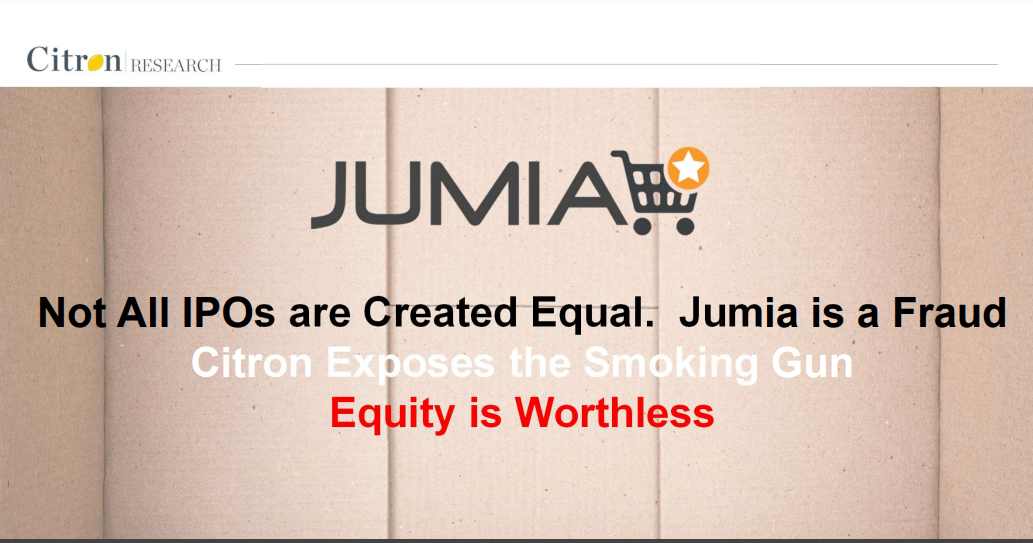
Jumia Technologies AG JMIA, -18.79% shares sank 14.6% in Thursday trading after Citron Research’s Andrew Left, a noted short seller, announced in a report that they have the “smoking gun” that shows why Jumia equity is “worthless.” “In 18 years of publishing, Citron has never seen such an obvious fraud as Jumia,” the report said.
Citron goes on to highlight what it calls “material discrepancies” between the confidential investor presentation from October 2018 and what the company told the Securities Exchange Commission, including: inflating active customer and active merchant numbers by 20% to 30%; and that 41% of orders were returned, not delivered or canceled. “When a company markets to investors ahead of its IPO and then a few months later omits material facts and makes material changes to its key financial metrics to make the business seem viable, this is securities fraud,” the report says.
Citron also references media from Nigeria, Jumia’s biggest market, accusing Jumia of fraudulent activity. Jumia shares began trading on April 12, and soared 160% as of early this week. Shares were priced at $14.50.
Unless the numbers below are typos, Jumia has huge issues to deal with.
From the report
Jumia stock value
*The author is a short seller. He makes money when stock drops value. I do not know if he has shorted Jumia.
I was surprised when I saw the NYSE event of Jumia. A lot of things went through my mind. It’s just like UBER, Lyft and a couple others rushing to the market. None of these companies are reporting profits but are heavily funded having raised a lot of cash. So what has been sold is just on paper, worthless because you cannot earn from dividend payouts on these firms because there’s none to pay out, but the returns on the stock market…this is capitalism…but how does this differ from the sub-prime mortgage where derivatives are sold on the back of loans that are given to people with no means of paying the loans while hyping property values.
Jumia could be the Amazon of Africa, but Amazon was not built on debt and is a profitable business. I think we are importing business ideas into Africa that are not adapted for Africa. The poor credit system and lack of social support system that ensures that cash is in circulation and people purchasing power is loosely dependent on their social standing makes it imperative that we look at businesses differently and contextually. There cannot be another Facebook of Africa, and Jumia isn’t the Amazon of Africa by any stretch of imagination. They really need to re-jig their approach.
Comment #2
What’s best suited for Africa is many small businesses in every part of Africa providing focused and tailored services at close to a person-to-person level. This is why I foresee that organizations that can “break up” to small focus businesses and excellent agents network will hit the bullseye faster than a behemoth like Jumia.
By listing, they just simply created an exit strategy for some investors who needed to cash out. You need to understand the big scheme of things. A company that’s making loads of profit would be hesitant to list (e.g. MTN)…one that’s struggling will do everything to list on the stock market so as to get liquidity and create exit points for the investors that have been bleeding!


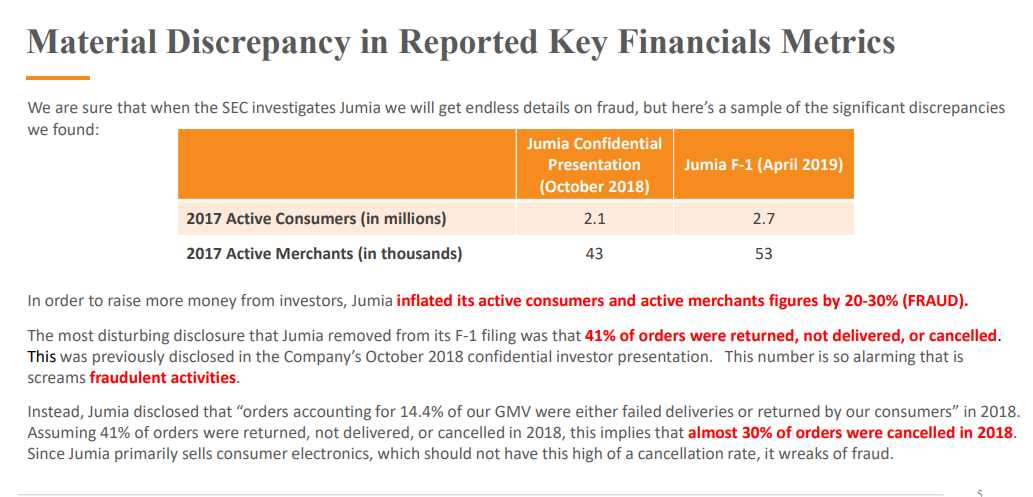 From the report