China Tech has matured in the ecommerce space with the likes of Alibaba and JD.com as capable as anything in America. Amazon is shutting down its 3rd-party marketplace business in China along with the fulfillment centers, after years of massive spending and nothing to show for it. The fact is this: China has since gone post-ecommerce to azcommerce (for anywhere commerce), ahead of whatever new any U.S. firm can provide for competitive advantage. Simply, “Ker Zheng, marketing specialist at Shenzhen-based e-commerce consultancy Azoya, said Amazon had no major competitive advantage in China over its domestic rivals.”
Amazon.com Inc said it will shut its China online store by July 18, as the U.S. e-commerce giant focuses on the lucrative businesses of selling overseas goods and cloud services in the world’s most populous nation.
The move underscores how entrenched, home-grown e-commerce rivals have made it difficult for Amazon’s marketplace to gain traction in China. Consumer research firm iResearch Global said Alibaba Group Holding’s Tmall marketplace and JD.com controlled 82 percent of the Chinese e-commerce market last year.
An Amazon spokeswoman told Reuters on Thursday that it is notifying sellers that it will no longer operate a marketplace, nor provide seller services on Amazon.cn.
Sources familiar with its plans had told Reuters a day before that the company had planned to make such a move.
Nonetheless, consumers will still be able to buy Amazon Web Services cloud services, Amazon devices, and goods from merchants in Amazon’s storefronts in the US and other markets.
Now China is gone, when will Amazon arrive Africa, and improve logistics, with its massive war chest of capital? Expect that before 2022.
LinkedIn Summary
It is called first mover advantage and category-king market positioning. Once a digital company has assumed those, all the money from amazon cannot easily change the trajectory. Yes, Amazon, the ecommerce firm, exits Chinese marketplace because no one will miss it as JD and Alibaba are in command.
I think it goes beyond first movers advantage – there’s more to doing business in China than first movers advantage – It isn’t that straightforward. The political terrain is complex and Chinese people generally prefer to buy Chinese, even while overseas
My Response: Good point but those things work because the local players have Min Viable Alternatives. Buying Chinese works when there are Chinese alternatives. In Baby food today, foreign brands still rule in most Chinese homes because the local alternatives are not overly trusted. The reason govt plans work is because there are local alternatives. Obasanjo did same on laptop with Omatek and Zinox, MDAS followed until quality issues crashed the party. Simply, give China tech credit
Some markets are owned, to come later and stand any chance: there must be serious flaw or friction you are coming in to fix, else your entrance is nothing other than ceremonial. Being that Amazon has a lot of money to play around with, it gives it the margins to test these markets, and after some sizable spending spree, you simply shake your head and exit… As for Amazon coming to Africa, the incentives or motivations may not be strong at the moment, but since it has perfected the art of losing money while remaining competitive; it will come in – and then sell other products or services that could shake things up across Africa.
She is indeed estimable. She raised the Wojcicki sisters—YouTube CEO Susan, pediatrics professor Janet, and 23andMe CEO Anne. Esther Wojcicki, a high school journalism teacher, dropped some hints on how to raise successful people, using a methodology – TRICK methodology – she had used on her girls. Updating the methodology, she left some lines in a Fortune interview. Her words: “The only thing we do now is confiscate kids’ phones, which is ridiculous. They don’t learn anything; they just learn that the phone is forbidden fruit”. She thinks we need to guide kids on “how to use your phone ethically, how to use technology for information” over blanket decision that results to raising a “nation of sheep”.
Wojcicki, or “Woj,” as she’s known to the 700 teenagers enrolled in her popular Media Arts Program at Palo Alto High School, came up with her own philosophy after many years of teaching and parenting. She lays out the secrets to cultivating effective and ethical leaders in a new book, How to Raise Successful People: Simple Lessons for Radical Results. Her tried-and-tested formula? It all boils down to TRICK, a catchy acronym that stands for trust, respect, independence, collaboration, and kindness.
These are the components of TRICK – trust, respect, independence, collaboration, and kindness. The full interview is here.
Wojcicki, or “Woj,” as she’s known to the 700 teenagers enrolled in her popular Media Arts Program at Palo Alto High School, came up with her own philosophy after many years of teaching and parenting. She lays out the secrets to cultivating effective and ethical leaders in a new book, How to Raise Successful People: Simple Lessons for Radical Results. Her tried-and-tested formula? It all boils down to TRICK, a catchy acronym that stands for trust, respect, independence, collaboration, and kindness
“The ultimate goal of TRICK is creating self-responsible people in a self-responsible world,” – to achieve this one could take a lifetime, going by how being responsible has become such a premium.
Some fine insights from her views: raising a nation of rule followers, a real virus that has bedevilled academic institutions and business entities till today.
I am also curious about why there’s no word in the dictionary that directly defines what it means when another person succeeds, without necessarily meeting your own expectation; perhaps because humans are naturally selfish. So we tend to view success only from the perspective of seeing people delivering what we want them to do, not whether they did so well bar your self-interest; something to think and research on…
When we do not allow people under us to try things and possibly make mistakes, creativity dies; and accusing them of not being good enough becomes self-indictment.
It is always painful when good people who once came together now want to go their different ways: divorce leaves wounds in the hearts of men and women. The way they do it in America is exceedingly unfortunate. Yes, little things that could easily be resolved break people apart. With everything institutionalized, the players – man and woman – have only paid agents of commerce to discuss things that have no place in commercial connotation. The counselors are clocking hours as they try to settle disputes and are bounded by many ordinances that creativity in extremely complex issues is stunted.
Think back in your village when men made it back from cities with their wives so that some issues can be resolved. The parents will call some trusted elders and confidants, and right there, they will explore solutions. If that one fails, they will try from the woman’s side, meeting the parents or elders. At the same time, the man who had served as an intermediary in the marriage is working hours to fix the problems. Simply, before people decide to call marriage off, real efforts have been exerted to see if they could stay together.
For all the goodies in the beautiful America, the marriage system demoralizes. They have taken out the bringing of families – just two people signing documents, and nothing but that. That was why a man earlier this year married and divorced within four days. In Nigeria, if that happens, you will shock family members who traveled from across the country as they are sure to still be hanging around after the marriage.
Africa, despite our challenges, does better in this space. Marriage disputes bring communities and families together. If MacKenzie Bezos, soon-to-be ex-wife of Amazon CEO, Jeff Bezos, has been a Nigerian, the marriage of 25 years might still be there despite the paralysis the man brought to their union. Sure, Jeff made mistakes but this woman is largely open to forgive. She allowed the man to take 75% of their Amazon assets and 100% of the other entities. She gets 25% of their Amazon assets which is worth about $39 billion.
The Bezoses announced the dissolution of their marriage in January and finalized the divorce just days ahead of her 49th birthday. MacKenzie is now worth about $36 billion, making her among the richest women on the planet. In her divorce statement, she said she was “happy” to give her ex-husband 75% of her Amazon stock and voting control over what she retains, while he takes complete ownership of the Washington Post newspaper and Blue Origin, his rocket venture.
From her actions, you can see a great woman trying to live out a culture which she was battling over. She took 25% and left many billions on the table. In the most challenging moment in her adult life, I guess, she showed so much admiration and respect to Jeff. Left to MacKenzie, she would have simply said: “Jeff made mistakes, not perfect. Yet, we will stay together to fix the issues”. Many at her level will call her weak for putting on with a man that looked elsewhere. Yet, that was the real MacKenzie. Her praises for Jeff in this issue, and her admiration of the past she had with him, and her written tales, tell me that if not for the peer pressure of pack-out-and-leave, Jeff will not become single in weeks. And MacKenzie will not also.
Weeks before divorce, the Bezos were going out together to events
The Nigerian Woman
Simply, without peer pressure that if a man had fallen to adultery, divorce is the only solution, MacKenzie Bezos and Jeff Bezos will still be planning their futures together. The admiration and respect they showed each other weeks before the divorce in events showed a communal meeting like the African type would have fixed some of these issues. That makes me to conclude that if MacKenzie Bezos had been a Nigerian, bringing her community in the process, they would have handled this better.
If Africa does not have anything else to brag about, at least we beat the West when it comes to families and marriages; we do not just give up indiscriminately on those areas. I just hope that our modern day ‘all knowing activists’ won’t push our people to embrace divorce as the new normal; our system is still much better in that respect.
America is a broken place, when it comes to families and husband and wives issues, and it’s always a big mistake when men and women think everything should be ‘institutionalised’, with government coming into these things. At the end of the day, you only destroy homes and breed desolate people who have no taste of happiness anymore.
Just like the legendary Einstein opined years ago, only two things are infinite: the universe and man’s stupidity, and he went ahead to state that he wasn’t sure of the former, while there is no doubt about the latter…
The Creator made marriage or family the way it should be, but in man’s ‘all knowing’ syndrome, that penchant for stupidity, we managed to turn everything on its head, and now we have disaster staring us everywhere you turn to.
Fix marriages, fix families, and you have a decent and thriving society; anything else is just a joke.
Another comment
I do not agree with this school of thought. Because African marriages tend to last longer does not mean that they are better marriages. When an African woman is encouraged to stay in a disrespectful, abusive, or infidelity ridden marriage, we should not clap for ourselves. Views like this continue to perpetuate the cycle of downplaying the impact of major issues affecting African families, particularly African women who have very little recourse.
Can we honestly say it’s better for a woman to remain in a relationship despite the African man maintaining mistresses and concubines, as is often the case?
Our sons then grow up to believe that it is somehow our right to be forgiven. And our daughters are conditioned to just accept and move on.
Kudos to MacKenzie for not sitting on the sidelines on this one. Yes she’s entitled to 50% of Jeff’s assets, but she is mature enough to know that she doesn’t need it. $30bn can create a whole new life for her.
My response: Mr. …. no one said any should stay. I am not sure there is any criminality here like abusive etc. Here in U,S, people get married and divorced within days. In the blog, I linked a celeb who filed within 4 days of marriage. My grand point is this: it does not have to be that way. A celeb divorced the husband because the man corrected the son in loud voice. You can extend this but I think Africa is better in many ways here, from my angle. Some of these things can be resolved, not just via divorce.
Someone’s response on same lead comment: Abdul, is having broken homes a better option? Certainly not. It’s very easy to frame “abusive relationships”, but the damage caused by encouraging people to part over things that with care and attention – they can be resolved, is still substantial. No matter how you look at it, Africa still have a better system than whatever that is out there, children whose parents are together are more stable mentally and emotionally. We cannot afford to ask people to embrace divorce, just because someone felt cheated, it’s colder outside. People should be more responsible, but nothing guarantees good behaviour all the time; humans will remain humans.
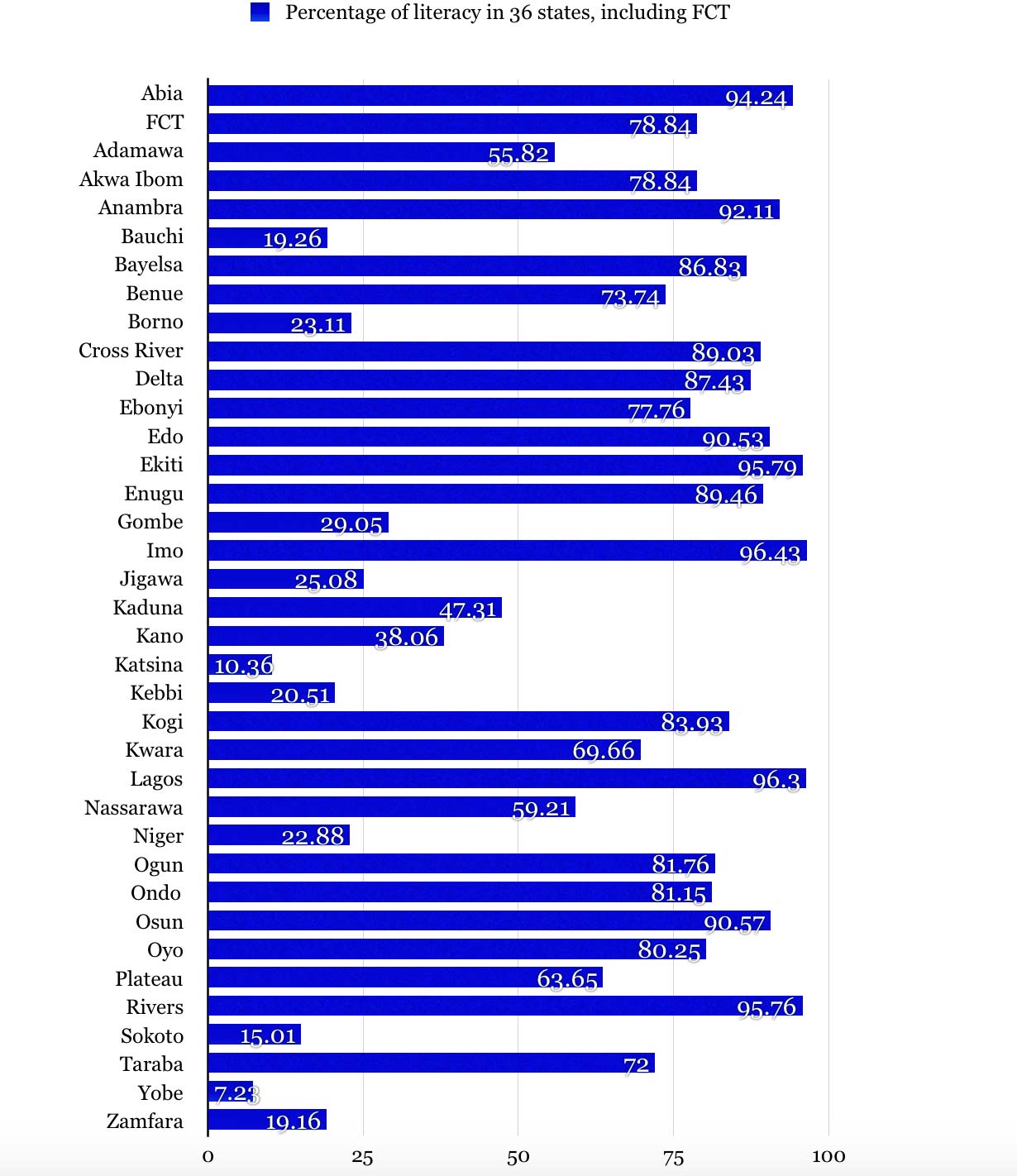
The federal ministry of education dropped something this week: illiteracy level in Nigeria. Watch the number – 60 million illiterates in Nigeria – as you pursue that digital strategy. It is a very significant number which takes away a huge chunk of the 180 million people in population. Largely, when you take out the pre-readers (at most 15 years by literacy classification, 44% of population), you may have only about 40 million literate adults since 60 million adults are already classified illiterates. (About 80 million Nigerians are aged at most 15 years which means you have 100 million remaining from 180 million. If you remove 60 million illiterates, you are left with 40 million adult literates in the population.)
Sonny Echono, Permanent Secretary, Federal Ministry of Education, says nearly 60 million Nigerians are illiterates, assuring that literacy centres will reduce the high percentage of illiteracy in the country.
Mr Echono made this known on Thursday at the Federal Government College Otobi, during the inauguration of a pilot Literacy Centre for the North-central zone.
The permanent secretary expressed regret that the illiteracy rate among the youth and adults is high, saying that the literacy level at the lower cadre of the colleges is also alarming.
As the Permanent Secretary ministry of education noted, the number is increasing. In other words, adult illiteracy in Nigeria is growing. In 2015, adult illiteracy for Nigeria was 41.3 million; today, it is now 60 million. Adult illiteracy of Nigeria increased from 24 million in 1991 to 41.3 million in 2015 growing at an average annual rate of 21.00 %.
I commend the government for doing something about this through this literacy school initiative. Besides, they need to add community-driven initiative that works with mosques/churches and village leaders. In my village where I can say we have close to 99% literacy rate (my state, Abia state, has literacy rate of 94.24%), community women leaders run the show.
Comment #1: As always, Nigeria is a strange place. Ordinarily, you would expect the illiteracy level to depreciate substantially over the past years, because the younger people were all expected to receive basic education; but it turned out that the opposite is the case. Again, to make blanket statements such as “60 million Nigerians are illiterates” is misleading too; when my home State is nearing 100% literacy level, so a clear distinction is needed, to get some people up and running.
No State in the entire northern region reached 80% mark, the few that crossed 70% are predominantly the minority tribes in those areas, so there is a clear relationship here; that’s where major enlightenment and awareness need to be directed. The federal government doesn’t have much to tell people from my State, its focus should be heavily directed, with laser-focused attention on the States that are simply below baseline.
Yobe State has 7.2% literacy level in a country that operates “federal character” regime, and one is still searching for the meaning of injustice? Most state governors in the north should just vote around 70% of their annual budgets to Education alone, the numbers coming from there are just pathetic.
Comment #2: And this figure is coming from the ministry which makes it likely to be a discounted account of the true picture. This fact even makes it more cringing.
Huawei Technologies, the Shenzhen-based Chinese telecommunication equipment maker, saw a 25 .01 percent rise in profits as a result of its continuous investment in research & development which has seen it develop innovative products that have improved the customer experiences in its markets. It posted net income of CNY 59.30 billion in 2018 while its revenue for the year jumped by 19.50 percent to CNY721.20 billion.
According to its 2018 annual report, Huawei invested CNY 101.5 billion (14.1 % of its sales revenue) in R&D ranking fifth in the European Union Industrial R&D Investment Scoreboard. Guo Ping, Huawei’s rotating chairman, said at the release of the report that Huawei’s R&D expenditure over the last 10 years had reached more than CNY480 billion.
According to the World Intellectual Property Organization (WIPO) data on patents filed, Huawei filed 5,405 patent applications in 2018, placing it in first position among all companies globally.
Asia-based innovators filed more than half of all international patent applications via WIPO for the first time in 2018 on significant growth from China, India and the Republic of Korea, capping another record-setting year for WIPO’s global intellectual property (IP) services.
[…]
China-based telecoms giant Huawei Technologies, with a record number of 5,405 published PCT applications, was the top corporate filer in 2018. It was followed by Mitsubishi Electric Corp. of Japan (2,812), Intel Corp. of the U.S. (2,499), Qualcomm Inc. of the U.S. (2,404) and ZTE Corp. of China (2,080). ZTE Corp., which was the top applicant in 2016, saw a 29.8% drop in the number of published PCT filings in 2018, its second straight year of declines. The top 10 applicant list comprises six companies from Asia, two from Europe and two from the U.S.
Huawei won the award for Supplier of the Year 2018, and Best Innovation 2018, at MTN’s Annual Supplier Award ceremony in Dubai, based on performance metrics such as quality, delivery and support, account performance management, innovation and meeting MTN’s compliance and risk requirements.
About 197 Fortune 500 companies use Huawei’s products, and in 2018, they sold 200 million phones getting 14.8 percent of global market share, and placing them in second position to Samsung Electronics. It has 36 joint Innovation centers across the world, 176,000 employees and 79,000 R&D employees.
Asia is now the majority filer of international patent applications via WIPO, which is an important milestone for that economically dynamic region and underscores the historical geographical shift of innovative activity from West to East.
Director General, WIPO, Francis Gurry
African companies should learn from Huawei and invest a significant portion of their annual profits on Research and Development to come up with products that will compete in blue and red oceans in order to consolidate their market dominance.