DD
MM
YYYY

PAGES

DD
MM
YYYY

spot_img

PAGES

Home Blog Page 6957

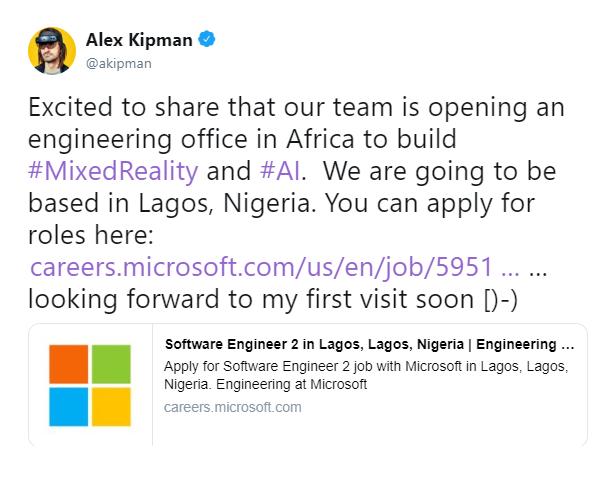
Microsoft Opens Engineering Office for AI and Mixed Reality in Lagos; APPLY for Jobs

2

It was a long time coming: why do they keep sending only salespeople to Africa? Yes, we have accused the multinational technology powerhouses of accelerating consumerism by simply amplifying our passions to spend without helping our capability bases. But that is now history: IBM opened in Nairobi a research unit, Google picked Accra for its AI, and now Microsoft is coming home. Yes, Microsoft is opening a Mixed Reality and AI engineering office in Lagos. That is amazing! (Alex Kipman is a Microsoft Technical Fellow and the co-creator of HoloLens.)

They are hiring – apply here to do AI and MR right in Lagos with Microsoft.

But did you notice something in the job descriptions? There is no academic requirement for the job! Yes, Microsoft does not care about your degree (get the idea, I have many though). It simply cares about what you can do. So, you may be surprised despite your BEng degree guys like Moses and John may win these jobs even though they did not enter a university one day. That is to give you an idea how these companies hire. Good luck.

Finally, I think Nigerian universities must start immediately to deepen their curricula with AI and MR as companies certainly expect these skills from our graduates.

Two Nigerian Brothers On A Quest To Democratize AI for Everyone

Nigeria’s Paylater Raises $5 Million as It Transitions into a Full-Service Digital Bank

0

Nigeria’s Paylater raises $5 million as it begins transition into a full-fledged digital banking institution. And I do think Paylater has to change its name because a bank does not just pay customers.  So, the name of a digital bank cannot be Paylater! PiggyVest did just that, after expanding its vision, renaming from Piggybank.

Nigerian retail lending startup, Paylater is working on a plan to transition to a full service digital bank after securing a $5 million debt facility from Nairobi-based Lendable, technology-enabled funding provider to African consumer and small business lenders.

Paylater is looking to deploy new products while transitioning to a digital bank. Since launching in 2016, the Paylater mobile app was downloaded by over 1 million users and disbursed loans of over 13 billion naira ($36 million). But now, the company is looking to get into the unbanked population of Nigeria and provide banking services for them. The startup will be announcing a name change to fit its new business in the first week in April.

I wrote about Paylater here on its promises in the Nigerian financial sector.  Across many indicators, this market has many latent opportunities: “Nigeria has a total of about 32 million unique BVN numbers, notes Vanguard. This strongly supports our thesis of 30 million people as the addressable core market.” Simply, things can only get better.

That is why Paylater is exciting. Owned by One Finance & Investments Ltd,Paylater is going after that market where the highest pain points are found in the Nigerian banking sector. We can surely live without shopping through the modern digital payments. But we know that it is challenging when there is an urgent need for funds and no friend or family can help. That is what happens across Nigerian families today. Challenges go beyond how to move money fast across digital channels. Simply, we want credits. Paylater focuses on short-term loans, mainly for emergencies.

Yet, winning the market will go beyond smartphones and apps. Paylater team knows that: “As we are pushing on with our web and digital platforms, we also want to reach out to a segment in the economy that is always talked about but not really catered to,” says Chijoke Dozie, who co-founded OneFi with his brother Ngozi. Of the $301 billion that moves in the consumer domain in Nigeria yearly, 98% are still in cash, notes MasterCard. Simply, growth for emerging financial solutions can only come when there is a fusion of bytes and atoms.

The Brilliance Of Nigeria’s Paylater. ng

Facyber Cybersecurity and Digital Forensics Programs

0

Our Cybersecurity education is structured around four key pillars of policy, management, technology and digital forensics. This implies that we cover all the core needs of any organization or state institutions. While some staff like corporate lawyers may require training on policy, some staff like IT managers may need technical skills.

Others like business leaders will find the management module useful. We deliver all these programs through our web portal – www.facyber.com. The program structure is presented below: certificate programs take 12 weeks; diploma programs which require certificate programs as perquisites take 24 weeks (inclusive of the certificate programs) and the nanodegree programs require a live (physical) one week training in Lagos (for Nigerian learners) with the diploma programs as prerequisites.

Africa’s leading cybersecurity training firm, First Atlantic Cybersecurity Institute (Facyber), has opportunities for African entities to join our partner (franchise) network. It offers opportunities for entities to represent and market Facyber products and services in selected countries of interest in Africa.

At Facyber, we deliver solutions which can be integrated into HR training to support corporate cybersecurity awareness initiatives. Besides, our cybersecurity services cover policy, technology and management with relevance in key industrial sectors and markets. The training program has three classes: certificate, diploma and nanodegree.

Program Descriptions

Certificate in Cybersecurity Policy (CCYP): Certificate in Cybersecurity Policy deals with the policy analysis and implementation aspects of cybersecurity. It presents theory and topical issues, at government and enterprise levels, with both technical and managerial components in the fields of information systems security. The program helps learners develop skills on the policy, ethical, and legal issues associated with cybersecurity and information security.

Diploma in Cybersecurity Policy (DCYP) Capstone: This is a practical-oriented program where learners are tasked with developing solutions for a theoretical or real case cybersecurity policy issue with the guidance of a mentor. A project report is required at the end of the program.

 Certificate in Cybersecurity Technology (CCYT): The Certificate in Cybersecurity Technology is designed to provide learners with skills to analyze multi-faceted complex cybersecurity issues, develop capabilities to make strategic decisions to protect organizations from threats and become competent cybersecurity professionals.

Diploma in Cybersecurity Technology (DCYT) Capstone: This is a practical-oriented program where learners are tasked with developing capabilities in the core technical aspect of cybersecurity. Learners will have access to some tools and equipment to work throughout this program. A project report is required at the end of the program.

Certificate in Cybersecurity Management (CCYM): The Certificate in Cybersecurity Management equips and prepares learners with modern skills to become effective managers across the broad nexus of cybersecurity and intrusion preventions in organizations. The central core is developing capacity to prevent anticipated cyber intrusions, using experiences to mitigate future threats, and formulating and implementing enterprise-level cybersecurity roadmaps. The program also explores the roles of regulation, policy developments, legal instruments and civil liberties.

 Diploma in Cybersecurity Management (DCYM) Capstone: This is a practical-oriented program where learners are tasked with developing cybersecurity project management capabilities with the guidance of a mentor. Here, learners develop cybersecurity implementation frameworks. A project report is required at the end of the program.

Certificate in Cybersecurity Intelligence & Digital Forensics (CCDF): The Certificate in Cybersecurity Intelligence & Digital Forensics is structured to provide modern skills to those interested in digital forensics, digital intelligence and uncovering digital evidence. The program equips learners with broad analytical frameworks and prepares them to become competent cyber investigators.

Diploma in Cybersecurity Intelligence & Digital Forensics (DCDF) Capstone: This is a practical-oriented program where learners are tasked with developing capabilities in digital forensics, digital evidence and digital intelligence. Learners will have access to some tools and equipment to work throughout this program. A project report is required at the end of the program.

Nanodegree Programs

The Amazing InterswitchSPAK Switch-a-Future Initiative on STEM Education

0

By Nnamdi Odumody

Over the years, the quality of STEM (Science, technology, engineering, and mathematics) education in Africa has gradually and steadily declined. This is as a result of various challenges such as poverty, inadequate funding, lack of interest from students, unqualified teachers, inadequate learning aids, and incessant strikes just to mention a few.

In promoting various opportunities for sound education of the African student, especially with STEM, InterswitchSPAK Switch-a-Future Initiative is being introduced predominantly for high school students to chart the ideal career paths and drive them towards full optimization of their potentials. The motivation: to help in the fulfillment of their dreams as inventors, entrepreneurs, workers and scholars, to transform Africa to a prosperous continent. Interswitch SPAK switch-a-future initiative is a unique concept developed to identify, promote and ignite the right support and reward for STEM students in Africa.

Over the years, research has revealed that the quality of STEM education; like other core areas in Africa has steadily and gradually declined. This is as a result of various challenges such as poverty; inadequate funding; lack of interest from students; unqualified teachers;inadequate learning aids, incessant strikes/ industrial actions, just to mention a few.

In promoting the various opportunities for sound education/background for the African student especially as it relates to STEM, InterswitchSPAK Switch-a-Future Initiative is being introduced predominantly for high school students to chart the ideal career path and drive them towards full optimization of their potentials / fulfillment of their dreams (either as an inventor or entrepreneur) thereby making Africa a better place to live in!

InterswitchSPAK switch-a-future Initiative is a unique concept developed to identify, promote and ignite the right support and reward for STEM students in Africa.

Interswitch SPAK organized the Interswitch SPAK 1.0 Innovation Challenge competition where secondary school students in nine teams were tasked with developing technology-driven solutions to problems in healthcare, public transportation and education for out of school children. Each of the teams had Interswitch staff who volunteered as mentors. Team Neptune made up of nine SS2 students emerged winners of the competition and received medals, laptops and will partake in a two-week internship programme at Interswitch Group Head Office during their holidays.

The students were tasked to propose a solution that promotes an all-inclusive health insurance scheme that leverages technology. Their solution which integrated the National Health Insurance Scheme makes provision for web doctors and policy holders. It has node for telemedicine. Noting that Nigerians prefer going to pharmacies for treatment, Team Neptune also proposed that neighborhood pharmacies be empowered with the health insurance scheme so that patients who consult the web doctors can purchase prescribed drugs from partner pharmacists in their localities. The criteria used in deciding the winners were ideas and presentation. The jury considered the integration of technology, attempt at defining the possibilities, feasibility of the idea, how impactful and disruptive it was. Team Neptune’s solution utilized blockchain technology which boosted their chances of emerging winners.

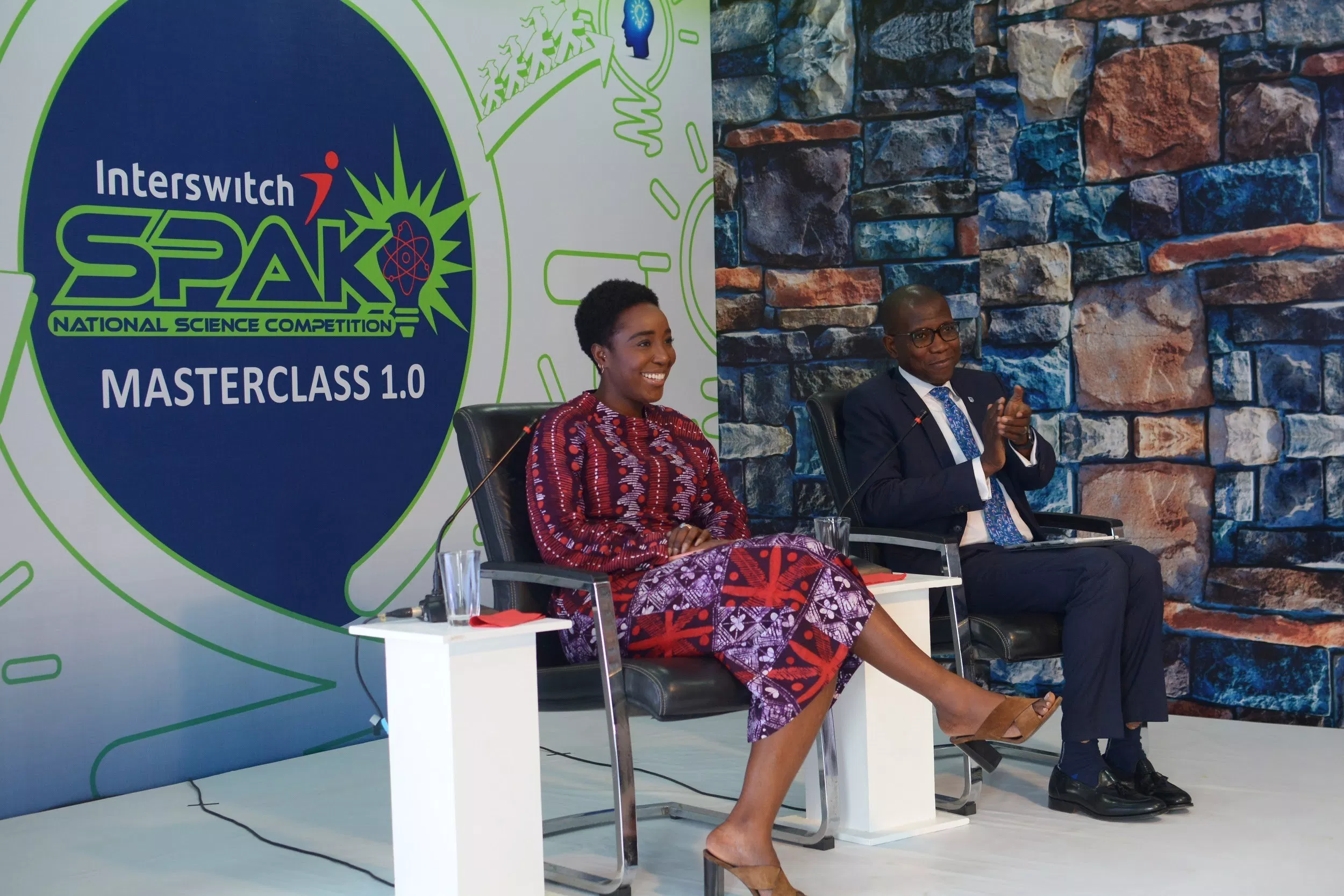
The InterswitchSPAK National Science Competition saw 16-year old Akachukwu Anumudu, a student of Apostolic Faith Secondary School, Lagos, emerge winner, beating eight other contestants, in a quiz session to win the star prize of N7.5 million worth of tertiary education scholarship spread over five years, a laptop and monthly stipend during  the course of the scholarship. Henry Umunna, a 16 year old student of Loyola Jesuit College, Abuja was first runner up, getting a scholarship of N4 million spread over three years while 16 year old Onyedikachi Kanu from Dority International School, Aba got a one year scholarship worth N1 million.

Nigerian organizations should take cue from Interswitch, and invest in STEM education, for  the future of the young generation, to take Nigeria to the league of industrialized nations in The Fourth Industrial Revolution. The talent pipeline is there – the nation must ensure they flourish.

Creating Jobs for Nigerian Youth in the Fourth Industrial Revolution