Excusers: they quit before they begin, unborn tomorrow but dead yesterday, crumbling empires by accepting no responsibility; avoid them.



Excusers: they quit before they begin, unborn tomorrow but dead yesterday, crumbling empires by accepting no responsibility; avoid them.
Our Cybersecurity education is structured around four key pillars of policy, management, technology and digital forensics. This implies that we cover all the core needs of any organization or state institutions. While some staff like corporate lawyers may require training on policy, some staff like IT managers may need technical skills.
Others like business leaders will find the management module useful. We deliver all these programs through our web portal – www.facyber.com. The program structure is presented below: certificate programs take 12 weeks; diploma programs which require certificate programs as perquisites take 24 weeks (inclusive of the certificate programs) and the nanodegree programs require a live (physical) one week training in Lagos (for Nigerian learners) with the diploma programs as prerequisites.
Africa’s leading cybersecurity training firm, First Atlantic Cybersecurity Institute (Facyber), has opportunities for African entities to join our partner (franchise) network. It offers opportunities for entities to represent and market Facyber products and services in selected countries of interest in Africa.
At Facyber, we deliver solutions which can be integrated into HR training to support corporate cybersecurity awareness initiatives. Besides, our cybersecurity services cover policy, technology and management with relevance in key industrial sectors and markets. The training program has three classes: certificate, diploma and nanodegree.
Certificate in Cybersecurity Policy (CCYP): Certificate in Cybersecurity Policy deals with the policy analysis and implementation aspects of cybersecurity. It presents theory and topical issues, at government and enterprise levels, with both technical and managerial components in the fields of information systems security. The program helps learners develop skills on the policy, ethical, and legal issues associated with cybersecurity and information security.
Diploma in Cybersecurity Policy (DCYP) Capstone: This is a practical-oriented program where learners are tasked with developing solutions for a theoretical or real case cybersecurity policy issue with the guidance of a mentor. A project report is required at the end of the program.
Certificate in Cybersecurity Technology (CCYT): The Certificate in Cybersecurity Technology is designed to provide learners with skills to analyze multi-faceted complex cybersecurity issues, develop capabilities to make strategic decisions to protect organizations from threats and become competent cybersecurity professionals.
Diploma in Cybersecurity Technology (DCYT) Capstone: This is a practical-oriented program where learners are tasked with developing capabilities in the core technical aspect of cybersecurity. Learners will have access to some tools and equipment to work throughout this program. A project report is required at the end of the program.
Certificate in Cybersecurity Management (CCYM): The Certificate in Cybersecurity Management equips and prepares learners with modern skills to become effective managers across the broad nexus of cybersecurity and intrusion preventions in organizations. The central core is developing capacity to prevent anticipated cyber intrusions, using experiences to mitigate future threats, and formulating and implementing enterprise-level cybersecurity roadmaps. The program also explores the roles of regulation, policy developments, legal instruments and civil liberties.
Diploma in Cybersecurity Management (DCYM) Capstone: This is a practical-oriented program where learners are tasked with developing cybersecurity project management capabilities with the guidance of a mentor. Here, learners develop cybersecurity implementation frameworks. A project report is required at the end of the program.
Certificate in Cybersecurity Intelligence & Digital Forensics (CCDF): The Certificate in Cybersecurity Intelligence & Digital Forensics is structured to provide modern skills to those interested in digital forensics, digital intelligence and uncovering digital evidence. The program equips learners with broad analytical frameworks and prepares them to become competent cyber investigators.
Diploma in Cybersecurity Intelligence & Digital Forensics (DCDF) Capstone: This is a practical-oriented program where learners are tasked with developing capabilities in digital forensics, digital evidence and digital intelligence. Learners will have access to some tools and equipment to work throughout this program. A project report is required at the end of the program.

By Nnamdi Odumody
Over the years, the quality of STEM (Science, technology, engineering, and mathematics) education in Africa has gradually and steadily declined. This is as a result of various challenges such as poverty, inadequate funding, lack of interest from students, unqualified teachers, inadequate learning aids, and incessant strikes just to mention a few.
In promoting various opportunities for sound education of the African student, especially with STEM, InterswitchSPAK Switch-a-Future Initiative is being introduced predominantly for high school students to chart the ideal career paths and drive them towards full optimization of their potentials. The motivation: to help in the fulfillment of their dreams as inventors, entrepreneurs, workers and scholars, to transform Africa to a prosperous continent. Interswitch SPAK switch-a-future initiative is a unique concept developed to identify, promote and ignite the right support and reward for STEM students in Africa.
Over the years, research has revealed that the quality of STEM education; like other core areas in Africa has steadily and gradually declined. This is as a result of various challenges such as poverty; inadequate funding; lack of interest from students; unqualified teachers;inadequate learning aids, incessant strikes/ industrial actions, just to mention a few.
In promoting the various opportunities for sound education/background for the African student especially as it relates to STEM, InterswitchSPAK Switch-a-Future Initiative is being introduced predominantly for high school students to chart the ideal career path and drive them towards full optimization of their potentials / fulfillment of their dreams (either as an inventor or entrepreneur) thereby making Africa a better place to live in!
InterswitchSPAK switch-a-future Initiative is a unique concept developed to identify, promote and ignite the right support and reward for STEM students in Africa.
Interswitch SPAK organized the Interswitch SPAK 1.0 Innovation Challenge competition where secondary school students in nine teams were tasked with developing technology-driven solutions to problems in healthcare, public transportation and education for out of school children. Each of the teams had Interswitch staff who volunteered as mentors. Team Neptune made up of nine SS2 students emerged winners of the competition and received medals, laptops and will partake in a two-week internship programme at Interswitch Group Head Office during their holidays.
The students were tasked to propose a solution that promotes an all-inclusive health insurance scheme that leverages technology. Their solution which integrated the National Health Insurance Scheme makes provision for web doctors and policy holders. It has node for telemedicine. Noting that Nigerians prefer going to pharmacies for treatment, Team Neptune also proposed that neighborhood pharmacies be empowered with the health insurance scheme so that patients who consult the web doctors can purchase prescribed drugs from partner pharmacists in their localities. The criteria used in deciding the winners were ideas and presentation. The jury considered the integration of technology, attempt at defining the possibilities, feasibility of the idea, how impactful and disruptive it was. Team Neptune’s solution utilized blockchain technology which boosted their chances of emerging winners.
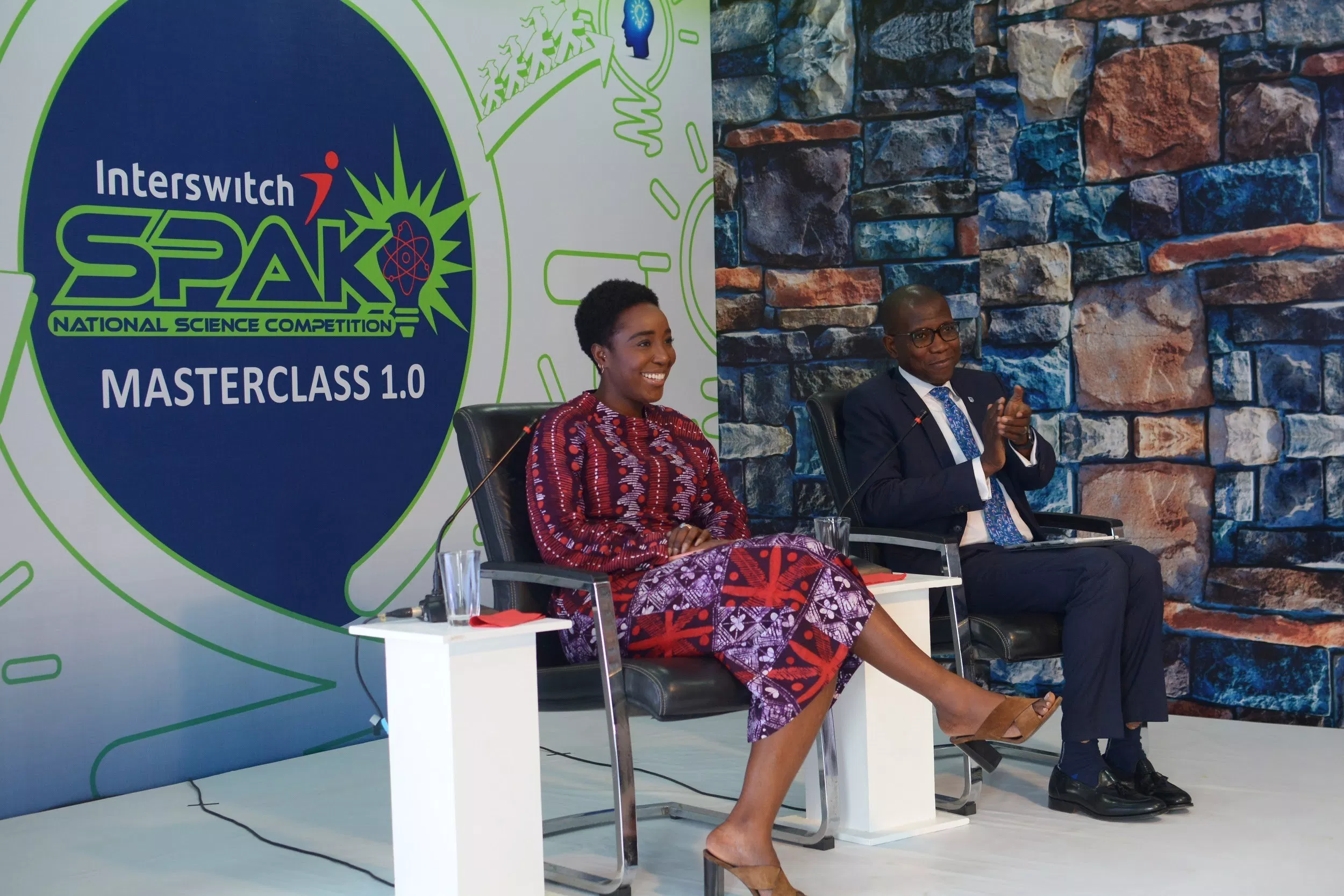
The InterswitchSPAK National Science Competition saw 16-year old Akachukwu Anumudu, a student of Apostolic Faith Secondary School, Lagos, emerge winner, beating eight other contestants, in a quiz session to win the star prize of N7.5 million worth of tertiary education scholarship spread over five years, a laptop and monthly stipend during the course of the scholarship. Henry Umunna, a 16 year old student of Loyola Jesuit College, Abuja was first runner up, getting a scholarship of N4 million spread over three years while 16 year old Onyedikachi Kanu from Dority International School, Aba got a one year scholarship worth N1 million.
Nigerian organizations should take cue from Interswitch, and invest in STEM education, for the future of the young generation, to take Nigeria to the league of industrialized nations in The Fourth Industrial Revolution. The talent pipeline is there – the nation must ensure they flourish.
Creating Jobs for Nigerian Youth in the Fourth Industrial Revolution

The greatest teachers have liberated the minds of many; find them for your business, education and career.
Education is one of the most important institutions ever created by man. It determines the wealth and prosperity of any society. Even in the medieval time, there was apprenticeship and that was a form of education. But the modern style of education goes beyond followership to helping students become creators of knowledge. In other words, it transforms students from becoming ‘recipients’ of education to ‘users’ of education as they partake in the process.
Nothing changes a society or a nation more than education. I always say that education is simply the liberation of the mind. It opens the mind to new possibilities and frees it from dogmas and destructive norms. It will remain a popular institution because it is the only institution that holds the key to the future.

An Ethiopian Airlines Boeing 737 on a routine flight to Nairobi, Kenya has crashed, with 149 passengers and eight crew members on board. CNN and Aljazeera report “No Survivors” at the moment. This is the same Boeing model as the Indonesian Lion Air jet that crashed and killed 189 people.
It was not clear whether there were any survivors in the crash that occurred Sunday morning.
A message of condolence by the office of Prime Minister Abiy Ahmed suggested that there were some deaths.
“The Office of the PM, on behalf of the Government and people of Ethiopia, would like to express its deepest condolences to the families of those that have lost their loved ones on Ethiopian Airlines Boeing 737 on regular scheduled flight to Nairobi, Kenya this morning”, the message on government’s Twitter handle read.
An Ethiopian Airlines spokesman said the crash occurred at 8:44 a.m. local time