DD
MM
YYYY

PAGES

DD
MM
YYYY

spot_img

PAGES

Home Blog Page 7021

Full Letter of Apple CEO Tim Cook, Warning Investors on iPhone, iPad Slowing Sales

0

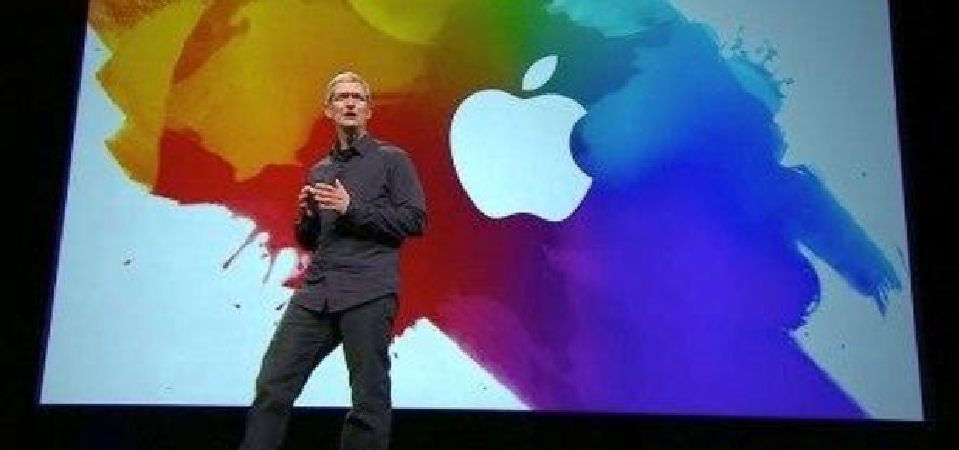
Apple CEO Tim Cook released a statement, warning investors Wednesday that the company is lowering expectations for its first quarter 2019 performance: “While we anticipated some challenges in key emerging markets, we did not foresee the magnitude of the economic deceleration, particularly in Greater China. In fact, most of our revenue shortfall to our guidance, and over 100 percent of our year-over-year worldwide revenue decline, occurred in Greater China across iPhone, Mac and iPad.”

The full letter.

Today we are revising our guidance for Apple’s fiscal 2019 first quarter, which ended on December 29. We now expect the following:

Revenue of approximately $84 billion
Gross margin of approximately 38 percent
Operating expenses of approximately $8.7 billion
Other income/(expense) of approximately $550 million
Tax rate of approximately 16.5 percent before discrete items
We expect the number of shares used in computing diluted EPS to be approximately 4.77 billion.
Based on these estimates, our revenue will be lower than our original guidance for the quarter, with other items remaining broadly in line with our guidance.

While it will be a number of weeks before we complete and report our final results, we wanted to get some preliminary information to you now. Our final results may differ somewhat from these preliminary estimates.
When we discussed our Q1 guidance with you about 60 days ago, we knew the first quarter would be impacted by both macroeconomic and Apple-specific factors. Based on our best estimates of how these would play out, we predicted that we would report slight revenue growth year-over-year for the quarter. As you may recall, we discussed four factors:

First, we knew the different timing of our iPhone launches would affect our year-over-year compares. Our top models, iPhone XS and iPhone XS Max, shipped in Q4’18 — placing the channel fill and early sales in that quarter, whereas last year iPhone X shipped in Q1’18, placing the channel fill and early sales in the December quarter. We knew this would create a difficult compare for Q1’19, and this played out broadly in line with our expectations.

Second, we knew the strong US dollar would create foreign exchange headwinds and forecasted this would reduce our revenue growth by about 200 basis points as compared to the previous year. This also played out broadly in line with our expectations.

Third, we knew we had an unprecedented number of new products to ramp during the quarter and predicted that supply constraints would gate our sales of certain products during Q1. Again, this also played out broadly in line with our expectations. Sales of Apple Watch Series 4 and iPad Pro were constrained much or all of the quarter. AirPods and MacBook Air were also constrained.

Fourth, we expected economic weakness in some emerging markets. This turned out to have a significantly greater impact than we had projected.

In addition, these and other factors resulted in fewer iPhone upgrades than we had anticipated.
These last two points have led us to reduce our revenue guidance. I’d like to go a bit deeper on both.

Emerging Market Challenges

While we anticipated some challenges in key emerging markets, we did not foresee the magnitude of the economic deceleration, particularly in Greater China. In fact, most of our revenue shortfall to our guidance, and over 100 percent of our year-over-year worldwide revenue decline, occurred in Greater China across iPhone, Mac and iPad.

China’s economy began to slow in the second half of 2018. The government-reported GDP growth during the September quarter was the second lowest in the last 25 years. We believe the economic environment in China has been further impacted by rising trade tensions with the United States. As the climate of mounting uncertainty weighed on financial markets, the effects appeared to reach consumers as well, with traffic to our retail stores and our channel partners in China declining as the quarter progressed. And market data has shown that the contraction in Greater China’s smartphone market has been particularly sharp.

Despite these challenges, we believe that our business in China has a bright future. The iOS developer community in China is among the most innovative, creative and vibrant in the world. Our products enjoy a strong following among customers, with a very high level of engagement and satisfaction. Our results in China include a new record for Services revenue, and our installed base of devices grew over the last year. We are proud to participate in the Chinese marketplace.

iPhone

Lower than anticipated iPhone revenue, primarily in Greater China, accounts for all of our revenue shortfall to our guidance and for much more than our entire year-over-year revenue decline. In fact, categories outside of iPhone (Services, Mac, iPad, Wearables/Home/Accessories) combined to grow almost 19 percent year-over-year.

While Greater China and other emerging markets accounted for the vast majority of the year-over-year iPhone revenue decline, in some developed markets, iPhone upgrades also were not as strong as we thought they would be. While macroeconomic challenges in some markets were a key contributor to this trend, we believe there are other factors broadly impacting our iPhone performance, including consumers adapting to a world with fewer carrier subsidies, US dollar strength-related price increases, and some customers taking advantage of significantly reduced pricing for iPhone battery replacements.

Many Positive Results in the December Quarter

While it’s disappointing to revise our guidance, our performance in many areas showed remarkable strength in spite of these challenges.

Our installed base of active devices hit a new all-time high—growing by more than 100 million units in 12 months. There are more Apple devices being used than ever before, and it’s a testament to the ongoing loyalty, satisfaction and engagement of our customers.

Also, as I mentioned earlier, revenue outside of our iPhone business grew by almost 19 percent year-over-year, including all-time record revenue from Services, Wearables and Mac. Our non-iPhone businesses have less exposure to emerging markets, and the vast majority of Services revenue is related to the size of the installed base, not current period sales.

Services generated over $10.8 billion in revenue during the quarter, growing to a new quarterly record in every geographic segment, and we are on track to achieve our goal of doubling the size of this business from 2016 to 2020.

Wearables grew by almost 50 percent year-over-year, as Apple Watch and AirPods were wildly popular among holiday shoppers; launches of MacBook Air and Mac mini powered the Mac to year-over-year revenue growth and the launch of the new iPad Pro drove iPad to year-over-year double-digit revenue growth.
We also expect to set all-time revenue records in several developed countries, including the United States, Canada, Germany, Italy, Spain, the Netherlands and Korea. And, while we saw challenges in some emerging markets, others set records, including Mexico, Poland, Malaysia and Vietnam.

Finally, we also expect to report a new all-time record for Apple’s earnings per share.

Looking Ahead

Our profitability and cash flow generation are strong, and we expect to exit the quarter with approximately $130 billion in net cash. As we have stated before, we plan to become net-cash neutral over time.

As we exit a challenging quarter, we are as confident as ever in the fundamental strength of our business. We manage Apple for the long term, and Apple has always used periods of adversity to re-examine our approach, to take advantage of our culture of flexibility, adaptability and creativity, and to emerge better as a result.
Most importantly, we are confident and excited about our pipeline of future products and services. Apple innovates like no other company on earth, and we are not taking our foot off the gas.

We can’t change macroeconomic conditions, but we are undertaking and accelerating other initiatives to improve our results. One such initiative is making it simple to trade in a phone in our stores, finance the purchase over time, and get help transferring data from the current to the new phone. This is not only great for the environment, it is great for the customer, as their existing phone acts as a subsidy for their new phone, and it is great for developers, as it can help grow our installed base.

This is one of a number of steps we are taking to respond. We can make these adjustments because Apple’s strength is in our resilience, the talent and creativity of our team, and the deeply held passion for the work we do every day.

Expectations are high for Apple because they should be. We are committed to exceeding those expectations every day.

That has always been the Apple way, and it always will be.

Tim

All Set for Major United Nations Speech in Cape Town Next Week

2

All set, the United Nations has sent all the final logistics for the Distinguished Speaker and the high profile speaker of the 3rd PAGE Ministerial Conference in South Africa. The Conference will take place in Cape Town, South Africa, on 10-11 January 2019. On LinkedIn, a user explains this event.

Well done Prof Ndubuisi Ekekwe… The President of the Linkedin Nation and the Knowledge Commandant of Global Policies. Your pen will never run dry sir. Prof had shared with us the news of his invitation about 2 months ago. 

For anyone thinking of what this conference is about, this is a journey to UN’s Sustainable Development Goals. This particular conference is the 3rd of its kind…The Third Ministerial Conference of the Partnership for Action on Green Economy (PAGE). And the theme? “Advancing Inclusive and Sustainable Economies”.

When your president is of this cadre, you are rest assured that he will deliver. Kudos sir.

When I visited Nairobi to speak in African Union Congress few years ago, the Nigerian Ambassador in Kenya surprised me by sending a driver to pick me at the airport. But AU vehicle was waiting. I politely went to the AU driver, and explained that I would ride that car with Nigerian flag, but he would have opportunity to drop me back. The next day, the ambassador came with senior officers in the embassy to greet. I shared that experience in the Guardian, thanking his Excellency for the hospitality.

I am hoping that we would improve the state of the world from what would happen next week!


$295 Billion Reasons Why Investors Like Nigerian Fintech Startups

0

Fintech will contribute $150 billion to sub-Saharan Africa’s GDP by 2022, according to Financial Sector Deepening Africa, a development-finance organization. According to IMF, sub-Saharan Africa has a total GDP of $1.6 trillion with Nigeria contributing nearly 30% of that number.

The contribution of the financial-technology industry to sub-Saharan Africa’s economic output will increase by at least $40 billion to $150 billion by 2022, according to Financial Sector Deepening Africa, a development-finance organization.

The industry currently employs about 3 million people directly and indirectly in the region, FSD Africa Financial Markets Director Evans Osano said in an interview on Thursday. Sub-Saharan Africa’s gross domestic product is about $1.6 trillion, according to data compiled by the International Monetary Fund.

Personally, I do think this estimate is low. Yes, $150 billion is small by 2022. Nonetheless, I understand that technology has a way of “destroying value” where new services dissipate broad industrial revenue which cannot be captured in traditional models used in GDP calculation. For example, when you use WhatsApp for a three-hour call from Lagos to London, after loading a $1-equivalent airtime, you have destroyed value for telcos [you might have paid more than $50 to call London direct with MTN sim card).

However, the differential of $49 does not go to WhatsApp since WhatsApp is free. Simply, that money is saved by you, but GDP may not capture it. To most economic models, revenue has dropped in the telecoms sector because MTN made $1 instead of the $50 which might have been possible without WhatsApp. Of course, without WhatsApp, you would not have tried making a three-hour from Lagos to London! The dissipation of value and creation of new values would be huge as new technologies penetrate into industrial sectors.

According to MasterCard and The Fletcher School, “of the $301 billion of funds flows from consumers to businesses in Nigeria, 98 percent is still based on cash.” Fintech will not merely have to move those $295 billion-worth cash transactions online/digital; it must create new value in the process. MPESA did not just digitize payment in Kenya; it added value upon the payment layer. For the whole of Africa, we should be hitting excess of additional $150 billion on economic growth by 2022. That is why investors are pumping money into African fintech startups: lots of money to be made.

GTBank Market Cap BIGGER Than Smallest Ten Banks; 15 Banks Trading in Nigeria

0

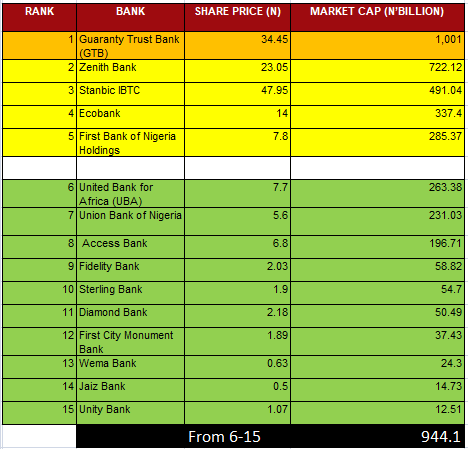
On pure market cap on the Nigerian Stock Exchange (NSE), GTBank remains the most dominant financial institution in Nigeria. From Cable data, closing on Dec 31 2018, you can see that GTBank can trade the ten “smallest” banks, based on market cap, with its market cap [sure, deals include premiums; this is pure academic here].

We have 15 banks trading on NSE; GTBank commands 26% of the total bank value, by market cap. GTBank is worth one trillion naira; the smallest bank, Unity Bank, is worth 12.5 billion naira.


RANK BANK SHARE PRICE (N) MARKET CAP (N’BILLION)
1 Guaranty Trust Bank (GTB) 34.45 1,001
2 Zenith Bank 23.05 722.12
3 Stanbic IBTC 47.95 491.04
4 Ecobank 14 337.4
5 First Bank of Nigeria Holdings 7.8 285.37
From 1-5 2,837
6 United Bank for Africa (UBA) 7.7 263.38
7 Union Bank of Nigeria 5.6 231.03
8  Access Bank 6.8 196.71
9 Fidelity Bank 2.03 58.82
10 Sterling Bank 1.9 54.7
11 Diamond Bank 2.18 50.49
12 First City Monument Bank 1.89 37.43
13 Wema Bank 0.63 24.3
14 Jaiz Bank 0.5 14.73
15 Unity Bank 1.07 12.51
From 6-15 944.1


The Uber Bank of Lagos

0

One of the most fascinating trends in modern commerce is the concept of technology-enabled modularity. Like the Cambrian Moment, modularity enables the combination and recombination of technology elements and primitives to achieve different objectives. Yes, when a company has invested in a category-crossing core technology infrastructure, it is possible it can use that platform to do many other things. With the fixed cost in the books, modularity opens vistas to build new technology layers upon the core infrastructure. That vision is not bounded by the industrial-age mantra of core competency because these modern species of tech companies are “unboundable” because they live in the unbounded Internet! I had since argued that the concept of core competency has been wounded: Amazon could be a health insurance firm in months even as Google could become your local attorney!

They taught us in economies that companies have to specialize and build core competencies.  They need to do things really well and be the best possible in the domains. But today, we think that does not make a lot of sense. For technology companies, everyone is doing everything, even at top-level. Alphabet, Google parent company, is a car company, a search company, a medical company, an advertising juggernaut, etc. Amazon.com is an e-commerce firm, a publisher, a movie producer, a drone maker, and soon a car maker.

Anyone can do anything because most of these firms operate on the internet where distribution is unbounded. And if distribution is not bounded,  vision must not be bounded. Amazon wants to sell to the world anything. If you expect it to stop on books, fashion and kitchenware, it is your risk. Facebook assembles its own servers for running its data centers. Google parent company, Alphabet, is a car company, internet service provider, and [pick your interest].

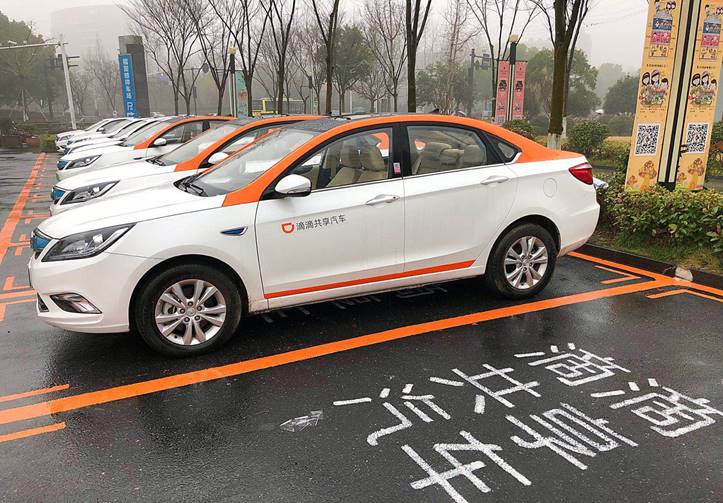
This trajectory is heating up, not in U.S. but also in China, where category-king digital empires are evolving. The news is this: Didi, Uber-clone in China which became more competitive than Uber in China, is now a fintech (financial technology) company.

China’s top ride-hailing app today expanded its repertoire by selling financial services to its 550 million users. Didi this morning announced the rollout of its first two financial products available inside its app: car loans and personal insurance. Other options, such as wealth management and more forms of credit services, are coming later, the company said.

[…]

The US$56 billion startup last year made some financial services available to its drivers, but today’s move expands its fintech ambitions to everyone across China.

Just imagine how its banking partners would feel: this company used to focus on its ecosystem members, but now wants to offer financial services to the broad citizens of China. So, it is fair to call Didi a fintech even as you are free to recognize it as a digital transportation company.

Why This is Possible

Technology has become so efficient that the capabilities to enter into territories have been reduced. To be a financial service firm these days would not require hiring many experts on compliance since someone had built most compliance elements in software. So, you can pay for that software and within days you are ready to go. Simply, the barriers of entry are falling and it is easier to enter into new domains. And as you move into that domain, technology gives you productivity gain that even if you are not really great, you would be fine to a large extent.

So, in the near future, Uber can wake up one day and apply for a banking license to offer financial services to customers in Lagos. For Uber, it makes no difference because it is another layer on the core technology which Uber had already built. Also, one day, it can add insurance because it is another layer. The most important part has been built. What remains is new market and territory to add new layers of applications. It is not hard to see as Facebook Inc through WhatsApp and Instagram is a fintech, money remittance company, ecommerce company, and meeting place.

This is an interesting future because internet is liberating markets from traditional custodians, and consumers will benefit. No market or sector is immune from this drug called ‘destructiv innovationi”.