DD
MM
YYYY

PAGES

DD
MM
YYYY

spot_img

PAGES

Home Blog Page 7029

How Early Stage Investors See African Opportunities

0

This is a press release, copyright-free, after a two-day Africa Early Stage Investor Summit organized by VC4A. Largely, the investors believe that Africa cannot be an extension of the Silicon Valley model.


Cape Town welcomed over 300 active and aspiring investors representing Africa’s early stage investing ecosystem for last week’s two-day Africa Early Stage Investor Summit organized by VC4A and ABAN.

Celebrating its fifth year, the summit attracted the highest ever number of early stage African investors from 35 different countries, and more specifically 25 African nations representing 110+ investor organizations to share expertise, experiences, and fostering collaborations to bolster the ecosystem of capital provision for African entrepreneurs.

Key takeaways from the two days included:

  1. Silicon Valley will not be replicated in Africa. Though there are lessons to be learned from the Valley, African VC faces unique constraints in scale, capital and exit opportunities. Rather than spend time ‘unicorn hunting,’ investors should push founders to build profitable, sustainable, and locally-adapted businesses.
  1. Collaboration is required to build a thriving industry. Investors must be activists in attracting more capital and resources into African markets, especially from larger corporates, growth equity investors and development finance institutions (DFIs). More collaboration is needed in designing instruments and financing structures tailored to African ventures.
  1. Human capital and diverse teams will be a key to success. In the coming decade, Africa will hold the majority of the global youth population, bringing a wealth of opportunity and innovation. Yet accessing strong talent and building diverse teams remains a stark challenge for most ventures. Investors want to see more female and locally-led organizations with thoughtful human capital strategies.

As Keet van Zyl from Knife Capital expressed during the opening panel discussion: “It is easy to invest money in Africa right now, but it is hard to make money in investing here. The key is to be exit centric – we only invest in entrepreneurs who are focusing on building sustainable businesses that can exit.” Ben White, CEO of VC4A says, “This conversation succinctly captures the challenges venture capital faces in Africa and why we need to keep working to strengthen and support the entire African venture ecosystem.”

One key announcement at the Summit came from Nikunj Jinsi from IFC Venture Capital: the World Bank Group has launched L’Afrique Excelle , a post seed stage acceleration program and showcase of the best startups from Francophone Africa. The program, following the first XL Africa cohort, will target and select high growth business in order to provide much needed support to the region’s nascent ecosystem. “With the conversations around the current lack of resources availed to Francophone Africa, and the importance of public-private partnerships, having frequently surfaced in the Summit sessions, this news was highly welcomed and appreciated by all in attendance,” says White.

While still in the early days, angel investors are experimenting across the continent and seeking ways to professionalize within their home markets. ABAN president Tomi Davies presented “Finding Product/Market Fit: The State of Angel Investing in Africa”  – a first ever scoping study by ABAN in partnership with infoDev / The World Bank Group on angel investing in Africa. The ABAN network has grown from 5 to 80 active networks and it is important to now have research that captures this emerging investor segment.

Babajide Sodipo, Regional Trade Adviser with the African Union (AU), announced a new partnership between the AU and ABAN formalizing their joint ambition in supporting entrepreneurs and SME’s across the continent. David van Dijk, ABAN Executive Director: “It’s great to see so many connections being made. More importantly we are excited by the level of engagement. Now is the time to take an active role and to be part of the next great African success story. We invite all actors and stakeholders to join the conversation.”

“It was the largest and most successful summit we have run with over 60 speakers participating in 7 panels, 4 investor masterclasses, 3 keynotes, 2 roundtables and 1 fireside chat. It’s amazing to see this industry rise in Africa. The passion and commitment shown by speakers and participants alike to partner with entrepreneurs to unlock the continent’s opportunities demonstrates how much there is to still achieve and I have no doubt that this ecosystem will prosper”, concludes White.

How Do You Manage Opportunities When They Come?

0

The Royal Netherlands Academy of Arts and Sciences, one of the world’s most respected institutions, heard I was in town, and invited me to speak to its members. But there was an issue: I was scheduled to fly into Sierra Leone in hours.

The Royal Netherlands Academy of Arts and Sciences (Dutch: Koninklijke Nederlandse Akademie van Wetenschappen, abbreviated: KNAW) is an organization dedicated to the advancement of science and literature in the Netherlands. The academy is housed in the Trippenhuis in Amsterdam.

In addition to various advisory and administrative functions it operates a number of research institutes and awards many prizes, including the Lorentz Medal in theoretical physics, the Dr Hendrik Muller Prize for Behavioural and Social Science and the Heineken Prizes.

Then, they sent the media team and I recorded an interview. We discussed many things, from inventing human immortality to transforming Africa through productivity-enablers anchored on technology. Then, a member, after watching the tape invited me to an EU committee, making my yearly trip to Brussels possible.

My message today: How do you handle the opportunities before you when they come? That interview, short conversation, etc could open a great future if you manage them well.

Review of GIHOSOFT iPhone Data Recovery Solution

0

Developer Gihosoft

Product Website https://www.gihosoft.com/iphone-data-recovery-free.html


ABOUT GIHOSOFT

They have a  > 30 staff including software development team, technical support team, marketing team, software UI and website designer team. The staff is sophisticated, responsible and enterprising. They strive for more professional programs and better technical support for global customers.

INSTALLATION & SETUP

This is the easy part of GihoSoft’s application. Just drag the icon to your applications map and you’re set and done. There is no preferences needed nor available in this application. So you’re ready to go !

USING GIHOSOFT iPHONE DATA RECOVERY

My first remark is you should always have/do a valid Backup of your device with iTunes. Always better be safe then sorry. Just nodding your head agreeing to this is not enough, DO IT ! This also applies to any computer-data you’ve got. BackUp your Mac, your photo’s and documents. Just about anything you can’t do without in times of trouble. I get asked by friends many times ” can you fix my computer problem”, and YES anything can be fixed but sometimes not without loss of data. So save your stuff as memory sticks or external hard drives are cheap nowadays.

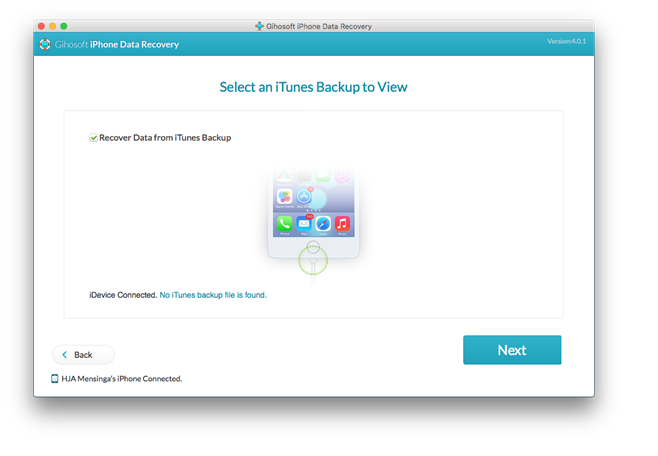
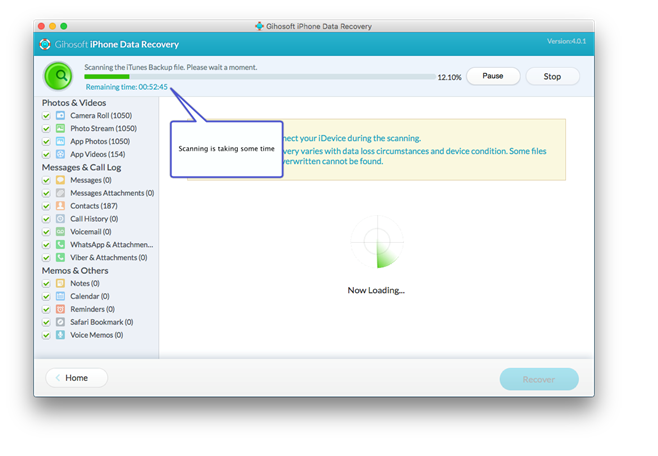
In this case we lack a backup from iTunes, as the application warns about the missing backup !  No worries, you may stil recover your lost files straight from your iPhone. Gihosoft iPhone Data Recovery will start scanning your device which can prove time consuming when your found backup on iTunes is encrypted which is recommended. My iPhone took 1 hour to finalise scanning.

FEATURES & OPTIONS

Free & Pro iPhone Data Recovery Software for Windows/Mac

  • Recover up to 12+ types of files, including contacts, SMS, photos, WhatsApp, Viber, notes, etc.
  • Restore lost data from iOS devices directly or from iTunes and iCloud backup
  • Recover iPhone data lost due to iOS upgrade/jailbreak, accidental deletion, device lost or broken
  • Support all the latest iPhone, iPad and iPod Touch
  • Both Free and Pro version. Why Pro >>

Support All iPhone, iPad and iPod Touch Models

  • iPhone: iPhone 7/7 Plus, SE, iPhone 6S/6S Plus, iPhone 6/6 Plus, iPhone 5S/5C/5, iPhone 4S/4, iPhone 3GS
  • iPad: iPad Pro, iPad Air 2, iPad Air, iPad Mini 4/3/2, the New iPad, iPad/iPad 2/3/4
  • iPod Touch: iPod touch 6/5/4

Recover Up to 12+ Types of Data from iPhone, iPad or iPod Touch

  • Photos & Videos: Camera Roll, Photo Stream, App Photos & Videos
  • Messages & Call Log: Messages, Message Attachments, Contacts, Call History, Voice mail, WhatsApp/Viber messages & attachments
  • Memos & Others: Notes, Calendar, Reminders, Safari Bookmark, Voice Memos

SCANNING YOUR IPHONE

Appearance of the layout is somewhat mixed feelings. Its not like the modern iMyFone application, but works well. All information is displayed as this is a ‘one trick pony utility’, scanning and presenting the preview of found files and leaves you to hit “NEXT’ and wait for the recovery.

The one thing that worries me is the absence of choice in doing a recovery from your iTunes Backup or skip this and go to your iPhone directly and scan for your missing data. Now to software always takes you to your iTunes backup whether is is Old or New. An older backup might not have your desired data available, and without skipping ( well I can’t undo the selection mark ! ) take you to your iPhone straight away. I may be wrong but will ask for tech. info from Gihosoft.

Choosing only ‘messages’ from the first selection page takes me straight to my iPhone, but again scanning takes 59 minutes ( only 16Gb used on iPhone ). Why when selecting all it takes me to iTunes backup, and when selecting just messages it goes straight to the iPhone puzzles me.

**

Gihosoft Giveaway Alert:

Comment and win free lifetime registration key of Gihosoft Free iPhone Data Recovery:https://www.gihosoft.com/iphone-data-recovery-free.html

Gihosoft Free iPhone Data Recovery is a professional iPhone Data Recovery software to get back all your lost text message, photo, video, call history, note, contact and more from iPhone/iPad/iPod Touch.

If you use android phones, please choose Gihosoft Android Data Recovery.

With Gihosoft Android Data Recovery, no longer afraid of data loss!

Michael Bloomberg Combined Gift To John Hopkins University Now Exceeds $3.35 billion

0

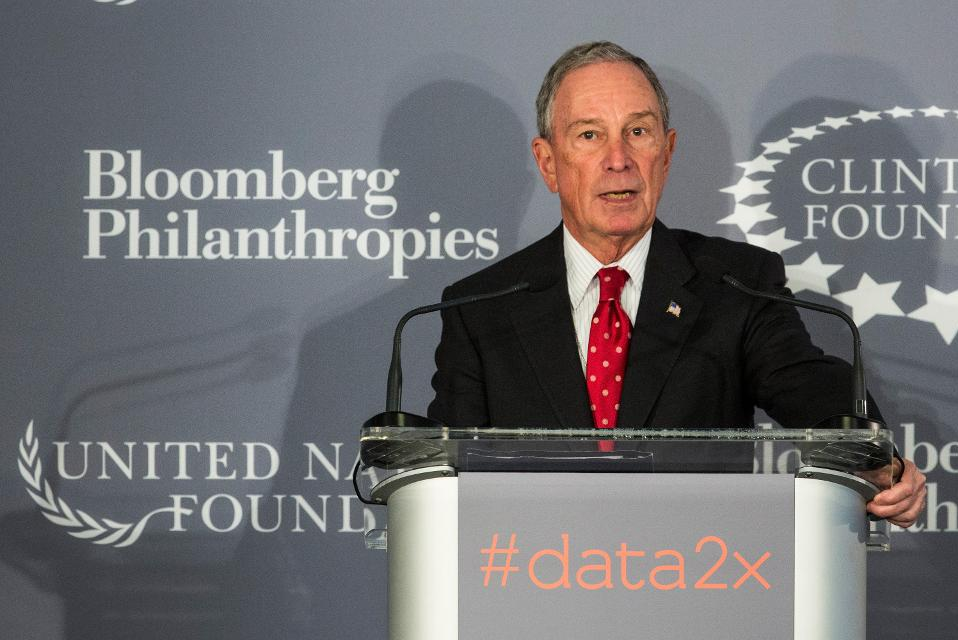
Michael Bloomberg gave Johns Hopkins University $1.8 billion. It’s thought to be the largest private donation in modern times to higher education. The money will support financial aid for students at the alma mater of the former New York City mayor.

Ronald J. Daniels, the President of the Johns Hopkins University, sent an email early this morning, informing the alumni community that Michael Bloomberg dropped $1.8 billion to the university.

In 1873, Johns Hopkins made a gift of $7 million for the university, seeding America’s first research university. That gift was the largest in the generation.

When I got into this university, I spent the first “light” days reading the formative phase of that school. Daniel Gilman, Johns Hopkins first President, was everywhere: founded Sheffield Scientific School in Yale; was President in University of California; Founding President of Carnegie Institution, etc.

As an engineering student studying the history of a university, his inaugural speech in 1876 got me: “our simple aim is to make scholars, strong, bright, useful and true.”

We are trying to do this with no controversy as to the relative importance of letters and science, the conflicts of religion and science, or the relation of abstractions and utilities; our simple aim is to make scholars, strong, bright, useful and true.

That moment, he seeded the first postgraduate education in America. I copied that statement as the vision of my ill-fated First Atlantic University which I had hoped would “clone” the university in Nigeria: “to discover and make scholars, noble, bright and useful”.

Mr. Bloomberg: Thank you.


An email from the University President to alumni of the university.

Dear Members of the Johns Hopkins Community:

When we gather with family or friends to celebrate Thanksgiving later this week, many of us will begin the holiday meal by expressing our gratitude for the blessings we have received.

Today, we are grateful and humbled for one more, extraordinary blessing.

Michael R. Bloomberg, graduate of the Class of 1964 and former chair of our board of trustees, has made a gift to us that is staggering in its vision and breathtaking in its impact: $1.8 billion to dramatically and permanently expand undergraduate financial aid at Johns Hopkins University.

This historic gift reflects Mike Bloomberg’s deep belief in the transformative power of higher education and his insistence that it be accessible to all qualified students, regardless of financial means. It also affirms Mike’s profound devotion to this university for the role that it played in enriching his life.

This belief in the role of higher education was central to the monumental gift we received at our founding. Johns Hopkins’ $7 million gift in 1873 was heralded by the New-York Tribune as “one of the grandest bequests ever made to any city.” In its day, Mr. Hopkins’ philanthropy was the largest ever given to a university and a hospital. It reverberated around the nation and launched America’s first research university on a path toward seminal achievements in virtually every sphere of scholarly endeavor.

Though he did not provide detailed instructions for the university he dreamed into being, Mr. Hopkins envisioned that it was to be an institution open to students not on the basis of their financial wherewithal but on “their character and intellectual promise.”

We have long sought to honor this directive, and we have been supported by a legion of committed donors. But we have never been fully able to realize the inspiring vision of a university that is open to, and supportive of, all high-achieving students regardless of their means or backgrounds. Our dedicated financial aid endowment was simply too small. Now, as a consequence of Mike Bloomberg’s extraordinary gift, we will be fully and permanently need-blind in our admissions and be able to substantially enrich the level of direct assistance we provide to our undergraduate students and their families.

Beginning in the fall of 2019, Johns Hopkins will be a loan-free institution. We will replace all undergraduate student loans with scholarships, and we will reduce overall family contributions to financial aid. In addition, for the spring 2019 semester, we will offer immediate loan relief to every enrolled undergraduate student whose financial aid package includes a federal need-based loan.

Coupled with expanded recruitment and post-enrollment support programs, these new financial aid offerings will ensure that we are able to recruit more first-generation and low-income students and provide them with full access to every dimension of the Johns Hopkins experience. Our goal is to attract and support a student body in which at least 20 percent of our students are eligible for federal Pell grants by 2023.

With this gift, Mike Bloomberg’s combined philanthropy to Johns Hopkins exceeds $3.35 billion. This constitutes the largest philanthropic investment ever made to any institution of higher education in the United States. In this, his unparalleled generosity echoes and honors the example forged by Johns Hopkins almost 150 years ago.

On behalf of the entire Johns Hopkins community, I express our heartfelt gratitude and appreciation to Mike Bloomberg, and reaffirm our sincere determination, in word and in deed, to vindicate the very substantial trust he has reposed in us.

I can think of no better way to begin this holiday season. We are profoundly grateful. We are truly blessed.

Sincerely,

Ronald J. Daniels

Last Mile Connectivity in Nigeria

0

By Olayinka Oduwole

I recently wrote a piece on the global outlook on 5G and there was an interesting comment about meeting the last mile connectivity in Africa. In this new piece, I address some of the barriers towards achieving last mile connectivity in Nigeria and conclude with some recommendations that may help address these barriers.

In recent times, there has been an appreciable number of submarine cables landing in Nigeria delivering a capacity of about 15-19 tbps to the country (this number is subject to verification). However, a noticeable challenge that has been highlighted is that most of these cables land in Lagos. The Government has pointed out the need to establish other landing points outside this major city (e.g. Ondo, Delta, Rivers, Bayelsa) to drive down costs and for security reasons.

Furthermore, it has been noted that multiple operators have island of cables that are not interconnected within similar regions of high traffic; this therefore implies that regions like Lagos have multiple fibre coverage while other regions e.g. rural areas lack fibre coverage. This poor network planning is one of the main factors contributing to the poor last mile connectivity in Nigeria.

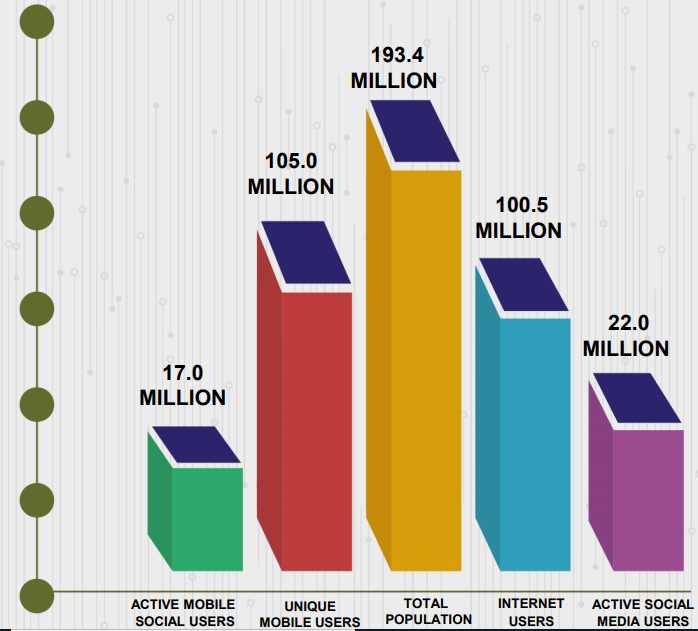
Source: Terragon

Furthermore, from a telco’s perspective, the poor return on investment means that telcos’ are discouraged from deploying telecommunication infrastructures in rural or under-served areas.

In order to address the last mile connectivity, it’s important that the Government create incentives that would encourage telcos to invest in connectivity in rural areas and other less profitable regions. This can be achieved through the efficient use of the Universal Service Provision Fund (USPF), a fund representing mandatory contributions from mobile operators and telecommunication service providers to address the digital inequalities. For instance, USPF can be used to cover the costs of deploying extended fibre coverage to rural areas; this would then encourage telcos to invest in rural connectivity. Data from A4AI shows that the USPF in Nigeria is spent annually on various projects within the country. Perhaps, a transparent system of documenting and providing information on the exact projects and cost of projects funded by USPF annually should be encouraged.

Data connectivity

Besides, technological solutions such as the deployment of low cost small antennas with green initiatives can be deployed in rural areas to help address the poor rural connectivity. This would no doubt help drive down costs associated with CAPEX and OPEX. The use of Satelites, as an alternative technology, can also help address this connectivity challenge; however, the huge cost associated with this technology may hinder its deployment in rural areas. Companies looking to deploy rural connectivity solution should also be offered incentives by the Government to encourage their investment in these deprived areas.

The Government should also consider policies that would support both an active and passive sharing of infrastructures among operators whilst supporting net neutrality. Passive infrastructure sharing is already prevalent in Nigeria, with the likes of IHS Towers acquiring towers belonging to MTN, Airtel and 9mobile. Active infrastructural sharing, on the other hand, needs to be encouraged and would require a close knit collaboration among mobile operators. It may squeeze operators’ margin but would no doubt help in pushing broadband prices down.

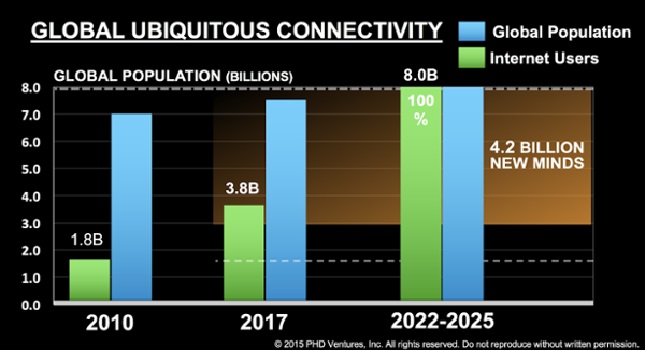
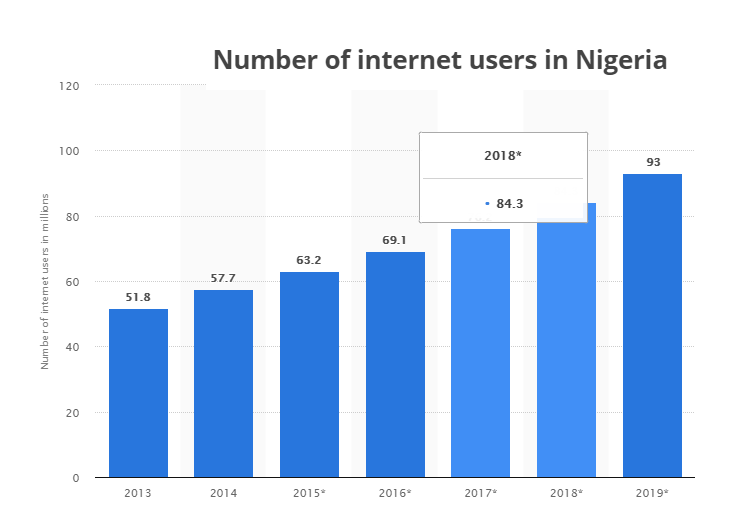
Source: Statista

Poor network planning was mentioned as a barrier contributing to the poor last mile connectivity. The rapid explosion of the telecommunication sector in Nigeria was not anticipated by the Government; this therefore means that little or no plans were in existence to deal with the rapid explosion. Market forces thus became the driving force determining where and when to deploy new networks. This has thus created a digital divide among different regions of the country. In order to address this challenge, it is important for the regulator to work alongside telcos to plan new networks and perhaps encourage the deployment of fibre layout during the construction of new infrastructures like roads, homes, buildings etc.

As earlier stated, market forces are incapable of bridging the digital divide that currently exists in Nigeria. Achieving last mile connectivity in Nigeria no doubt requires a concerted effort among Government, Civil Society Organizations, Policy makers, mobile operators, service providers, academia etc. It also requires a combination of solutions ranging from policies to technologies, transparency to regulations etc. As the United Nations has stated, ‘Access to broadband is a human right’. Hence, it is important that Nigeria looks into achieving last mile connectivity and most importantly ensure that none of its citizens are left behind in the digital race, especially as the world looks to move into an era of ubiquitous connectivity, massive data and internet of things.