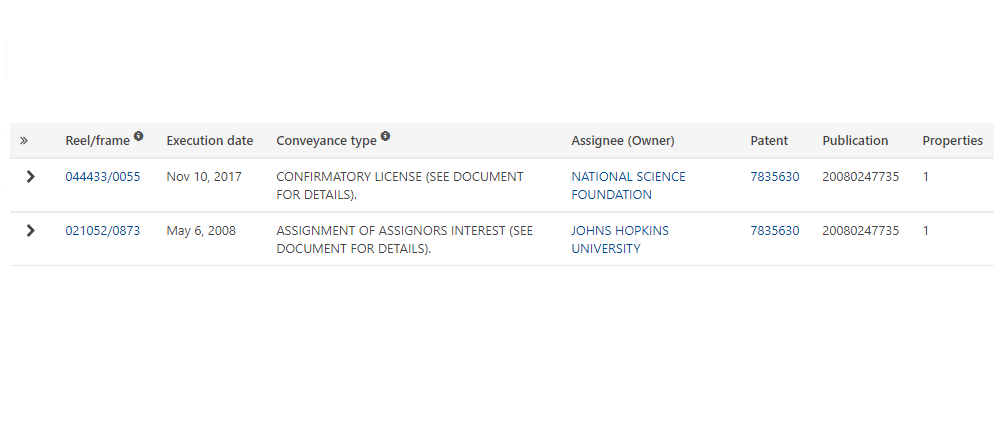
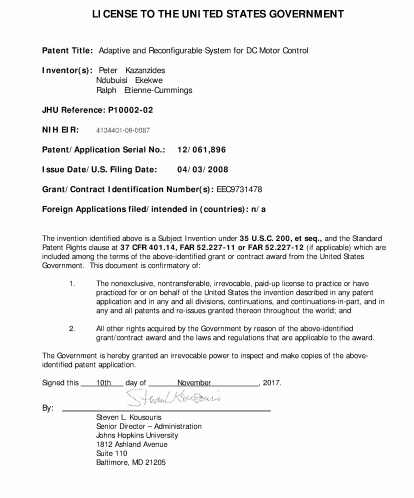
My Johns Hopkins University PhD work with the patent that came out of it has a major assignee: The United States Government via the National Science Foundation of the United States. I invented a special method of controlling the dexterity of medical robots, making such robots effective during minimally invasive surgeries. This patent is currently used by some medical device companies. The U.S. Government now has the rights to “make copies” as captured in the patent assignee file. Simply, it is now licensed to the United States Government which can use it for different national projects.
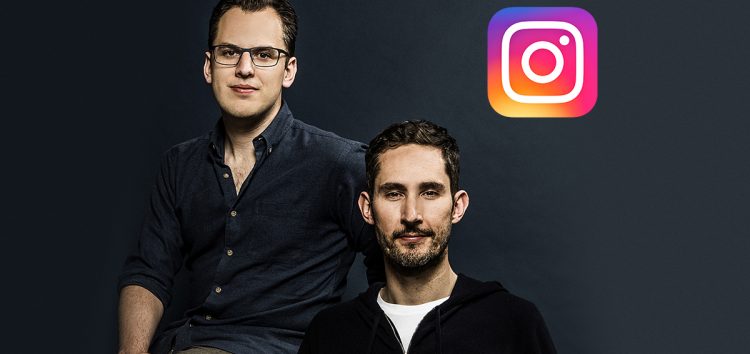
One of the greatest moments in the creation of Instagram was when the founders (Kevin Systrom and Mike Krieger) discovered that its first idea to clone Foursquare (a location app) was not cutting it. Instead of people caring about location, they were interested in sharing photos. Just like that, the founded abandoned Burbn, the Foursquare-clone, and created Instagram which focuses on helping people to share photos.
Burbn was not, however, terribly successful. The app was too complicated, Sawyer points out, and had “a jumble of features that made it confusing.” Systrom, however, kept tweaking the app. He paid attention to how people were using it. He brought on another programmer, Mike Krieger; the pair used analytics to determine how, exactly, their customers were using Burbn. Their finding? People weren’t using Burbn’s check-in features at all. What they were using, though, were the app’s photo-sharing features. “They were posting and sharing photos like crazy,” Sawyer notes
Founders of Instagram (Source: Technext)
Contrast that with Snap CEO Evan Spiegel who had a wonderful product in Snapchat but felt he knew what he wanted. He went on excursion and redesigned the product, pushing many out of his platform. Good enough, he has recovered: “The biggest mistake we made with our redesign was compromising our core product value of being the fastest way to communicate,” he wrote.
In a 15-page memo to employees, Snap CEO Evan Spiegel said his company is aiming for profitability next year and apologized for the much-criticized redesign of the Snapchat app. “The biggest mistake we made with our redesign was compromising our core product value of being the fastest way to communicate,” he wrote. (Fortune Newsletter)
In business, a product is for whatever customers use it for (legally) – forget what you have in mind. From suya joints to pineapple sellers across Nigeria, they have converted toothpicks into a quasi-wooden fork. You would be naïve to tell customers toothpicks are for picking teeth and not for eating pineapples or suya. The key is looking at your data to understand what customers really care for and how they are using your products. That way you can quickly pivot.
I wrote few days ago that microfinance banks in Nigeria have terrible business models, and must be fixed. The business model problem was endemic as it emanated from the regulations the Central Bank of Nigeria (CBN) imposed on them. My conclusion in that piece was clear: unless they are refocused, most would die, and the mission – financial inclusion of underbanked – lost.
There is an inherent systemic flaw in the microfinance banking business model in Nigeria. I know someone won a Nobel Prize for pioneering the broad nexus of microfinance sector, but in Nigeria, it is simply not a good business model. You are expected to serve largely non-premium customers even though you cannot receive easy deposits as a “bank”. Yes, you have to look for expensive capital to serve people you would struggle to make money from. No issues – you would just be doing it until you run out of cash.
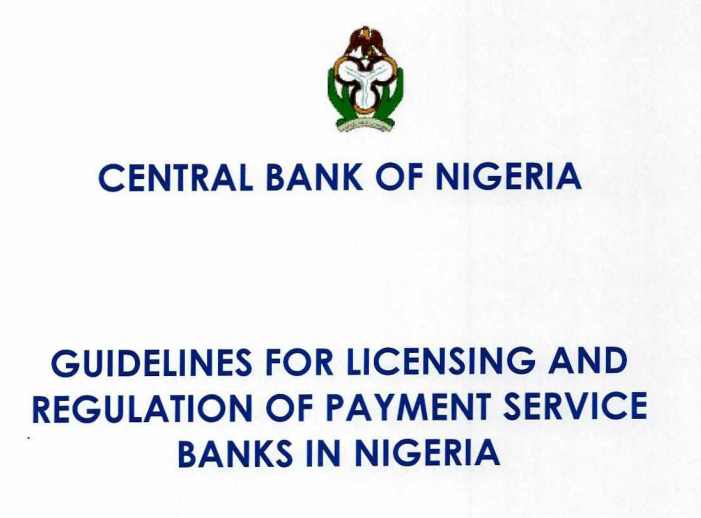
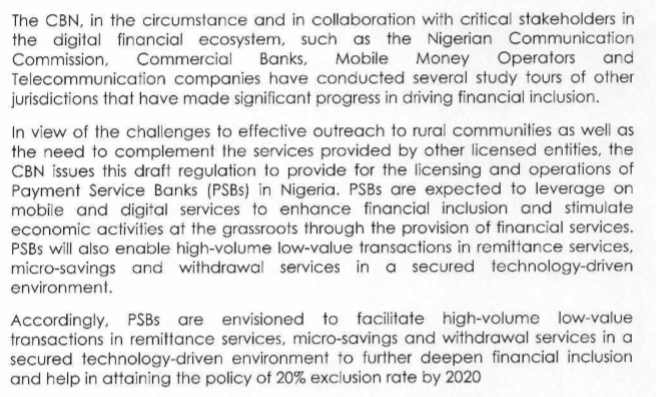
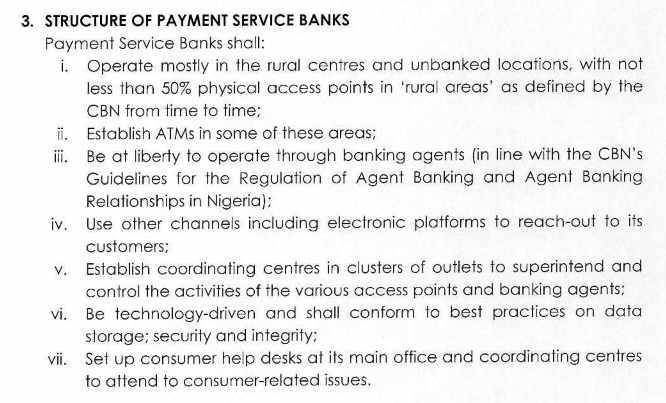
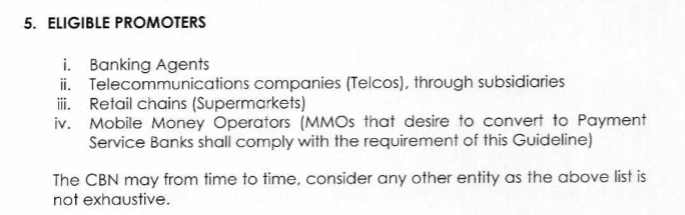
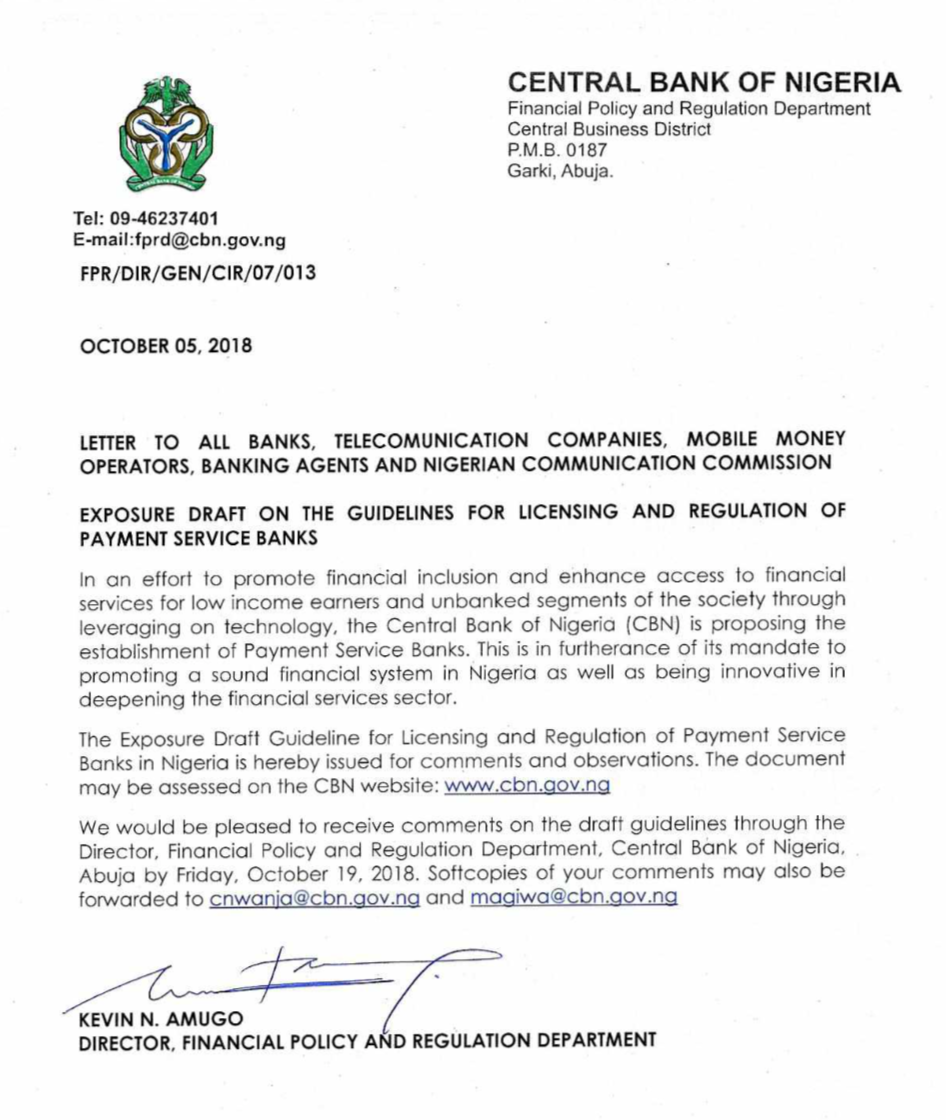
By coincidence, CBN is out to fix some levels of the challenges with a new financing institution: Payment Service Banks. In the notice, CBN did acknowledge that microfinance banks and other institutions did not achieve the goal they were licensed for in the nation. It does hope Payment Service Banks will deliver. With PSB, banking agents (yes, the human-platform banking entities), supermarkets, etc can be banks.
The apex bank is asking for submissions on the best way to design this new institution for the nation. Oct 19, 2018 is the due date.
The Joint Admissions and Matriculation Board (JAMB), says about 200,000 candidates have been offered admission by the board, for the 2018/2019 academic session.
The Head, Media and Information of the JAMB, Fabian Benjamin, who disclosed this to the News Agency of Nigeria (NAN) on Sunday in Lagos, said that the admission took effect after the board’s policy meeting in June in Gbogan, Osun State.
According to him, the exercise is done through the Central Admission Process (CAP), an automated process to eliminate all human interference.
“We have so far offered not less than 200,000 first choice admissions to candidates.
“To this effect therefore, we are urging candidates to go to our site and check their admission status and those who have been offered such admission should quickly indicate by accepting and printing such offer, as failure to do so will automatically mean the candidate is no longer interested.
“And therefore, the board may see all such offers as rejected and would have no option than to mop them up and give it to other interested candidates.
“Candidates are to accept or reject all offers not later than Oct.16 as that is when all offers of admissions of first choice will close.
“After that, we will commence admission exercise for the second choice of candidates,” Benjamin said.
He added that the admission process has been made easy as it is clear on the board’s official website, all what the candidates need to know about their admission status and process.
NAN reports that over 1.6 million candidates wrote JAMB-organised 2018 Unified Tertiary Matriculation Examination (UTME). (NAN)
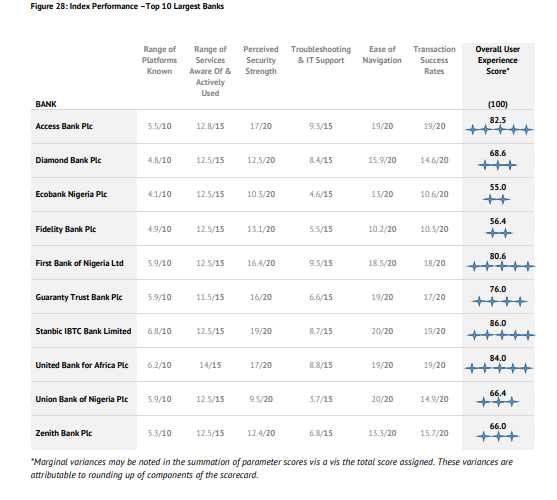
Agusto & Co, a credit rating and research agency, committed a serious error in its methodology on its report titled “2018 Agusto & Co. Consumer Digital Banking Satisfaction Index”.
The 2018 Agusto & Co. Consumer Digital Banking Satisfaction Index, comprising a survey and a scorecard, examines customers’ preferences and attitude towards digital banking platforms hosted by their respective Banks. A focus group of respondents were drawn from the formal and informal sector segments of the economy. Respondents were sampled from various geopolitical regions within Nigeria including the South-West, South-East, South-South, North-Central and North-West regions. Respondents were also a combination of students, self-employed and employed customers of various commercial banks in Nigeria. The data collection technique used was a questionnaire designed to gain insight into the behavioural pattern of the sample population. The survey focused on issues around service quality and ease of carrying out transactions. The questionnaire comprised of multiple choice, closed and open ended questions. The questionnaire was administered both electronically and physically, thus encouraging a wider pool of respondents across the country.
It is very strange that banks affected have not pushed back. But in Nigeria, intellectual conversation is not in our styles. Agusto & Co failed in its core objective: “to create an independent appraisal of the ease of using digital banking platforms by the Nigerian populace considering that banks have invested significantly in digitalization.“ Simply, they had a fudge factor in the data collection and that rendered the conclusion meaningless.
StanbicIBTC ranked highest in Agusto & Co report
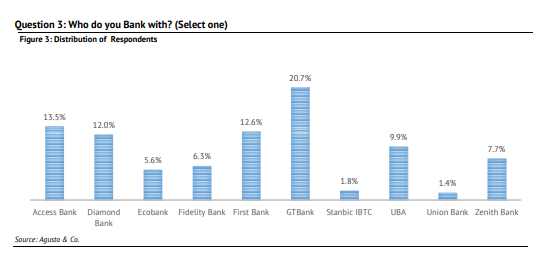
This is the full report from Augusto & Co (download here). It made a big mistake on the sample collected in Question 3 ‘Who do you bank with?”. Here are SOME of the main issues looking at the plot:
The sample distribution (source: Agusto & Co)
GTBank provided 20% of the participants. That is a big problem. GTBank does not command 20% of the market by number of customers in Nigerian banking. First Bank (I do think) is the largest bank (by customer size) in Nigeria. So, not making the sample to represent reality is a huge problem.
Even if we assume we can ignore the actual market share, there is still an issue. Yes, when you have many GTBank customers, above a clear mean, in the study, you are essentially moving many elements which may affect the bank differently from its peers. Largely, StanbicIBTC Bank should not have been included in the final rating as it did not meet the minimum participation level for a scientific assessment. You cannot have one bank providing 20% and another 2%, of the sample if you have not bothered to consider the actual market shares (by customer size), and expect the inferences to be uncorrelated.
Consider this scenario: you went to Ajegunle Lagos and meet 100 people. You ask them about their banking experiences. In all, one person used StanbicIBTC and he is happy; you give StanbicIBTC 5 stars. But you sampled 10 Union bank customers; 9 are happy while one is not. For that you issue 4.9 stars. You have not done justice to the whole process: StanbicIBTC might have done well but that is not reality. To get a real scientific result, your sample must mimic the actual customer distribution to a large extent and you need to sample many customers.
Look at Access Bank (13.5%) and Zenith Bank (7.7%), you are having nearly 2x participation ratio between them. That is creating a fictitious market share in this industry where Access Bank is nearly twice of Zenith Bank! And you know there is trouble when you have a sample size with more Access Bank than First Bank customers in Nigeria. (The report did not explain how it managed all that.)
I can go on and on but let me spare you the troubles
In short, the report is totally not balanced. I picked the press release from Guardian but did not read the report before sharing the conclusion. But one of my data engineers looked at it and flagged it: “Prof, if I did what Agusto did, I would be in trouble with you.”
Sure, while it is possible StanbicIBTC is doing well and GTBank has issues (I spent 46 minutes, last week, in its Ajao Estate branch for a very simple transaction as the banking hall was full), this report is not a scientific way to make sense of anything. We can all rant over services in the banking sector. But this report offers no credible insights. GTBank is not 5th and StanbicIBTC is not 1st either – they are all working and fixing market frictions but no scientific work exists, yet, to rank them.
Agusto & Co should withdraw it and re-do the data collection and analysis. It needs to calibrate out the impacts of the sampling to get a better picture of the state of our banking innovation. And they need to include how many customers that were sampled, not just the percentage distribution by banks. Did they sample 100 or 10,000 customers? You cannot miss such in a very impactful report like this.
Update
This comment on LinkedIn explains my point better.
[Name] not necessarily how much more but what are the probabilities or assumptions involved in the sampling? For example, what is the share of banking customers in Nigeria as a population? What share does each bank have? What is the regional split of the banking population? All these make up to decisions on sampling. As commented earlier, the approach would have been more suitable with a quota sampling than random.