DD
MM
YYYY

PAGES

DD
MM
YYYY

spot_img

PAGES

Home Blog Page 7096

Nigeria’s Paylater Unveils PayVest, Fixed-Interest Investment Account

0
PayVest Nigeria, PayLater Nigeriia

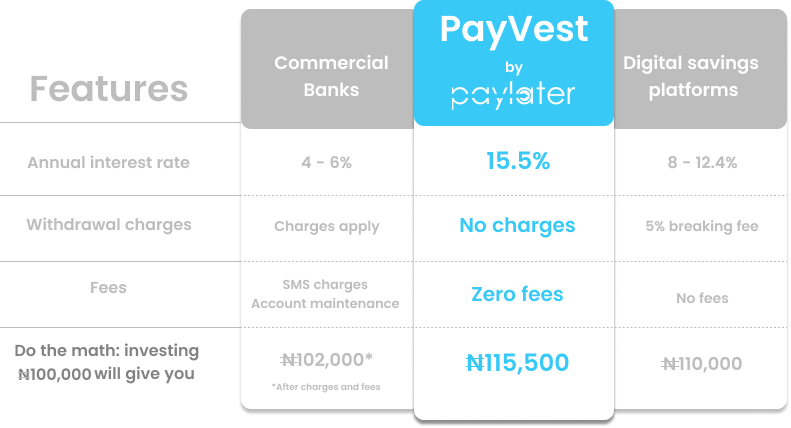
Paylater, a consumer lending startup in Nigeria, has launched a new product: “PayVest: a fixed-interest investment account.” This product can pay an interest rate in the range of 15.5% per year.

PayVest provides the flexibility, convenience and stability you need, at one of the best interest rates you’ll find available, anywhere. …

Fantastic Investment Terms

With annual interest rates of up to 15.5%*, you’ll struggle to find anything (legal) that matches PayVest’s return on investment. It’s comfortably above the inflation rate, thus ensuring you’re only ever earning money and not losing it. Single investments can range from N50,000 to N10 million.

PayBest Nigeria
PayVest rates (source: Medium)

In my last piece about this company, I noted that it could work with entities like Piggybank, an online saving portal, to pioneer new sectors in the Nigerian financial sector. I noted that these companies are competitors and also coopetitors, and together these entities can redesign our financial system. The thesis of my point is this: Piggybank is a saving startup, and Paylater could borrow from it to make loans since Piggybank has cash from its savers. Of course, there are regulatory reasons why the startups  cannot handshake at this level. Nonetheless, for Paylater to continue to grow, it has to find CHEAP capital. Without cheap capital, its scalable advantage will drop.

Paylater is pioneering a new area in fintech along with other lending startups in Nigeria. Though their annual interest rates can vary from “31% to 213%”, for most people, it is better than nothing. Simply, they are meeting the needs of customers, left behind by banks. For the very fact that they are CBN regulated, it means that they have to disclose every element of their loan terms in ways that customers will understand.

With PayVest, it is working to fix that problem. Simply, if the PayVest vision works, Paylater will receive “investment” deposits from customers which will cost it up to 15.5% yearly. It will then take that money and lend to customers at above 31%. Just like that, the company has fixed a big challenge which is having enough money to lend. Also, with this structure, it may not need to take expensive capital from say banks. You see why the move is brilliant: PayVest will anchor a virtuoso circle which will make it possible that the Paylater system can support itself organically provided it continues to manage risks well.

This is what most hedge funds in U.S. do: they have reinsurance/insurance businesses which help them with cheap capital. Warren Buffett does same with Geico, an insurer, where he gets cheap capital from premiums and then use that capital to invest in long term deals. If you can control both arms, get cheap capital, invest with bigger spreads, you have a winner anytime.

PayVest has just raised capital for Paylater in the way great companies do: your customers FUND you. Yes, customers are the best investors.

French President Macron’s €1,000,000,000 Fund to Africa – Markets Over Govt Houses

0
Macron Elumelu Jim Dangote

The President of France, Mr. Emmanuel Macron, has announced a total of 1 billion euro investment fund for private sector players in Africa, to enable them scale up their business enterprises. The fund would anchor an initiative to gather African and Europeans titles and business players to build a business platform,  to develop, leverage and accelerate the private sector. President Macron shared this as the special guest at an interactive business forum hosted by the Tony Elumelu Foundation in Lagos.

“We will participate with you to strengthen and to frame the financial ecosystem of West Africa.

“We decided to invest one billion euros, which means N500 billion in the African private sector through the French Development Agency to start the Digital Africa Initiative.”

He also challenged young African entrepreneurs from the Tony Elumelu Entrepreneurs, reminding them that “If you believe in your projects: just do it right now”.  Yes indeed: remember the Fedex founder piece.

 “Nobody should decide your future; you must arise and take responsibility for your continent. If Africa does not succeed, Europe and America will not,” he said.

“If you believe in your projects: just do it right now. If you want to do it, if you want to change this world, if you want to change your country, if you believe in your innovation, in your project, just make it visible, create, dare and do it right now. That’s the answer for this continent,” he stressed

I like this – it is time for the world to focus on building Africa from the private sector over giving money to governments. I am very confident that a solid financial structure would benefit Africa if the African businesses lead the relationships with Europe. The funds should be accessible to big and small companies plus startups in Africa. We want more funds going into markets than government houses.

Contents and quotes from Daily Trust report on this.

Nigeria’s Best Network for Mobile Internet Product Partnership

2

In Nigeria, the four mobile network operators control more than 99% of the total mobile internet market. The less than 1% remaining portion is shared by Spectranet, Smile, Swift Networks, and nTel, reports Asoko Insight in a new report.

The mobile internet market is dominated by four Mobile Network Operators (MNOs) operating GSM networks: MTN Nigeria, Airtel Networks, Glo Mobile, and 9Mobile. Together, these MNOs account for over 99% of mobile internet subscriptions in the country. The remainder of the mobile internet market consists of a number of LTE focused operators such as Spectranet, Smile, Swift Networks, and NATCOM (nTel).

In Nigeria, this is the data we are used to: MTN Nigeria leads the competition with 54.5 million subscribers and others follow.

NCC Subscriber data
Quarterly Subscriber Operator Data (Source: NCC)

But from the report, there is something revealing: the number of smartphone users in these networks.

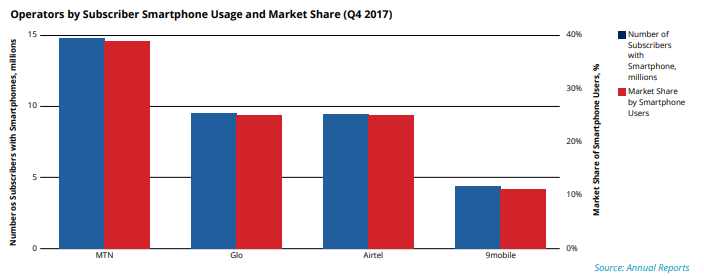
Of those subscribing to the four major operators, just 38 million are smartphone users, with MTN accounting for more than one third of the total. Airtel and Glo have almost equal number of subscribers falling into this segment.

Operators by Subscriber Smartphone Usage and Market Share (Q4 2017) (source: Asoko Insight)

From this plot, you can see that MTN has about 14.5 million smartphone users. For Glo and Airtel Nigeria, each has about 9.5 million with 9Mobile rounding up at about 4.5 million. Simply, if you want a solution which would be telco-driven and requires smartphone [mobile device] users, the best network to work with is MTN in Nigeria. It gives you more mileage and spread if there is any requirement of exclusivity where you cannot sign multiple telcos at the same time. (According to StatCounter, Nigeria is a mobile internet nation with more than 83% of internet traffic generated via mobile devices like smartphones or tablets; computers only account for 17 %.)

All Together

If you are launching an app or any product that requires smartphones, MTN Nigeria should be your #1 consideration if you hope to strike telco partnership. But where that partnership is not possible, make sure anything you have in the market works perfectly in MTN network. It has the largest mobile internet users and of course it leads the total subscriber base (voice and data combined).

Names of Officials of Nigeria’s “Reformed APC”, R-APC (Splinter faction of APC)

1
Reformed APC

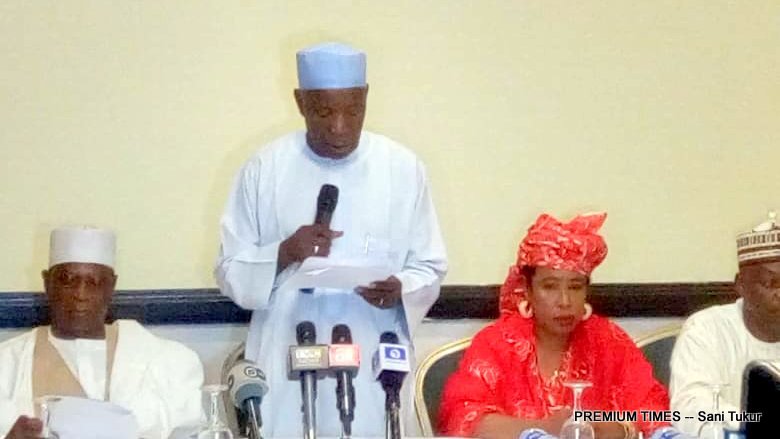
Reformed APC (R-APC) is the name of the splinter faction of Nigeria’s ruling party, APC. It has named its leadership at both national and state levels, Premium Times reports.

Buba Galadima, who read the text of the press statement, was announced as the national chairman of the faction; while Kassim Afeguba, a spokesman to ex-military ruler, Ibrahim Babangida, is the National Publicity Secretary.

Full press statement below after the list of some of the National Officers of the R-APC:

  1. Yobe State – Buba Galadima (National Chairman)
  2. Kano State – Bala Muhd Gwagwarwa (National Deputy Chairman, North)
  3. Abia State – Chief Theo Nkire (National Deputy Chairman, South East)
  4. Ondo State – Hon. Eko Olakunle (National Vice Chairman South West)
  5. Kaduna State – Hon. Hussaini Dambo (National Vice Chairman North West)
  6. Kogi State – Mahmud Mohammed Abubakar – (National Vice Chairman, North Central)
  7. Benue State – Hon. Godwin Akaan (Deputy National Secretary)
  8. Oyo State -Dr Fatai Atanda (National Secretary)
  9. Edo State – Kazeem Afegbua (National Publicity Secretary)
  10. Adamawa State – Daniel Bwala (Financial Secretary)
  11. Jigawa State – Abba Malami Taura (Deputy National Auditor)
  12. Kwara State – Hon. Kayode Omotosho (National Treasurer)
  13. Anambra State -Barr. Nicholas Asuzu (National Youth Leader)
  14. Rivers State – Barr. Baride A. Gwezia (Legal Adviser)
  15. Katsina State – Haj Aisha Kaita (National Woman Leader)
  16. Bauchi State – Mrs. Fatima Adamu (National Welfare Secretary)
  17. Ogun State -Alh. Isiak Akinwumi (Deputy Financial Secretary)
  18. Zamfara State – Alh. Bashir Mai Mashi (Deputy National Treasurer)
  19. Abuja – Hauwa Adam Mamuda (Deputy Welfare Secretary)
  20. Sokoto State – Hon. Shuaibu Gwanda Gobir (Deputy National Publicity Secretary)
  21. Katsina State – M. T. Liman (National Organising Secretary)
  22. Niger State – Dr Theo Sheshi ( Deputy National Organising Secretary.
  23. Some of the State Chairmen include:
  24. Adamawa – Dimas Ezra
  25. Anambra – Sir Toby Chukwudi Okwuaya
  26. Bauchi – Sani Shehu
  27. Benue – Noah Mark Dickson
  28. Jigawa – Hon. Nasiru Garba Dantiye
  29. Kaduna – Col. Gora (Rtd)
  30. Kano – Umar Haruna Doguwa
  31. Katsina – Sada Ilu
  32. Kogi – Alh. Hadi Ametuo
  33. Ogun – Alhaji Adeleke Adewale Taofeek
  34. Ondo – Hon. Otetubi Idowu
  35. Oyo – Alh. Ali Alimi Isiaka Adisa
  36. Yobe – Mohammed Burgo Dalah
  37. Zamfara – Alh. Nasiru Yakubu
  38. Niger – Hon. Samaila Yusuf Kontagora
  39. FCT – Adaji Usman


PRESS CONFERENCE ADDRESSED BY ALHAJI BUBA GALADIMA, NATIONAL CHAIRMAN, REFORMED – ALL PROGRESSIVES CONGRESS (R-APC) AT SHERATON HOTELS ABUJA ON 4TH JULY, 2018

We are here assembled to address you on the state of our party, the APC, the state of the nation and the future of our experiment in constitutional democracy, in Nigeria.

  1. You will recall that in the build up to the 2015 General elections, some political parties and groups came together, and formed a brand new political party, the All Progressives Congress, APC. This merger was based on the strong belief that Nigeria had come of age, but was severely underperforming and unable to meet its potentials for good governance. The Nigerian people entrusted power to the APC based on its promises and potentials.

  2. We are sad to report that after more than three years of governance, our hopes have been betrayed, our expectations completely dashed. The APC has run a rudderless, inept and incompetent government that has failed to deliver good governance to the Nigerian people. It has rather imposed dictatorship, impunity, abuse of power, complete abdication of constitutional and statutory responsibilities, infidelity to the rule of law and constitutionalism. It has failed to ensure the security and welfare of our people and elevated nepotism to unacceptable height. The APC has failed to deliver on its key promises to the nation. There is no evidence of any political will to reverse the decline of our party, while leaders who have created these circumstances continue to behave as if Nigerians owe our party votes as a matter of right.

  3. The APC government, has been a monumental disaster, even worse than the government it replaced. The political party that was a vehicle for enthroning the government was rendered powerless by manipulations and complete lack of due process in its operations.

  4. The last straw, was the Congresses and Convention of the APC held recently. The Congresses were intensely disputed as it was conducted with impunity, total disregard for due process, disregard for the party Constitution and naked display of power and practices that have no place in a party we all worked the very hard to put in place.

  5. There are countless cases in courts all over the country challenging the legality of congresses and even the National Convention itself. It is very likely that the judicial decisions on these cases will result in massive chaos, confusion and uncertainties. The fate of a party in this state with a few months to the elections is best left to the imagination, but it is not a fate we believe our millions of members should be abandoned to. There were parallel congresses in 24 States namely: Abia, Adamawa, Bauchi, Bayelsa, Benue, Borno, Cross River, Delta, Enugu, Imo, Jigawa, Kaduna, Kano, Katsina, Kebbi, Kogi, Kwara, Lagos, Niger, Ondo, Oyo, Rivers, Sokoto and Zamfara.

These congresses in Wards, Local Government Areas and States all over the federation produced different sets of delegates. We therefore had an unfortunate situation where the party has been seriously factionalised and divided in not just 24 States but the 36 States and Abuja FCT.

7. The so-called National Convention of the APC was even worse. The National Convention of the party was ridiculed with constitutional infirmities that were so glaring and obvious that no fair minded person can claim that a legitimate and lawful executive emerged from that process. The Chairman of the organising Committee, Jigawa State Governor, His Excellency, Alhaji Mohammed Badaru Abubakar, declared 18 seats unopposed and uncontested, since only one valid candidate stood at the end of the grossly manipulated nomination exercise for each of the offices. He therefore proceeded to declare them duly elected in flagrant abuse and violence to the Constitution of the APC.

Indeed, Article 20 of the APC Constitution is very clear and explicit. It envisages a situation where if at the close of nomination, only one person is nominated, the Convention must vote “Yes” or “No”, for each candidate before he is declared duly elected. For the avoidance of doubt, let us re-produce the article verbatim:

Article 20 (1) of the APC Constitution states “Unless otherwise provided for: All party posts prescribed or implied by this Constitution shall be filled by democratically conducted elections at the respective National Convention or Congress subject, where possible, to consensus, Provided that where a Candidate has emerged by consensus for an elective position, a vote of “Yes” or “No” by ballot or voice shall be called, to ensure that it was not an imposition which could breed discontent and crisis”.

We all witnessed on live television and at the venue, Eagles Square Abuja, that the Convention Chairman, only put the “Yes” question to all the delegates, using words to the effect: Do you affirm? Do you agree? There was no opportunity whatsoever given to the delegates to say whether they are voting “No” for any candidate as the “No” question was never put to them.

It may well be that it the convention Chairman put the “No” Question, the voice vote for the “Noes”, may have been more. We will never know, since it was never done, contrary to the express provisions of the APC Constitution. It is therefore unquestionably clear that the 18 officers of APC that was “Elected” through this process could not have been duly elected. This constitutional vice infected the offices of:

  1. Comrade Adams Oshiomhole – National Chairman
  2. Mai Mala Buni – National Secretary
  3. Alhaji Ibrahim Masari – National Welfare Secretary
  4. Tunde Bello – National Financial Secretary
  5. Babatunde Ogala – National Legal Adviser
  6. Bankole Oluwajana – National Vice Chairman (South West)
  7. Dr. Zakari Mohammed – Zonal Secretary (North Central)
  8. Abubakar Sadiq – Zonal Secretary (North East)
  9. Hassana Abdullahi – Zonal Woman Leader (North Central)
  10. Nelson Abba – Ex-officio (North-Central)
  11. Isa Azare – Ex-officio (North-East)
  12. Tukur Gusau – Zonal Secretary (North West)
  13. Nasiru Haladu – Ex-officio (North-West)
  14. Rachael Akpabio – Zonal Woman Leader (South South)
  15. Misbahu L. Didi – Representative of the physically challenged
    and others.

  16. Even before these illegal exercises that have alienated millions of members, there has been widespread disenchantment with the manner the party has been run, and the conduct and performance of our governments. The nPDP, a group that has made a major contribution to the emergence of the APC administration has made strenuous efforts to invite attention to inequities, injustice and poor management in our party without any success.The nPDP had shown good faith and commitment to the party, but it has been rewarded with indifference and even contempt.It is obvious that the leadership of the APC has decided to shut out members of the APC, as well as other members who have raised genuine grievances and a desire to improve the responsiveness of the APC to the desire of members for a party founded on democratic principles.

  17. Under the circumstances, patriotic elements and most of the original founders of the APC have found themselves in the opposing side of this charade. Most of the delegates who bought and paid for forms for the congresses and convention and were elected as delegates have come together to take control and give legitimacy to APC to be now known as and called REFORMED-APC (R-APC).

The R-APC as constituted have officers in all the wards, 774 Local Governments, and all the 36 States of the Federation including the FCT.

The R-APC also have National Executive Committee, the National Working Committee and other organs of the Party are properly constituted and functional.

  1. Some of the National Officers of the R-APC include:
  2. Yobe State – Buba Galadima (National Chairman)

  3. Kano State – Bala Muhd Gwagwarwa (National Deputy Chairman, North)
  4. Abia State – Chief Theo Nkire (National Deputy Chairman, South East)
  5. Ondo State – Hon. Eko Olakunle (National Vice Chairman South West)
  6. Kaduna State – Hon. Hussaini Dambo (National Vice Chairman North West)
  7. Kogi State – Mahmud Mohammed Abubakar – (National Vice Chairman, North Central)
  8. Benue State – Hon. Godwin Akaan (Deputy National Secretary)
  9. Oyo State -Dr Fatai Atanda (National Secretary)
  10. Edo State – Kazeem Afegbua (National Publicity Secretary)
  11. Adamawa State – Daniel Bwala (Financial Secretary)
  12. Jigawa State – Abba Malami Taura (Deputy National Auditor)
  13. Kwara State – Hon. Kayode Omotosho (National Treasurer)
  14. Anambra State -Barr. Nicholas Asuzu (National Youth Leader)
  15. Rivers State – Barr. Baride A. Gwezia (Legal Adviser)
  16. Katsina State – Haj Aisha Kaita (National Woman Leader)
  17. Bauchi State – Mrs. Fatima Adamu (National Welfare Secretary)
  18. Ogun State -Alh. Isiak Akinwumi (Deputy Financial Secretary)
  19. Zamfara State – Alh. Bashir Mai Mashi (Deputy National Treasurer)
  20. Abuja – Hauwa Adam Mamuda (Deputy Welfare Secretary)
  21. Sokoto State – Hon. Shuaibu Gwanda Gobir (Deputy National Publicity Secretary)
  22. Katsina State – M. T. Liman (National Organising Secretary)
  23. Niger State – Dr Theo Sheshi ( Deputy National Organising Secretary.
  24. Some of the State Chairmen include:
  25. Adamawa – Dimas Ezra
  26. Anambra – Sir Toby Chukwudi Okwuaya
  27. Bauchi – Sani Shehu
  28. Benue – Noah Mark Dickson
  29. Jigawa – Hon. Nasiru Garba Dantiye
  30. Kaduna – Col. Gora (Rtd)
  31. Kano – Umar Haruna Doguwa
  32. Katsina – Sada Ilu
  33. Kogi – Alh. Hadi Ametuo
  34. Ogun – Alhaji Adeleke Adewale Taofeek
  35. Ondo – Hon. Otetubi Idowu
  36. Oyo – Alh. Ali Alimi Isiaka Adisa
  37. Yobe – Mohammed Burgo Dalah
  38. Zamfara – Alh. Nasiru Yakubu
  39. Niger – Hon. Samaila Yusuf Kontagora
  40. FCT – Adaji Usman

The R-APC includes all the progressive forces in APC, including most of the leading members of the defunct nPDP, CPC, ANPP, ACN and others.

  1. The R-APC, will work with like-minded political parties and groups to offer Nigeria qualitative good governance in 2019. Nigeria faces an existential threat arising from three years of near destruction of this country and the exacerbation of our ethnic, religious and divisive cleavages. We will in concert with others offer real change to Nigeria. Not fake change. It is clear that our party needs a leadership that will live by its founding ideals.We have therefore decided to legitimately lead those members to work to rebuild our nation more firmly on genuine democratic principles, to enshrine good governance and restore the faith of Nigerians in the possibility of the existence of a prosperous, secure and peaceful nation

  2. We call on all Nigerians, not to despair as a rescue plan is in the works and will be unfolded soon.

  3. I thank you all for listening.

Why Airtel Africa has a Record Profit Margin even as ARPU dropped

0
Airtel Africa

Few quarters ago, we received an email from an ICT operator and integrator from an African country where Airtel Africa operates. The CEO wanted to understand the implications of competing for one of the Airtel’s outsourced partner opportunities. A brilliant businessman but yet inexperienced, he needed guidance. We signed him up as a client and I was going to be his strategy coach [he has access to me on phone most times]. I had already explained to him that Airtel was not leaving Africa as Airtel’s home country (India) was becoming a Jio nation. With the unmatched pricing innovations that Jio had unleashed in India, it may be possible that Airtel may exit the Indian market to focus on Africa and other markets. The rumour of Airtel Africa exit did not make sense unless Airtel was planning to close shop.

So, we went ahead and the firm participated and won. Just like that from nation to nation, Airtel Africa has become a fully-outsourced telecom operator, shifting infrastructure risks to partners and freeing up cash to invest in customer service and experience. I knew that Airtel Africa was going to improve customer acquisition and profits (this does not debunk the global consensus that OTT like WhatsApp is reducing profits; Airtel could have done better without those OTT solutions. In short, its ARPU continues to go southward). It was evident because Airtel has ceased to become an (infrastructure) telecom company, transmuting itself into a quasi financial company focused on deals and partner management.

… Airtel upgraded its business model. Today, Airtel is leaving the infrastructure business, outsourcing all to partners across Nigeria. Typically, such enables companies to conserve cash. The impact is now visible in the subscriber numbers. Provided Airtel continues to find partners, it would continue to grow at a faster rate than its peers.

Telecom equipment leasing and outsourcing of critical infrastructure pose risks – your quality is determined by the capabilities of the partners. Most people like to be in charge of their destinies.

By doing that transition, Airtel Africa was bound to reap the kind of cost-to-income ratios typical in banking. Yes, moving from an infrastructure business into a pure service business, Airtel can add few percentages in its profit margins.

Of course, there is risk as I noted in the quote above: “your quality is determined by the capabilities of the partners”. But the good news is that most of these infrastructure integration jobs are matured which means it may not be an issue provided the relationships are properly managed. There are many good providers in the continent who can deliver with absolute quality, anytime and anywhere. My client was one of them. Unfortunately, they bear the risks as Airtel has no risk exposure in any way in most of its operations.

In a recent piece, tracking how Airtel Nigeria is adding users, I wrote: “I do believe that Airtel is well positioned at the moment to unlock more values in Nigerian telecom sector. Its business model is certainly better …”

The Record Profit Margin

Airtel Africa is having record profit margin. It made $155 million last quarter compared with $58 million in the last quarter of 2016-17. Its latest result is record profit margin since its debut in Africa about a decade ago.

Airtel Africa’s post-tax profit for the quarter that closed in March is $154.52 million, up from $57.5 million in the last quarter of 2016-17. This is a record profit margin in the eight years since the company commenced its African operations.

Airtel Africa CEO, Raghunath Mandava said, “Africa revenues grew by 10.7% year-on-year led by strong growth in data and Airtel money transaction value. Mobile data traffic has grown by 88% to 70 billion megabytes in the quarter as compared with 37 billion MBs in the corresponding quarter last year. Data customers increased by 48% to 24.9 million from 16.9 million in the corresponding quarter last year.”

The New Airtel Africa

Airtel Africa has a new strategy: move into service business, leave infrastructure to outsourced partners and then enjoy a great margin with good cashflow typical when assets are leased or financed. The company confirmed that in the statement credited to its Africa CEO.

“Our strategy in Africa is centered on strengthening our distribution model and enhancing the consumer experience via network modernization,” [Airtel Africa CEO, Raghunath Mandava] added.

Yes, the business is unambiguous: improve distribution model and enhance customer experience. That network modernization would be carried by those outsourced partners. With technology moving very fast, the risk goes to those partners to deliver continuous modernized infrastructure. If not, Airtel Africa moves on to something new. You can also see that vision in another part of that piece from the Global CFO.

Nilanjan Roy, Airtel global CFO said that the steady improvement  … by strict cost controls. “We have seen a net revenue growth of 13.4% year-on-year, while the operations expenditure has declined 5.4% in the past year. The business has entered into a sustainable positive cashflow era, …”

That summarizes the whole points: there is strict cost control, reduced “operations expenditure” and a business built on “positive cashflow era”. That “era” is indeed a new era because when you are improving revenue and experiencing record profits while reducing investments, you have a new era.

The ARPU Drop

Airtel Africa recorded marginal drop in ARPU (average revenue per user) of 1.8%. That number is very impressive (in a quarter) even though you can consider it a huge number if it keeps compounding over years. It is impressive because other telcos are seeing bigger drops. Airtel Africa managed that better because of its improved customer service which keeps getting better. In my village (in eastern Nigeria), at least, its services have improved that people are dropping competitors’ sim cards.

However, Airtel Africa’s average revenue per user fell by 1.8% to $3 year-on-year. At the end of March this year, Airtel Africa had a data customer base of 24.9 million, accounting for 27.9% of its total customer base compared to the previous year’s 22%.

The ARPU achievement is highly commendable if you see what OTT services have done to telcos. I noted here that MTN Nigeria has seen its ARPU dropped from $22 (in 2005) to $4.14.

MTN Nigeria Made N81.4B Revenue in Q1 2018; ARPU Dropped from $22 (2005) to $4 (2018)

All Together

Airtel Africa is growing and has become very profitable. Besides everything it has done, this is a testament that business model can be as impactful as technology-driven innovation. The way you structure your business and how you relate with partners and clients could be catalytic in your success. Do not make innovation to just focus on products (innovation), neglecting business models. Airtel is no more your regular telecom operator; its new business model (a quasi-financial service firm with telephony and mobile internet products) is the reason it is winning even as the products experience marginal improvements.