
DD
MM
YYYY

PAGES

DD
MM
YYYY

spot_img

PAGES

Home Blog Page 711

July 2025 CPI Data Shows Softer Headline But Stickier Core Inflation, Alongside Rising Tariff Pressures

0

The July 2025 U.S. CPI data shows headline inflation at 2.7% annually, slightly below the expected 2.8%, indicating a modest cooling of overall price pressures. Core CPI, excluding volatile food and energy, rose to 3.1%, above the forecasted 3%, suggesting persistent underlying inflationary trends.

The monthly CPI increase was 0.2%, aligning with estimates, while core CPI rose 0.3%, also as expected but marking a five-month high. Key drivers include falling energy prices (gasoline down 2.2%) and stable food prices, though shelter costs (up 0.2%) and rising prices for used cars, transportation services, and new vehicles continue to fuel core inflation.

The mixed data—headline CPI beating estimates and core CPI missing them—has markets pricing in a 96% probability of a Federal Reserve rate cut in September, up from 90% post-release, per CME FedWatch.

This reflects expectations that the Fed may prioritize moderating inflation over persistent core pressures, especially with signs of labor market weakness. However, sticky core inflation could temper aggressive easing, as some analysts note the Fed faces a balancing act.

Tariffs are increasingly influencing prices, with Goldman Sachs estimating 67% of tariff costs may hit consumers by October, potentially complicating the inflation outlook. Crypto markets, sensitive to rate expectations, may see boosted sentiment for risk assets like Bitcoin if cuts materialize.

The lower-than-expected headline CPI suggests moderating price pressures, driven by declining energy prices (e.g., gasoline down 2.2%) and stable food prices. This could ease consumer burdens and support real income growth, potentially boosting consumer spending, a key driver of U.S. GDP (about 70% of economic activity).

The higher-than-expected core CPI, fueled by persistent shelter costs (up 0.2%) and rising prices for used cars, transportation services, and new vehicles, indicates sticky underlying inflation. This could constrain consumer purchasing power in non-energy sectors, potentially dampening demand for discretionary goods and services.

Tariffs increase the cost of imported goods, reducing domestic production efficiency and potentially lowering GDP by 0.8–1% in broad tariff scenarios, with the U.S. and China facing the largest losses (up to 3.6% and 2.4% GDP declines, respectively).

However, tariff revenues, if redistributed to consumers, could partially offset these losses by boosting disposable income. Additionally, tariffs may spur domestic manufacturing employment (up to 1.1% by 2027), but at the cost of declines in services (down 0.3%) and agriculture (down 1.8%).

Federal Reserve Policy and Rate Cut Expectations

The slightly softer headline CPI, combined with signs of labor market weakness (e.g., unemployment at 4.2% and cooling job growth), has raised the probability of a September 2025 rate cut to 96%, per CME FedWatch.

A rate cut would lower borrowing costs, potentially stimulating investment and consumption, which could strengthen economic growth. The elevated core CPI and tariff-driven inflation risks complicate the Fed’s decision.

Some officials, like Susan Collins and Raphael Bostic, suggest that temporary tariff-induced price spikes might not necessitate rate hikes if inflation expectations remain anchored. However, persistent core inflation or rising consumer inflation expectations could prompt the Fed to maintain or even raise rates, especially if tariffs escalate.

The Fed is cautious due to uncertainty around tariff implementation. For instance, Trump’s 90-day trade truce with China and delayed tariffs on Canada/Mexico create a “wait-and-see” environment. If tariffs significantly boost inflation, the Fed may delay easing, keeping rates higher to prevent overheating, which could slow economic growth.

Tariffs incentivize domestic production by making imports costlier, potentially increasing manufacturing jobs (e.g., a 1.1% rise in manufacturing employment by 2027). This could strengthen industrial regions, particularly states less integrated into global supply chains (e.g., Colorado, Wyoming, Oklahoma, with real income gains up to 1.7%).

Tariffs may reduce reliance on foreign suppliers (e.g., China, where U.S. import dependence has decreased), enhancing economic resilience against supply chain disruptions. Tariffs raise costs for imported goods and domestically produced goods with imported components.

A September rate cut would lower borrowing costs for businesses and consumers, encouraging investment in capital-intensive projects and boosting consumer spending on big-ticket items like homes and cars. This could counteract tariff-induced price pressures and support GDP growth, especially given the Q2 2025 GDP growth of 3% despite trade war disruptions.

Manufacturing gains from tariffs, but services and agriculture face losses due to reduced competitiveness and higher input costs. A rate cut could mitigate these losses by lowering financing costs for service-oriented businesses and farmers.

Businesses are adapting to tariffs by building inventories, rerouting supply chains (e.g., via Mexico under USMCA), or seeking exemptions (e.g., consumer electronics from China). This could mitigate some inflationary and economic damage over time, but persistent high tariffs may force price hikes if trade deals falter.

A September rate cut (96% probability) would likely strengthen the economy by lowering borrowing costs, supporting consumer spending, and stabilizing the labor market, but it must be timed carefully to avoid exacerbating tariff-driven inflation. The Fed’s cautious approach, awaiting clarity on tariff impacts and upcoming data.
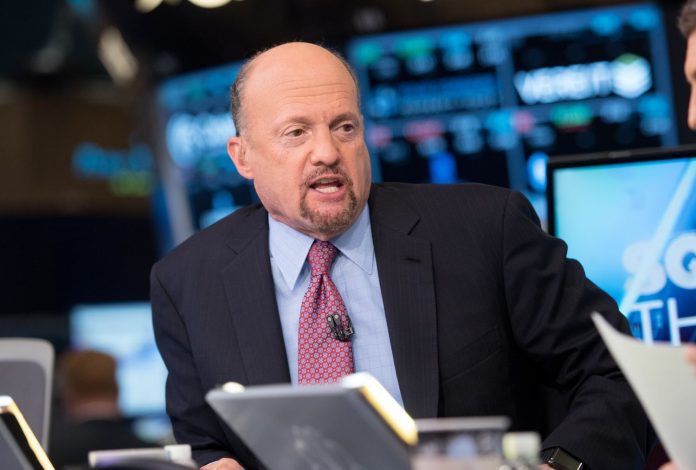

Trump–Nvidia–AMD Deal: Nothing Novel About Taking A 15% Cut – Cramer

0

CNBC’s Jim Cramer said Monday that President Donald Trump’s new arrangement with semiconductor giants Nvidia and AMD is far from unprecedented, likening it to past instances where the U.S. government took financial stakes in private companies.

Under the deal, confirmed by the White House, Nvidia and AMD will hand over 15% of their revenue from sales to China directly to the U.S. Treasury in exchange for licenses to export certain advanced chips to the country. The Financial Times first reported the agreement, which follows months of escalating restrictions on high-tech exports to China.

The arrangement marks a sharp turn in policy. The Trump administration had previously moved to block chip exports over national security concerns, prompting warnings from industry leaders that the U.S. risked ceding a lucrative $50 billion artificial intelligence market to foreign competitors. Nvidia CEO Jensen Huang had been among the most vocal critics of the restrictions, urging Washington to find a compromise.

Just last week, Trump imposed a 100% tariff on all semiconductor and chip imports — except those produced in the United States. Monday’s deal effectively exempts Nvidia and AMD from the full force of those tariffs, provided they share a slice of their China revenue with the government.

Cramer described the agreement as “basically just another form of tariff,” but one that might be more palatable to both industry and taxpayers.

“There’s nothing novel at all about taking a 15% cut,” he said on CNBC. “It’s not like Trump’s collecting this money personally… that 15% goes straight to the Treasury.”

While acknowledging “an element of pay-to-play” in the arrangement, Cramer said the policy was “benign” compared to other forms of government intervention in business. He pointed to historical precedents, such as the federal government’s investment in Chrysler during its 1979 near-bankruptcy and the capital injections into major U.S. banks during the 2008–09 financial crisis, both of which ultimately generated profits for the Treasury.

To Cramer, the most important aspect is not the revenue-sharing clause but the fact that the administration is allowing chipmakers to re-enter the Chinese market.

“The government intervened where it shouldn’t have, and then it changed course to do the right thing,” he said. “Wring your hands all you want, but this chip deal is good for the taxpayer and good for Nvidia and AMD. If the chipmakers aren’t complaining, why should we?”

The Trump–Nvidia–AMD deal follows Trump’s recent policy shift toward fostering “strategic cooperation” among U.S. tech leaders to counter China’s aggressive push into AI and semiconductor technology. In 2023, the Biden administration strongly supported the CHIPS and Science Act, providing billions in subsidies to domestic semiconductor production. That effort intensified in early 2025, following Beijing’s expansion of its own AI chip programs and increased subsidies for Chinese manufacturers.

In January 2025, Trump convened a closed-door meeting with Nvidia CEO Jensen Huang and AMD CEO Lisa Su at the White House. Sources familiar with the talks said Trump pitched a revenue-sharing model as a way to prevent U.S. firms from exhausting resources in cutthroat competition while Chinese rivals benefit. Under the arrangement, Nvidia and AMD will maintain separate R&D pipelines but will collaborate on certain AI chip projects, particularly those targeting defense, space, and high-performance data centers.

The deal underscores the Trump administration’s willingness to use unconventional trade and industrial policies to reshape the global technology supply chain while maintaining a focus on domestic manufacturing and revenue generation for the federal government. It also signals a more transactional approach to U.S.–China tech relations — one that could have ripple effects for other industries navigating between geopolitical tension and market opportunity.

VFD Group Delivers Near 80% Surge in Half-Year Profit Despite Soaring Finance Costs

0

VFD Group Plc has posted a strong profit surge for the first half of 2025, nearly doubling its pretax earnings from a year earlier, driven by robust investment income and disciplined portfolio management despite a significant rise in borrowing costs.

In its financial results for the six months ended June 30, 2025, the financial services and investment company reported a pretax profit of N6.03 billion, representing a 79.97 percent increase from N3.35 billion recorded in the same period of 2024. Post-tax profit rose notably to N5 billion from N2.5 billion, underlining the group’s resilience in a high-cost operating environment.

The earnings growth was anchored by a sharp jump in investment income, which climbed 49.5 percent to N37.5 billion compared to N25.1 billion in the prior year. The top contributors to this performance were interest from placements at N9.6 billion, investment income of N6.6 billion, interest from loans and advances totaling N6.2 billion, and N5.6 billion from interest on investment logistics. As a result, net investment income stood at N35.6 billion, up from N23.8 billion a year ago.

Gross earnings increased to N41.1 billion, representing a 43.99 percent year-on-year rise, while net revenue expanded by 44.74 percent to N37.9 billion. Operating profit rose sharply to N27.1 billion, a 64.15 percent increase from N16.5 billion in the first half of last year.

However, the group faced a steep rise in financing costs, with expenses linked to borrowings climbing 60.18 percent to N21.1 billion. Total operating expenses also grew, rising 11.54 percent to N10.7 billion from N9.6 billion in H1 2024. Even so, the strong revenue growth was enough to offset these pressures and deliver a healthy bottom-line expansion.

Chief Executive Officer Nonso Okpala described the half-year performance as the result of “deliberate strategic moves, disciplined portfolio management, improved group-wide efficiency, and focused capital deployment.”

Looking ahead, he reaffirmed that the group remains committed to its “North Star” strategy, which outlines a clear path toward continental expansion, deeper institutional capabilities, and securing market leadership.

The company’s performance has also been reflected on the Nigerian Exchange (NGX), where its shares have gained 63.51 percent year-to-date as of the trading day ended August 11, 2025, closing at N12.10 per share. Investor sentiment has been buoyed by the strong results, even as analysts caution that the rising finance costs could become a more pressing concern if borrowing pressures persist.

This robust showing in the first half of the year positions VFD Group for a potentially stronger full-year performance, though its ability to maintain this trajectory will depend on how effectively it manages funding costs while executing its ambitious expansion plans across the continent.

Money Isn’t The Most Important Thing: AMD CEO Pushes Mission Over Money in AI Talent War

0

AMD CEO Lisa Su has pushed back against the tech industry’s escalating pay packages for artificial intelligence talent, arguing that while money matters, mission and purpose remain the most powerful recruitment tools.

In an interview with Wired published Tuesday, Su was asked about Meta CEO Mark Zuckerberg’s strategy of offering lavish compensation to attract AI researchers, sometimes running into the hundreds of millions of dollars. While acknowledging the fierce competition for top minds, the 55-year-old executive dismissed the idea of billion-dollar offers ever coming from AMD.

“I think competition for talent is fierce. I am a believer, though, that money is important, but frankly, it’s not necessarily the most important thing when you’re attracting talent,” she said. “It’s important to be in the ZIP code of those numbers, but then it’s super-important to have people who really believe in the mission of what you’re trying to do.”

A High-Stakes Recruitment Battlefield

The AI talent war has intensified over the past two years, with major players like Meta, Microsoft, Google, and OpenAI offering multimillion-dollar salaries and massive signing bonuses to secure scarce expertise in machine learning, generative AI, and semiconductor design. Meta has reportedly offered some candidates $100 million to jump ship — a figure OpenAI CEO Sam Altman publicly described as “crazy” in a June podcast.

The poaching attempts have become so aggressive that some engineers report receiving job pitches within hours of announcing roles at rival companies. AI engineer Yangshun Tay, based in Singapore, told Business Insider that he received an email from Meta almost immediately after posting his OpenAI job offer on LinkedIn, asking if he would consider joining them instead.

Altman, like Su, has questioned whether such huge sums create the right workplace culture.

“The strategy of a ton of upfront guaranteed comp and that being the reason you tell someone to join, like really the degree to which they’re focusing on that and not the work and not the mission, I don’t think that’s going to set up a great culture,” he said on the June podcast.

AMD’s Position in the AI Race

Su’s stance comes at a critical time for AMD, which is racing to challenge Nvidia’s dominance in the AI chip market. The company’s latest AI accelerators, the MI300 series, are aimed squarely at powering large-scale AI models — a field that has seen explosive investment since OpenAI’s ChatGPT launched in late 2022. While AMD has historically competed with Intel and Nvidia in CPUs and GPUs, the surge in demand for AI-specific processors has pushed recruitment of elite chip engineers and AI scientists to the top of its priorities.

Culture vs. Compensation

Industry analysts say Su’s comments highlight a philosophical divide in Silicon Valley and beyond: whether the most groundbreaking work emerges from mission-driven teams or from talent lured by extraordinary pay. While there is no denying the influence of competitive salaries, Su’s emphasis on purpose mirrors a sentiment among some executives that innovation and loyalty come from those who buy into the company’s vision — not just its payroll.

With AI reshaping the semiconductor industry and demand for specialized talent outstripping supply, the question remains whether Su’s approach can hold the line against competitors willing to write nine-figure checks.

U.S. Budget Deficit Jumps 20% to $291bn in July Even as Trump’s Tariffs Swell Customs Revenues

0

The U.S. government’s budget deficit widened by nearly 20% in July to $291 billion, even as customs duty collections surged by almost $21 billion due to President Donald Trump’s tariffs, according to Treasury Department data released Tuesday.

The July shortfall was $47 billion higher than the same month last year, driven by outlays growing far faster than receipts. Federal revenues rose 2%, or $8 billion, to $338 billion, but spending jumped 10%, or $56 billion, to $630 billion — the highest ever for the month. The Treasury noted that July had fewer business days than last year; adjusting for that difference, receipts would have been about $20 billion higher, trimming the monthly deficit to roughly $271 billion.

Customs receipts in July soared to $27.7 billion from $7.1 billion a year earlier, reflecting the higher tariff rates imposed under Trump’s trade policy. The jump, largely consistent with June’s tariff collections, marks steady growth since April. For the first 10 months of the fiscal year, customs duties totaled $135.7 billion, up $73 billion — or 116% — compared to the same period last year.

Trump has repeatedly touted the tariffs as a windfall for U.S. coffers, though the duties are paid by importers, many of whom pass some of the cost on to consumers. This dynamic has fueled concerns that the levies could feed inflation, putting Trump at odds with Federal Reserve Chair Jerome Powell over the potential economic fallout.

Inflation data from July, however, showed a more nuanced picture. The Consumer Price Index revealed that while some tariff-sensitive categories saw price increases, the overall rise in prices was softer than anticipated. Household furnishings and supplies rose 0.7% after a 1% jump in June, apparel prices edged up just 0.1%, and core commodity prices increased by 0.2%. Prices for canned fruits and vegetables — often imported and sensitive to tariffs — were flat. Lower gasoline prices helped offset these increases in the broader index.

“The tariffs are in the numbers, but they’re certainly not jumping out hair on fire at this point,” said Jared Bernstein, a former White House economist who served under President Joe Biden, speaking on CNBC.

For the fiscal year to date, the U.S. deficit has reached $1.629 trillion, 7% higher than the same period last year. Revenues climbed 6% to a record $4.347 trillion for the 10-month period, while outlays grew 7% to $5.975 trillion, also a record.

Economists are divided over the long-term inflationary impact of the tariffs. While many see them as causing a one-time price adjustment, the broad range of goods covered under Trump’s orders has raised fears that price pressures could persist.

“Inflation is on the rise, but it didn’t increase as much as some people feared,” said Ellen Zentner, chief economic strategist for Morgan Stanley Wealth Management. “In the short term, markets will likely embrace these numbers because they should allow the Fed to focus on labor-market weakness and keep a September rate cut on the table. Longer term, we likely haven’t seen the end of rising prices as tariffs continue to work their way through the economy.”

As the September Fed meeting approaches, policymakers face a delicate balancing act of weighing persistent fiscal deficits, rising but tempered inflation, and the potential economic aftershocks of a trade policy that has both bolstered federal revenue and rekindled concerns over the cost of everyday goods.

With the tariff regime still in its early stages, economists warn the impact could intensify in the coming months, particularly if more categories begin to absorb higher import costs. However, July’s CPI suggests the inflationary effect is selective for now, but the full picture may yet unfold later this year.