
DD
MM
YYYY

PAGES

DD
MM
YYYY

spot_img

PAGES

Home Blog Page 7132

The Lagos State’s Laughable “Silicon Valley in 18 Months”

0

Across Africa, governments are converting abandoned public buildings into technology makerspaces and hubs. There is nothing wrong doing just that. I support them. But when they add the statement – “We’ll create Silicon Valley here”- in different fashions to those initiatives, I get very concerned for the lack of basic understanding of what it would take to have a Silicon Valley.

Pursuing the vision of creating Silicon Valley is noble. Everyone needs one, from Nairobi to Kigali, Kampala to Lagos, it would help, as we strive to diversify the African economy. But the plan by Lagos State to actually create Silicon Valley within “18 months” in Sabo Industrial Estate got me laughing.

The Lagos State Government said on Friday that it had concluded plans to transform the Sabo Industrial Estate in Yaba into a technology hub and a silicon valley within 18 monhs.

The state Commissioner for Science and Technology, Mr Hakeem Fahm, made the disclosure at the 2018 Ministerial Press Briefing in commemoration of the third year of the administration of Gov. Akinwunmi Ambode.

Fahm said that the transformation meant that a new set of entrepreneurs and innovators would be raised to address the challenges confronting the Information and Communication Technology (ICT) sector.

Mr. Commissioner, you cannot create Silicon Valley in Lagos within 18 months because there is really no formal zip code called Silicon Valley. Silicon Valley means 24/7 electricity, better schools, good roads, excellent teachers in schools, smart regulations, healthcare systems, security and those things no one wants to deal with in Nigeria.

Once you can produce those, Silicon Valley would evolve. No refurbishing of abandoned buildings or building useless fancy offices will create Silicon Valley if you do not have electricity, pay health workers to avoid strikes, etc. In Silicon Valley, their leaders visit hospitals in Silicon Valley and not those in London, Paris and Baltimore. That means, the hospitals in Silicon Valley work, and they pay workers, preventing strikes.

I do not want to discourage you, but remember that the Federal Ministry of Science & Technology has many “Silicon Valleys” in nearly all states in Nigeria. Yes, find abandoned government buildings, ask a contractor to supply computers, get some young people to go there daily, and magically you have a Silicon Valley. It is irrelevant if those young people have electricity to power those computers.

Of course, go ahead and re-build Sabo but there is no need to add “Silicon Valley” to the initiative. Adding Silicon Valley complicates a noble vision which is to add facilities which any decent community should have. Let us just focus on such before we begin the unhelpful comparison which adds no value.

Sabo will be fine to be Sabo (Lagos State) in 18 months. It does not need to be Silicon Valley. It simply needs to be a community with good roads, constant power, decent schools, solid security, good hospital, etc. If you make such happen, you have done all you need. The rest belongs to the promise of the future – no one knows. Possibly, Sabo could be Silicon Mars because it makes better sense than a Valley. Yes, Sabo boys and girls can go to Mars but it may not be in 18 months.

COMMENT ON LINKEDIN FEED

Politicians and their acolytes, they have once again activated the ‘reverse thinking’ or ‘inverted thinking’ mode, with one clear feature always present: lack of understanding about that is being copied or mimicked.

We have a Nollywood, with no physical address, but trying to mimic Hollywood; this time, it’s about renaming enclaves to ‘Silicon Valleys’, as if a name suddenly makes magical transformation, without the hardwork therein.

The fact that many of those in public service only see and understand tech innovations through the lens of ‘ICT’, says a lot about how knowledgeable they really are. Until they first learn to appreciate technology from the wider lens of knowledge economy, and do away with the already stale and mundane use of ‘ICT’ to convey their ineptitude about what tech innovation truly demands, in order to thrive; we may be stuck in this regurgitation for ages.

Sabo doesn’t need a ‘Silicon Valley’ emblazoned on its forehead in order to thrive, rather it needs just a change of mentality: knowing what needs to be done first, and then going ahead to do those things.
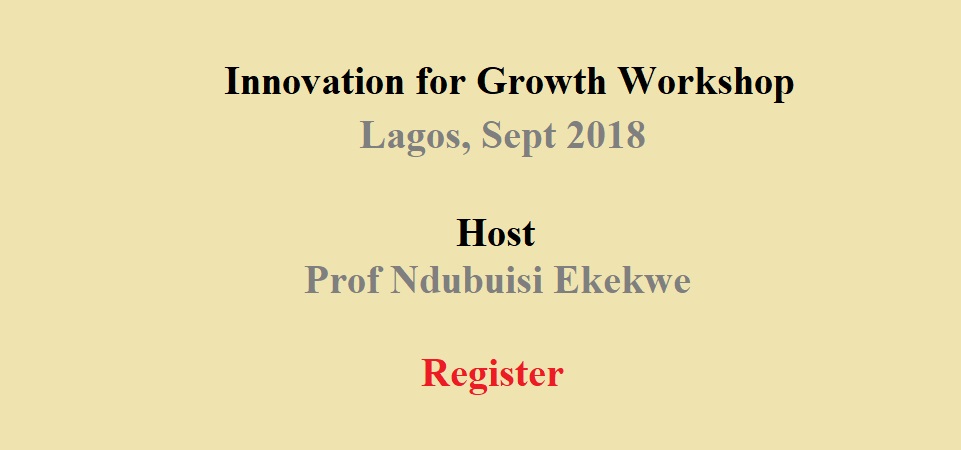
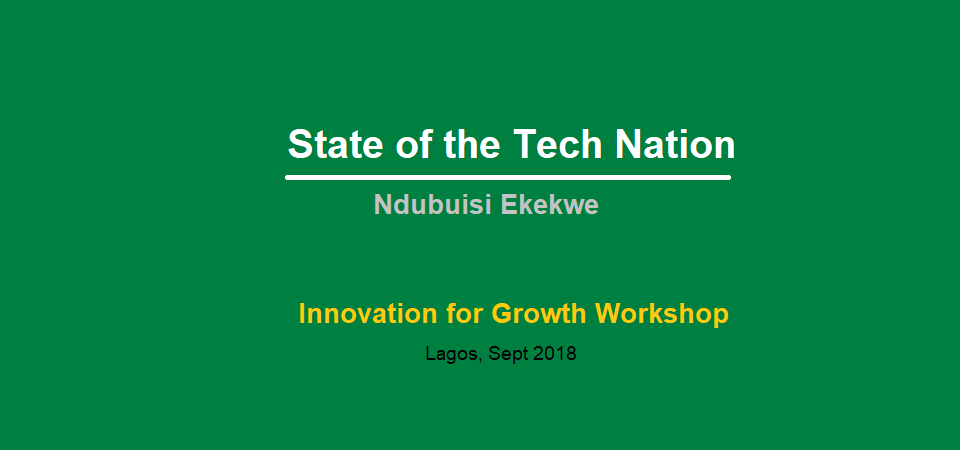
[Register] Innovation for Growth Workshop, Lagos – Sept 2018

1

Webmaster Note (N.U): This event has sold out. Please contact us for a new workshop we plan to run in Lagos.

The ITNews Africa, a South African publisher, has called me a “doctor of innovation”. As they were creating a new product – the “African Innovator Magazine” – they knocked at my door. The London-based Planet Earth Institute, a non-profit chaired by a former UK Chief Secretary to the Treasury, has recognized me as an “African science and technology pioneer”. From TED fellowship to the World Economic Forum’s Young Global Leader, through my doctoral degrees and master’s degrees, to my works on iPhone sensors, innovation has been my only strategy. I teach innovation, from South Africa to Vietnam, from Kenya to United States, and beyond. And on the pages of Harvard Business Review, I have been writing on innovation for years. And I live innovation in my businesses and we have won awards because we delight customers.

This September, I will bring an innovation workshop to Nigeria. I always come to Nigeria to lead programs for banks, insurers, technology companies, governments and more. The cost is above industry pricing, making it very hard for some firms to afford to host me solely.

To solve that, I am going to run an open [anyone can pay and attend] workshop for three days in September. The cost is N800,000 ($2,300) per participant. The venue would be Lagos.

State of the Tech Nation – This address will discuss Technology, Opportunities & Unlocking Wealth in Nigeria

Workshop Structure

To innovate is to set a new basis of competition in an economy, business sector or market. Typically, it results to disruption. This workshop will focus on innovation and growth because growth is the reward of innovation. Otherwise, that innovation is actually an invention. I will be the lead instructor with my supporting crew. The table below provides the workshop structure.

Day 1 – Innovation Discovery Day 2- Innovation Exploration Day 3- Innovation Design and Applications
The State of Nigerian markets State of the Tech Nation address Becoming a Digital Innovator
Mapping internal & external trends Innovation Translation Filtering & modelling [Business & Functional Vision]
Digital Innovation frameworks Emerging Technologies Labs with Innovation Roadmap Brief
Business Challenges Teamwork / Disruptive thinking Takeoff Vision & Frontiers (see video)
Enablers and Creativity tools The Category-Kings Benchmarking [Local  & International] Innovation Execution

Who should attend?

The workshop is designed for mid and senior leadership teams. These include CEOs, VPs, directors, technology, sales, marketing, strategy and finance leads in all business sectors. The workshop is aimed at:

  • Companies looking for new growth areas and products
  • Companies with potential, ambition and capacity for high growth
  • New company owners, founders and entreprenuers who want to build robust businesses.
  • Existing companies who want to engineer innovation within existing enterprises
  • Startups and their leaders who need directions on roadmaps and strategies
  • Governments and policy makers working to stimulate innovations

How to Register

There are two ways to register – either method works  for us.

  • Make a payment of N800,000 to any of our bank accounts here [you can also use Interswicth and GTPay, though you can just make the transfer to our bank directly]. Once you make payment, email the contact below.
  • Make payment via Paypal using our FASMICRO U.S.A. merchant account for $2,300. Once you do, contact the email below. Use this link here to process the payment via Paypal.

Before the Program [Your Innovation Roadmap Brief]

Once you make payment, my team would reach out. We would need at least a two-page document frOm you, explaining your business (or function) and the challenges you are having or what you expect. Using the insight, we would develop an Innovation Roadmap Brief which will be sent to you before the program starts. That document would form a part of your Lab during the workshop. Our workshop ensures we look into your business (or functional role) and you leave our program with clarity on execution.

Venue

This event will take place in Lagos (Nigeria), September 2018, in a leading hotel. We would share with registered participants.

Expected Outcome

My goal is that after this workshop, you would have a clear roadmap to execute innovation at a company-wide or functional level. My workshops are intense, practical and interactive with local cases flavored with international examples, making sure you are global-aware even as you plot a gloCal strategy (see my Harvard piece on this]. I will focus on the growth of your business (or your functional role), and I expect you to return to work with clarity on how to make innovation happen at scale.

First Come, First Serve

We have limited space. Once we reach capacity, we would stop accepting participants. So, register immediately. You can also inform my team via email to reserve space immediately while you seek approval for payment [they typically give a time frame for that].

About Prof Ndubuisi Ekekwe, PhD

Please read about me here.

Refund Policy

We would refund you 100% of your payment up to 24 hours before the program starts.

Discounts

We offer discounts for multiple registrations. Please contact team via email below.

Questions

Please email tekedia@fasmicro.com. My team would follow up. We hope to meet you in Lagos.


Cellulant Raises $47.5M to Battle Paystack, Flutterwave, others on Digital Payments

0

The most exciting space in Africa to raise money at the moment is in fintech. Agtech (agricultural technology) comes second but the separation is huge. Fintech is raising money because Africa is still largely a cash-based economy, as I noted yesterday. Investors understand that the future is going to be digital, and they are pumping money into startups working to digitize African payments. Despite what we have done so far, about 98% of all consumer-to business-transactions are still cash-based in Nigeria.

According to research done by The Fletcher School and MasterCard, of the $301 billion of funds flow from consumers to businesses in Nigeria, 98 percent is still based on cash.

Yet, most firms are focusing too much on “clicks” neglecting “bricks”. If 98% of your revenue is coming from bricks today, you cannot neglect the physical. Do not listen to them when they say that today is mobile and online. Sure, the future promises mobile and online, but we have to survive today.

Do not be intimidated with the alarms on online disruption: the glory on the clicks is a promise. But “bricks” is on our hands. You are investing too much for clicks and your management is focusing largely exclusively on clicks. No one cares about the bricks. Unfortunately, the “bricks” customers are noticing. They are not happy in your stores.

So, digital payment companies have 98% of opportunities ahead to be tapped. If they can move from 2% digital payment penetration to 50% of the $301 billion, they would be earning about $4.5 billion on fees if the average commission is 3%. This explains why you are seeing foreign and local investors throwing cash on fintech companies with specific focus on payments. Yes, those companies include Paystack, Flutterwave, and just few hours ago Cellulant. Cellulant raised $47.5 million from TPG Growth fund (along with others).

The Rise Fund owned by private equity firm TPG Growth, led a $47.5 million investment in Cellulant, an African digital payments provider with operations in Kenya and Nigeria.

The deal which includes Endeavour Catalyst and Satya Capital and was announced on Monday, 14 May, is the first of its kind in Africa not just for the firm but it is the largest involving a fintech company that does business in Africa. The last time a fintech company received equity investment exceeding two digits was in 2017 when Flutterwave secured over $10 million.

“This accelerates the company’s goal of becoming the number one digital payments and financial services provider,” Bolaji Akinboro, co-founder of Cellulant and CEO of Cellulant Nigeria said on Twitter on Monday morning.

Cellulant was established in 2004 by Ken Njoroge (Kenyan) and Bolaji Akinboro. Initially, the founders focused the company in providing music and news content on mobile to consumers in Kenya and Nigeria. The company began to diversify into mobile money services in 2005. It was awarded a mobile payment license by the Central Bank of Nigerian in 2014 which helped to facilitate its partnership with the Nigerian government to supply fertiliser to farmers using a mobile wallet scheme.

Cellulant has operations in 11 countries including Ghana, Tanzania, Zambia, Zimbabwe, Uganda, Liberia, Malawi, Botswana, and Mozambique, with 94 banks and seven mobile money platforms that have a combined potential customer base of 130 million

This is just a starting point – the startups would need multiples of these amounts to scratch the sector. The challenge is really that they would have to build the foundation infrastructure since government has not provided most basic amenities. Think of offering merchant digital payments when there is no electricity and connectivity. And that is also why what they are doing is exciting: if they build these systems now, they could lockup the opportunities if everything runs on their pipelines. There is no doubt – fintech would offer Africa the first major exit in the startup world.

Building an Exponential Organisation

0

by Mehmood Khan, Chief Operating Officer at SAP Africa

The term ‘exponential organisation’ was first introduced in a 2014 book by the Singularity University founding director Salim Ismail and co-authors Michael Malone and Yuri van Geest. An exponential organisation is one governed by an assumption of abundance, where the typical constraints of linear organisations – for example, building more offices in new locations and equipping them with the requisite staff and facilities – are bypassed through clever use of technology that enables low organisational demands.

Airbnb is a typical exponential organisation: instead of establishing new locations for guest houses and hotels, building and equipping those locations, maintaining the properties, and sourcing and retaining staff, Airbnb accumulates listings around the world without incurring the capital expenditure to which most hotel groups are subject, leveraging technology to deliver a seamless and enjoyable customer experience that is often largely self-governable.

The DNA of exponential organisations

What nearly all exponential organisations have in common is a digitised supply chain that enables rapid scaling and frictionless customer experiences, often across global markets. They make use of technological innovations to compete on even footing with even the largest organisations, and then leverage an abundance mindset to move faster and more effectively than their bigger competitors.

Essentially, an exponential organisation is structured in such a way that they are able to fully realise the benefits of the digital economy. And within this, the COO plays a critical, often unseen role in ensuring the organisational building blocks are in place to enable the realisation of the exponential organisation.

In an EY study, half of the global COOs polled were closely engaged in discussing the role that operations can play in business transformation, with 57% seeing this as a fundamental part of creating organisational value. This is key to shifting the role of the COO from a largely operational one to a more strategic one.

The COO balancing act

Since the COO controls how organisational resources are allocated and prioritised, he or she must ensure that such resources are in the right place at the right time to enable the effective execution of exponential organisational strategy. However, in the same EY study, only half of COOs polled had identified opportunities to get operations involved with strategic decision-making. This creates a dilemma for the COO: their function within the organisation demands a firm focus on current demands, while their longer-term and arguably greater impact rests firmly in the future.

Technology has a critical role to play in enabling the COO to execute on broader strategy initiatives that can take a linear organisation – one focused on exploiting vertical market dominance – to an exponential one. Predictive analytics, for example, can combine sensor-based data with machine learning and AI capability to equip COOs with live insights into the current performance of the digitised supply chain. This frees up some of the COO’s time to focus on the more high-yield strategic initiatives that will ensure the organisation’s long-term competitiveness and sustainability.

A to-do list for the exponential COO

A recent IDC infographic pointed to the top five business priorities for executives right now, including reducing external supplier costs, outperforming the competition, improving security (necessitated by increased connectivity), regulatory compliance, and improved customer service. However, the priorities are going to shift greatly over the next few years, with one key priority falling straight in the ambit of the COO: improving adaptability and flexibility of the supply chain.

The fundamental role of the traditional COO is to ensure that operations quality, efficiency and customer services are improved and optimised through their interventions. In a digital economy, I would argue there is a new dimension fundamental to the effective functioning of the COO: removing friction within the organisational value chain by effecting a digital supply chain. Customer demands for personalised service and individualised products means organisations need to be highly responsive to individual needs and desires. The growing complexity of doing business also requires technological intervention to ensure COOs are not left treading water, endlessly dealing with current problems and challenges and losing sight of the longer-term strategic value that will elevate the business.

COOs can start laying the foundation of a future exponential organisation now by focusing on five key actions, namely:

1. Improved customer centricity;

2. Investment in smart automation;

3. Enabling predictive business decision-making;

4. Ensuring total visibility across all lines-of-business; and

5. Leveraging a digital innovation platform powered by IoT, blockchain, AI, machine learning and analytics, to enable secure process automation, better decision-making, and faster and more accurate responses to customer demands.