DD
MM
YYYY

PAGES

DD
MM
YYYY

spot_img

PAGES

Home Blog Page 717

How Google, News Media Commodified Wasiu Ayinde’s Airport Incident

0

When news broke of the confrontation between Wasiu Ayinde, popularly known as KWAM 1 or K1 De Ultimate, and ValueJet at Nnamdi Azikiwe International Airport in Abuja, the story followed a predictable path in Nigeria’s digital information ecosystem. It began as a celebrity scandal, quickly became the subject of news reports, and then turned into a searchable commodity shaped by Google’s indexing logic and amplified by media framing.

In this piece, our analyst notes that at first, the incident appeared to be just another airport altercation involving a public figure. However, search data reveals a deeper process. Public interest was not simply recorded; it was actively shaped and packaged into thematic clusters that serve both the news industry and the search economy.

From Incident to Search Commodity

Direct incident terms such as “KWAM 1 Abuja airport” and “KWAM 1 ValueJet” recorded hundreds of thousands of indexed results. For instance, “KWAM 1 Abuja airport” generated about 279,000 search results, while “KWAM 1 ValueJet” had around 235,000. Yet these numbers were modest compared to thematic aviation-related terms. “Aviation safety Nigeria” returned over 65 million results, and “no-fly list Nigeria” appeared in almost 40 million results.

This difference shows that once the story entered Google’s ecosystem, it was no longer treated only as a celebrity dispute. Our analyst points out that algorithms began associating it with high-volume and evergreen aviation topics. This ensured that the content remained relevant to a much larger audience and could attract clicks long after the initial news cycle ended.

How the News Media Framed the Story

Media coverage did not limit itself to narrating the confrontation. Traditional and digital-first outlets linked the incident to governance and security, bringing in institutional actors such as the Federal Airports Authority of Nigeria (FAAN), which had over 1.58 million indexed results, and the Nigerian Civil Aviation Authority (NCAA).

This type of framing benefits both the media and the search engine. For media houses, connecting a celebrity incident to official agencies adds credibility and extends the story’s appeal to readers who may be more interested in aviation governance than entertainment gossip. For Google, these institutional references strengthen the semantic connections between the incident and ongoing public policy debates, which helps the story remain visible in search results for months or even years.

Themes and Issues as the Real Traffic Drivers

The search volume for aviation-related themes far surpassed that of the incident-specific keywords. Aviation safety, no-fly lists, and airport security dominate the search space. For example, “airport security Nigeria” generated more than 29 million results.

This shows that the incident was quickly absorbed into a wider conversation about aviation safety and passenger conduct. For Google’s algorithm, these thematic connections are valuable because they keep articles about the incident ranked highly for as long as those themes remain relevant. For the news media, it means that stories can be republished or reframed under broader aviation or security headlines, prolonging their commercial value.

The Underused Legal and Regulatory Angle

Legal references such as “Section 459A Criminal Code Nigeria” and “obstruction of aircraft Nigerian law” appeared far less frequently in searches, even though they were part of some reports. While “aviation regulation compliance Nigeria” had more than three million results, specific statutes remained niche and did not draw significant search traffic.

This suggests that although the media mentioned legal consequences, they did not succeed in making them central to the public conversation. For Google, the lower search interest in these legal terms meant they were deprioritised in ranking. For the media, it was a missed opportunity to connect the incident to deeper discussions about Nigeria’s aviation laws.

Co-occurrence Patterns and Search Economies

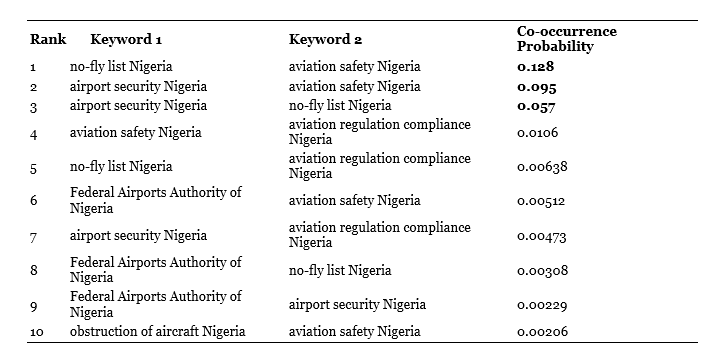
A co-occurrence probability analysis showed that the strongest connections were between “no-fly list Nigeria” and “aviation safety Nigeria,” “airport security Nigeria” and “aviation safety Nigeria,” and “airport security Nigeria” and “no-fly list Nigeria.” These are broad, structural themes that exist independently of KWAM 1’s celebrity status.

The data suggests that while the incident was the entry point for attention, the enduring search value lies in these generic themes. This is a key part of commoditisation: a transient event is repurposed into content that serves as an anchor for ongoing search interest.

Exhibit 1: Top 10 keyword pairs most likely to trend together based on search volume co-occurrence probabilities
Source: Google, 2025; Nigerian News Media, 2025; Infoprations Analysis, 2025

The Algorithm as a Cultural Broker

Google does more than passively index events. It acts as a cultural broker by determining which parts of a story will continue to be searchable and which will fade away. Specific keywords like “KWAM 1 Abuja airport” may spike in the short term but will eventually decline. Broader terms such as “aviation safety Nigeria” will keep trending and will continue to pull in any content historically linked to them.

For the news media, understanding this means adapting their coverage. By pairing celebrity names with broader themes and institutional references, they can secure long-tail discoverability. This is why many reports blended the details of the incident with discussions of safety, security, and regulation. It was not just a matter of journalism; it was also search-engine optimisation.


Implications of the Mizuki Anime Shorts NFT Minting on OpenSea

0

The Azuki “Mizuki Anime Shorts”, ERC-1155 NFTs, priced at 0.0014 ETH with no wallet or whitelist restrictions, aim to fund the production of the Mizuki anime short film, directed by Gensho Yasuda and featuring Mizuki (Elemental #9195), a character from the Azuki universe. Proceeds support the creative team, promoting decentralized financing for animation projects.

The collection is designed to be accessible, targeting a broad range of fans and collectors, and is part of Azuki’s broader Web3 anime ecosystem, The Garden.  By channeling proceeds to the creative team, Azuki pioneers a decentralized funding model that bypasses traditional media financing, empowering creators and collectors alike.

The low mint price and open minting period (one week initially, followed by a six-month open period for the standard version) encourage widespread participation, strengthening community ties and fostering a sense of ownership in the Azuki narrative. The Mizuki Anime Shorts project integrates tokenized collectibles with narrative content, allowing collectors to own “First Edition” pieces of the Mizuki storyline.

This fusion of digital collectibles and storytelling sets a precedent for how NFTs can extend beyond static art to become integral to media production and fan-driven narratives. By featuring Mizuki, a character from the Azuki Elementals collection, the project ties into the broader Azuki universe, enhancing narrative continuity and deepening fan engagement through recognizable ccharacters.

The partnership with OpenSea, the world’s largest NFT marketplace, amplifies Azuki’s visibility and accessibility. OpenSea’s platform provides a trusted and scalable infrastructure for minting and trading, leveraging its significant reach to attract new users to the Azuki ecosystem. This collaboration builds on Azuki’s history of high-profile partnerships (e.g., with AniplexUSA and IPX), signaling its ability to bridge Web3 and traditional anime industries, which could lead to further mainstream adoption.

Following criticism over the Azuki Elementals mint in 2023 for lack of originality and technical issues, the Mizuki Anime Shorts project emphasizes transparency in its purpose (funding animation) and accessibility. This move addresses past community concerns, aiming to rebuild trust and align with fan expectations.

The project’s focus on cultural relevance within the anime universe and its playful, otaku-friendly tone (e.g., “more waifus in your wallet”) resonates with Azuki’s core demographic, reinforcing brand loyalty. While the low mint price broadens access, gas fees and market volatility could still deter casual fans, particularly in regions with lower purchasing power.

Azuki’s premium brand image may also create a perception of exclusivity, potentially alienating new entrants. The success of this model depends on sustained community engagement and favorable market conditions, as previous Azuki collections faced price drops post-launch (e.g., Elementals floor price fell to 0.24 ETH from 2 ETH).

How This Trend Enhances Azuki’s Web3 Anime Ecosystem Footprint

The Mizuki Anime Shorts build on Azuki’s existing anime ventures, such as the “Enter the Garden” anthology series and the Anime.com platform. By integrating NFTs with animated content, Azuki strengthens its transmedia strategy, creating a cohesive universe where digital collectibles, storytelling, and community interaction converge.

The project supports Azuki’s vision of “Anime 2.0,” where fans co-create and own parts of the narrative through NFTs, enhancing its reputation as a pioneer in decentralized anime production. By targeting anime fans beyond the NFT space, the Mizuki Shorts tap into a global audience of over one billion anime enthusiasts. The accessible pricing and cultural resonance with otaku culture.

Azuki’s ecosystem, including The Garden and Animechain, empowers holders to influence narratives and participate in events (e.g., the Mizuki drawing contest). The Mizuki Shorts extend this by enabling collectors to fund and own pieces of the creative process, fostering a community-driven economy.

The use of the ERC-1155 standard reduces transaction costs, making it easier for fans to participate, which could set a standard for future Web3 creative projects. The launch of the ANIME token in January 2025 and initiatives like Anime.com and Animechain underscore Azuki’s ambition to transform the anime industry into a community-owned network.

The Mizuki Shorts reinforce this by showcasing practical applications of NFTs in funding culturally relevant content, positioning Azuki as a leader in Web3 culture coins. The project’s alignment with anime’s cultural significance and its integration with blockchain technology enhance Azuki’s brand as a bridge between Web2 and Web3, appealing to both traditional anime fans and crypto natives.

Successful execution of the Mizuki Shorts could pave the way for more tokenized anime projects, potentially integrating with planned initiatives like the Azuki Trading Card Game or Anime.com’s digital asset ecosystem. This could increase the utility and value of Azuki NFTs, including the Mizuki Shorts, over time.

The Mizuki Anime Shorts NFT minting on OpenSea is a strategic move that enhances Azuki’s Web3 anime ecosystem footprint by pioneering decentralized financing, broadening accessibility, and deepening community engagement. It strengthens Azuki’s transmedia brand, leverages strategic partnerships, and positions the project as a cultural and technological innovator in the anime and NFT spaces.

The 39% U.S. Tariff on Swiss Goods, Particularly Gold Bars, Threatens Switzerland’s Economy

0

The United States has imposed tariffs on imports of one-kilogram and 100-ounce gold bars, as reported by the Financial Times, citing a July 31, 2025, letter from U.S. Customs and Border Protection (CBP). These bars are now classified under a customs code subject to levies, reversing expectations that they would be exempt.

The tariff, part of reciprocal measures by the Trump administration, includes a 39% rate on Swiss goods, significantly impacting Switzerland, the world’s largest gold refining hub. Switzerland exported $61.5 billion in gold to the U.S. in the year ending June 2025, with approximately $24 billion now potentially subject to tariffs.

This has disrupted global bullion flows, with Swiss refineries halting or reducing shipments due to the new costs and uncertainty. Gold futures in New York surged to a record high of $3,534.10 per ounce on August 8, 2025, with December contracts trading at a $100+ premium over spot prices, which remained near $3,400.

The move has sparked market turmoil, raised concerns about the U.S. futures market (Comex), and could affect global gold trade, including indirect impacts on markets like India. There’s speculation the ruling may be challenged legally, and it’s unclear if larger 400-ounce bars, common in London, will also face tariffs.

Switzerland, the world’s largest gold refining hub, processes around 70% of global gold and exported $61.5 billion in gold to the U.S. in the year ending June 2025, with roughly $24 billion now subject to tariffs. The 39% tariff on one-kilogram and 100-ounce gold bars, critical for the U.S. Comex futures market, makes exporting these bars economically unviable, as noted by the Swiss Precious Metals Association.

Swiss refiners, who typically earn slim margins (a few dollars per ounce) for recasting gold, face significant financial strain. The tariff could halt exports to the U.S., disrupting the global flow of physical gold, as Switzerland serves as a key intermediary between markets like London and New York.

Impact on Trade Balance and U.S.-Swiss Relations

The U.S. justifies the tariffs by citing Switzerland’s $48 billion trade surplus, driven largely by gold exports ($36 billion in Q1 2025 alone). However, the Swiss National Bank and analysts argue that gold should be excluded from trade balance calculations, as it is processed rather than produced, distorting economic metrics. The tariff, one of the highest among developed nations, has strained U.S.-Swiss trade relations.

Swiss efforts to negotiate a lower rate (e.g., 10-15% like the EU or UK) have been unsuccessful, with President Karin Keller-Sutter unable to secure a meeting with Trump. The KOF Swiss Economic Institute estimates that the 39% tariff could reduce Swiss GDP by 0.3% to 0.6% over the next year if sustained, with non-gold sectors like watches, machinery, and chocolate bearing the brunt.

Swiss manufacturers warn of tens of thousands of jobs at risk, particularly in export-reliant industries. The Swissmem manufacturing association called the tariffs “economically incomprehensible,” noting that every second franc in the Swiss economy comes from foreign trade. Swiss goods in the U.S. will become significantly more expensive compared to EU (15% tariff) or UK (10% tariff) imports, reducing competitiveness.

For example, luxury watchmakers like Breitling may raise prices or accept lower margins, with some firms already furloughing employees. While pharmaceuticals are currently exempt, a pending U.S. Section 232 investigation could impose tariffs up to 200%, threatening Switzerland’s $35 billion pharma export sector.

The Swiss franc, already up 11% against the dollar in 2025, faces pressure as tariffs weaken export sectors. This could exacerbate deflationary trends, as seen in Switzerland’s return to deflation in May 2025, prompting the Swiss National Bank to cut interest rates to zero. Switzerland’s neutrality and role as a global gold hub are under strain.

The Swiss government is pursuing dialogue, proposing increased U.S. LNG imports to offset the trade deficit, but Trump’s focus on reducing the $40 billion U.S. trade deficit remains a hurdle. Switzerland is pivoting to diversify trade, particularly toward Asia (e.g., India’s growing luxury market), and deepening EU ties to mitigate U.S. market losses.

Swiss firms like Roche and Novartis are also investing $50 billion in the U.S. by 2030 to hedge against potential pharma tariffs. The tariffs impose a “rising risk premium” on Swiss financial assets, potentially weakening the Swiss equity market and franc. Investors are advised to overweight gold and Swiss real estate as safe-haven assets.

While the gold refining industry’s direct economic impact is modest, its role in global trade and Switzerland’s trade surplus amplifies the tariffs’ effects. The Swiss government and businesses are adapting through diversification, dialogue, and furlough programs, but the high tariff rate—compared to lower rates for the EU and UK—could cost Switzerland 0.3-0.6% of GDP and strain its export-driven economy.

Pinterest CEO Labels Platform “AI-Enabled Shopping Assistant,” To Reassure Investors Amid Relevance Concern Following Rise of Agentic Web

0

Pinterest CEO Bill Ready is attempting to reassure investors that the platform remains relevant in an AI-driven future, positioning the company not just as a social and inspirational site, but also as an “AI-enabled shopping assistant.”

His comments came during Pinterest’s second-quarter earnings call, where he sought to address concerns about the rise of the “agentic web” — a concept in which AI agents could eventually shop on behalf of users, bypassing platforms like Pinterest entirely.

Ready acknowledged that such a future could disrupt Pinterest’s position in the shopping funnel. The platform traditionally thrives at the early stage of the shopping journey, where users seek inspiration before making purchasing decisions. But in a world where AI could fully anticipate and fulfill users’ shopping needs, platforms that depend on user browsing and discovery could see engagement dwindle.

Still, Ready said that scenario is “a very, very long cycle” away, noting that most consumers are not yet ready to surrender full shopping control to an algorithm — except in simple, utilitarian cases.

Instead, he framed Pinterest as already functioning like a personal shopping assistant, even if users don’t describe it that way.

“When users say things like ‘Pinterest just gets me,’ it’s because they can open the app and get proactive recommendations that match their taste and style — just like a great personal shopping assistant would,” Ready said.

He described the current period for AI innovation as a “Cambrian moment,” pointing to Pinterest’s use of AI-powered personalization and recommendation systems, proprietary multimodal AI models that combine text and images, visual and conversational search features, and AI-driven ad targeting efficiencies.

However, the company is also navigating the downsides of AI. Pinterest has faced growing user frustration over an influx of low-quality, AI-generated content cluttering feeds. Earlier this year, it introduced labels for AI-created images and filters, allowing users to block generative AI pins. There have also been unexplained mass account bans, which users suspect are linked to overly aggressive automated moderation systems — an issue Pinterest has downplayed as an “internal error” but one that mirrors similar problems at Facebook, Instagram, and Tumblr.

On the talent side, Ready said Pinterest is competing in the intense market for AI expertise by appealing to developers who want their work to have a “positive” impact. He stressed the company’s mission to use AI “responsibly,” positioning Pinterest as a healthier alternative to the toxicity often associated with other social platforms.

Wall Street reacted coolly to the earnings report. Pinterest posted revenue of $998 million, surpassing sales expectations, but adjusted earnings per share came in at 33 cents, below the 35 cents analysts had forecast. The company also highlighted its growing appeal to younger audiences, with over half of its monthly active users now from Gen Z, and male user numbers jumping 95% year-over-year.

Suppose investor concerns about the agentic web persist. In that case, Pinterest may face pressure to prove that its AI-enabled shopping assistant model can withstand the seismic shifts in e-commerce that next-generation AI could bring. However, Ready’s betting that human curiosity and the desire for inspiration will keep users browsing, not just buying, for years to come.

As 9Mobile Rebrands To T2, T2 Must Pay Attention to PMVQ

0

What is in a name as 9Mobile rebrands to T2? “Nigeria’s fourth-largest telecommunications operator, 9mobile, has officially rebranded to T2, marking what company executives describe as the dawn of a “bold new chapter” in its history. The unveiling took place on Friday at the Eko Convention Centre in Lagos, a year after LH Telecommunication Limited acquired a 95.5 percent controlling stake in the operator.”

I have used this brand for a case study on product minimum viable quality (PMVQ). A PMVQ in Tekedia’s context refers to the idea that a product doesn’t need to be perfect from the start, but it must have a baseline level of quality that meets the needs of the target market at a specific price point. It’s a practical approach to product development that acknowledges the importance of price considerations and market segmentation when determining acceptable quality levels.

The parent of T2 was Etisalat which at its peak offered the highest quality broadband service in Nigeria, but it was expensive. Then, you would be spending about 3x on cost for the same bandwidth compared with MTN or Airtel. But you would get value from Etisalat. But unfortunately for Etisalat, there were not many customers who needed that level of quality at the price point offered. Glo was not a category-king, but its services were affordable; it picked users then.

However, there was a redesign in the market as Airtel and MTN gained on quality, and the quality level largely became like an industry hygiene factor. Price became the dominant differentiator, and Etisalat lost its leverage. Then, it faded, and morphed to 9Mobile.

But today, it is reborn as T2, and it has another opportunity. For this company to thrive, it needs to define its segments. Do not pursue the entire segment at once, as that would be tough in a world where MTN is minting cash. Yes, pay attention to PMVQ, with a clear mindset that quality without the consideration of cost is an illusion.

This means you cannot pursue quality without checking if that will move you out of your sweet spot with customers. No one buys the electric bulb used in airports that costs $10,000 and lasts for 10 years for their house; we buy the cheap ones that last about 18 months for less than $2.

T2, good luck.