DD
MM
YYYY

PAGES

DD
MM
YYYY

spot_img

PAGES

Home Blog Page 7224

Why Your Online Sales Are Failing

0

Last year, we did a project for an East African company which had wanted to go big on online sales. The company had tried many things but had struggled to boost its online channel revenue. The firm wanted to know why despite its capacity to bring customers to its sites, getting them to buy things was not happening. This firm is not an ecommerce company; selling things online does not make a company an ecommerce firm. For the firm, online is just an additional channel to sell products: without the web, this company has a business offline, unlike a typical ecommerce firm which is largely dependent on digital channels.

We wrote codes to analyze the site and put applets to essentially understand what people do when they arrive. I bought things myself to understand the challenges. We re-created the scenarios and asked people to test different experiments. We also hired some shoppers, we spoke and interviewed people.

Simply, after our experiments, we noticed many things. I will share one of them here. The address has an optional zip code field. It turns out that many shoppers were rattled by its presence. Zip code is very common in U.S. websites. And African developers have adopted it in many stores they build online in the continent. That is unfortunate since we do not have functioning zip codes in the continent.
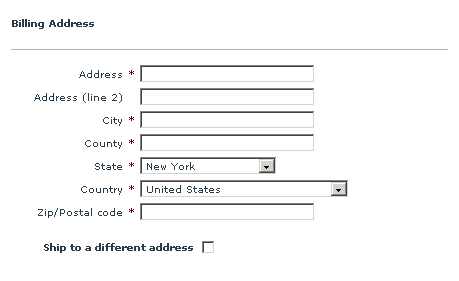
Typical U.S. address template with Zip Code field

We asked the client to remove the zip code field. Immediately, the conversion rate went up. Yes, zip code could destroy your online store capacity to get customers to buy. Our finding was that it frustrates shoppers by asking them to provide something they cannot technically provide. No one knows his or her zip code in Nigeria unless you are working in the Post Office. Yet, asking for that, even optional, is common in online stores in Nigeria.

Please remove that field. You can borrow a line from Tekedia store here. We have only email and password. No need for address or zip code [we sell virtual things]. Then in stores in our other businesses, we make sure we ask for address in comment format, not the typical address structure, to ensure customers have the freedom to explain it in any form he or she wants. We do not use the limiting U.S. address format.
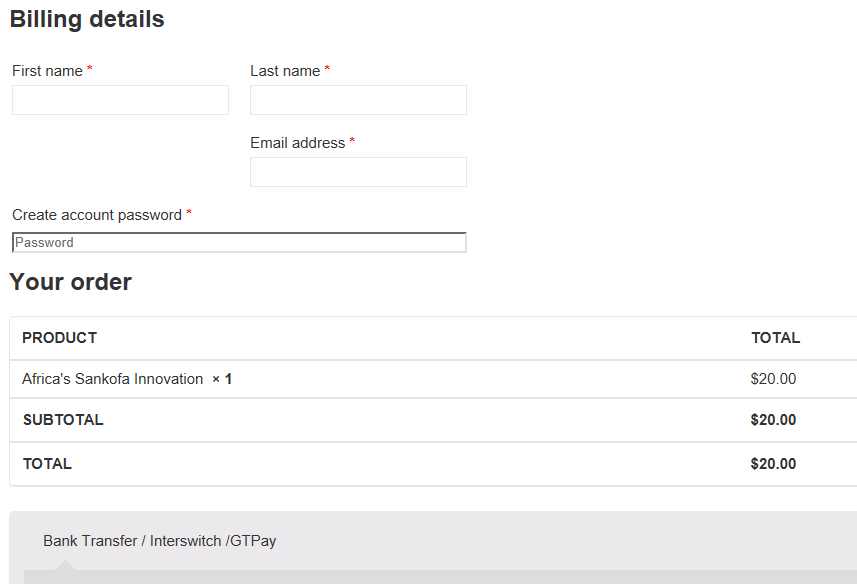
Tekedia Address format (here, we removed the zip code and address fields)


So, someone could write for address as thus: “The bungalow painted white behind Mr. Biggs, after the fuel station by the left. There is a water tank painted on top, if you are looking from the express.” This address would not fly in most U.S. address templates but not giving the customer this freedom will convince him or her that you would never ship that item since there is no way you could trace the house, to deliver the item. If you do not have what the customer thinks he/she needs to explain the address, the person would close the browser.

You need to take a harder look on what you copy and paste from systems and solutions engineered for U.S. and European markets. Those could be causing your conversion problems [inability to convert visitor traffic to revenue]. If you visit your store traffic, and only very few customers are finishing payment, you have a real problem in your hand. Before you call the payment company, check if those fields in the address form are in order. It could be as simple as not giving enough fields for someone to “explain” the address. Yes, in Africa, we explain address, and not just “write” one. The U.S. template was engineered for writing an address, but typically fails when there is no formal address, as typical in our lands.

Neither Silver nor Bronze in America

2

If football (yes, the real football) had been invented in America, there would neither be Silver nor Bronze prizes in competitions. Largely, U.S. does not believe in any prize that is not No.1 (the Gold), and that is why in most of its games, competitions and prizes, minimal provisions are made for second or third places. It is either you are No. 1 or you go home without a metal.

Yes, in the soccer, American football, baseball and hockey, there is nothing like 3rd place medal. That thinking is what drives America. They do not derive joy in coming second, and they have made their systems to eliminate second places. President Donald Trump has amplified this philosophy which has been at the core of the superpower, even though muted in past presidencies.

Boldly, the U.S. does not believe in the “Rise of the Rest” because it views that as destabilizing. In a recent report, the U.S. Defense Department made it clear that the “great-power competition” [with China and Russia], not necessarily terrorism, must drive U.S. national security. The report notes that China and Russia are actively working to “co-opt or replace the free and open order that has enabled global security and prosperity in since World War II.” Simply, if China rises, the world would see imbalance. And if Russia comes up, there would be a dislocation. Essentially, the global order which must exist is the one which America holds the Gold medal.

America has the right to its philosophy on its national security. They have the technology, economy, military might and they fought themselves into the position they are today. No one gave it to them. Joggling for that position is part of humanity: yes, it has been like that since the days of Nebuchadnezzar through Caesar to the British Empire.

On Friday, the U.S. Defense Department released an 11 page unclassified summary of its 2018 National Defense Strategy identifying competition with China and Russia as “principal priorities” for the US military. The report, distilled from a more detailed classified document submitted to Congress last year, warned that the two U.S. rivals are actively seeking to “co-opt or replace the free and open order that has enabled global security and prosperity in since World War II.” Henceforth, “great-power competition,” not terrorism, must be the primary focus of U.S. national security, the report declared: “The central challenge to U.S. prosperity and security is the reemergence of long-term strategic competition,” primarily from China and Russia. (Fortune Newsletter)

Implications

You may not like that way of thinking because we like to preach win-win and co-opetition in markets. But the way I see it is that America wants domination, from its governments to its startups. That is how they are educated and that is how they play sports. Yes, the only win is when you have all the cakes, for the United States of America.

Contrast that with our Nigerian mindset; you will see where things change. That global domination is not just in our way. One of our former presidents was so disturbed with so much money in our national bank account that he started paying salaries of striking workers in other African countries. Had it been an American president, he might have asked for a piece of territory of that country. Unless kindness is exerted through power, which is undisputed as who holds the gold medal, it has no value.

That American fixation with China would be a long battle. The U.S. recently stopped a company owned by the founder of Alibaba from buying MoneyGram, a money remittance company. It indirectly truncated a deal between Huawei and AT&T, a U.S. wireless carrier. But China would not go away: it wants that gold medal. A China-based venture capital firm in Shenzhen, Green Pine Capital Partners, has launched a $155 million fund to lure Chinese scientists who are living overseas to return to China and start businesses.  I bet you dozens of elite Chinese researchers in leading U.S. companies may be going home. That is the battle U.S. has to fight. Why? That $155 million could become $1.55 billion through support from the Chinese Central Government if the citizens answer the call.

In recent years, many talented Chinese scientists have abandoned Silicon Valley to seek greater opportunities at home with local tech firms. Now they will have an added incentive as Chinese venture capital firm Shenzhen Green Pine Capital Partners has launched a RMB1 billion (US$155 million) fund to help overseas Chinese scientists start businesses in the southern city of Shenzhen.

Together with the fund, Green Pine Capital Partners also established a start-up incubator for overseas Chinese scientists. The incubator will provide free office space in Shenzhen for half a year, help scientists find business partners, and provide business consulting in areas like equity structuring, corporate finance and property rights

They would make the trips back to China. And from across the Pacific, the battle for the Gold medal continues.

All Together

In America, nothing matters but No.1. Their kids grow up having that understanding. It is an agitation that if you make mistakes, you are off the chart. Sure, there is no published data on any correlation [I can cite in any scientific journal) between that way of seeing things to how they conceptualize the whole construct of creating companies that are out to dominate the world. Yet, I would not give up that a kid that notices that coming second is a waste of effort would not be conditioned to do all to be No. 1 even when running a business. And if necessary, do all to have 100% of the cake because that is not really bad!

SoftBank Now Dominates Global Ride-Hailing App Business

0

SoftBank, the Japanese investment company, has put a statement on its investment in Uber.

We are very pleased to have successfully closed the Uber investment and appreciate the support and professionalism of the Board, management team and shareholders who made this transaction possible. Uber has a very bright future under its new leadership. It is now part of a wider SoftBank network ranging from Sprint to WeWork. I look forward to SoftBank helping Uber become an even bigger global success [SoftBank statement]

Yes, Uber is now part of the SoftBank Network. Also in that network is the world’s most valued private technology startup, China-based Didi. It was Didi that gave Uber heat in China, and later on picked up the assets of the U.S. ride-hailing app pioneer. Besides Uber and Didi, SoftBank has Grab in the network through Didi.

Simply, if the industry becomes tougher with margin-depressing regulations, I would expect Uber and Didi to merge. It is going to be a logical thing to do, to avoid value-destroying competition. Why have Didi and Uber waste resources when both are partially controlled by one huge investor?

Lyft, the other U.S. ride-hailing app may be the loser in this game. It has been circled and it has only one market to work on: United States of America. It may not necessarily be all that bad since this business is largely localized. That you have an app does not mean you can be everywhere without dealing with regulators. Contrast that with products from Facebook and Google which are global on launch. For ride-hailing apps, they still need to have booths on ground to operate the businesses.  Yet, Lyft’s future is settled: it would not be the category-king but a regional business largely in North America. Over time, it may become increasingly irrelevant at the global level.

In all these redesigns, SoftBank is now the largest ride-hailing business in the world. It is irrelevant that it is not making apps in Japan. Right now, SoftBank is creating the apps that really matter: feeding platforms with dollars to dominate a sector. It has eminently done well and we can now say that it has won this category. Yes, the global ride-hailing app sector belongs to SoftBank

Nigeria’s New Sector is Distributed Sports Betting

2

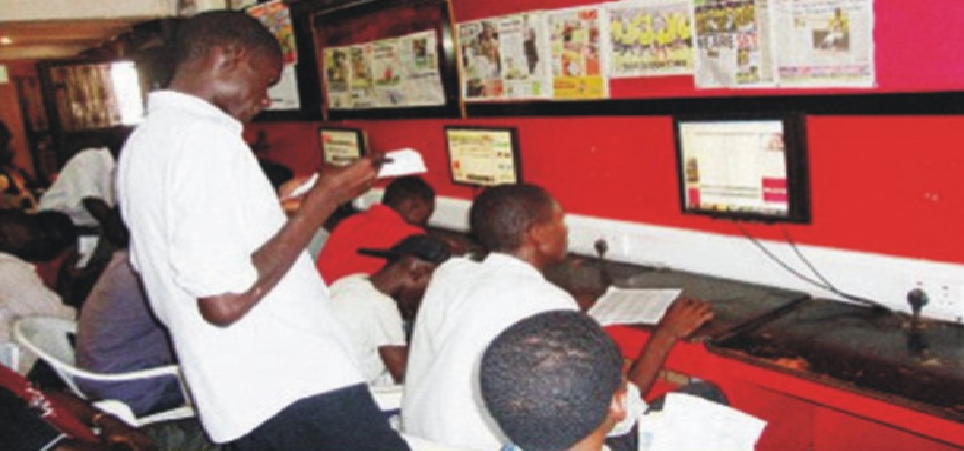
There is a new industry in Nigeria: Distributed Sports Betting (DSB). It is very unfortunate that this particular industry exists. During my last few trips to Nigeria, I have watched how young people are betting real money on sports especially football.  The business is still informal with deep concentration in mainly market areas.

But unlike another informal sector (the Nollywood) which has since gone mainstream, this one is not a product of strength and innovation.  When Chris Obi Rapu, Okechukwu Ogunjiofor,  Kenneth Okonkwo and Nnenna Nwabueze invented the Nigerian Nollywood through Living in Bondage, they made a path to artistic freedom for many Nigerians. Starting with Kanayo Kanayo through Circle of Doom to thousands of movies unveiled yearly, we have seen massive scaling of that vision where Andy used Merit for ritual and Kanayo reminded us that “Jesus is a Christian”.  Though the industry has a long way ahead, we are confident that Nollywood has been a great force, for good, across Nigerian families. Remove our Churches, Mosques and Nollywood, the hardship in the land would have killed more people. Nollywood makes us forget the frustrations in the land, for a while.

[Of course, there is a debate on how Nollywood came. My point is largely that Living in Bondage redesigned the movie acting “experience”, creating celebs from actors and actresses. With that, it became something people saw as a career to be proud of. Living in Bondage was not the first home movie, but in my opinion, it was very instrumental in luring talent into the sector and normalizing the perception of Nigerians in the sector.]

This sports betting is a product of huge youth unemployment and frustration, pushing young people to think that wagering N2000 could make them instant millionaires. That will not happen, but that does not mean that government should outlaw it.

In this trip, I have come to consider DSB as a full-brown industry which government must take a hard look at. It is operating at the periphery and no one really cares. That is in our DNA, no one ever cares in Nigeria. But it is a mistake to think that Nigeria has not built another (informal) sector. Yes, that is not what many of us would wish. But that outcome does not diminish the fact that we have a new sector – Distributed Sports Betting – in our hand.

In my model, I estimate it to be about a N180 billion sector (~ $500 million). It is seasonal since it tracks the European football season. Government should quickly regulate it and make sure the players are paying not just VAT but gambling tax. For state governments looking for internally generated revenue, DSB is a growth sector and they should work to incubate it, making sure that Nairabet,  Bet9ja, Naijabet,  Megabet, Merrybet, BetOlimp, Bet365,  Betway and others are paying VAT and taxes.

There are many elements in regulation. They could include stipulating legal age for betters, restrictive advert zones [not close to primary schools], etc.

What drives DSB is the same thing that is driving digital business: near-zero marginal cost which anchors huge scalable advantage. With that low marginal cost made possible by Internet, this sector would continue to grow. In short, the unbounded and unconstrained distribution nature of the web is the very reason why government should invest resources now to track the sector. Doing this is really simple: let all the betting platforms register with the  National Lottery Regulatory Commission  with all linked to the Federal Inland Revenue Service (FIRS) for tax purposes.

Nigerians would continue to create. We have a new one – DSB – and government must normalize it as quickly as possible. This is different from the old “pool” which your uncle played. That was one was bounded by paperwork and transistor radio for the weekly magic winning numbers. Today, the web has redesigned that business and the global headquarters of sports betting – England – has made it cool. Yes, betting firms in England adorn the jerseys of sports heroes. Nigerian young people are hooked. You may not easily cure them, unless you give them jobs, but you can ensure the platforms pay taxes possibly to help them indirectly.


Facebook Groups To Become Africa’s #1 Ecommerce Platform

1

According to Geopoll, a polling company, Facebook group is growing massively, threatening companies like Jumia and Konga on ecommerce. The informal groups in Facebook are now ecosystems of digital commerce as users use them to shop without going to the traditional ecommerce companies.

According to the Black Friday Straw Poll, which ran in December 2017 among 2,031 respondents in Nigeria, South Africa, and Kenya, Jumia still remains the most preferred e-commerce vendor. Fifty-six percent of our poll respondents have shopped on Jumia before.

Interestingly, a significant number of online shoppers utilize Facebook groups. At 32%, Facebook is the second leading online retailer in the leading e-commerce regions. Through informal entrepreneurs who utilize this leading social media channel to either sell through their groups or similar interest groups, Facebook is proving to be a formidable albeit odd player in this space. (Source: Geopoll Newsletter)

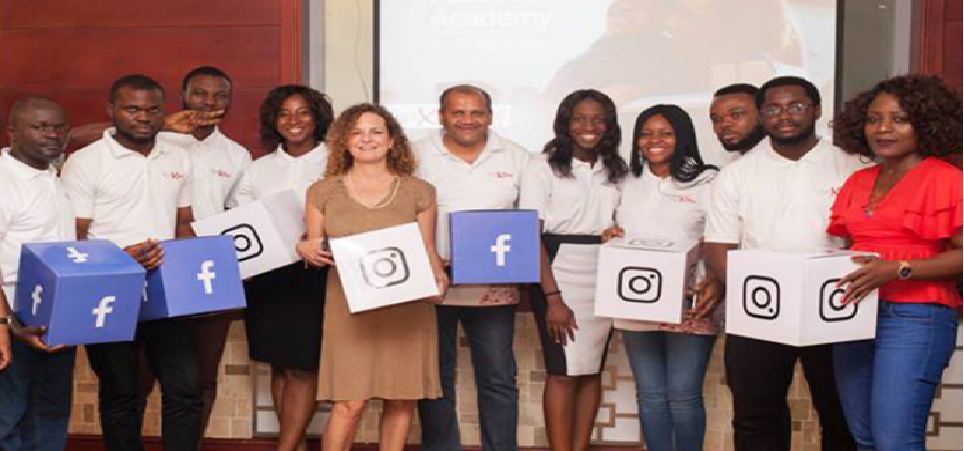
This has been expected. I have predicted that by 2022, the ecommerce platforms we may have are really Facebook, Instagram and WhatsApp in Africa.  I expect these ICT utilities to add store features in their platforms to make it easier for people to list and sell things. That also means that people can get paid easily.

The dominance of Facebook group as an ecommerce ecosystem, especially for marketplaces, would be driven by the following.

Free Internet: When you shop on Facebook, under the Internet Free Basics, you do not waste mobile credit. This means that more people will increasingly adopt it. It puts the traditional ecommerce players on clear disadvantage.

Trust: Facebook deals with the issue of trust in African ecommerce. Both the buyer and seller have clear linkages with others as the accounts do not just appear. So, it makes the bonding better. You would see a seller account with 2000 likes and that boosts your confidence level that the seller is genuine. Traditional ecommerce companies do not enjoy that since accounts are not socially associated in their platforms.

Commission: We expect Facebook commission to be lower compared with traditional ecommerce. The implication is that more people will flock to Facebook group. The Facebook group has an element of entrepreneurial freedom since the sellers can “build” the stores themselves.

Network effect: While a company like Konga is hosting about sub-500k active users in its platforms, Facebook has largely everyone that is online in Nigeria. That is a huge advantage. That can move sellers to operate accounts there.

Facebook may not do this in U.S. because of antitrust issues, but I am not sure anyone can stop it in Africa. Yet, this goes beyond Facebook; Instagram would be the best show room most businesses would have in Africa. That is already happening in the continent as photographers, designers, and artists are abandoning traditional websites to focus on their Instagram engagements. As ICT utilities like Instagram put store features, in their platforms, many things would happen: they will disrupt the traditional nexus of ecommerce.