DD
MM
YYYY

PAGES

DD
MM
YYYY

spot_img

PAGES

Home Blog Page 7262

iPhone X Begins the Era of Facial Behavioral Biometrics

0

We are all humans. Our faces define our identities. When you see a man on the street, the face is the most important element that personifies that person. From school year book to Facebook, our faces are our lives. They initiate us at primary schools where most of us take our first passport photos for entrance examinations into secondary schools. When we get jobs, they ask for photos for badges. At immigration services, they want to see our faces. Indeed, our faces are our journeys in life.

Now, Apple wants to use those faces to secure our digital lives. The iPhone X facial recognition feature is not new because Samsung has already implemented a face-based technology in Galaxy S8 to unlock phones. What Apple has done differently is the immersive use of 3-D topology of a face as a password. That 3-D is the key innovation. Apple uses infrared lights with advanced AI (artificial intelligence) to correlate a person’s face with the one already stored in the iPhone X memory. If there is a match, the phone is unlocked. The Face ID feature in the iPhone X will make it into other smartphones in coming months, with varying levels of efficiency.

But the value of the face is not going to stop with Apple. According to the South China Morning Post, China is developing a facial recognition technology with the capability to match the faces of about 1.3 billion Chinese to their ID photos with more than 90% accuracy. As they build this massive dataset of faces, they will connect them to surveillance camera networks powered by cloud computing solutions across China. Go figure: the same human face, now a national symbol of tracking everything a citizen does. With the requirements that citizens use their real identities in their social media networks, before they can comment on things, China is sure to have a good grasp of what is happening in the lives of every citizen. And the fact that China also wants to take about 1% of equity in many Chinese technology companies, you will understand where that country is going. From Fortune Newsletter:

Chinese internet regulators are looking into taking 1% stakes and management roles with corporate decision-making powers in social media giants Tencent, Weibo and Alibaba Group’s Youku Tudou, as the tech companies rapidly expand beyond their niches into finance, health care and transportation services that affect hundreds of millions of Chinese citizens.

From Apple to China, using our faces is now part of the digital lives. Facebook ran some algorithms which made it possible that someone can pick a photo, put it in Facebook ecosystem and using that image, Facebook will tell you whom that individual is. That is the same technology that makes it possible to auto-tag your friends when you are in a group photo. It saves you time, but it also confirms that Facebook knows you really well. That is the new age we are now.

The Future of Face in Tech

What Apple has done with its Face ID is unleashing AI and advanced 3-D microprocessors in our pockets. To all the possibilities, this is at infancy. In coming versions of iPhone, I expect the deployment of these tools and technologies to drive facial-based behavioral biometrics which make it possible for people to use their facial movements to shop, initiate phone calls, and do banking.

In coming models, I expect Apple to link this facial technology to how we use our phones. That includes how we navigate menus, scrolls, close pages, and more. Those elements which are certainly unique in the way we use digital systems can be used to detect fraud. To make that happen, you may be asked to use your phone for two weeks and after the two weeks, your bank app will activate the feature since it has collected enough data about how you use your phone.

If someone is trying to impersonate you, it is not likely the person can easily construct the subconscious movements which the phone and apps have built about you. This application will work even if you are using a different device. All you need to do is to log into the bank app, and they will use the already stored insights about your behavior, to ascertain if fraud is about to happen.

All Together

Voice and face will drive a new dawn in computing and security. Amazon Alexa is pushing the envelope on voice, to create a new operating system which will be pivotal to the new age of computing. Apple’s iOS will introduce us to more behavioral biometrics as it continues to integrate the face, and subconscious human usage of mobile devices and commerce. The zenith will come when they can use these fascinating datasets to extrapolate our thought processes. In other words, by looking at your face, and how you are moving your cursor, Apple could determine what you are thinking or about to do, and help you finish it up. Calling a taxi, or calling sick for work, or calling a doctor could in future be outsourced to our phones: they look at our faces, piece together subconscious movements on our devices, and using both make the calls on what we are thinking. Our faces can go far indeed. Yes, it will be a key element to Thought Computing, after we are done with perfecting Voice Computing.


Our Advisory Services

0

I lead an Advisory Services Practice in Fasmicro Group.  We help clients architect winning strategies through new business models, technologies and processes. We provide deep insights to clients’ business challenges, uncovering patterns, and delivering outcomes that win in markets. Our clients include leading banks, telcos, fintechs, militaries, governments, insurers, and more.

The centerpiece of our work is to structure how technology will help clients to accelerate innovation and growth. We work to deliver technology which goes beyond running an organization to one that actually transforms a firm. As we do this, we stay focused on the corporate goal, making sure that technology is anchoring the realization of business objectives.

Our work covers change, leadership, and strategy. We serve clients in these areas, among others:

  • IT Strategy
  • Board/Executive Management IT Roadmap presentation (industry landscape tailored for your firm/industry, delivering what to prepare for in short-, mid- and long-terms)
  • IT Skill Capabilities Mapping
  • Digital Products (business model, strategy, growth)
  • Quarterly Report (max of 8 pages, summarizing key industry evolution, around your business, with how you can prepare)
  • IT Governance
  • IT Value Realization
  • IT Process Documentation
  • Center of Excellence (design, development, deployment, evaluation)
  • IT Product Conception and Launch (business model, strategy, growth)
  • IT Spend Planning
  • Data Consolidation

I lead my team and we handle engagements with absolute commitment to quality. Our clients receive the highest level of value, and our pricing is industry-competitive.

Contact: info@fasmicrogroup.com or audrey.kumar@fasmicrogroup.com

Nigerian Banks Are Plotting Decade-Long Growth Strategies

0

In the subscriber section of Tekedia, I wrote how GTBank (Nigeria) plotted one of the finest corporate redesigns in Nigeria’s banking sector and became the category-king. Today, across many indicators, GTBank is the industry leader. Its market capitalization can buy more than 80% of our local banks excluding Zenith Bank. GTBank is winning and continues to open new vistas with enviable cost-to-income ratio of sub-45%. To do this, GTBank made a pivotal decision in mid 2000s. That decision has since paid off, evidently. It was a decade-long business strategy with one mission:  make GTBank the preferred bank for upward mobile (professional) customers in Nigeria. Today, GTBank is the bank for working professionals. It was not automatic: GTBank was like most new generation banks before 2004. Then, it took off and became a king. (It is important to note that GTBank has been having severe technology challenges these days. Last month, services were down for hours.)

As you look at the data and read banks’ annual reports, you can see trajectories of banks on their missions. Most of the plans take years for the impacts to be visible in the financial statements. Briefly, I explain what some banks are doing:

  • GTBank: Many years ago, GTBank wanted to become the preferred bank for Nigerian corporate working professionals. It executed that strategy with some enablers which I have noted here. The bank has some of the most profitable customers in the nation. Interestingly, these same customers are also the cheapest to serve because they are well educated, and can do many things by themselves without the bank support. This remains the heart of GTBank strategy.
  • Wema Bank: Wema Bank through ALAT has made it clear that it wants to on-board youthful customers. This business model is still ongoing. By having its ALAT business “partly separated” from the main bank, it wants to become a largely clean bank, a digital bank. This is a nice strategy, and I do predict that in five years, if banks do not curtail their fees, the favorability will drop: bank fees in the nation’s banking sector are skyrocketing. The risk is that there will be many ways to do banking without banks, and solutions like ALAT could be in that equation for young people. My local bank now charges me monthly debit card maintenance fee of N40. That fee comes besides the stamp duty on digital transactions. And there is the monthly N302 maintenance fee. Wema’s future will be finding a pan-African strategy where it can pioneer a currency-agnostic solution that will serve most parts of Africa. That ALAT’s future may not involve Wema Bank at its core. And needless to say that it will take time to bear fruits. ALAT is a startup and must go through its growth phase before the push for monetization begins.
  • Diamond Bank: Diamond Bank is deepening retail banking at scale. In Lagos, it is easy to see Diamond Bank associates wearing Diamond T-shirts looking for business. I do think that the bank is working to win through agency banking and that means it wants to be the king of retail. Diamond Bank since it pioneered Diamond Bank Integrated Banking System (DIBS) has been loved by traders and retailers. DIBS fixed a major friction: eliminated the need of moving cash in intra-national trading. With DIBS, traders could travel from Aba to Lagos without having to carry cash. Before DIBS, that was not possible as bank branches were not connected. In other words, if you had an account in Union Bank Aba then, you could not collect money from Union Bank Idumota. DIBS changed that and traders loved that. The bank through its agency banking business is planning for another win. The redesign will take years to yield fruits: the bank has to grow the customer base before it can make money serving them.
  • United Bank for Africa: UBA is Africa’s global bank with operations in excess of 19 African countries, the largest of any Nigerian bank. UBA believes that its future will be Africa and it has a leg-ahead of other banks. It has invested massively over the years, building these country networks, and the moments of glory may already be here. In the last two years, the stock has moved from N2.73 to above N9. Its growth is working. Its decision to push into Africa is making it a pan-African bank in the age where integration will be the order of the day.

Other banks have also anchored their businesses on strategic core visions. I will discuss those in the subscriber section. The most fascinating is First Bank which wants to add new 16 million customers within three years. We will examine how the bank could do this, and if that is even possible, by pointing its growth strategy which I think will be in excess of five years to be practically visible. Skye Bank which was clipped by the Central Bank of Nigeria when its ratios deteriorated has sold assets in its non-Nigerian businesses, to boost its balance sheet. Today, it has a clear growth plan. Keystone Bank under the new CEO is working on digital strategy for its future. The most fascinating is what Union Bank is doing as it is clearly linked to Atlas Mara team in Dubai which has invested in the bank. I will discuss.

The Mission of Margin

0

In the startup world, we like growth and always spend time planning how to make it happen. Job titles like VP, Growth; Manager, User Growth; and Team Lead, High Growth are now common. There is nothing wrong with that: growth is the heart of any business. In web business, because of the elements of network effects and the benefits of invertibility construct, the thinking is that growth drives the business. Yes, growth is important; but without  an important margin in business, over time, the business will die. The profit margin is the most important element in any business formation and operation. It is the fuel that gets a business going. It is the enabler, catalyst and the anchor of the corporate long-term vision.

Largely, we are in business for profit margin. It may not be obvious because there are many companies which operate for years without profitability, by raising tons of money, in successions. But even with that, over time, the companies will be expected to make money.  Even if the companies are sold, the buyer must still have to find profitability in the operations for the following reasons:

  • Running and Growing Companies: It is only by making profit that a business can be sustained over time. Without profit, the mission is stalled. The vision of accelerating prosperity and the welfare of people can only happen when a firm makes money
  • Corporate Social Responsibility: Doing good as a business does not happen with free water or air. Money funds great ideas to help communities and societies. To do that, a firm must make profit
  • Investors Part: When investors put money in your company, they are really investing in your profitability. It is irrelevant if you are making money today or not. The fact is that they do believe that you will make money in future. It is from that profit that you would pay dividend. If the firm is publicly traded, profitability provides a good metric to the health of business. Generally, it does impact the growth of the stock.

So, as you work on the mission to change the world, it is important to understand that you must make money doing so. Making money, ethically, is the core business you are in, because without making money, you may be unable to help society.  The passion for profit has pushed even typical non-profits to explore ways to make money so that they can serve communities better.

The Kenya Red Cross is a very good example: the charity runs a hotel business in Kenya and invests in education, farming and more. At the end, it generates good profit margin that it does not need any donation to support its mission. With ventures generating profits, executing the mission of Kenya Red Cross has been simplified. I spent a day with the CEO early this year and was thrilled on how they have fused business with helping communities, at scale. They have more functioning ambulances than the Government of Kenya, and they run a top-rate school on hotel management with students coming from far away China, Nigeria and India.

If a charity can see that profit margin is vital, it means that for-profit startups have no hiding place.  Indeed, “No Margin, No Mission”, as Fortune aptly captured it, recently. You must find ways to have good margin because that is the first mission in business. Other missions emanate from it.

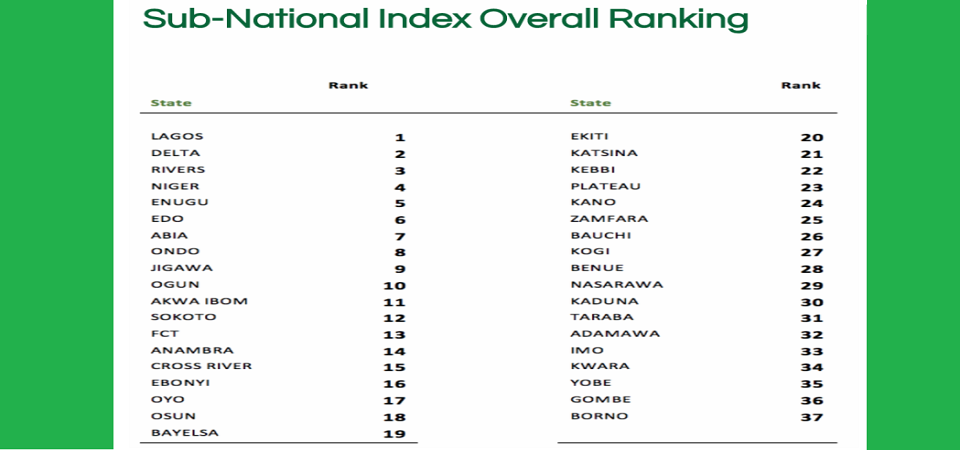
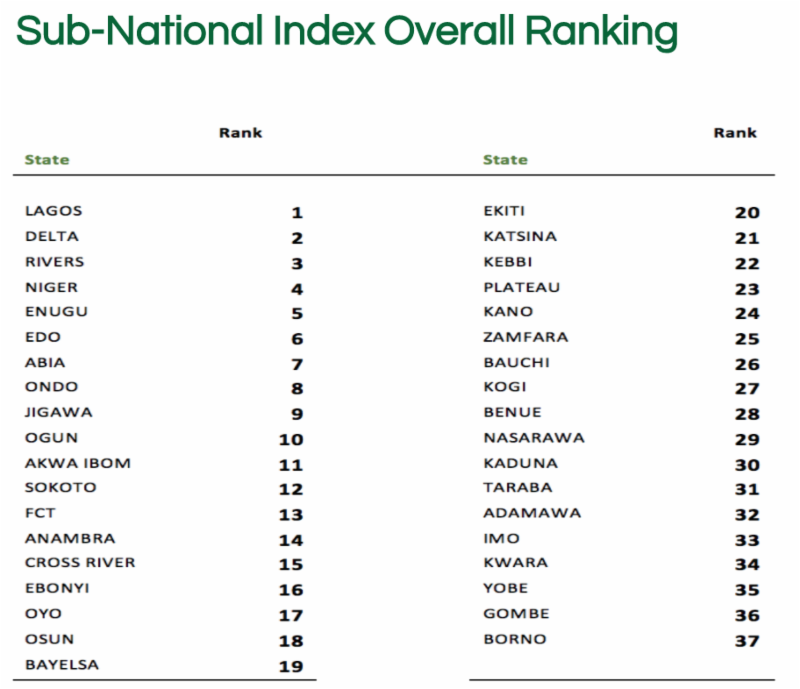
Lagos Tops Ranking of Sub-National Competitiveness, Borno is Last

5

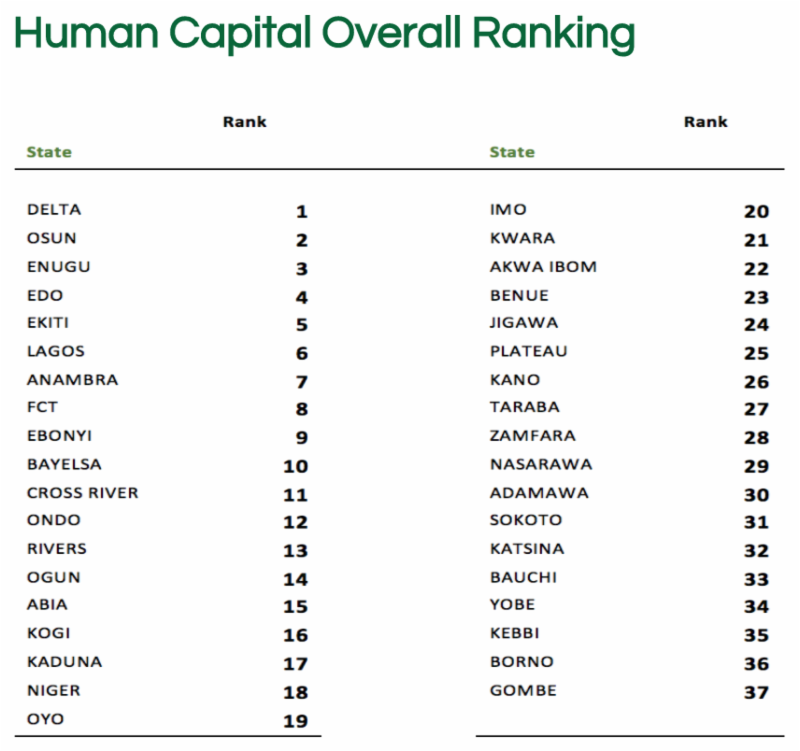
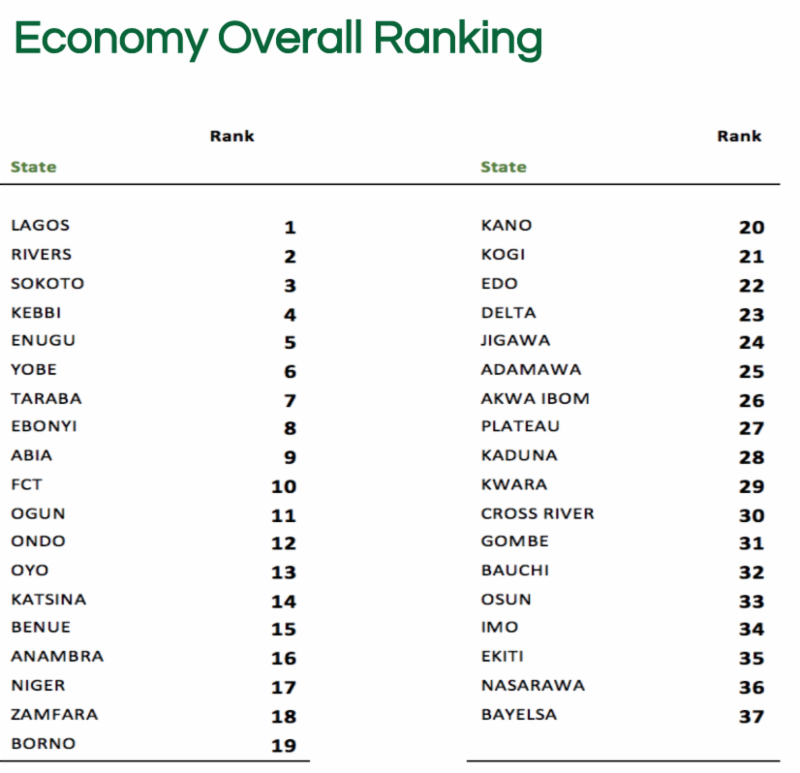
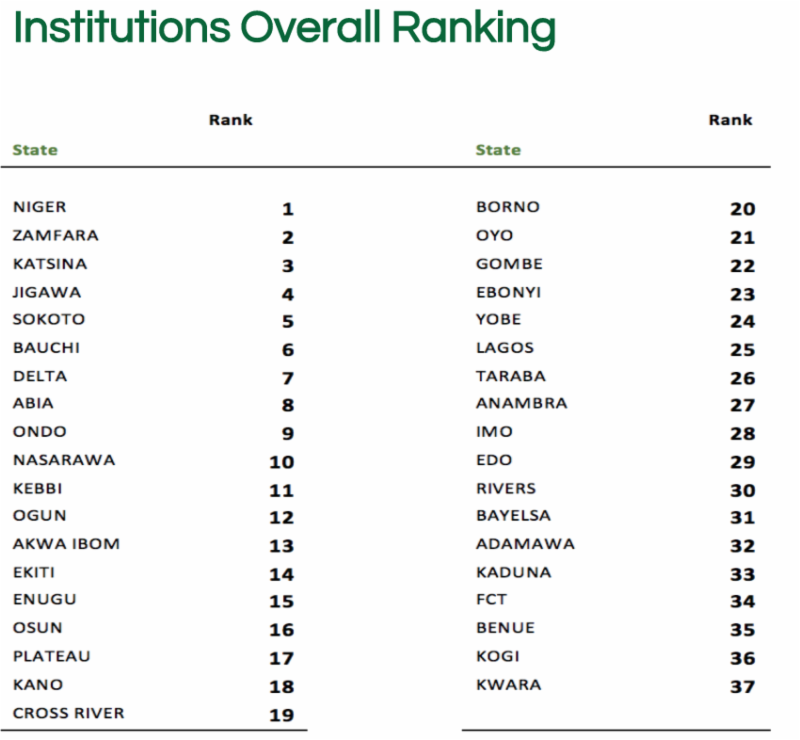
The National Competitiveness Council of Nigeria has released Nigeria’s first Sub-National Competitiveness Index. It is a two year research into the factors that drive competitiveness in Nigeria’s 36 states and the FCT. Ford Foundation and the Tony Elumelu Foundation funded the research. The research covered more than 2,000 businesses, 8,000 households, 400 indicators and 4 pillars.

  • Pillar #1 is Human Capital which covers education, migration, gender equality and heath: Delta State is #1 and Gombe is #37.
  • Pillar #2 is Infrastructure which covers roads, electricity, airport, telecom, waste and water: Rivers is #1 and Zamfara is #37

  • Pillar #3 is Economy which covers access to finance, state finances, business-sophistication and tax: Lagos is #1 and Bayelsa is #37

  • Pillar #4 is Institutions which covers security, transparency, justice, corruption and permits. Niger is #1 and Kwara is #37.

  • State Ranking: Lagos is #1 and Borno is #37.