DD
MM
YYYY

PAGES

DD
MM
YYYY

spot_img

PAGES

Home Blog Page 727

Musk Accuses Apple of Manipulating App Store Rankings to Favor OpenAI Over Grok, Threatens Antitrust Lawsuit

0

Elon Musk has escalated his long-running feud with Apple, accusing the tech giant of deliberately manipulating its App Store rankings to disadvantage his artificial intelligence ventures.

The billionaire entrepreneur said on Monday night that his AI company, xAI, would “take immediate legal action” against Apple for allegedly sidelining both the X social platform and its Grok chatbot in favor of rival AI apps.

In a series of posts on X, Musk accused Apple of “playing politics” by refusing to list either X or Grok in the App Store’s “Must Have” recommendations, despite what he claimed were their global popularity.

“Apple is behaving in a manner that makes it impossible for any AI company besides OpenAI to reach #1 in the App Store, which is an unequivocal antitrust violation,” Musk wrote. He followed with a pointed challenge: “Why do you refuse to put either X or Grok in your ‘Must Have’ section when X is the #1 news app in the world and Grok is #5 among all apps?”

Musk provided no evidence to substantiate his accusations, and it remains unclear whether any lawsuit has actually been filed. However, in response to a report about his legal threats, Musk doubled down: “Unfortunately, what choice do we have? Apple didn’t just put their thumb on the scale, they put their whole body!”

As of Tuesday, Apple’s U.S. App Store ranked OpenAI’s ChatGPT as the top free iPhone app, with Grok in sixth place. Notably, in January, China’s DeepSeek AI briefly overtook ChatGPT for the top spot—an episode that undercuts Musk’s claim that Apple’s ranking system makes it “impossible” for other AI apps to succeed.

OpenAI–Apple Integration Underpins Musk’s Frustration

At the heart of Musk’s complaint is Apple’s high-profile partnership with OpenAI. Launched at WWDC 2024, the collaboration enabled seamless integration of ChatGPT into iOS, iPadOS, and macOS experiences under the brand Apple Intelligence. This suite leverages OpenAI’s GPT-4o model across Siri, Writing Tools, and generative features like Visual Intelligence and Genmoji, delivering AI-powered assistance directly within Apple’s ecosystem.

The feature was lauded as a seamless way to bring generative AI to a broad audience, but to Musk, it represents a clear circumvention of xAI’s offerings.

Musk’s frustration is amplified by OpenAI’s soaring visibility—ChatGPT is pre-integrated into Apple’s UI, benefiting from prime positioning and default access. It’s a classic distribution advantage: millions of iPhone, iPad, and Mac users can now tap ChatGPT features without switching apps or even knowing they’re using it.

The clash comes against a backdrop of mounting regulatory scrutiny of Apple’s App Store practices. Antitrust watchdogs in the U.S., EU, and other jurisdictions have long accused Apple of favoring its own products or preferred partners, leading to several ongoing legal battles.

Last year, following the announcement that ChatGPT would be integrated into iPhones, iPads, and Macs, Musk threatened to ban Apple devices at all his companies if OpenAI’s technology was “fused” with Apple’s operating systems.

The dispute is also colored by Musk’s personal history with OpenAI. A co-founder of the AI startup in 2015, Musk later split from the organization, citing disagreements over its direction. Since then, he has repeatedly attacked OpenAI for abandoning its original nonprofit mission, even attempting a $97.4 billion buyout that was unanimously rejected. He has also targeted the company through multiple lawsuits, claiming its partnership with Microsoft and commercial focus violate its founding principles.

Critics were quick to note the irony of Musk accusing Apple of algorithmic bias. Since his $44 billion acquisition of Twitter in 2022, now renamed X, Musk has faced allegations of meddling with the platform’s ranking systems to boost his own posts. A 2024 research study suggested X’s algorithm had been modified to amplify Musk’s account disproportionately. OpenAI CEO Sam Altman, in a pointed response to Musk’s latest claims, shared a 2023 Platformer report that detailed a system Musk allegedly had built to promote his posts to all X users.

Questions have also been raised about Grok’s own impartiality. In June, investigations found that the “maximally truth-seeking” chatbot frequently deferred to Musk’s personal opinions when answering sensitive questions on subjects like the Israel–Palestine conflict, U.S. immigration policy, and abortion rights.

The unfolding battle adds another front to Musk’s increasingly public conflicts with both Apple and OpenAI, while also highlighting the growing competitive tensions in the AI sector.
LayerZero-Stargate $110M Buyout Could Reshape Cross-Chain Interoperability

0

The LayerZero Foundation has proposed a $110 million acquisition of Stargate (STG), a cross-chain bridge protocol it originally launched in 2022.

The deal would merge Stargate’s token economy into LayerZero’s ZRO ecosystem, with STG tokens swapped for ZRO at a fixed rate of 1 STG to 0.08634 ZRO, valuing STG at $0.1675 and ZRO at $1.94 at the time of the announcement. If approved, the Stargate DAO would dissolve, and future Stargate revenue would fund ZRO buybacks.

The proposal has driven a market rally, with STG up 12-16.5% to around $0.188-$0.198 and ZRO up 15-23% to $2.33-$2.44, though both tokens remain far below their historical peaks. Community reactions are mixed, with some STG holders criticizing the swap ratio as unfair and lamenting the loss of staking rewards, while others see operational benefits in unification.

The proposal is open for comment for seven days, followed by a Stargate DAO vote requiring 70% approval and a 1.2 million veSTG quorum. By acquiring Stargate, LayerZero aims to streamline its cross-chain operations, integrating Stargate’s bridging capabilities with its omnichain messaging protocol.

The acquisition aligns with a broader trend of consolidation in the cross-chain sector, as protocols seek to strengthen their competitive edge. LayerZero’s control over Stargate could position it as a dominant player in interoperability, potentially attracting more projects and users.

The buyout would dissolve the Stargate DAO, transferring governance to LayerZero’s unified structure. This centralization may streamline decision-making but could alienate community members who value decentralized governance.  Some STG holders criticize the swap ratio (1 STG to 0.08634 ZRO) as undervaluing Stargate’s potential, given its $70 billion in historical transfer volume.

The deal’s value increased to ~$127 million due to these price movements, indicating strong initial investor support. Converting STG to ZRO eliminates STG’s independent market presence, potentially reducing liquidity for STG holders. However, it integrates them into LayerZero’s larger ecosystem, which may offer long-term growth potential.

LayerZero plans to expand Stargate’s functionality beyond asset bridging into broader interoperability solutions, such as enhanced DeFi integrations and consumer-facing applications. This could increase adoption but requires successful execution.

How Buybacks Boost Investor Confidence

Buybacks involve repurchasing ZRO tokens from the market, reducing the circulating supply. This scarcity can drive up token value, as demand remains constant or grows, signaling potential price appreciation to investors.

Investors often view buybacks as a commitment to long-term value creation, as they suggest the protocol believes its token is undervalued or anticipates strong future cash flows.Stargate’s significant revenue from $70 billion in transfer volume will fund ZRO buybacks. This ties token value to tangible protocol earnings, reassuring investors of sustainable financial backing rather than speculative hype.

Buybacks are a strong market signal that LayerZero is confident in its strategic vision and financial health. This can attract institutional and retail investors, as seen in the 15-23% ZRO price surge post-announcement. The positive market response (STG and ZRO price increases) reflects investor optimism about the merger’s synergies and the buyback’s potential to enhance ZRO’s value.

The 70% approval threshold and 1.2 million veSTG quorum requirement mean significant community support is needed. Discontent over the swap ratio or loss of DAO autonomy could derail the deal. The success of LayerZero’s vision depends on integrating Stargate effectively and delivering on promised innovations. Failure to do so could undermine investor confidence.

The ZRO buyback plan boosts investor confidence by signaling financial strength, reducing token supply, and tying value to Stargate’s revenue stream. However, success hinges on community approval and LayerZero’s ability to execute its ambitious roadmap. Investors appear optimistic, as evidenced by the post-announcement price surges, but ongoing communication and transparency will be critical to sustaining confidence.

Kaspa Targets $0.10, Arbitrum Fights $0.50 While BlockDAG’s $371M Presale Gains Speed with Dashboard V4

0

The list of top trending crypto picks is heating up, but not every name is moving with the same weight. The latest Kaspa (KAS) price prediction shows a steady rise if buyers protect key levels. Arbitrum (ARB) is still wrestling with a tough $0.50 barrier.

Both KAS and ARB are in motion, but BlockDAG (BDAG) is delivering something extra. Its new Dashboard V4 doesn’t just hint at trading after launch. It lets the community experience it right now during the presale. With over $371 million already raised, BDAG is proving why it may outpace the rest.

Arbitrum Price Forecast: $0.50 Resistance Holds the Next Move

The Arbitrum (ARB) price forecast depends on breaking the $0.50 ceiling after a 9.02% daily jump brought ARB to $0.4736. Trading volume touched $397.49 million, while the past week’s 28.32% rise ended a flat spell.

Analysts see $0.50 as the deciding level. A close above it could open a run toward $1.17. Long-term outlooks range widely from $0.321 to $2.40. For now, momentum is there, but the push higher will need to clear resistance before sellers step in.

Kaspa Price Prediction: Buyers Aim to Hold $0.092 Support

This week’s Kaspa price prediction focuses on keeping support above $0.092 after rebounding from early August’s $0.0799 low. KAS now trades at $0.0944, showing higher lows that signal steady buying despite rising short interest.

Trading volume stands at 43.58M, slightly off late July’s peak, while $111.67M in open interest confirms active market engagement. A rise above $0.098 could test the $0.10 mark, with further momentum possibly stretching to $0.105. Holding support remains the key to keeping sentiment positive.

BlockDAG Dashboard V4 Brings Presale Trading to Life

BlockDAG’s new Dashboard V4 arrives at a decisive moment, with the presale moving past the halfway mark toward its $600 million goal. This upgraded dashboard blends advanced market tools with a clean, easy-to-use design that connects directly to the fast-growing presale.

It delivers real-time execution, detailed price tracking, and a fully working BUY/SELL system, giving the BDAG community access to the same type of setup they will use after launch.

The presale has already reached $371 million, with more than 25 billion BDAG coins sold across 29 batches. The current price is $0.0276, and the shift to $0.029 in batch 30 is getting close, while the launch price remains locked at $0.05. From batch 1 to 29, early participants have seen gains of 2,660%, rewarding those who moved quickly.

For both experienced traders and newcomers, Dashboard V4 offers more than a trial run. It gives an early edge, letting participants test and sharpen their approach before BDAG enters the live market. The layout matches the official exchange, making the transition smooth when trading opens.

As the presale heads into its final stages, each price step is a reminder of the potential gains waiting for those who secure their spot before the market goes live.

Top Trending Crypto Moves Point to 2025’s Big Players

Some names are still building momentum. Kaspa works to keep its gains. Arbitrum eyes the $0.50 breakout. But BlockDAG is already operating at a level that feels like launch day.

The $371 million raised, over 25 billion coins sold, and a trading dashboard that mimics live market conditions are signs it’s moving ahead faster than most. With each batch pushing BDAG closer to $0.05, the window to secure it at current levels is closing quickly. In a space where many are still preparing, BDAG looks ready to lead 2025’s top trending crypto picks.

Presale: https://purchase.blockdag.network

Website: https://blockdag.network

Telegram: https://t.me/blockDAGnetworkOfficial

Discord: https://discord.gg/Q7BxghMVyu

Trump Signals Openness to Scaled-Back Nvidia Blackwell Chip Sales to China, Following 15% Revenue-Sharing Deal

0

President Donald Trump said Monday he would be open to allowing Nvidia to sell a reduced-performance version of its most advanced artificial intelligence chip to China, in what could become a second high-profile revenue-sharing deal between Washington and a leading U.S. semiconductor firm.

Trump said he would consider approving exports of Nvidia’s cutting-edge Blackwell processors to China if the company could engineer a version that is 30% to 50% less powerful than the original.

“It’s possible I’d make a deal” on a “somewhat enhanced — in a negative way — Blackwell” processor, Trump said. “In other words, take 30% to 50% off of it.”

The statement came as Trump confirmed a separate, unprecedented arrangement with Nvidia that will allow the company to sell its less-advanced H20 AI chip to China if it pays 15% of revenue from those sales to the U.S. government. Advanced Micro Devices Inc. (AMD) will be subject to the same 15% revenue-sharing requirement for its China-targeted Instinct MI308 chip, according to a person familiar with the matter.

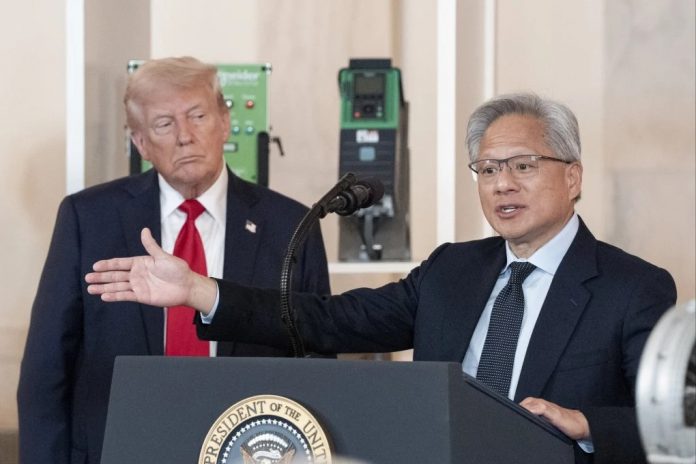
Trump said he had initially demanded a 20% cut of Nvidia’s China sales before CEO Jensen Huang negotiated it down to 15% during a meeting at the White House on Friday.

“I said, ‘listen, I want 20% if I’m going to approve this for you, for the country,’” Trump told reporters.

Calling the H20 an “old chip that China already has” and “obsolete,” Trump compared it to the Blackwell, which he described as “super-duper advanced” and unmatched globally.

“That’s the latest and the greatest in the world. Nobody has it. They won’t have it for five years,” Trump said.

He reiterated that any Blackwell exports to China would require “significant downgrades” in performance before being considered.

U.S. export controls on advanced chips are aimed at preventing China from acquiring technology that could enable it to surpass the U.S. in AI capabilities — a development many officials consider a national security risk. Trump said China already possesses chips with similar capabilities to the H20, adding that Huawei has a comparable product.

Nvidia CEO Huang has argued that it is in America’s strategic interest for Chinese AI developers to use U.S.-made chips, warning that blocking access entirely could accelerate the growth of China’s domestic semiconductor industry.

“He’s selling essentially an old chip,” Trump said, downplaying the H20’s potential to enhance Chinese AI capacity.

The H20, a China-specific variant of Nvidia’s H100 and H200 chips, was developed after the Biden administration’s 2023 export restrictions. Its performance has been deliberately reduced to comply with U.S. rules. In April, the Trump administration required a license for H20 exports, effectively cutting Nvidia off from the Chinese market. Huang later said the company had anticipated $8 billion in H20 sales for the July quarter before shipments were halted.

A Potential Precedent in Trade and Tech Policy

The revenue-sharing arrangement for the H20 and the possibility of a similar one for the Blackwell marks a shift in U.S. export policy, blending national security restrictions with direct fiscal benefit. Trump has framed these deals as ways to ensure America gets a “payout” in exchange for concessions on trade.

Experts say such agreements could set a precedent for future tech exports, particularly in strategic sectors like semiconductors, aerospace, and quantum computing. The U.S. could both limit the performance of exported products and capture a share of the revenue stream by imposing a percentage levy on high-value technology sales to China.

While the approach offers a mechanism to keep U.S. firms competitive in China without granting access to their most advanced capabilities, it could also undermine the strict rationale for export controls if overused.

Nvidia and AMD have both seen their China revenues decline sharply under tightened U.S. export rules. Although Washington has recently issued licenses for certain downgraded chips, these products are often comparable to existing Chinese offerings, raising questions about their appeal in the market.

A scaled-down Blackwell, if approved, could improve Nvidia’s position with Chinese customers and recapture lost sales, but it would also become a bargaining chip in broader U.S.–China trade and technology negotiations.

The timing is significant: Beijing is pressing for eased export curbs on high-bandwidth memory (HBM) chips as part of ongoing trade talks, reportedly seeking to include such concessions in a deal ahead of a potential Trump–Xi Jinping summit. HBM chips are critical for AI training and data processing, making them a parallel flashpoint alongside the Blackwell debate.

Trump hinted that Huang would return to the White House soon to discuss the Blackwell issue further.

“I think he’s coming to see me again about that, but that will be a unenhanced version of the big one,” Trump said.

If the deal scales, the government will be deriving more 15% revenue from Nvidia’s Blackwell exports to China.

Key Metrics for Tracking App Growth in 2025

1

App growth isn’t just about downloads anymore. In 2025, real success comes from tracking the right performance metrics—those that reveal how users engage, stick around, and ultimately convert into revenue. As a growth marketing agency, we help brands decode these metrics and turn insights into action.

Key Takeaways

  • Retention > Downloads: Sustainable growth comes from keeping users, not just acquiring them.
  • Focus on user behaviour: Track how people actually use your app to identify friction points and drop-offs.
  • Localise your benchmarks: What’s “good” in Kenya or Ghana may differ from Europe or the US—context is key.
  • Prioritise meaningful metrics: Engagement, retention, and LTV matter more than vanity KPIs like installs.
  • Improve UX with insights: Let real user data guide product and design decisions.

This guide breaks down the most important KPIs for mobile app growth, with actionable tips for product managers, marketers, and founders alike.

  1. Downloads vs. Active Users: Know the Difference Downloads show initial interest, but DAU (Daily Active Users) and MAU (Monthly Active Users) reveal real engagement. Monitor the DAU/MAU ratio: anything above 20% typically indicates healthy recurring usage and strong product stickiness.
  2. Retention Rates: Engage and Retain Track Day-1, Day-7, and Day-30 retention to gauge early engagement and long-term loyalty. A sharp drop after Day-1 may signal onboarding friction or unclear value. Cohort analysis can help you understand how different user groups behave over time, revealing where to intervene.
  3. Session Metrics: Frequency and Duration Sessions per user shows how often people use your app, while average session length reveals how deeply they engage. High session counts with low duration could point to usability problems or unclear next steps. The goal is to increase both quality and quantity of interactions.
  4. User Acquisition Efficiency Knowing how much it costs to acquire a user is key to sustainable growth. Calculate your Customer Acquisition Cost (CAC), then compare it across channels—paid, organic, influencer, or referral. A healthy mix of organic installs shows strong brand recognition or effective App Store Optimisation (ASO).
  5. Lifetime Value (LTV) LTV is the total revenue a user is expected to generate during their time using your app. This helps you understand long-term profitability and how much you can afford to spend acquiring new users. A strong benchmark is maintaining an LTV:CAC ratio of 3:1 or better.
  6. Feature Engagement Beyond sessions and retention, track how users interact with the core value of your app whether that’s sending messages, making purchases, or hitting milestones. Low engagement with key features might indicate onboarding issues, poor UI/UX, or misalignment with user expectations.
  7. Churn Rate Churn is the percentage of users who stop using your app over a given time. High churn undermines growth and wastes acquisition spend. Look at when users tend to churn and why—surveys, heatmaps, or session replays can provide valuable context. Reducing churn starts with understanding friction points.
  8. App Store Metrics App Store presence impacts both visibility and credibility. Monitor your app’s conversion rate from impression to install, along with average ratings and review sentiment. Encourage happy users to leave feedback after key positive interactions ,this boosts trust and store ranking.
  9. Technical Performance A great app must also be stable and fast. Track crash rate (aim for under 1%) and loading speed (under 2 seconds is ideal). These metrics are particularly critical in African markets where network conditions and device quality vary widely. Use tools like Firebase Crashlytics to stay on top of performance.
  10. Monetisation Metrics Track ARPU (Average Revenue Per User), conversion rates from free to paid users, and completion rates for in-app purchases. These numbers help you refine pricing models, identify friction in payment flows, and develop promotions or incentives to boost revenue.

Ready to Level Up Your App Growth?

Want to build smarter dashboards, refine your acquisition funnel, or boost retention in African markets? Get in touch with Welcome Tomorrow, we turn your data into growth. Or subscribe to our newsletter for weekly growth tips, data insights, and no-fluff marketing strategies.

About Welcome Tomorrow

Welcome Tomorrow is a team of growth marketing experts partnering with ambitious African brands to drive sustainable growth through performance marketing, mobile growth strategies, creative content, and data analytics. We integrate data, media, and creative services under one roof to deliver measurable results, focusing on emerging markets across Africa.