DD
MM
YYYY

PAGES

DD
MM
YYYY

spot_img

PAGES

Home Blog Page 7279

The Most Brilliant Moment In Business

2

When Toyota recalled one of its car brands that I own, it sent me a notice of the recall, and provided a document for me to take the car to a dealer for it to be fixed at no cost to me. That is expected in the automobile industry: the makers of the cars are responsible for fixing major issues when the vehicles are under warranty.

If you go to a grocery shop, and buy food that later causes problems for you, you can easily get a trial lawyer to sue the shop in America and most parts of the advanced world. Advancement is used here in terms of maturity of legal institutions.

And when you have a smoke detector in your house, you expect it to do its job which is to detect smoke. But if that smoke detector malfunctions and the house burns down, and you can trace the fault to it, the makers are in trouble.

From one product to another, the makers are responsible when their products fail or severely malfunction. But except one product: software. Sure, there are minor cases as in radiology where a software update error can cause the wrong amount of dose leading to deaths. But even with that, it is the whole radiology equipment that is faulted and not necessarily the software.

So what happens is this: software can cause problems in the world, and the makers are not held responsible. When virus corrupts your files in your Windows laptop, Microsoft is not on the hook. When hackers break banks to steal money, the makers of faulty software that made that easy to happen are not charged. When hackers break into your firm to manipulate your data, you do not return to the software company, suing them for ever selling a product that made that possible.

So, all over the world, the software companies are never faulted. The focus is always on the hackers. There is nothing wrong going after the bad people, of course. The law enforcement will go after them. But no one remembers the person that sold a crappy software product that made that possible, to start with. I am not sure any major software company has been invited by the U.S. Congress to explain why they sell products which are easily hacked. Contrast that to the fire the Congress will send to Ford, GM and Toyota when people are crashing due to faulty cars.

You Never Own Software

Yes, software is one of those products you never own as a company. You have to keep paying licenses to continue to have the rights to use it. Any day you cease to pay the license, you will immediately lose the legal rights to use the product.

Yet, if you are paying and a problem arises like the product has been hacked and your company data stolen, you cannot sue the software firm. You simply rant about hackers. Technically, software ought to be easier to deal with since the users never own the rights. The rights are reserved to the makers. This is far different from cars, for example, where you own all the rights but when challenges come, you still go back to the car makers.

All Together

The most brilliant people in the world are those that architected the structure of pricing software. They elegantly made it possible that value comes to them and risks stay with their clients. Otherwise, there is no reason why the world has not challenged major software companies shipping products which are easily hacked. The makers are brilliant as they have cleverly deflected the burden of product quality with the narratives of hackers being evil.

Yes, take a closer look, and you will agree that the model is not supposed to be that way: if Ford takes the heat for faulty cars, software makers like Oracle should be held responsible for making hack-able software. But they are not responsible, and they are lucky.

The software men created an industry far superior (for themselves) than anything markets and industries have ever seen. They have made sure you never own what you bought and when you have problems, they are never to be blamed. They pioneered a clever narrative that their faulty products which continue to be hacked are never their faults. That has kept them away from the crosshairs of risks.

If you make and sell software, you better thank the legends that came before you. Why? If not the way they structured the business, trial lawyers would sue you if hackers break your software and inflict damages to their operations. Today, those lawyers cannot come after you, just as they go after Toyota and Ford for faulty cars. The software pioneers are peerless in business contracting innovation: head, they win; tail, they win.
Nigeria’s JAMB N5,000,000,000 Error

2

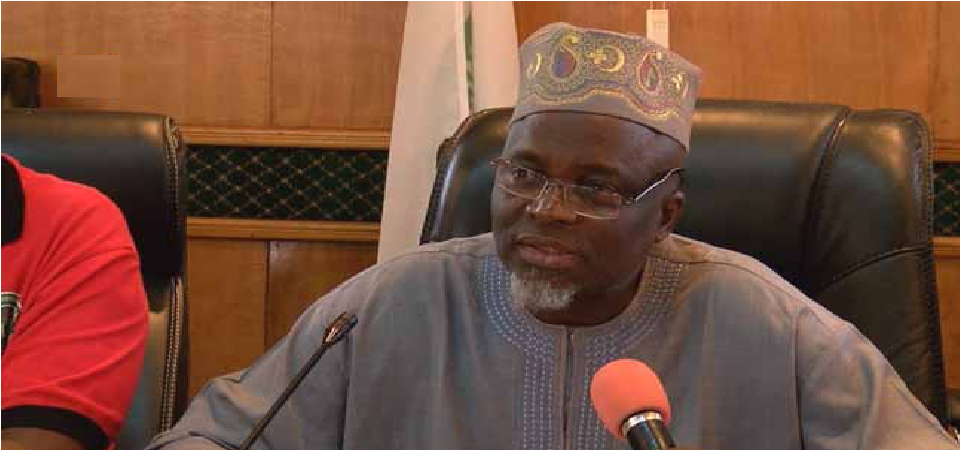
Nigerians cheered. JAMB (Joint Admissions and Matriculation Boardhad remitted N5 billion to the federal government. We saw it as government working. Glory, even JAMB can remit money to CBN for the good of the Nigerian people.

The agency also said it had so far remitted more than N5 billion to government, the highest ever in the 40 years of its existence.

A statement signed by JAMB’s Head of Public Relations, Fabian Benjamin, said in Abuja on Sunday.

Unfortunately, that does not make it right. When JAMB charges more than it needs to run its exams into our tertiary institutions in Nigeria, it hurts the future of Nigeria. I do not understand the basis for JAMB to be remitting money to the federal government.

JAMB is not NNPC (Nigerian National Petroleum Corporation). We know that NNPC exists for the purpose of remitting funds to the federal government. JAMB should not emulate that feature. It is totally unnecessary.

JAMB is a vehicle to test and ascertain the readiness of our young people to transition from secondary to tertiary education. It is not supposed to be a revenue generating entity for the Nigerian government. .

If that is the new vision of JAMB, to show efficiency in the utilization and management of funds, we have a problem. Yes, it is a problem, because it is not necessary. I was expecting the federal government to reject that money with this instruction to JAMB Management: use it to further reduce the cost of subsequent JAMB fees and next time only charge to be revenue-neutral.

Students taking JAMB exam (credit: PR Nigeria)

The world is investing in the future of its young people. Indonesia has free education up to university level. In Nigeria, we are turning our government-only entity that determines who enters our tertiary institutions into a cash milking factory. That is wrong.

Yet, I do not support government waiving any fee. I just ask that JAMB keeps its money and makes sure it does not charge more than required. The only benefit poor Nigerians get from the government is tertiary education which is heavily subsidized. Allowing everyone to compete for the available spots, irrespective of income level, will help the nation.

We know that Nigeria does not have cash. But the revenue from JAMB will not fix anything. We know where to go for revenue: we have NNPC, LNG, and other entities structured to generate revenues for Nigeria. JAMB is not supposed to be one. And government should make it clear to JAMB that it does not need its money. Let the exams be affordable, accessible and revenue-neutral. Set the fees to the extent that you can cover all your expenses. Do not wire anything to CBN.

Of course, they need to commend the Registrar of JAMB for his leadership. He has shown excellence by turning JAMB around with excess cash capacity. Government must acknowledge that. But we just have to thank him while challenging him to focus more on making the exams more affordable over fattening our national purse. The kids will take care of our national purse, if we get their futures right.

Abjcoin is Nigeria’s First Cryptocurrency, Raising Funds via ICO. Has a Whitepaper

7

First, I do not support cryptocurrency; I am a big fan of blockchain, nevertheless.  The most popular cryptocurrency is Bitcoin and it is made possible by blockchain technology.

A cryptocurrency is a digital asset designed to work as a medium of exchange using cryptography to secure the transactions and to control the creation of additional units of the currency.  Cryptocurrencies are classified as a subset of digital currencies and are also classified as a subset of alternative currencies and virtual currencies.

Yes, even though I am not a fan of this type of currency, it does not mean that when guys have brought it home, to Abuja, that I cannot write about it. A group has published a whitepaper for Nigeria’s first cryptocurrency. The name of the currency is ABJCOIN. They are also raising money via initial coin offering (ICO) around it.

An unregulated means by which funds are raised for a new cryptocurrency venture. An Initial Coin Offering (ICO) is used by startups to bypass the rigorous and regulated capital-raising process required by venture capitalists or banks. In an ICO campaign, a percentage of the cryptocurrency is sold to early backers of the project in exchange for legal tender or other cryptocurrencies.

What is Abjcoin?

According to their website, this is what it is:

Abjcoin will connect banks, payment providers, digital asset exchanges and corporates to provide one frictionless experience to use money globally. Abjcoin aims to provide a payment process and trade exchange between Nigerians and other part of the world. This is achieved through the Abjcoin global trade market where African fiat currencies can be paired for and against the Abjcoin, and also through it marketplace were goods and services can be exchanged between Nigerians and other part of the world in escrow payment through Abjcoin.

AbjCoin Blockchain makes use of the Proof of stake algorithm as a system of securing the network. Users who keep their wallet open to secure the network via staking will get from 1% to 100% interest per year (varies according to network weight)

Anyone can run the wallet and transact with the same anonymity as Bitcoin, or better. No personal identifying information is required to create and use AbjCoin addresses for sending and receiving funds both locally and globally.

Everyone shares the bank history, so it’s entirely transparent.It is extremely fast, you can send money to anyone in the world within seconds.There is no fear of been hack because there is no central server that AbjCoin blockchain can be hacked from.

All payments in the world can be fully interoperable. AbjCoin allows any bank, business or individual to securely send and receive payments anywhere at any time, with or without a bank account. AbjCoin increases global access to commerce.

I do not want to write so much here to avoid sending the wrong message. Please you invest or participate at your own risk. But let me say that the Central Bank of Nigeria (CBN), and the Securities and Exchange Commission (SEC) Nigeria must lead in this sector and come up with regulations. You cannot stop blockchain and we need to know the modalities that will make it possible for industry players to connect into Nigeria’s financial sector, at scale and in real time.

The Industry Change

There are many activities in this space: “A consortium of Japanese banks plan to introduce a digital currency “J Coin” ready for the 2020 Tokyo Olympics as they respond to the threat from China’s Alibaba, which recently launched its mobile-phone payments service in the country”. Nigeria may need to have its own strategy.

The J Coin is designed to wean the Japanese off their heavy dependency on cash, which accounts for 70 per cent of all transactions by value. That is higher than any developed country, which have on average reduced cash utilisation to only 30 per cent. “We like cash, because Japan is a very safety-conscious country,” said Mr Sato. “But cash is not so productive so we have to change the structure from cash to electronic money.”

The Invisible Innovators

0

I agree, Nigeria’s Corporate Affairs Commission (CAC) which handles business registration and incorporation in Nigeria has improved. If you have all your documents right, you can get a company registered within two weeks. Yet, to get that done, you may need to use a lawyer who understands the CAC world. That costs money and makes incorporating a private limited liability company to require expenses of  at least N80,000. The government part of the N80,000 is largely small with the bulk going to the lawyer.  You may say that the amount is relatively small for the lawyer. But when you note that few graduates in Nigeria earn up to N70,000 per month, you will understand that the process remains costly for artisans and makers who we need to formalize their ventures.

But despite the cost of incorporating, Nigeria is making progress, just as many parts of Africa, but we are still far behind. When artisans and innovators cannot incorporate, they become invisible. Most times, they are forgotten in the national industrial policy. That is a problem.

It takes less than ten minutes to approve certain documents towards starting a new business in New Zealand. At most, it takes a day to get a business approved to open its doors to customers. And all the procedures are combined into a single step. That is why the World Bank ranks it among the top five in its Doing Business report. This pattern of quick new business approval is similar in most developed nations where it could take from a day to a week. In the United States, it takes hours depending on the state. In short, in some states, it could be automatic if they can validate your identity digitally.

But move to Africa. It takes 136 days to get approval to start a new business in Equatorial Guinea. Why? Because the country’s Prime Minister must approve all new businesses. Yes, a Prime Minister must approve a small business to be operated by a college student in that country. By moving this approval to the office of the Prime Minister, the nation creates about 20 procedures compared to 1 in New Zealand.

Nigeria’s Industry minister: Okey Enelamah

Yet, Equatorial Guinea does better than another country, Guinea-Bissau. Guinea-Bissau needs 213 days to approve a new business. The fees and legal costs are a factor of 807 more when compared to New Zealand. So if an entrepreneur in New Zealand pays $1 to launch a new business, the counterpart in Guinea-Bissau will pay $807, in relative terms.

The whole outlooks show that only the rich can afford to create new businesses in most parts of the black race. In Haiti, it takes more than three years to get a building permit with many layers of bureaucracy.

I have created firms in two countries. In the United States, it took less than a week and all was done via the web. In Nigeria, it took weeks when I first did it in 2010. Sure, I do blame myself. I had “engineering” in my company name when technically I was not a Nigerian engineer (I was not registered with the professional body, so I cannot have a firm with engineering title. It is irrelevant that I hold a PhD in engineering.). Since I registered, Nigeria has made progress. Yet, there are still many hurdles we need to overcome. Nigeria remains ranked in triple digits in World Bank’s Doing Business. That has to improve.  I understand that the government is simplifying that process.

From Cameroon to Botswana, the experience is basically the same. The high barrier to incorporation makes it tougher for most business owners to operate and join the formal economy. The reality is that unless Africa finds ways to improve its business registration climate, most entrepreneurs will continue to operate in the informal sector thereby depriving the state much needed taxes and fees.

I used some World Bank numbers to examine the relationship between the Doing Business ranking and the percentage of a nation’ GDP in the informal economy. There was no surprise: a correlation exists. As the burden of registering businesses increases, the percentage of GDP in the informal economy also increases. So, Guinea-Bissau has more of its GDP controlled in the informal sector than New Zealand.

There are many reasons why this trend happens in Africa where we have disproportional level of informal economies dominating our GDPs. A key factor is that most business owners in Africa are not educated and their businesses rarely need government approvals to thrive. The woman that sells oranges and carrots by roadsides may not bother to register with the governments as there seem to be no major benefit incorporating the business will give her. The same applies to most African subsistence farmers.

Another reason is the cost and time needed to incorporate. When most people consider these factors, they decide to go under and operate in the shadow economy. That does not help government statistics and national planning.

Nonetheless, most of these business owners will be most willing to incorporate if the process is efficient and affordable. From Nigeria to Cameroon, Africa must work very hard to modernize most of its business environments so that people could be attracted to launch businesses legally. If they leave the system as it is, governments are basically encouraging their entrepreneurs to shun the formal sector. Certainly, it will not be the best model for development.

As we expect to diversify our economies, moving away from minerals and hydrocarbon, the inventors and  innovators can only make progress when they are formalized. That is the only path through which they can attract funding and scale. It is a message that must be communicated with policies designed and implemented to make it easier for dreamers to become makers. 

Agriculture: Most Fascinating Business Sector

0

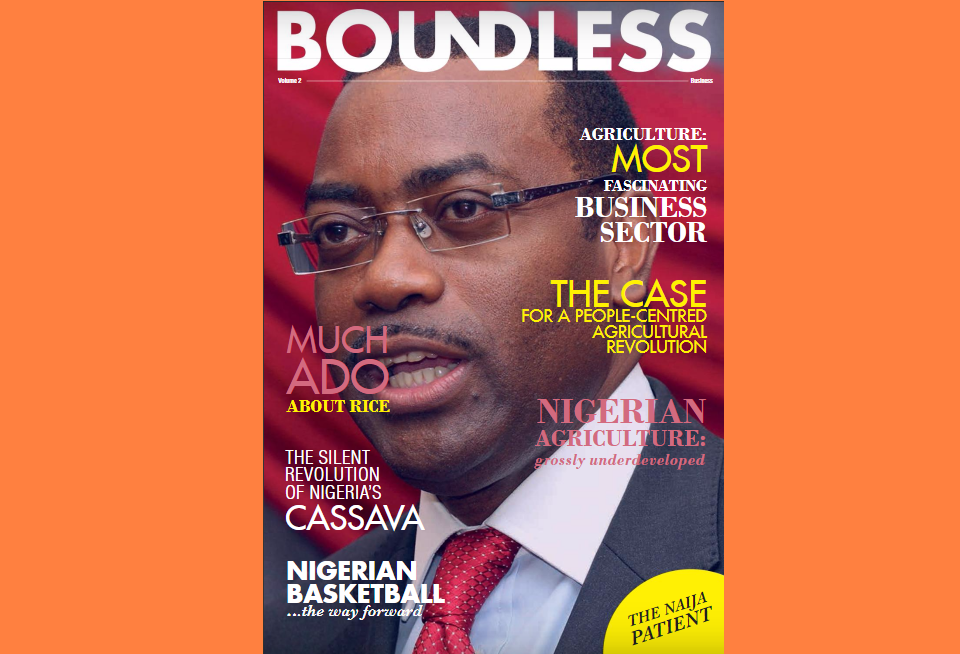
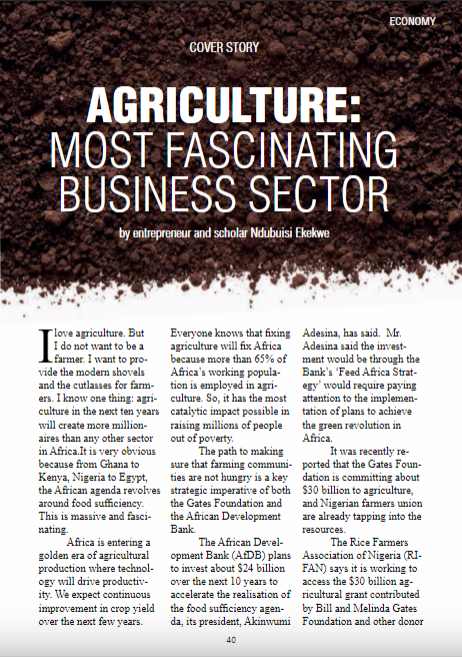
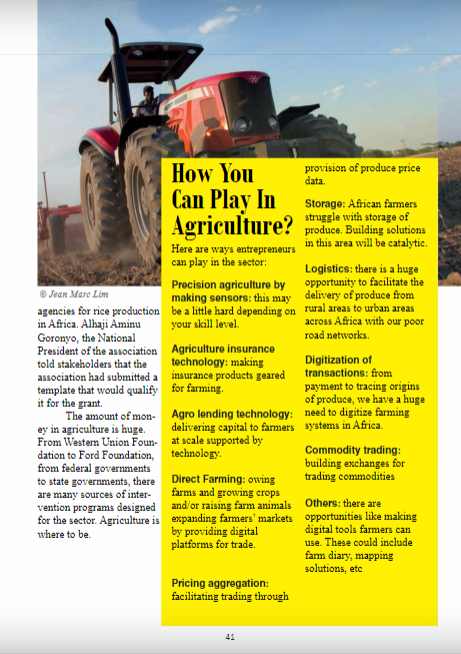
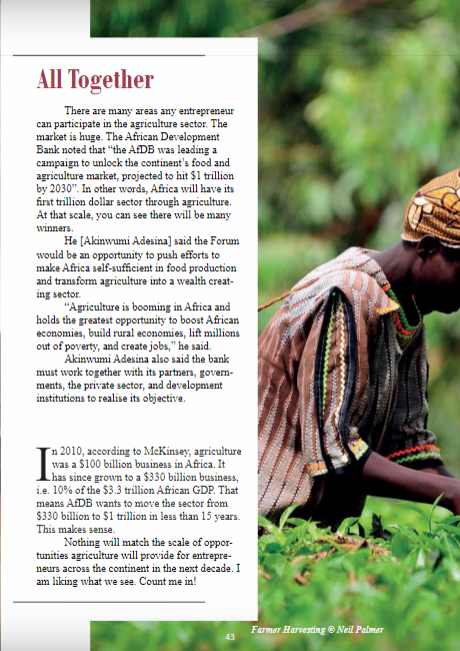
The team at Boundless has one of our articles as cover page. You can read it here. The piece was titled  “Agriculture: Most Fascinating Business Sector” and was adapted from this one.  You will like what they did, a far superior usage of Mama Charlie grammar. People, you can be a farmer without farming. You can wear your blazers and ties and still participate in Africa’s agriculture.

Some images below.