DD
MM
YYYY

PAGES

DD
MM
YYYY

spot_img

PAGES

Home Blog Page 728

Trump Rules Out Tariffs on Gold After Customs Decision Sparks Market Jitters

0

President Donald Trump moved Monday to clarify that gold will not face U.S. tariffs, overruling a recent Customs and Border Protection (CBP) determination that had briefly rattled the global precious metals market.

“Gold will not be Tariffed!” Trump declared in a post on Truth Social, a statement that immediately cooled market fears. Gold futures, which had surged to record highs the previous week, fell sharply after the announcement, closing 2.48% lower at $3,404.70 per ounce.

How the Tariff Scare Began

The turbulence began Friday when CBP ruled that one-kilogram and 100-ounce cast gold bars imported from Switzerland were subject to the 39% tariff Trump imposed on Swiss goods earlier this month. Those bars are widely used to settle contracts on the Commodity Exchange (COMEX), the leading U.S. futures market for gold, silver, and other precious metals.

The ruling was not limited to Switzerland. According to the Swiss Precious Metal Association (SPMA), it would have applied to any country exporting these gold bars to the U.S., making them subject to whatever tariff rate Washington had levied on the country of origin. The SPMA warned that this could “negatively impact the international flow of physical gold,” potentially complicating global trade in a commodity that underpins financial stability in multiple markets.

Trade Policy Background

Trump’s August 7 announcement of broad “reciprocal tariffs” marked one of the most sweeping expansions of U.S. trade duties in decades. The measures targeted dozens of trade partners, including allies, in what the administration described as an effort to ensure the U.S. only paid tariffs equivalent to those imposed on American exports. Switzerland, a major player in global precious metals refining, was hit with a 39% duty — a rate that CBP initially sought to extend to key gold bar imports.

Had the CBP ruling stood, it could have raised costs for U.S. futures traders, investment funds, and bullion dealers, with ripple effects in global pricing. Analysts warned that higher import costs would likely have been passed on to end buyers, including jewelry makers and institutional investors, and could have created arbitrage opportunities that distorted the market.

Trump’s Reversal and Market Impact

Trump has sought to stabilize a market that had been on edge since Friday by explicitly removing gold from the tariff list. His decision comes amid growing concerns from commodity traders and international refiners about the unintended consequences of applying blanket tariffs to globally traded, fungible commodities.

For Switzerland, the reversal spares a key export sector from a sharp disruption. The country is one of the world’s largest gold refiners, processing metal mined across multiple continents. Many of those refined bars ultimately pass through Swiss facilities before reaching the U.S. market.

Still, the episode has left some in the industry uneasy, with some noting that this kind of policy whiplash makes it very hard to plan for the future. This is because even the hint of tariffs on gold can trigger price spikes and affect delivery schedules.

While gold is now exempt, Trump’s tariff regime on other Swiss exports — and on goods from numerous other nations — remains in force. This means the broader trade tensions underpinning the CBP ruling are unresolved. This has triggered the hope that other globally traded commodities might be inadvertently caught in similar customs decisions, forcing further presidential interventions.

COMEX liquidity and futures market mechanics – If the tariffs hold

COMEX futures depend on a seamless pipeline between paper markets and physical metal. If import tariffs on standard cast bars had stuck, the immediate effect would be to raise the landed cost of physical bullion used to meet delivery obligations. That would likely have produced three near-term outcomes.

First, delivery volumes could shrink. Commercial traders who arbitrage between London/Zurich refined bars and COMEX futures might pause shipments rather than absorb a sudden duty, reducing the pool of physical available to satisfy futures delivery notices and narrowing the link between futures and spot. That weakens liquidity in the front months and can widen bid-ask spreads as longs scramble to secure metal or roll contracts.

Second, margin and financing pressures would increase. Brokers and clearing members would treat the elevated cost and delivery risk as additional tail risk, prompting higher margin requirements on gold futures. Higher margins make leveraged speculative positions more expensive and can depress futures open interest and turnover, at least temporarily.

Third, price dynamics across the curve would change. A tariff that raises physical delivery costs is pro-inflationary for spot relative to nearby futures; the market shifts toward a stronger contango (where spot exceeds near futures after adjusting for funding) or unpredictable swings if delivery uncertainty spikes. Volatility would rise as hedge portfolios and producers reprice inventories and forward sales.

Implications for physically backed ETFs (GLD, IAU, others)

ETFs that back shares with allocated physical gold rely on an efficient market to create and redeem shares via authorized participants who move bullion into or out of vaults. A tariff on standard cast bars would have raised the cost of bringing bullion into U.S. vaults, thereby creating a wedge between ETF NAV and the tradable share price.

Authorized participants would face higher transaction and customs costs to deliver metal to funds. That can produce transient premiums on ETF shares (creation becomes more expensive) or discounts (redemptions are deterred), increasing tracking error versus spot. In stressed scenarios, some funds might temporarily halt creations/redemptions for operational reasons, which itself would amplify secondary-market dislocations.

Large ETFs could also face increased storage and logistics frictions. If Swiss-refined bars were deterred, funds would need to source alternative Good-Delivery bars and potentially reconfigure custody arrangements — all of which lengthen settlement times and increase operational costs, which ultimately flow through as slightly wider expense ratios or, in severe episodes, reduced liquidity in ETF secondary markets.

Central bank purchases and reserve management

Central banks acquire metal for reserves using a global network of refineries and authorized sellers — Switzerland is a central node in that network. Tariffs on Swiss-cast bars create frictions for those purchases in two ways.

Operationally, central banks that routinely settle via Zurich could face higher landed costs or prefer to reroute purchases through alternative refining hubs. That might temporarily reduce the volume of gold flowing into U.S. custody or delay deliveries into specific jurisdictions, affecting short-term reserve allocation plans.

Strategically, central banks could accelerate diversification of sourcing and storage locations. Countries might shift purchases to local suppliers, to third-party refiners not subject to the tariff, or increase direct shipments to vaults outside the U.S. That reshuffles patterns of custody and could, over time, reduce the relative share of U.S.-held bullion in international reserves — a geopolitical as well as market effect.

Secondary consequences and market behavior

Beyond those three pillars, several knock-on effects would be likely. Jewelry and industrial users could face higher input costs if tariffs feed into broader spot price rises. Dealers would expand reliance on leased metal, swaps, and OTC forwards to bridge physical shortages, possibly raising counterparty and basis risk.

Market participants would seek arbitrage, creating cross-border flows where duties are lowest, but those flows bring compliance and KYC risks, increasing regulatory scrutiny. Smuggling and misclassification concerns would attract enforcement attention and further disrupt legal supply channels.

Musk Accuses Apple of Manipulating App Store Rankings to Favor OpenAI Over Grok, Threatens Antitrust Lawsuit

0

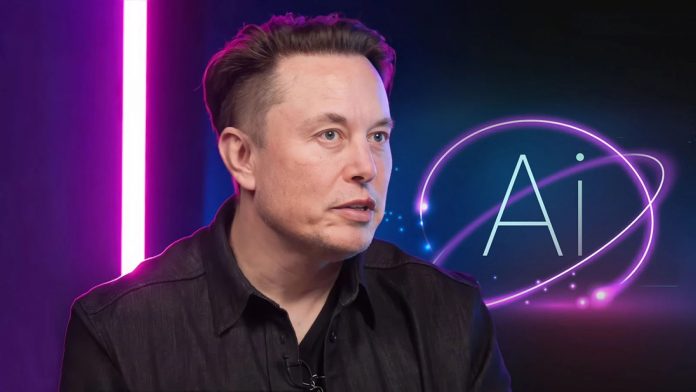
Elon Musk has escalated his long-running feud with Apple, accusing the tech giant of deliberately manipulating its App Store rankings to disadvantage his artificial intelligence ventures.

The billionaire entrepreneur said on Monday night that his AI company, xAI, would “take immediate legal action” against Apple for allegedly sidelining both the X social platform and its Grok chatbot in favor of rival AI apps.

In a series of posts on X, Musk accused Apple of “playing politics” by refusing to list either X or Grok in the App Store’s “Must Have” recommendations, despite what he claimed were their global popularity.

“Apple is behaving in a manner that makes it impossible for any AI company besides OpenAI to reach #1 in the App Store, which is an unequivocal antitrust violation,” Musk wrote. He followed with a pointed challenge: “Why do you refuse to put either X or Grok in your ‘Must Have’ section when X is the #1 news app in the world and Grok is #5 among all apps?”

Musk provided no evidence to substantiate his accusations, and it remains unclear whether any lawsuit has actually been filed. However, in response to a report about his legal threats, Musk doubled down: “Unfortunately, what choice do we have? Apple didn’t just put their thumb on the scale, they put their whole body!”

As of Tuesday, Apple’s U.S. App Store ranked OpenAI’s ChatGPT as the top free iPhone app, with Grok in sixth place. Notably, in January, China’s DeepSeek AI briefly overtook ChatGPT for the top spot—an episode that undercuts Musk’s claim that Apple’s ranking system makes it “impossible” for other AI apps to succeed.

OpenAI–Apple Integration Underpins Musk’s Frustration

At the heart of Musk’s complaint is Apple’s high-profile partnership with OpenAI. Launched at WWDC 2024, the collaboration enabled seamless integration of ChatGPT into iOS, iPadOS, and macOS experiences under the brand Apple Intelligence. This suite leverages OpenAI’s GPT-4o model across Siri, Writing Tools, and generative features like Visual Intelligence and Genmoji, delivering AI-powered assistance directly within Apple’s ecosystem.

The feature was lauded as a seamless way to bring generative AI to a broad audience, but to Musk, it represents a clear circumvention of xAI’s offerings.

Musk’s frustration is amplified by OpenAI’s soaring visibility—ChatGPT is pre-integrated into Apple’s UI, benefiting from prime positioning and default access. It’s a classic distribution advantage: millions of iPhone, iPad, and Mac users can now tap ChatGPT features without switching apps or even knowing they’re using it.

The clash comes against a backdrop of mounting regulatory scrutiny of Apple’s App Store practices. Antitrust watchdogs in the U.S., EU, and other jurisdictions have long accused Apple of favoring its own products or preferred partners, leading to several ongoing legal battles.

Last year, following the announcement that ChatGPT would be integrated into iPhones, iPads, and Macs, Musk threatened to ban Apple devices at all his companies if OpenAI’s technology was “fused” with Apple’s operating systems.

The dispute is also colored by Musk’s personal history with OpenAI. A co-founder of the AI startup in 2015, Musk later split from the organization, citing disagreements over its direction. Since then, he has repeatedly attacked OpenAI for abandoning its original nonprofit mission, even attempting a $97.4 billion buyout that was unanimously rejected. He has also targeted the company through multiple lawsuits, claiming its partnership with Microsoft and commercial focus violate its founding principles.

Critics were quick to note the irony of Musk accusing Apple of algorithmic bias. Since his $44 billion acquisition of Twitter in 2022, now renamed X, Musk has faced allegations of meddling with the platform’s ranking systems to boost his own posts. A 2024 research study suggested X’s algorithm had been modified to amplify Musk’s account disproportionately. OpenAI CEO Sam Altman, in a pointed response to Musk’s latest claims, shared a 2023 Platformer report that detailed a system Musk allegedly had built to promote his posts to all X users.

Questions have also been raised about Grok’s own impartiality. In June, investigations found that the “maximally truth-seeking” chatbot frequently deferred to Musk’s personal opinions when answering sensitive questions on subjects like the Israel–Palestine conflict, U.S. immigration policy, and abortion rights.

The unfolding battle adds another front to Musk’s increasingly public conflicts with both Apple and OpenAI, while also highlighting the growing competitive tensions in the AI sector.

LayerZero-Stargate $110M Buyout Could Reshape Cross-Chain Interoperability

0

The LayerZero Foundation has proposed a $110 million acquisition of Stargate (STG), a cross-chain bridge protocol it originally launched in 2022.

The deal would merge Stargate’s token economy into LayerZero’s ZRO ecosystem, with STG tokens swapped for ZRO at a fixed rate of 1 STG to 0.08634 ZRO, valuing STG at $0.1675 and ZRO at $1.94 at the time of the announcement. If approved, the Stargate DAO would dissolve, and future Stargate revenue would fund ZRO buybacks.

The proposal has driven a market rally, with STG up 12-16.5% to around $0.188-$0.198 and ZRO up 15-23% to $2.33-$2.44, though both tokens remain far below their historical peaks. Community reactions are mixed, with some STG holders criticizing the swap ratio as unfair and lamenting the loss of staking rewards, while others see operational benefits in unification.

The proposal is open for comment for seven days, followed by a Stargate DAO vote requiring 70% approval and a 1.2 million veSTG quorum. By acquiring Stargate, LayerZero aims to streamline its cross-chain operations, integrating Stargate’s bridging capabilities with its omnichain messaging protocol.

The acquisition aligns with a broader trend of consolidation in the cross-chain sector, as protocols seek to strengthen their competitive edge. LayerZero’s control over Stargate could position it as a dominant player in interoperability, potentially attracting more projects and users.

The buyout would dissolve the Stargate DAO, transferring governance to LayerZero’s unified structure. This centralization may streamline decision-making but could alienate community members who value decentralized governance.  Some STG holders criticize the swap ratio (1 STG to 0.08634 ZRO) as undervaluing Stargate’s potential, given its $70 billion in historical transfer volume.

The deal’s value increased to ~$127 million due to these price movements, indicating strong initial investor support. Converting STG to ZRO eliminates STG’s independent market presence, potentially reducing liquidity for STG holders. However, it integrates them into LayerZero’s larger ecosystem, which may offer long-term growth potential.

LayerZero plans to expand Stargate’s functionality beyond asset bridging into broader interoperability solutions, such as enhanced DeFi integrations and consumer-facing applications. This could increase adoption but requires successful execution.

How Buybacks Boost Investor Confidence

Buybacks involve repurchasing ZRO tokens from the market, reducing the circulating supply. This scarcity can drive up token value, as demand remains constant or grows, signaling potential price appreciation to investors.

Investors often view buybacks as a commitment to long-term value creation, as they suggest the protocol believes its token is undervalued or anticipates strong future cash flows.Stargate’s significant revenue from $70 billion in transfer volume will fund ZRO buybacks. This ties token value to tangible protocol earnings, reassuring investors of sustainable financial backing rather than speculative hype.

Buybacks are a strong market signal that LayerZero is confident in its strategic vision and financial health. This can attract institutional and retail investors, as seen in the 15-23% ZRO price surge post-announcement. The positive market response (STG and ZRO price increases) reflects investor optimism about the merger’s synergies and the buyback’s potential to enhance ZRO’s value.

The 70% approval threshold and 1.2 million veSTG quorum requirement mean significant community support is needed. Discontent over the swap ratio or loss of DAO autonomy could derail the deal. The success of LayerZero’s vision depends on integrating Stargate effectively and delivering on promised innovations. Failure to do so could undermine investor confidence.

The ZRO buyback plan boosts investor confidence by signaling financial strength, reducing token supply, and tying value to Stargate’s revenue stream. However, success hinges on community approval and LayerZero’s ability to execute its ambitious roadmap. Investors appear optimistic, as evidenced by the post-announcement price surges, but ongoing communication and transparency will be critical to sustaining confidence.

Kaspa Targets $0.10, Arbitrum Fights $0.50 While BlockDAG’s $371M Presale Gains Speed with Dashboard V4

0

The list of top trending crypto picks is heating up, but not every name is moving with the same weight. The latest Kaspa (KAS) price prediction shows a steady rise if buyers protect key levels. Arbitrum (ARB) is still wrestling with a tough $0.50 barrier.

Both KAS and ARB are in motion, but BlockDAG (BDAG) is delivering something extra. Its new Dashboard V4 doesn’t just hint at trading after launch. It lets the community experience it right now during the presale. With over $371 million already raised, BDAG is proving why it may outpace the rest.

Arbitrum Price Forecast: $0.50 Resistance Holds the Next Move

The Arbitrum (ARB) price forecast depends on breaking the $0.50 ceiling after a 9.02% daily jump brought ARB to $0.4736. Trading volume touched $397.49 million, while the past week’s 28.32% rise ended a flat spell.

Analysts see $0.50 as the deciding level. A close above it could open a run toward $1.17. Long-term outlooks range widely from $0.321 to $2.40. For now, momentum is there, but the push higher will need to clear resistance before sellers step in.

Kaspa Price Prediction: Buyers Aim to Hold $0.092 Support

This week’s Kaspa price prediction focuses on keeping support above $0.092 after rebounding from early August’s $0.0799 low. KAS now trades at $0.0944, showing higher lows that signal steady buying despite rising short interest.

Trading volume stands at 43.58M, slightly off late July’s peak, while $111.67M in open interest confirms active market engagement. A rise above $0.098 could test the $0.10 mark, with further momentum possibly stretching to $0.105. Holding support remains the key to keeping sentiment positive.

BlockDAG Dashboard V4 Brings Presale Trading to Life

BlockDAG’s new Dashboard V4 arrives at a decisive moment, with the presale moving past the halfway mark toward its $600 million goal. This upgraded dashboard blends advanced market tools with a clean, easy-to-use design that connects directly to the fast-growing presale.

It delivers real-time execution, detailed price tracking, and a fully working BUY/SELL system, giving the BDAG community access to the same type of setup they will use after launch.

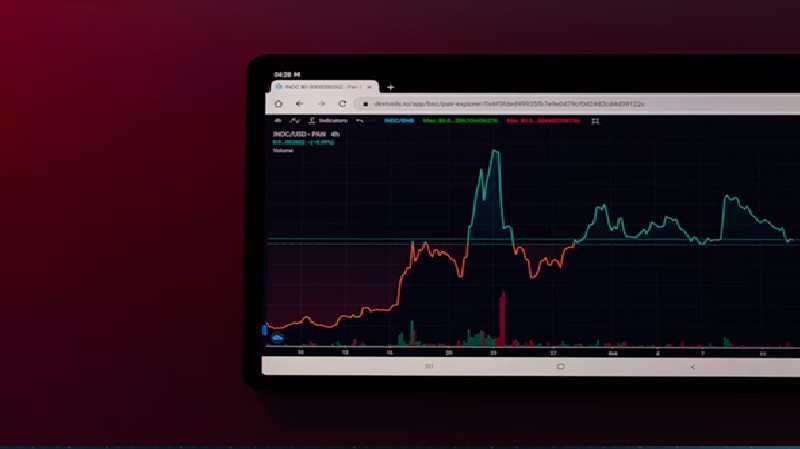
The presale has already reached $371 million, with more than 25 billion BDAG coins sold across 29 batches. The current price is $0.0276, and the shift to $0.029 in batch 30 is getting close, while the launch price remains locked at $0.05. From batch 1 to 29, early participants have seen gains of 2,660%, rewarding those who moved quickly.

For both experienced traders and newcomers, Dashboard V4 offers more than a trial run. It gives an early edge, letting participants test and sharpen their approach before BDAG enters the live market. The layout matches the official exchange, making the transition smooth when trading opens.

As the presale heads into its final stages, each price step is a reminder of the potential gains waiting for those who secure their spot before the market goes live.

Top Trending Crypto Moves Point to 2025’s Big Players

Some names are still building momentum. Kaspa works to keep its gains. Arbitrum eyes the $0.50 breakout. But BlockDAG is already operating at a level that feels like launch day.

The $371 million raised, over 25 billion coins sold, and a trading dashboard that mimics live market conditions are signs it’s moving ahead faster than most. With each batch pushing BDAG closer to $0.05, the window to secure it at current levels is closing quickly. In a space where many are still preparing, BDAG looks ready to lead 2025’s top trending crypto picks.

Presale: https://purchase.blockdag.network

Website: https://blockdag.network

Telegram: https://t.me/blockDAGnetworkOfficial

Discord: https://discord.gg/Q7BxghMVyu

Trump Signals Openness to Scaled-Back Nvidia Blackwell Chip Sales to China, Following 15% Revenue-Sharing Deal

0

President Donald Trump said Monday he would be open to allowing Nvidia to sell a reduced-performance version of its most advanced artificial intelligence chip to China, in what could become a second high-profile revenue-sharing deal between Washington and a leading U.S. semiconductor firm.

Trump said he would consider approving exports of Nvidia’s cutting-edge Blackwell processors to China if the company could engineer a version that is 30% to 50% less powerful than the original.

“It’s possible I’d make a deal” on a “somewhat enhanced — in a negative way — Blackwell” processor, Trump said. “In other words, take 30% to 50% off of it.”

The statement came as Trump confirmed a separate, unprecedented arrangement with Nvidia that will allow the company to sell its less-advanced H20 AI chip to China if it pays 15% of revenue from those sales to the U.S. government. Advanced Micro Devices Inc. (AMD) will be subject to the same 15% revenue-sharing requirement for its China-targeted Instinct MI308 chip, according to a person familiar with the matter.

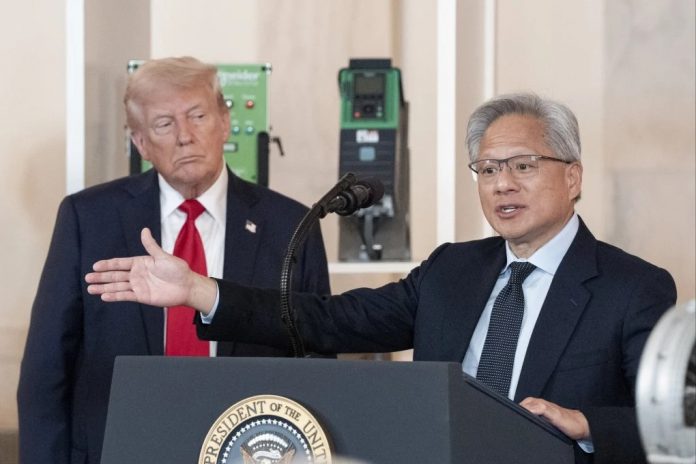
Trump said he had initially demanded a 20% cut of Nvidia’s China sales before CEO Jensen Huang negotiated it down to 15% during a meeting at the White House on Friday.

“I said, ‘listen, I want 20% if I’m going to approve this for you, for the country,’” Trump told reporters.

Calling the H20 an “old chip that China already has” and “obsolete,” Trump compared it to the Blackwell, which he described as “super-duper advanced” and unmatched globally.

“That’s the latest and the greatest in the world. Nobody has it. They won’t have it for five years,” Trump said.

He reiterated that any Blackwell exports to China would require “significant downgrades” in performance before being considered.

U.S. export controls on advanced chips are aimed at preventing China from acquiring technology that could enable it to surpass the U.S. in AI capabilities — a development many officials consider a national security risk. Trump said China already possesses chips with similar capabilities to the H20, adding that Huawei has a comparable product.

Nvidia CEO Huang has argued that it is in America’s strategic interest for Chinese AI developers to use U.S.-made chips, warning that blocking access entirely could accelerate the growth of China’s domestic semiconductor industry.

“He’s selling essentially an old chip,” Trump said, downplaying the H20’s potential to enhance Chinese AI capacity.

The H20, a China-specific variant of Nvidia’s H100 and H200 chips, was developed after the Biden administration’s 2023 export restrictions. Its performance has been deliberately reduced to comply with U.S. rules. In April, the Trump administration required a license for H20 exports, effectively cutting Nvidia off from the Chinese market. Huang later said the company had anticipated $8 billion in H20 sales for the July quarter before shipments were halted.

A Potential Precedent in Trade and Tech Policy

The revenue-sharing arrangement for the H20 and the possibility of a similar one for the Blackwell marks a shift in U.S. export policy, blending national security restrictions with direct fiscal benefit. Trump has framed these deals as ways to ensure America gets a “payout” in exchange for concessions on trade.

Experts say such agreements could set a precedent for future tech exports, particularly in strategic sectors like semiconductors, aerospace, and quantum computing. The U.S. could both limit the performance of exported products and capture a share of the revenue stream by imposing a percentage levy on high-value technology sales to China.

While the approach offers a mechanism to keep U.S. firms competitive in China without granting access to their most advanced capabilities, it could also undermine the strict rationale for export controls if overused.

Nvidia and AMD have both seen their China revenues decline sharply under tightened U.S. export rules. Although Washington has recently issued licenses for certain downgraded chips, these products are often comparable to existing Chinese offerings, raising questions about their appeal in the market.

A scaled-down Blackwell, if approved, could improve Nvidia’s position with Chinese customers and recapture lost sales, but it would also become a bargaining chip in broader U.S.–China trade and technology negotiations.

The timing is significant: Beijing is pressing for eased export curbs on high-bandwidth memory (HBM) chips as part of ongoing trade talks, reportedly seeking to include such concessions in a deal ahead of a potential Trump–Xi Jinping summit. HBM chips are critical for AI training and data processing, making them a parallel flashpoint alongside the Blackwell debate.

Trump hinted that Huang would return to the White House soon to discuss the Blackwell issue further.

“I think he’s coming to see me again about that, but that will be a unenhanced version of the big one,” Trump said.

If the deal scales, the government will be deriving more 15% revenue from Nvidia’s Blackwell exports to China.