DD
MM
YYYY

PAGES

DD
MM
YYYY

spot_img

PAGES

Home Blog Page 7282

The Fakecial Media

0

There is a major problem in the world right now. It is not North Korea. It is not oil price and certainly not any of the global political leaders. The world has one key challenge: social media which has been turned into a fakecial media.

If we do not do anything in the next few years, the world will live fact-free, because anyone can create its version of facts and propagate it. The implications will be huge and could challenge the fabrics upon which civilization is built upon. As you read how the U.S. presidential election was allegedly affected by foreign hackers, you will agree that man has the capability to deceive at scale with supreme outcomes. From Bloomberg newsletter:

Cybersecurity firm FireEye found thousands of fake accounts linked to Russia that regularly posted anti-Clinton messages. It found that on election day, one group of Twitter bots sent out the hashtag #WarAgainstDemocrats more than 1,700 times. Suspected Russian bots even caused the hashtag #HillaryDown to start trending.

This is indeed scary. People can use social media to create a distortion and have excellent results. For something to “trend” on Twitter means that the item is popular. It means the world has joined in a bandwagon with agreement in commonality. Simply, many people were deceived, but they did not know. Why? The contents seemed genuine and real. But it was not.

The Distortion

The biggest challenge today is that while TV and radio are regulated, social media which is the 21st century radio and TV is not regulated. While antenna TV can reach people bounded in a geographical area, social media can reach the world, unbounded. Yet, the message carried by social media is not controlled. The implication is that messages which cannot go through radio and TV can easily find propagation paths via social media. The Russians which are accused to have swayed the U.S. presidential election could not have bought airtime in U.S. TV and radio stations, but they easily penetrated the social media sites and executed their strategies. It was immaterial if the content was heard on radio or read on Facebook. The expected outcome was achieved. Facebook delivered the goods. No law exists today to ensure a fact-based world in social media as we have for TV and radio. It is not likely anyone that tries creating such regulations will succeed unless you live in Eritrea, North Korea and possibly China.

“Everybody realizes that the lines between TV and online are blurring more and more everyday,” said Meredith McGehee, chief of policy, programs and strategy at Issue One, a group that seeks to limit the impact of large donors on politicians. “We have television and communication law that was written in the 1930s and we have campaign law that was written in the 1970s. Neither is appropriate for the 21st century.”

The Problem

There is a real issue. And the issue is that people can have identities which are fake in social media. That enables them to intoxicate minds, accelerating fake news with no consequences. With the structure of the web which has served the world very well for decades, there is nothing anyone can really do. The openness of the internet is going to create a real challenge in the future. It will be a real chaos because this distortion effectiveness will get better.

“Social-media platforms offer the ability to target millions of users based upon a wealth of highly-detailed information,” John Sarbanes, Elijah Cummings, etc wrote in a  letter to the Federal Elections Commission. “As we have seen, the low cost of reaching these users equips hostile foreign actors with a powerful new tool for disruption of our democratic process.”

When the Nigerian Army and the IPOB members clashed in Abia State few days ago, it was tough to ascertain the facts. Social media presented visuals and counter-visuals that left many confused. Even supposedly real videos were disputed. This is big. It goes beyond free speech to speech with free facts. If the world fails to fix this challenge, the global order will be broken.

In Nigeria today, politicians caught on tape committing crime will say that their voices were computer generated. Courts are struggling to admit evidence because anything digital can be discredited. It does not have to be so.

The Future

The next U.S. election will have this fake news and propaganda problem. It is not going away. It will go 2-3 election cycles before the U.S. Congress will pass a regulation requiring Facebook to demand users to validate their accounts with government-issued IDs before they will have posting rights, at least in contents U.S. users can see. Clearly, Congress will threaten Facebook and other social media empires. The threat will be: do it or we will break you into pieces. Facebook will do it. Twitter will do it. And Google will also follow along. Where they fail, the heart of civilization will be irreversibly broken.

In Nigeria, government will increasingly go antagonistic as it tries to control its message. As fake news move upstream in the 2019 election now that the art has been launched in America, Nigerian Senate will take drastic action to curtail.

But there is a challenge: both America and Nigeria cannot fix this problem. But that will not mean that they will not try. Because your fake news may be my fact news, no one can regulate that.

Waiting for Nigeria’s “Unfair Advantage”

0

Two things, and they will help us understand how corporate and national business friendships are structured.

The first one, at the national level, is between U.S. and China. European Union is also there. Simply, some countries are troubled by China’s success because as it does well, it takes away a piece of the cake which U.S. and EU have enjoyed for decades. That is typical, everyone wants to win and stay winning..

 But that is not the end of the story. Tensions over China’s industrial might now threaten the architecture of the global economy. America’s trade representative this week called China an “unprecedented” threat that cannot be tamed by existing trade rules. The European Union, worried by a spate of Chinese acquisitions, is drafting stricter rules on foreign investment. And, all the while, China’s strategy for modernising its economy is adding further strain.

The Western World sees it that China is winning with unfair advantage: it restricts and protects some of its markets while it can compete unfettered in other territories. .There is truth in that. But there is also a fact that China is indeed doing well at home, innovating across many industrial sectors. As I have noted in the past, China is winning at home and now has a clear global ambition, not just in infrastructure construction, but also in technology.

Uber lost to Didi Chuxing in China. Facebook’s WhatsApp is a tech generation behind the innovation of WeChat. DJI is peerless in civilian drone making. Alibaba pioneered a new sector in digital commerce. Baidu has a vision to become the operating system of the autonomous vehicles through Apollo. Chinese companies are ferocious in battles and they are winning, at home. Apple is brutalized, in China

China has always protected its markets. But the problem now is that it seems to be capable of serving the available markets where foreign companies can participate. Had it just ended in protecting its markets and then cannot serve the openly available ones very well, no one will care that much. If WhatsApp had beaten WeChat, Uber crushed Didi Chuxing and DJI lost its hold on drone making, China will be a good global technology player. But today, it is not because it is winning. As it exerts its influence in payments through Alibaba and Ant Financials, it is changing the global order. Many will accuse it of “unfair advantage”. China expects that.

Secondly, Google is showing that it does not like to lose. Simply, companies like to have competitive advantages. For all the nice talks about ecosystem and community friendships, when firms see that you are about to crush them, you will see the other side. Google is showing it to Amazon. Amazon will do it to another firm that comes against it. That is the way it is, provided that you can modify your Terms of Use to exclude a mortal threat. It is part of the game. You simply do not want to surrender. I am yet to get documents created in Windows and Mac to work seamlessly when shared with partners. They can make it work, but they will not because everyone wants to hold its domain.

Google pulled the video service from the smart speaker this afternoon, a move Amazon doesn’t seem too happy about. Echo Show owners weren’t given any advance warning previous to the removal. […]

Google made a change today around 3 pm. YouTube used to be available to our shared customers on Echo Show. As of this afternoon, Google has chosen to no longer make YouTube available on Echo Show, without explanation and without notification to customers. There is no technical reason for that decision, which is disappointing and hurts both of our customers.

This is what it is: until we start winning in Africa, we cannot be seen as threats. But when we begin to win, threats will come. China is experiencing it. Amazon is getting it from all angles. China and Amazon are winning. Bombardier joins them as Boeing sues to ensure U.S. government punishes it. If bombardier is not winning, it will be a friendly competitor to Boeing. That does not mean that Boeing does not have a point. It does, but things change when there is a major threat. Boeing has used low interest funds from US EXIM Bank to finance sales. Airbus had complained for that. No one is happy when losing.

The day has been dominated by the ructions following the US decision to slap 219% tariffs on Bombardier, the result of a dispute with rival Boeing.

For Nigeria, we need to have some wins. The action of Google against Amazon does not seem like what you expect from it. But Google wants to survive and cannot arm its opponent. It is not about Google. It is just the way these companies play.

All Together

Whether it is Yaba, Kaduna or Aba, I am hoping that our moment will come. It will be glorious a day U.S. or China will say that Nigeria is not being fair in its business competitiveness. That shows that we have arrived. It will take time but I do know it will come. Imagine Google blocking API access from a Nigerian company that it sees a as serious threat. That will be glorious.

How do we make it happen? This is my suggestion. Give local and foreign partners 5-10 years and after the period maintain that government will not patronize any solution that does not have major local contents. So, the government must buy local. That will motivate foreign firms to invest locally and also empower local investors to expand knowing that the market is there. The government needs to give time and stick with that plan so that local capabilities can emerge. When we do that for 15 years, knowing that all levels of our governments are customers, you will see top grade Nigerian companies emerge. Then the foreign firms will have design centers and not just sales offices, to serve Nigerian markets. Nigeria can then be accused of being unfair in its business competition. That will be nice, because it means, we are beginning to win. Industrializing Nigeria can only come when the best customer can buy from Nigeria. That best customer in our tilted public sector-driven economy is Government.

Nigeria’s First Bank Incredulous 30 Million Target

2
CEO Adebola

First Bank of Nigeria is an eminent banking institution. It has top-rate managers and arguably one of the finest companies in Nigeria. But recently, First Bank is making statements that confound any careful observer. The latest one is its plan to add 16 million customers in the next three years, by broadening its digital marketing. Since 1894 (note “8”), the bank has added only 14 million customers till date. Then in three years, it will magically add 16 million new customers. The bank is not clear on how it will execute such an audacious target that may risk making the managers look weak in a scenario they fail..

First Bank of Nigeria Ltd , one of Nigeria’s pioneer financial institutions, has said it is currently broadening its digital marketing initiatives in a bid to add 16 million customers to the present 14 million customers.

According to Dr. Adesola Adedutan, FirstBank’s Managing Director/Chief Executive, said this is part of its growth strategy to get 30 million customers over the next three years, and to migrate its existing and new customers to alternative channels, namely First Online, Firstmobile, USSD and ATM cards.

He said,“We have a focus of building our customer base to 30 million in the next three years from the 14 million we currently have. That is the way forward for us and we are making significant progress already.”

First Bank is not a Nigerian political party. I hold the bank shares. I make time to know what is happening in the bank. But recently, First Bank is talking like APC and PDP. Sometimes, the bank makes statements without supporting insights. If anyone believes that First Bank will add 16 million new customers in three years when it took it more than a century for 14 million, I have a bridge to sell that person.

The bank needs to know that it may need to first buy other big banks like GTBank and UBA before it can get closer to 12 million new customers (most customers have multiple bank accounts so if you sort  and combine them, the number of unique customers will drop from a combined total). GTBank has 8.3 million customers. UBA has about 8 million customers. If you combine GTBank and UBA, you may get about 12 million unique customers. Of course, First Bank cannot buy GTBank, the reverse is more plausible. First Bank is worth around N207 billion while GTBank is worth about N1.12 trillion in the Nigerian Stock Exchange excluding its listing in Europe.  So, I do not know where these 16 million new customers will come from within three years for First Bank if big acquisition is not the path.

In short, it is nearly impossible, using today’s data, for First Bank to execute this target. The total number of unique Nigerian bank customers is less than 30 million. (It could have gone up, but not certainly more than 40 million.) Yet, a bank CEO will tell the world that it can get 30 million customers. If you subtract the 14 million customers First Bank currently has, what will remain is 16 million customers. Simply, if First Bank should succeed, on this target, it does imply that every Nigerian bank customer must have an account with it.

It is estimated that the Bank Verification Number exercise which links customers with their biometric data like facial features and fingerprints generated about 25 million unique customers in Nigeria. Those 25 million customers accounted for about 45 million bank accounts in Nigeria.

The numbers are relatively poor for a country of more than 180 million people. For the banks to get their next 30 million customers, they need to improve their games

We need to become a country that is more fact-based and common sense-driven, especially in an industry that holds the economy. Banks must speak with common sense. They are not political parties. In U.S., analysts would have challenged First Bank to show how it will get to this huge customer base. But in Nigeria, no one cares. The press just reported it and moved on.

Of course, I concede that the digital marketing can target more than 80 million Nigerian adults who are not yet in the banking sector. That is mathematically possible. Yet, I do not know how many of those 80 million people anyone can reach digitally within three years. But First Bank may have its strategy in the vault; 2021 will tell us how solid it is. But for today, I find it incredulous because the basic elements of the markets do not support such level of growth.

The Law of Diminishing Apple Returns

0

Apple transformed the mobile telephony consumer market by changing the basis of competition. Through the new basis of competition which elevated the industry, Blackberry and Nokia were destroyed. Apple became the industry category-king and the world’s most valued company.

Apple did that through pioneering innovations via products like iPod, iPhone and iPad. The world responded. Apple saw glory and triumphed. The stock price went through the sky. Legends were made. Steve Jobs became a demi-god with disciples from the Himalayas to the Kilimanjaro, and from the Mississippi to the Shinano.

Then Apple started incremental innovation. The bold disruption is gone. When that happens, we can return to agriculture, picking a lesson from the law of diminishing returns:

In economics, diminishing returns is the decrease in the marginal (incremental) output of a production process as the amount of a single factor of production is incrementally increased, while the amounts of all other factors of production stay constant.

The law of diminishing returns states that in all productive processes, adding more of one factor of production, while holding all others constant (“ceteris paribus“), will at some point yield lower incremental per-unit returns

In most agricultural science examples in Nigerian secondary schools, fertilizer was always what was to be added while the land was always held constant. What the law means there is that there is a limit that adding more fertilizer to a piece of land can continue to improve your farm yield, In other words, after a time, despite adding more fertilizers, the yield impact will be negligible.

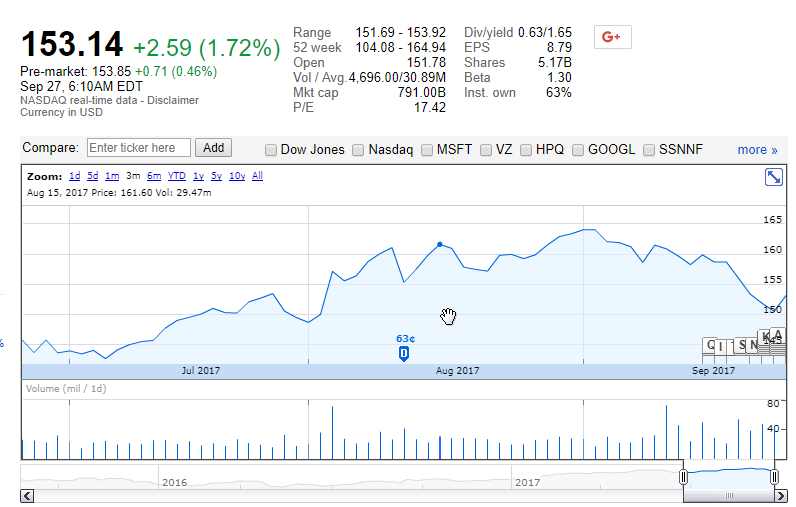
For Apple, adding more of incremental features on iPhone will get to a level where the impact will be negligible in the stock price. The incremental feature is the fertilizer here and wowing users is the land. The output is the stock performance. (There is a negative return in Apple stock over the last few weeks, and not just flat. When the law of diminishing returns is extended for a long period, the marginal output is always low. But again, negative return over a short time does not say a lot of things. For Apple, it is negligible). Fortune Newsletter has a good summary on this:

Shares in Apple hit an eight-week low after a report suggesting weak initial demand for the iPhone X. Fortune‘s Don Reisinger dissected that specific story skeptically, but market sentiment has clearly turned cautious since the launch of the X and iPhone 8, amid fears that they will cannibalize each other’s sales and, more specifically, that the X’s $999 price tag is too ambitious. At a little over 17 times trailing 12-month earnings, the stock has a curiously old-economy feel to it all of a sudden

A three-month Apple stock performance (Source: Google Finance)

But do not bet against Apple yet, it has a record of turning this diminishing return into an abundant return.

In the end, the iPhone 7 turned out to be a big seller, and Apple ordered the remaining supplies a couple of months later.

In other words, Apple’s iPhone X component strategy, as reported by Digitimes, wouldn’t be unique. It could merely be a strategy that it has followed in the past, and that Apple just wants to avoid forking out too much money for parts

We do hope for iPhone X to find success. iPhone 8 has been unable to start the carnivals for the Apple fans. Where iPhone X also fails, then you can be talking of a diminishing returns.

The Web is Changing the Gaming Industry

0

Information and communicating technology (ICT) is changing the world. ICT has provided productivity gains making it easier to get many things done. From banking to entertainment, there is no sector which technology has not affected. That is a good thing because when technology penetrates across industrial sectors, we do see improvement in efficiency, quality and cost effectiveness.

But from ICT we have the internet which is changing the game entirely. The internet is offering highly level of distribution which is not constrained by any location or distance. In short there is no geography. And firms are moving to take advantages accordingly.

Yes, we do see across the world the transitioning of many industrial sectors into the digital domain. One that has taken shape over the last few years is broad entertainment with specificity on gaming. In the sub-sector gaming we have casino which continues to move online. The trajectory is very obvious because Internet helps the sector to scale without bounds. Unlike the physical space, the internet makes it possible for players like casino.netbet.co.uk to distribute their services and reach their clients unbounded by geography and distance.

It saves them cost as they do not have to build game halls and also save their players money as they do not have to travel. All what matters is simply to go online and play 24/7 without any limitation on time and space.

I do recall when the web was coming alive at scale. That was when I started using Yahoo. I think it was around 1995. Yahoo was a priced commodity then: the storage was about 4MB and you needed to delete many contents even in SENT folder just to have space to send more emails. There were projections on the possibility of the email app. It progressed. The websites started arriving where companies had static pages to showcase their services and innovations. Those continue to exist. But over the last few years, we have seen a whole sector moved online.

Entertainment is one of the biggest beneficiaries and we continue to see its dimensions in many ways. From football to casino, the future of gaming is certainly online. The computing power and its processing speed have gotten better making it possible for individuals to effectively play at home without the need of going to Las Vegas, London or other cities there they can participate in gaming. Today, the laptop is the city with internet access. It is just one addition of the unbounded capabilities of the web and its disruptive effects to how global commerce works. The world has changed including the ecosystem of online gaming. The path to digital cannot be stopped: everything is going digital indeed.

Contributed by K.C. Beats