Just thinking about it, America and Nigeria share many things in common. I have lived in four states in U.S. and have experienced the diversity of its economic systems. In Alabama, you have the farms with extremely affordable food. As California creates its technology startups, New York is setting the pace of global financial innovations. You cannot forget Texas, with its energy leadership, even as Florida makes itself a place to go and relax. That diversity of America is what makes it great.
Sharing a story with a friend on how I used to buy a whole chicken for 65 cents in Alabama as a student, he told me that I was even wasting money. Apparently, going to the farms, you could get the chickens far cheaper. Potatoes were largely free. You could get it for free by welcoming farmers returning from farms every Friday, as a student. Alabama contributes to U.S. food security.
Florida is a destination for people to come and spend their money. It makes itself a heaven on earth depending on how you look at it.
Truth be told, the way America is wired is largely similar to the way Nigeria exists. The only problem is that the latter has not unlocked the opportunities in its systems. Kano is Nigeria’s Alabama for food. Chicago reminds me of mercantile and trade, just as Aba and Onitsha. I know that Lagos is our New York, a center of excellence in finance. Port Harcourt or Warri is there as our seat of energy, representing Houston, Texas. Calabar and Jos could be the beautiful Miami and Orlando (all in Florida).
There is nothing you can find in America that Nigeria does not have. In our case, we are missing leadership which can help redesign the country and unlock the opportunities. That we have Kano, Lagos, Aba, Calabar and other great cities are opportunities. That is why I do think Nigeria represents strength as one nation. We cannot be forgotten if we band together. With that diversity, we can manage challenges, compensating for the cyclical movements in industries and markets, if only there is a leader that can harness them.
Knowledge will rule modern man and this knowledge is new, fresh and combative. Since Adam Smith’s ‘Wealth of Nations’, there has never been a more urgent time in the history of man where innovative economic and political leadership is required of leaders. The reason is simple; globalization makes it difficult to control factors like trade and labor, which hitherto, could be easily controlled to the advantages of nations. Because of the “new continent”, Internet, only nations with dynamic and insightful leadership can prosper.
This is Nigeria’s time and we need to do whatever is necessary to unlock the opportunities in our national diversity. Wasting the immense opportunities of a highly blessed nation is a shame to our generation. Yet, we still have time to correct whatever that needs to be fixed.
As most African countries work on the diversification of their economies, agriculture is going to be one of the core pillars of that economic redesign. Agriculture employs more than 60% of Africa’s working population and generates a huge component of the gross domestic product (GDP). The path to Africa’s wellbeing will run through improved agricultural processes. The sector is the low hanging fruit, to improve Africa’s economy, and everyone knows that.
To make that work, we need new technologies in farms to drive new processes that will improve productivity and farm yields. If Africa improves its farm yields, the possibility of reducing mass poverty will be certain. Across human history, when productivity improves, human welfare always accelerates. This implies that African farming systems must be redesigned to move them from largely subsistence model into a scalable architecture that delivers value at scale. In others words, the inventive processes must be engineered to become innovative ecosystems that bring massive commercialization, turning rural villages and communities into center of commerce. Farmers then transmute from being just farmers into business-people, focusing on profits and generating value, over just experiencing ancestral cultural ways of living.
The Future Farming
The future of African agriculture must be technology enabled. Here are areas technology can help:
Soil Mapping: African farmers need soil data to make better decisions on what to plant and how to grow crops. The soil data will be used to support building growth model for crops for each area as well as managing fertilizer mix, for each region. This means we want farmers to focus on crops where they will earn more, over just following cultural traditions handed by ancestors
eFarm Diary: farmers need to use electronic farm diary in real-time. This diary will keep all records – financial, staff, tools, etc in one secured place.
Pricing Information – empowers rural farmers with real-time produce prices across major cities. This will provide farmers with data to effectively negotiate prices with merchants who normally pay them little, owing to lack of pricing information
Capital – helps farmers raise capital (loan or equity) by providing independent farm data from precision sensors to help banks and investors evaluate overall profitability of farms.
Crowdfund – helps farmers crowdfund capital from local donors who they can deliver produce after harvest.
Insurance – helps farmers insure their farms by providing independent farm data from precision sensors to insurers. This will help insurance companies to model risks based on actual farm data.
Marketplace – provides a platform for farmers to sell their produce. This will be an avenue for farmers to expand their markets by removing geographic limitations. Farmers list their harvest days and buyers connect.
Precision farming: Farmers do not need to make sacrifices to gods for bumper harvest. They cannot do farming blindly. Now is the moment for technology to provide insights in what they do. They need sensory data from farms to help provide insights on what, how and when to farm
One of the biggest challenges that continue to affect the deployment of technology in Africa’s agriculture is connectivity. For all the modern technologies to work, farmers must have access to the web or be connected. Yes, they have to be connected. I had noted that telcos across Africa have opportunities in this area.
With AgTech IoT (Internet of Things) innovation, companies like MTN, Airtel, 9Mobile and Glo can pipe a lot of agriculture data to farmers, banks, insurers and others, across the food chain. The telcos will aim to improve the connectivity of sensors and other data-capturing devices on farms to help farmers turn data into actionable insights through software platform. The opportunity is huge as this is an untapped market. I am hoping that telcos can come together to seed a new layer of African farming through connectivity. An initiative to connect African farms would be a necessary investment for them to expand beyond where they are today.
The telecom companies will help agtech entrepreneurs handle connectivity issues with a standard, if necessary, set for the agriculture space. This is good business because the new business will help boost demand for data. We suggest for the telcos to work together and build a new business segment. Bringing networks, and platforms from agtech startups together, will quickly help drive the ag-innovation process.
In addition to providing farmers with the ability to track everything that’s happening in their fields, such as water pipe leak, irrigation, efficient fertilizer application, the telecom firms working with agtech entrepreneurs will aim to provide farmers with prescriptive recommendations, based on the combination of historical, geospatial and on-farm data. The key is partnership with the startups working in the agriculture technology space, who will need ways to move their data to farmers. Farmers pay data subscriptions and telcos enjoy.
Unfortunately, the telcos do not seem to be highly interested in this space.
The HITCH Innovation
HITCH makes technology which helps people consume online content for free or largely free. It is a cloud platform that enables curation and access to videos via a HITCH-designed (smart) WiFi hotspot that caches content, and lets users access it offline. It is working to execute the following as noted in referred site:
Nurture and sustain economic opportunity, gender equality and empowerment, & social standing, using videos.
Achieve significant savings from a multi-sided platform of customers and users, as well as other technological innovations, as the core of its model.
Are owned/managed by local community operators, with whom it shares revenue from customers.
Offering also includes: market-based information, freemium entertainment (from Nollywood, etc.), & off-grid energy access(recharging service for phones, LED appliances, etc.).
HITCH has an African vision and already operating in Nigeria. What they do is developing a technology that “removes the barriers posed by availability, affordability, and accessibility of broadband, to the reliable, cost-effective, and seamless creation and consumption of video, in underserved communities around the world”. They innovate at the elements to make enjoying online contents to be more affordable.
By “free”, we mean that we are focused on leveraging technologies, processes, and use-cases that enable on-demand user-driven “video buffet” content delivery to them. This video buffet encompasses a sustainable value offering?—?ranging from free, to a fraction of current costs, especially as is relative to average monthly incomes, irrespective of their underserved status or location.
HITCH has a vision and it touches many pieces of connectivity in Africa. It wants to empower underserved users in emerging markets through unrestricted access to impactful videos that transcend literacy barriers. It has also made its technology easy to use: “Local community operators just turn on HITCH smart WiFi hotspot and service is automatically enabled. The users access free service by connecting to open SSID at HITCH smart WiFi hotspots; after which their devices automatically redirect to landing page (no further input required)”.
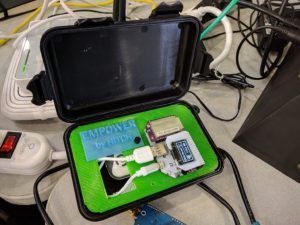
What HITCH has developed can be used in other sectors like video-on-demand markets, education and more. It goes beyond agriculture. They are already working with partners like Empower in East Africa to make access to online contents possible.
Empower from HITCH (source: HITCH)
The Promise of HITCH In Nigeria
With this technology ease of us, it is very possible that farmers cooperatives can organize and connect in the HITCH ecosystem. The company clearly understands the enormous opportunities of reaching rural communities, beyond cities, where the telcos focus, as noted in its homepage.
Globally, over 4 billion people don’t have sustainable (available, affordable, & accessible) broadband. Most of these users are un/underserved by existing coverage and service infrastructure; and live in rural and urban emerging markets. Thus, are denied the ability to benefit from real technology-driven economic growth.
Broadband is important because low digital and conventional literacy in these markets, means video (especially in local languages/dialects) presents an enhanced medium for information, knowledge, and power. For these users, the prevalent notion of “trickle-down broadband” is a death knell; as ROI of current options struggles to present a reliable pathway to sustainable broadband delivery.
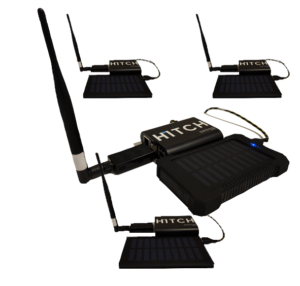
HITCH system (source: HITCH)
All Together
HITCH offers great value for people with limited access to the web. It is not the only company working in this space. Flobyt, Cafe Neo and Surfwella are other entities which are providing free or affordable internet in Nigeria. But HITCH takes this business model forward with its inclusion of rural community like farming areas. It will have to deal with many challenges (power, density, purchasing power, etc) typical in serving rural regions across Africa. How it solves those problems will determine its sustainability and potential profitability.
My company Zenvus will surely benefit from this initiative because a limiting factor in our work is connectivity in farming communities. We have solved some of the problems through satellite connectivity. But that has its cost element which makes it limiting to some clients.
HITCH is very exciting and a startup to watch in Nigeria, and beyond, over the next few years. If they succeed, we will be certain that poverty will drop because farmers will surely improve yields and earn more.
Snap, the owner of Snapchat, may not be redeemable. The company seems to lack vision. From Fortune Magazine newsletter, I quote:
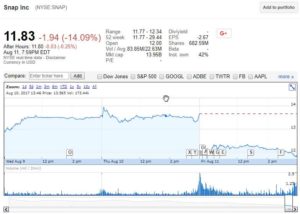
Snap’s shares are set to open … after it reported that its quarterly loss nearly quadrupled and said increasing competition from Facebook hit user growth. Revenue rose to $%182 million from $72 million a year earlier, but the net loss hit an eye-watering $443 million, up from $116 million. CEO and co-founder Evan Spiegel tried to cheer investors up by reminding them that slower user growth meant lower Cloud data storage bills in the short term. He didn’t succeed
Essentially, the company is wishing that it does not grow user base so that it can save on computing bills. I mean Snap wishes that it does not add more users to avoid spending on supporting user growth. For an American public company that depends on network effect, possible with huge user base, to execute its business model, this is extremely worrisome. This company has lost its vision.
When you read a portion of a statement credited to Evan, you will wonder if it is not time to be looking for a new CEO for Snap.
A sudden influx of users is “just not appealing at this stage of the business,” Spiegel said. He didn’t say what cloud hosting providers he was referring to in terms of the big bills, but Snap has previously agreed to spend $1 billion over the next five years on Amazon Web Services.
If Snap does not want to be growing users, it simply means that Snap is done. You cannot make up lack of vision any better than this.The statement is illogical, and could put many people wondering if Snap can be saved, even in the midst of competitive onslaught from Facebook.
Just as Fortune noted that Wall Street was not convinced on the argument, I do not buy it also. Snap ended the day down 14%
Over the last few months, a new business model is emerging in Nigeria: free wifi. Companies provide free wifi and then make money via advertisement and other support services. Our university campuses are becoming the first anchor recipients of these bold entrepreneurial pursuits. Don Jazzy started this, at scale, and others like Cyberspace Network are joining the race.
Nigerian universities will be boosted academically with the introduction of free internet access on campus, as Cyberspace Network Limited has made available wifi access for all through its Surwella initiative. …
According to Olusola Bankole, chief marketing officer, Surfwella, the free internet wifi will be launched across the length and breadth of university campuses in Nigeria, starting with the University of Abuja, from today, Wednesday 9, August 2017.
The service will be free, “no payment, no subscription, no data purchase, and no need for modems. Free internet in the most useable form, on wifi,” he stated.
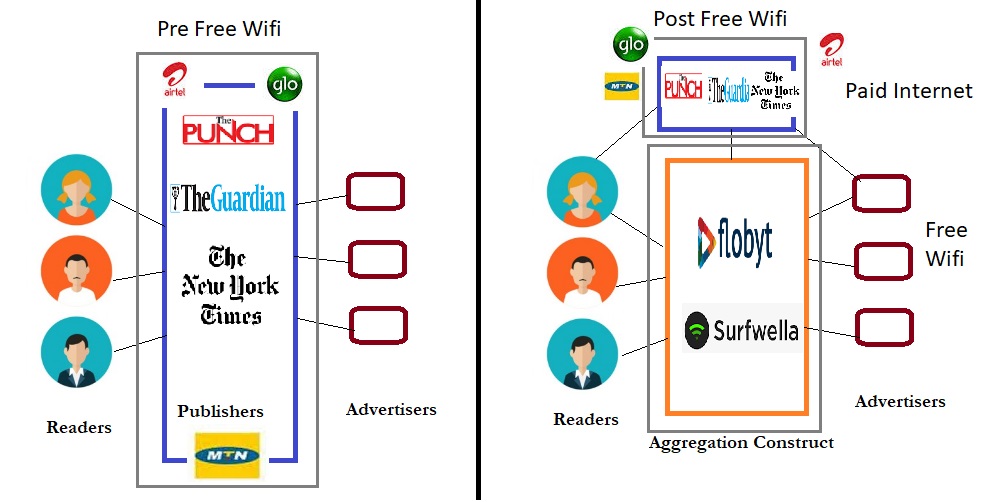
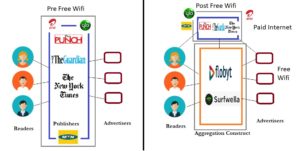
This is exciting for the end users because getting internet free in Nigeria is certainly empowering. The providers are working on the established constructs that scale, through freemium, can deliver huge value down the line. You give the Wifi service free and in that system become an aggregator who controls the ecosystem through which the end users and the publishers get in contact. This is the aggregation construct.
Under the aggregation construct, the companies that control the value are not usually the ones that created them. Google News and Facebook control news distribution in Nigeria than Guardian, ThisDay and others. Because the MNCs tech firms “own” the audience and the customers, the advertises focus on them, hoping to reach the readers through them. Just like that, the news creators have been systematically sidelined as they earn lesser and lesser from their works. But the aggregators like Facebook and Google smile to the bank. The reason why this happens is because of the abundance which Internet makes possible. Everyone has access to more users but that does not correlate to more revenue because the money goes to people that can help simplify the experiences to the users who will not prefer to be visiting all the news site to get any information they want. They go to Google and search and then Google takes them to the website in Nigeria with the information. Advertisers understand the value created is now with Google which simplifies that process.
The Wifi provider manages what passes through its network, assuming a power similar to Google News, as noted in the example of the aggregation construct. Just as Airbnb, and Uber simplify the processes of linking users to houses and vehicles respectively, the Wifi provider can link publishers to the end users effectively. Who cares to advertise via Guardian, Vanguard and ThisDay in Nigeria when you know there is a Wifi provider everyone uses to read the contents. You simply advertise through that Wifi provider expecting that it can organize what it wants its readers to see in its ecosystem. It becomes a key component in the system. That is a very powerful business model, if done at scale.
Core Elements of the Business Model
There are many ways people that deliver free wifi can make money in Nigeria. They include the following:
Advertisement: This is the same model used in many airports around the world. Before you can get on the web, you will need to watch some adverts. This is the key element of the free wifi business model.
Partnership: Just as Facebook helps New York Times to publish its contents on Facebook to reach more audience, ThisDay Nigeria can decide to work with these free wifi entrepreneurs to get people to read their contents in Nigeria. In that case, the entrepreneurs will be compensated. Also, in case governments want people to access contents online and are worried that few can afford to access them, they can partner with these free wifi entrepreneurs to host those contents for them. I expect companies like iflix and other video on demand firms to work with these entrepreneurs under revenue sharing model so that users can use their services to watch movies. This will happen as the wifi companies become stronger with scale.
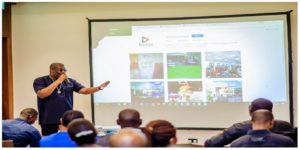
Unveiling of Flobyt
Mining and Analytics: As data goes through their systems, they can make sense of many elements for partners. From surveys, as seen in some airports, to understanding what users care about in some specific localities, these entrepreneurs can provide insights on so many things. They will mine all the data they are collecting and can make money reselling them. This can help partners to deliver services and solutions at higher quality.
Promotions: You expect the companies doing this to position preferred products in front of the users. Some of those products could be their own products. Just like banks put their services in your view when you use their free wifi services, you expect the entrepreneurs to position their services, from movie to music, ahead of competitors’.Do not expect this to be a neutral internet. In some airports, you get free wifi sponsored by ecommerce companies which provide them to help you buy things from their sites For example, Konga can partner with a free wifi company in Lagos to make its site the landing page.
New Industries: The same manifestos which I have written that telcos need will be useful here. The free wifi or affordable internet business could unlock value in agriculture, as HITCH is doing in Nigeria.
With AgTech IoT (Internet of Things) innovation, companies like MTN, Airtel, 9Mobile and Glo can pipe a lot of agriculture data to farmers, banks, insurers and others, across the food chain. The telcos will aim to improve the connectivity of sensors and other data-capturing devices on farms to help farmers turn data into actionable insights through software platform. The opportunity is huge as this is an untapped market. I am hoping that telcos can come together to seed a new layer of African farming through connectivity. An initiative to connect African farms would be a necessary investment for them to expand beyond where they are today.
Investors See Value
As the free wifi entrepreneurs shake Nigeria, nothing will be the same again. I will not be discussing the impacts to telcos because that will miss the mark. The key thing is that these entrepreneurs can control access to digital contents in the Internet. As aggregators, they will be the winners, not the creators of contents, under the abundance of internet. Investors love such positioning in markets and that is why the money is flowing in..
Tizeti, a Nigerian startup which develops solar powered WiFi towers with its Wifi.com.ng service, today announced it had secured $2.1-million in funding through US-based Y Combinator from several investors.
“Today’s seed announcement allows us to grow aggressively in the Nigerian market, and we will continue to invest in building out our own solar-powered infrastructure, as well as refine and expand our consumer-focused product,” said Kendall Ananyi, the CEO of Tizeti, in a press release.
The round’s investors include Western Technology Investment, Social Capital, Vy Capital, Picus Capital, Ace & Company, Lynett Capital Partners, Zeno Ventures. The round also consists of a handful of angel investors including Y Combinator’s Michael Seibel and Gabriel Hammond.
Sure Tizeti is not free as in Cyberspace Network since it charges from $30 per month, Nevertheless, Tizeti is well positioned to have substantial market opportunity for unlimited Internet service at that price point. This aggregation model does not have to be wholly-free to work, in Nigeria. What I expect to happen is for people to come together and pay for one account and then use the service in turns. For example, three students can pay for that $30 and they will decide who uses the service over the month at what point. Provided that the service is of decent quality, the model will work since the amount is still largely affordable.
The Industry Players
One of the pioneers of this business model is Don Jazzy, the CEO of Mavin Records. With his partners, they unveiled Flobyt Wifi – a free, fast, reliable and easy to use wifi service across partner locations including; eateries, parks, taxis, buses, restaurants, cafés, etc.
Flobyt is a free WiFi service installed across partner locations in Lagos like eateries, parks, taxis, buses, restaurants, cafés and many other businesses. The service is free for patrons of a business who wish to access the internet while in the premises of the patron locations. The internet router itself is a plug-and-play device that, according to the founders, does not require much technical know-how to operate….
There is no charge to use Flobyt WiFi, all it takes is to walk into a partner outlet, patronise them and use the internet without restrictions…
The company plans to take its services to other parts of Nigeria, through West Africa and ultimately throughout Africa giving the public access to free internet while providing value for the business owners.
This is very ambitious indeed and they certainly have a plan. With his celebrity status and contents (he is an entertainer), Don can offer contents and essentially drive what people can access through his Wifi service. Expect his products to be well promoted through this avenue.
Besides Don Jazzy, we have CafeNeo which offers free internet in its stores. Another firm, HITCH, takes it further, delivering value to users by helping them catch contents, to access offline. Users access free service by connecting to HITCH smart WiFi hotspots.
HITCH is a cloud platform that enables curation and access to videos via a HITCH-designed (smart) WiFi hotspot that caches content, and lets users access it offline.
You can add Facebook Free Basics here as it is free to the approved sites.There are also banks like Diamond Bank and Union Bank which allow customers to browse free in their bank premises, provided you are a customer of the bank.
There players will have to expand beyond into other areas for growth and opportunities. A piece by Oluwole Ogunlade noted that free wifi could be very catalytic in the transportation sector. Imagine deploying these services in luxury buses like ABC Transport or Chisco Transport. Any transporter that does this will certainly win customers. The entrepreneurs should explore such partnerships.
What if you could instantly turn those “bored” commuters to your potential market audience by giving them free WiFi while they travel or wait at bus stations? It’s an instant win-win as the BRT becomes more appealing to commuters. And aside BRT services, there are over 16 car hailing services in which a provider can hook up with as distribution partners.
All Together
These services are not really designed for serious work on the web with their less than an hour session caps in some cases. Largely, they expect you to use this to check emails, update Facebook and do nothing of great value. That should be the consolation for the telcos as it will be a tough order to offer great wifi experience free in Nigeria. However, if they find value, they will continue to make free better.
I was in Cape Town last November and noticed that in some parts of the city, one can have good quality free Wifi. Indeed, entrepreneurs across Africa see this as a promising business model. Free wifi is not a business model that should be taken for granted, especially for the telcos. The telcos will have to think what they have to do because if these free wifi entrepreneurs succeed, they will have challenges selling their priced data plans. Giving things for free or nearly free under the aggregation construct is always very contagious. Just like it is hard to compete against Facebook and Google since they offer their services free, free Wifi entrepreneurs can essentially lock out opportunities for many telcos. But these wifi entrepreneurs have a long way to go. Scale will, at the end, become the limiting factor in their business models.