DD
MM
YYYY

PAGES

DD
MM
YYYY

spot_img

PAGES

Home Blog Page 7332

Mechanics Of Startup Product Pricing

0

Congratulations! You have built this awesome company. You have products and services, and now you want to price them. The pros discuss the constructs of cost-based pricing and value-based pricing: “Value-based pricing is the setting of a product or service’s price based on the benefits it provides to consumers. By contrast, cost-plus pricing is based on the amount of money it takes to produce the product”. Deciding the model to adopt for the optimal value creation, in your startup, is the next level as you fix the launch date.

You possibly have some marketing guys to assist. Marketing is a great profession. The bests in the field understand how to present their product offerings to customers to get them  to open their wallets. Irrespective of the quality of the product or service, a very poor marketing campaign could be very disastrous. This field is full of psychology. They focus on mastering the behavior of man under his limited scarce resources. He must make choices and bring that concept of opportunity cost in action; and making sure your product wins in this choice makes a star marketer.

The Pricing Options

The best marketing strategy begins with pricing. Pricing is such a very huge aspect of microeconomics and the all important topic of demand and supply. Depending on products and markets, a manufacturer could go with value-based pricing or cost-based pricing. In most cases, I prefer the former as the seller could win big provided he understands the potential customers very well.

Under value-basing pricing, you are examining the ability of the customer to pay, focusing on the value you are creating for the customer. So, it opens the door to super high profits or possible losses just to keep your market share. For instance, you want to introduce a new brand in a market and your feasibility studies show that your customers cannot pay more than a certain amount that will enable you to break even. Yet, you move ahead because presence in that market provides future prospects for growth and profitability.

Pharmaceutical companies do that a lot when they are moving into developing economies. The prices they ask for their products are aligned with the power of the patients to pay than what the products cost them. Through that, they increase market share as more patients buy their products. This implies that a drug that sells $200 in Florida could be sold for $50 in Botswana by the same company. Simply, it is using the purchasing power of the market to drive the marketing dynamics.

This is your product, congrats (source: healthyliving nature)

The other one- cost based pricing- looks at setting price that will give you a certain profit level. You look at your fixed and variable costs and based on those arrive on the price of the product. This method may not be ideal in most cases and I think it is a weaker strategy. Marketing is a behavioral science and having rigidity could hurt you in the market. It is better to know your break even point and possibly ascertain if you can take advantage of the purchasing power of your customers.

In a commodity market where differentiation is very limited, cost-based pricing could win. Irrespective of your pricing technique, it is vital you know your production cost before you map how to market your products. Some markets command great mark-ups while some do not. If your product is elastic, you must approach the market, understanding the behavior of price to your customers.

Similarly, for high entry barrier markets like pharmaceuticals, cost-based pricing will never win. The products are so important that consumers rarely have choices than to buy within the industry. That is why the Big Pharma could make profits in excess of 2000%.

The Pricing Psychology

First, you need to examine how you actually get to buy things. Marketers work our brain. Look at it this way with basic examples. You visit a grocery store and see a big markdown in price; say 60% off. The reality is that there may not be a markdown. The seller simply understands that you will think of a bargain when you see big markdowns and then open your wallets.

In short the propensity to pay $20 for a trouser after the original price was marked down by 80% is higher than paying $18 for a similar trouser without a markdown. The latter does not communicate winning in our brain, while the former gives a feeling of success and win. But in reality, you lost, financially, in the former by $2. Have you ever wondered why a grocer is stocking a product for the first time and immediately marking it down by 30%? They also try to give a relative time stamped pricing like “was $200, now $50” or they yanked a product very high, mark it down immediately and use that old price to give an impression that price was cut.

That brings another point where some airlines will tell you that bags could be transported free and then charge high ticket fees to cover that cost of bag. Others will charge for bags, but their ticket fees are lower. Which one is better? It depends if you carry checked bags when you travel. The one that charges for bags could be more efficient as the price is not shared by all customers. So if you carry checked bag, you pay for it; otherwise, no worries. The other one distributes and subsidies the costs of the bags for those that carry bags and then make ticket fees more expensive for those that don’t. However, you may be stuck with the theme that your bags were not paid in one without realizing that your ticket fee was higher.

Psychology of pricing is in everything we do. Government, especially in U.S., wants our taxes to be withheld and then at the end of the year, they send us tax refunds. Though this is really a very inefficient system to us, the payers, since the government is not paying interest on the money we have “loaned” it, we tend to think we made a gain. Simply, any time you get a tax refund (i.e. if you overpaid your taxes, not for social benefits), it means you have not invested your money very well. You gave government free loan accumulated over one year; that money might have yielded some interests if invested. But what can you do? Nothing, because it is government and in most cases, it can be designed to look like government just did you a great deal while in reality they used your money for free and not paying any interest.

Your Strategy

Pricing is very important and making customers to feel like winners is very important. If you know how to do that, you will have a great product launch. That is why understanding your customer matters. If you do not understand them, you will be leaving money on the table. If your business is selling digital products, the best strategy is value-based pricing since cost-based model does not make a lot of sense: in a perfect market, the marginal cost of a digital product, under most scenarios, is zero. I am confident you will not give out the product for free, unless your business model is freemium, since theoretically the price should be zero.

All Together

A startup must invest efforts to understand its customers towards having the optimal pricing strategy. You cannot afford to leave money on the table by pricing timidly. The ability to ascertain value created by your company is the foundation that will help you model how much customers will pay while considering many other factors like growth, product penetration and competition. As always, it is easier to reduce price than to raise it, in a digital product, especially when you do not have a highly differentiated product. This means you may begin high, and after checking the market dynamics, you will adjust accordingly. You must make pricing a science.


The Amazing Flutterwave

1

Flutterwave is exciting, not just for its vision, but also for the speed it is pursuing it. The firm provides technology, infrastructure and services  which help global merchants, payment service providers and African banks process and accept payments on any channel  including web, ATM, POS and mobile. It simplifies the process of managing the African problem – many small nation borders – by building infrastructure for modern trade. From outside looking in, Flutterwave connects the world to Africa, and from inside Africa looking out to the world, Flutterwave can power unbounded opportunities, smoothing the exchange of funds in excess of 150 currencies.

Flutterwave was founded in May 2016 by a team of African ex-bankers, engineers and entrepreneurs. Flutterwave’s award-winning payments infrastructure for banks and businesses helps to drive their growth across Africa. In just over a year since its launch, Flutterwave’s technology has been responsible for processing over $1.2 billion dollars across 10 million transactions. Headquartered in San Francisco with offices in Lagos, Nairobi, Accra, Johannesburg, the company is eliminating barriers to the digital economy for African consumers and businesses.

The company is still a toddler – just about a year old – but it already has a history. It is indeed one of the finest startups operating in Africa today. If it succeeds in its mission, it will be a key entity in modern Africa with the capacity to drive trade drivers in the continent and beyond. Payment business is about the movement of funds and anyone that does that efficiently will be rewarded.

Managing Director, Flutterwave, Iyinoluwa Aboyeji

The world believes Flutterwave. It just raised $10 million for “rapid expansion”.

Greycroft Partners and Green Visor have led a Series A funding round of over $10 million in Flutterwave. They will be investing alongside existing investors like Y Combinator and new investors like Glynn Capital. The new capital will be used to hire more talent, build out our global operations and fuel rapid expansion of our organization across Africa.

Make no mistake, Flutterwave Managing Director and co-Founder Iyinoluwa Aboyeji and his team are on a mission. They have a war chest of about $10.17 million, from four funding rounds, to battle in the African payment sector . This battle will be across Africa because other fintechs and local banks understand the competitive implications and  their possible existential threats.

The Vision: A Single African Currency

Flutterwave wants to build the real African currency. Sure, it is not a currency in the typical way, with the heads of dead presidents. It is a currency in the sense that commerce can happen within a system that simplifies the movement of funds, agnostic of location and time, across Africa. In other words, making sure that transfer of funds from one part of Africa to another will be so seamlessly done that a man in Cape Town sending money to another man in Lagos will have the same level of friction as though he is sending that money to a woman in Johannesburg. Most friction will be gone, with technology hiding all of them from the users. And when the merchants in Paris, London and New York see Africa, they will see one system – the Flutterwave system. The system becomes the currency of trade because it will be irrelevant where your bank bank is domiciled within Africa. You can pay a man in Cedi in his Accra bank account from a  Nigerian naira bank account, in Lagos, and you will not even blink, provided both accounts are in Flutterwave ecosystem.

Once that happens, reducing the constructs of Rand, Naira, Cedi, etc into the background, what will matter is if a merchant, consumer or business is connected into Flutterwave. You can sell to someone in Ghana from Nigeria and he pays you in Cedi but the money shows in your bank account in Naira, in real-time. All the regulatory, cross-border issues, are all complied with, but importantly invisible to you.

There is no ambiguity on this vision, if you read carefully the press release: “Flutterwave’s global payments solutions will make it easier for Africans to participate in the digital economy so you can make and accept payments for whatever you want, in whatever currency or payment method you want, across the globe.”

The Laurels

Flutterwave is a beacon of excellence. For just about a year, this company has built a top-grade technology business that executes at high level. When you mix technology and efficiency, at scale, solving a huge problem, great things happen. For all the Africa-focused Y Combinator alumni, Flutterwave is already one of the great stories. It will open doors that will help on how the world sees new generation of African entrepreneurs. I am so happy that our Iyin is driving this. He has validated many young people before the world, beyond what any conference, promoting Nigerian entrepreneurs, will do in the next few years. And when you know that this young man is just starting, you will be marveled.

The key win for Flutterwave will be becoming the entity of choice at scale in the continent. It may become a very important banking institution even though it is not a bank. The consequence could be huge across African banking markets. The disruptive impacts of simplifying payments especially from the lens of foreign corporation cannot be underestimated. Apple can decide to open a one-African store where all currencies across the continent are accepted; Flutterwave will be a natural partner to it. From Spotify to Netflix, they will see huge value in this firm. There is no need of playing dozens of currencies when one can handle most things efficiently.

Over a year ago today, we founded Flutterwave to build underlying payments infrastructure for African businesses to accept card, mobile money, and bank account payments in a single place. Without this payments infrastructure it was impossible for African businesses to scale acceptance of digital payments.

The Numbers

Good numbers make entrepreneurs good presenters. Flutterwave has processed a total of $1.5 billion worth of translations since founding. This number, I expect, will triple by next year, because they generated it in just few of the countries. When they scale with this new war chest of $10 million, they can put many more things in their views.

Source: Flutterwave

The Challenge Ahead

Flutterwave has solid engineering. But others will not just wait for it to eat their lunch. I expect the local banks and other competitors like Paystack, Interswitch, Remita and amalgam of Kenyan and South African companies to prepare for battle. Unlike most competitors, Flutterwave is pursuing a pan-African strategy from day one and that is what makes it extremely disruptive. Once it achieves network effect, the rest will be history. The local competitors may see increasingly high level of defection because it will create more value with more people in its ecosystem.

Flutterwave must win the battles against competitors and those that will come via technology including blockchain/bitcoin-enabled variants. But looking at it, if there is any firm that can scale the competition, I expect it to be among the league.

The Sound of Exit

Flutterwave will be acquired within the next five years. The trajectory is very obvious. Once they fix the African payment infrastructure challenge, they will depart. How? The people funding it are the same people that funded Stripe, Xoom, etc

The next chapter for us at Flutterwave is building a global payments technology company that changes how the world does business with Africa. This is why we have partnered with Greycroft, Green Visor, Glynn Capital and Y Combinator?—?the same teams that helped fund and build global payments giants like Braintree, Stripe, Xoom, Square and Visa.

If you are an investor, the best way to create more value is to connect the firm with others. I expect Stripe to be the company that will acquire Flutterwave.

All Together

Flutterwave is amazing and it is a new generation company which will do so much good for the continent. By removing the friction that exists in payment, African companies will have expanded markets. Similarly, global merchants can reach us more efficiently. How everyone wishes Flutterwave is a Lagos business instead of the beautiful America owing another good one, to forever enjoy the taxes, this firm will generate. That is the Nigerian burden, which must be fixed. It remains easier to build a business with this scale of vision from America. And that is why it is operating from there. Iyin said it clearly when CNN asked him why San Francisco, he responded: “We’re trying to connect Africa to the digital economy — there’s no other place that exemplifies the digital economy than San Francisco.”. Irrespective of location, we celebrate Flutterwave for scaling brilliance.

Osinbajo Appoints New Heads for ICPC (Bolaji Owasanoye), Wages Commission (Ekpo Nta), etc (Full List)

0

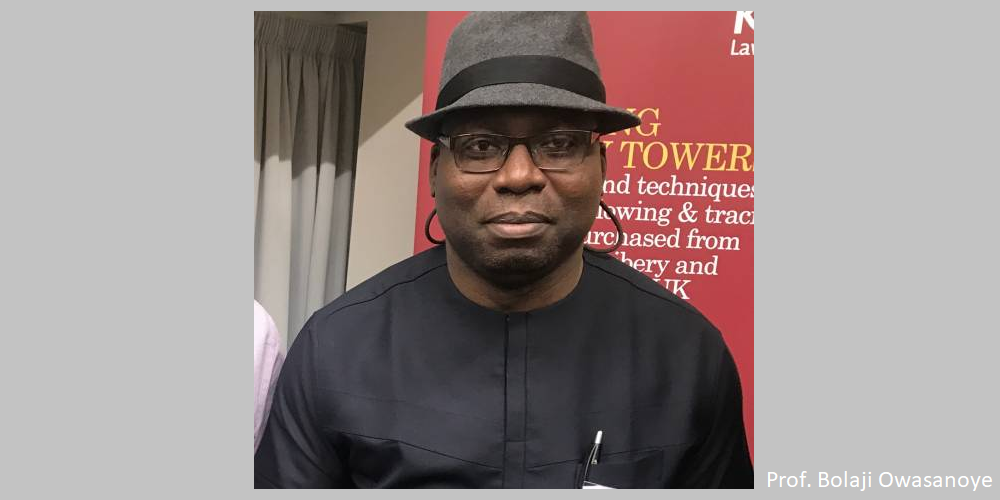
Yemi Osinbajo, Acting President of Nigeria, has appointed a new chairman for the anti-graft agency, ICPC. The new chairman is Professor Bolaji Owasanoye.

Professor Bolaji Owasanoye is renowned for his expertise in International Economic Law;Human Development and Social Justice Activism. He has been a Professor of Law for about 15 years with the apex legal academic institution in Nigeria: The Nigerian Institute of Advanced Legal Studies (NIALS) where he served as two-time Director of Research, and the rst to be conferred with the Taslim Elias Distinguished Professor of Law. He has pro ciency in teaching Legal Aspects of External Debt Management, Corporate Law, Legislative Drafting, Human Rights and Strategic Governance amongst others.

The full statement below.

Osinbajo Approved New Appointments

His Excellency, the Acting President, Professor Yemi Osinbajo, SAN, has approved the underlisted appointments in Federal Government Agencies.

A.?Independent Corrupt Practices and Other Related Offences Commission

?(i) ?Prof. Bolaji Owasanoye??-?Chairman
?(ii) ?Dr. Grace N. Chinda???-?Member
?(iii) ?Okolo Titus M.????-?Member
?(iv) ? Barr. Obiora Igwedebia??-?Member
?(v) ?Mrs. Olubukola Balogun??-?Member
?(vi)? Group Captain Sam Ewang (Rtd.) ?- ?Member
?(vii) ?Justice Adamu Bello???-?Member
?(viii) ?Hannatu Mohammed???-?Member
?(ix)? Abdullahi Maikano Saidu??-?Member
?(x)? Dr. Sa’ad Alanamu???-?Member
?(xi)? Yahaya Umar Dauda???-?Member
?(xii) ?Khamis Ahmed Mailantarki? ?-?Member
?(xiii) ?Maimuna Aliyu???-?Member
?(xiv)? Prof. Musa Usman Abubakar? ?-?Secretary

The appointment of the Chairman is for 5 years, while the tenure for all the members is 4 years. Also, these appointments are subject to Senate confirmation.

B.?National Salaries, Incomes and Wages Commission

(i)? Ekpo Nta, Esq?????-?Full-time Commissioner
?(ii) ?Alhaji Dauda Yahaya, mni???-?Full-time Commissioner?
?(iii) ?Hon. Garba Musa Gulma???-?Full-time Commissioner
?(iv) ?Barr. Victoria Nnenna Chukwuani??-?Part-time Commissioner
?(v) ?Mr. Geoffery Yeilong????-?Part-time Commissioner
?(vi)? Prof. Ropo Shekoni????-?Part-time Commissioner
?(vii)? Ahmed Mahmud Gumel???-?Part-time Commissioner
?(viii)?Permanent Secretary,(Estab.) OHCSF????-?Member
?(ix) ?Permanent Secretary, Fed. Min. of Labour & Prod.???-?Member
?(x) ?Comrade Isa Aremu (NLC)???-?Member
?(xi) ?Mr. Chuma Nwankwo (NECA)??-?Member

The new appointments are for a period of 5 years. The Chairman of the Commission is High Chief Richard Egbule, while Mr. E. A. Thompson is the Secretary. Both were appointed in August 2014.

C.?Investment And Security Tribunal

(i)? Siaka Isaiah Idoko??-?Chairman/CEO
(ii)? Jude I. Udunni???-?Full-time Member
(iii) ?Mr. Nosa Osemwengie?-?Full-time Member
(iv)? Abubakar A. Ahmad??-?Full-time Member
(v)? Albert L. Otesile??-?Full-time Member
(vi) ?Emeka Madubuike??-?Part-time Member
(vii)? Kasumi Garba Kurfi??-?Part-time Member
(viii)?Edward O. Ajayi??-?Part-time Member
(ix)? Onyemaechi E. M. Elujekor?-?Part-time Member
(x) ?Mamman Bukar Zargana?-?Part-time Member

D.?Infrastructure Concession Regulatory Commission

(i) ?Engr. Chidi K. C. Izuwah?-?Director-General

This appointment is also subject to Senate confirmation.

E.?In another development, the Acting President, with powers conferred on the President by Recovery of Public Property (Special Provisions) Act Cap R4, Laws of the Federation of Nigeria 2004 has approved the setting up of a Special Presidential Investigation Panel for the Recovery of Public Property. The Chairman of the Panel is Chief Okoi Obona-Obla, Special Assistant to the President on Prosecution. Mr. Akingbolahan Adeniran is the Secretary to the Panel.

(Signed)
Bolaji Adebiyi
Director (Press)
Office of the Secretary to the Government of the Federation.

The Remita Moments, SystemSpecs’ Glory

5

The most successful or impactful financial technology product, in Nigeria, after Diamond Bank industry-shaping DIBS (Diamond Integrated Banking System), is Remita, an integrated electronic payments and collections platform developed by SystemSpecs, a local ICT powerhouse.  While DIBS pioneered a new way of banking, making banking exciting, Remita is redesigning the core architecture of government in Nigeria. Before DIBS, intercity merchants moved cash in bags, exposing themselves to armed robbers, because bank accounts could only be operated in the specific branches they were opened. But when DIBS came, the era of open in any branch, enjoy banking in all branches, of the same bank, was invented. Nigerian banking has never been the same.

Remita is doing likewise, but unlike helping the citizens and businesses access their money irrespective of local domicile, Remita is making government to operate with memory. In the past, government with positive account balance could be taking overdraft in another account, in the same bank, despite having enough positive balance in the other account. Through the Treasury Single Account (TSA), anchored on Remita, government now operates, with clearer visibility. For Remita, it is a moment, unprecedented in the local financial technology space.

Remita is an e-Payments and e-Collections solution on a single multi-bank platform. Today, Remita is in use by many individuals, public and private sector organisations that process over 500 Billion Naira worth of transactions on a monthly basis. Adopted by the Central Bank of Nigeria for the payment and collections of funds on behalf of the Federal Government of Nigeria and used by all 22 commercial banks and over 400 micro finance banks, Remita has significantly assisted to revolutionize the e-payment industry in Nigeria.

Remita also comes with an optional Payroll and HR solution for full integrated processing.  Remita, developed by SystemSpecs, and voted many times as Nigeria’s Software of the Year, is indeed a success story and a pride to Africa.

A key component of the Remita N500 billion monthly transaction volume is the TSA, a financial policy introduced by the federal government of Nigeria, to consolidate all inflows from all MDAs (ministries, departments and agencies)  into a single account at the Central Bank of Nigeria. Through Remita, the TSA initiative enabled Nigerian government to take full control of its cash assets.

The Remita Moments

This is what Remita gets from the federal government of Nigeria, according to the Vanguard  which partly supports an entry in Wikipedia.

In a letter reportedly written to President Muhammadu Buhari by John Obaro, Founder and Managing Director of SystemSpecs, developers of the Remita application, the allegation that SystemSpecs pocketed 25 billion Naira was refuted. Obaro explained that the one per cent commission was negotiated prior to the signing of the contract; and the one per cent commission was shared by SystemSpecs, participating commercial banks and the Central Bank of Nigeria in the ratio of 50:40:10 respectively. According to findings by PremiumTimes,’Remita’ is not “an agency” but an application/software for executing payment instructions and collection of government revenue

If you do the maths, it does imply that Remita generates more than N2.5 billion monthly for SystemSpecs (500 billion monthly transaction, mainly through government with commission of 1% and receiving 50% of that 1%). So, the annual revenue from Remita comes down to N30 billion. It is very safe to assume that Remita commands more than 90% in profit since banks do the jobs; all it does is to provide the code. Using that, Remita could be generating N27 billion of profit yearly. (Note: the N500 billion was in 2016. I do expect this volume  to have increased as more entities are moved into Remita by the government.)

That is why Remita is the most successful product, in profitability, in the Nigerian financial sector, ever. There is no record of any technology that has generated that level of margin and volume mix within years of launch in the history of Nigeria. Remita is having its moments; the glory is on SystemSpecs.

The impact is huge and let me explain, comparing with the total market valuation of some banks in Nigeria, using Bloomberg Markets which captures the data daily. As of today, here is the state of selected banks.

  • Wema Bank Plc: N20.4 billion
  • Unity Bank Plc: N7.13 billion
  • Fidelity Bank Plc: N32 billion
  • FCMB: N25 billion
  • Skye Bank: N9.4 billion
  • Sterling Bank: 29.4 billion

Now, you can see  who is really doing banking and making money. Oh yes, banking is necessary, but banks are not really that important, if you want to join the club. Remita can buy most Nigerian banks with its annual profit. This is what the fintech (financial technology) entrepreneurs see and the reason the sector is heating up with many players. The value creation does not belong to the people on suits, exclusively.

Beyond Government: Journey to Africa

Remita has since moved beyond serving government. It is aggressively working to win startups, SMEs and companies of any size. It understands that government partnership will not be enough, because what is outside is certainly substantial. The Management of this product believes the product is on a mission: build a pan-African brand that commands presence in key markets in the continent. They are marketing, promoting and pursuing new market segments for a product that is largely bigger than the owner. Remita is SystemSpecs and, I predict, it will not be long for SystemSpecs to be renamed Remita.

But there are others with ambitions. This business is not just Remita. Interswitch, Paystack, Fluuerwave and other payment companies are aggressively competing. I do think that the winner will be anchored on technology and service. Remita is far ahead. Paystack crossed N1 billion worth of monthly transaction last month, Remita processed more than N500 billion worth,monthly, last year.

Nigerian ICT legend, John Obaro, Founder of SystemSpecs

The competition will be intense and many fintech companies will have to consolidate in the next five years. According to Disrupt Africa, Africa has more than 300 fintech entities. That is more than needed. I expect Remita to be one of the winners. It begins with a huge advantage: free cash from its federal government of Nigeria contract. That provides it capital to fund expansion. Moving into small African countries will be very catalytic for it now fintech is still at infancy in Africa. It cannot afford to make the mistake of Interswitch which wasted time before it began to execute its African strategy.

The Remita Limit

While Remita sounds very exciting, the core of its opportunity is the contract it has with the Nigerian government. It can be switched off if a new government seeks new terms or decides to work with another partner. This is the Remita risk. It has to think beyond what it does today, to build a solution that will unite Africa, and offer something none has been able to do in Africa.

In this videocast, I discuss the need to build a truly pan-African digital remittance/transfer banking product which is agnostic of location or currency in Africa. None of the products we have today meets that standard. Largely, I envisage a situation where all you need to buy and sell across Africa is one bank account in just one African Union country. With that, you do not have to even think about the specific currency of that account as technology will seamlessly make it possible to access other African markets for payments, transfer, etc. The banks or fintech companies must still comply with all regulations related to inter-national transfers, forex ,etc. The only difference is that customers will not see them as they will be hidden with technology.

Rounding Up / Remita Bank

As I conclude this piece, I hear Remita bank: an internet-only banking institution that will have zero branch network. This bank will deliver service and help pioneer digital lending, and other digital banking services in Nigeria, at cost model that will beat traditional banks. SystemSpecs has the money to get a license, because it has to diversify from its one-contract product, even as it seeks for alpha from other areas. It’s Remita – remitting value.

Key Pillars Before Nigeria Joins the Europe’s Digital Single Market

2

According to the Guardian, the Nigerian Government plans to join the European Union-driven Digital Single Market by setting up one in Nigeria.

Federal government through the Ministry of Communications is set to unveil Digital Single Market in Nigeria in collaboration with the European Union Commission.

Adebayo Shittu, minister of Communications, made this disclosure in Lagos at the 2017 Information Communication Technology & Telecommunication Expo (2017 ICTEL Expo) held at the Eko Hotel & Suites….

Towards achieving this, the minister stated that he had instructed that a committee is raised comprising the Ministry’s agencies and the Nigerian Computer Society on the new Digital Single Market paradigm ahead of the EU/Africa Summit holding November 2017 in Addis Ababa, Ethiopia.

The Digital Single Market is an initiative by the European Union to deepen the region’s digital business. The goal is to accelerate digital opportunities and enhance Europe’s competitiveness in the global digital economy. Since it was unveiled, it has explored how to integrate Africa in this ecosystem, which brings digital marketing, e-commerce and telecommunication together..

A Digital Single Market (DSM) is one in which the free movement of persons, services and capital is ensured and where the individuals and businesses can seamlessly access and exercise online activities under conditions of fair competition, and a high level of consumer and personal data protection, irrespective of their nationality or place of residence….

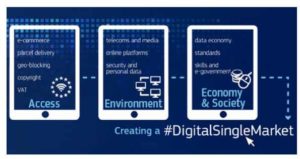
The program has three core pillars:

  1. Access: Access to online products and services
  2. Environment: creating the right conditions and a level playing field for digital networks and innovative services to flourish;
  3. Economy & Society: maximising the growth potential of the digital economy.
The EU is creating a digital single market

Largely, the vision is noble and there is certainly nothing bad about joining such initiatives, for Nigeria. No one will argue against the need to access more goods and services digitally. Likewise, it makes sense  to provide the enabling environment for the growth and success of digital services through better digital networks.  The EU’s plan to grow its digital economy is what it has do.

But I have issues: implementing this DSM initiative could distract Nigeria from focusing on the key elements needed for a thriving digital economy which must be fixed for local digital innovation to blossom. Indeed, joining the DSM could be a distraction, clouding our quest to deal with the root issues that stifle the growth of the sector. Even if we go ahead and join, it is very imperative that we deal with many factors currently affecting our digital economy.

Nigeria’s Core Issues Before DSM

At this moment, there are core issues Nigeria should focus as it works with partners like EU. It is not really certain if EU will help since it did note that it may not be offering any financial support to Nigeria anymore.So, the implication is that only Nigeria can find the strategy to fix the challenges that affect its digital economy. As I have noted in my works in the Harvard Business Review, finding solutions to the following will help our digital business.

Nigeria’s Minister of Communications, Adebayo Shittu

Distrust :  Providing mass campaign to educate the Nigerian people that trade and commerce can take place digitally is needed. One of the biggest challenges today is that people have not fully embraced online business in Nigeria. Government has a role to play to change that, through incentives, that can do what America did by waiving all taxes when products are paid online.

Cost of broadband: Our broadband cost remains high for most people to do meaningful things online. Government should focus on how to solve this local problem through incentives that can help bring cost of broadband down.

Logistics: We have no postal system and without it, Nigerian e-commerce will struggle for years. Joining DSM will not fix this problem.

Literacy rates: Even if all the infrastructure and integration issues are fixed, illiterate citizens may be unable to participate directly on the digital economy. Without investing in the education of our citizens, the pool of potential participants in the digital economy will not improve. EU had noted that it will not bring any funding, so Nigeria has to fix these issues by itself especially when funding is required.

Others: I will not waste time discussing funding, electricity and the typical challenges.

What Nigeria Needs To Do

As I noted above, Nigeria has to waive all taxes when things are bought online. That is one step to get people to start using online as a medium of commerce. I also propose for Nigeria to sell its nationwide postal rights to a private sector to provide postal system; in other words, privatize the postal system and allow private sector to run it. As it works on the postal system, it needs to invest to educate its citizens on digital literacy. In most villages, primary school teachers do not know how to use personal computers. They need to be educated so that their pupils can be informed. With these enablers, DSM will also benefit from Nigerian participation.

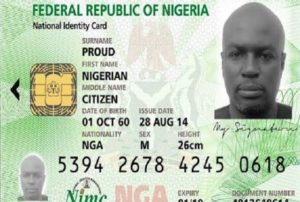
NIMC Card [Source: NIMC|
Besides the above suggestions, we need to ensure that the National Identity Management Commission (NIMC) has the resources to finish its works of capturing the identity of every Nigerian. That is the core enabler that will drive the digital economy Nigeria desperately needs. NIMC has the Management to execute. We do know that, despite the importance of this Commission, it remains severely underfunded.

[NIMC Vision].. to provide sustainable world-class identity management solution to affirm identity, enhance governance and service delivery in Nigeria by 2019.

[NIMC Mission]…to establish and regulate a reliable and sustainable system of National Identity Management that enables citizens and legal residents affirm their identity in an environment of innovation and excellence

It is very important that Nigeria looks at this DSM market from the lens of getting in not to be a mere consumer, but rather, to also be a creator. As noted, “The European Digital Single Market would become one of the most valuable trade markets in the world for online businesses”, but it can only work for those prepared as creators and not just buyers.

Rounding Up

Our government has a duty to ensure that Nigeria is connected to other nations. But in this Digital Single Market, the nation may not necessarily get net benefit since the enablers that will help Nigerian companies to compete are severely lacking. Focusing on how to deal with those issues will be more catalytic than the government making it far easier for Europe to win our local customers. Europe Union is a friendly institution to Nigeria but in this case, we do not need to just join because it has invited us. Our focus, at this moment, should be dealing with the root causes that inhibit our digital economy, and fixing then. Europe will eat our launch, pushing their wares to our consumers because our creators do not have the enablers, yet, to add more creative value in the market structured to empower Europe.