DD
MM
YYYY

PAGES

DD
MM
YYYY

spot_img

PAGES

Home Blog Page 7347

How MTN, Glo, Etisalat, Airtel Will Solve OTT Problems And Boost Revenue In Nigeria

1

OTT (Over The Top) services like WhatsApp and Skype are decimating revenue for telecom operators around the world. The trajectory is an existential threat to the operators, as if the revenue base is lost, these operators could collapse. From Kenya to Brazil, Nigeria to Indonesia and beyond, operators are exploring ways to overcome this problem.

OTT services use the infrastructure made possible by telecom operators to enable users to communicate with marginal monetary value accruing to the operators. OTT destroys monetary value (the revenue) in the industry; it does not by itself keep the value. The revenue MTN loses on SMS due to Skype is not directly transferred to Skype. That monetary value is simply destroyed, though the user benefits for using it largely free.

In Nigeria, the telecom industry has lobbied for government to regulate the use of the OTT services. The industry regulator, Nigerian Communication Commission (NCC), has noted that it would not be regulating the services. The EVC of the government institution, Prof. Umar Danbatta, in First Annual Lecture of CKN News noted:

“As a regulator, we will remain technology-neutral and will not regulate social media use of apps also referred as OTT’s. We nevertheless use our moral authority to request that Nigerians take advantage of the social media platforms to exchange information and participate in the political, social and economic processes of our country” Prof. Umar Danbatta,

In this piece, I propose three ways telcos can deal with this OTT problem in Nigeria. It will take a long-term approach. It is evident that the telcos have  enough customer base to execute the steps proposed.

(Table below presents the number of subscribers per each individual telecoms operator at the end Q1 2017) (Source: NCC).

MTN 60,391,959
Glo 37,328,827
Airtel 34,656,605
Etisalat 19,621,806
  • Build Credit Bureau with Banks

In Nigeria, the telecom operators already have massive personal data of Nigerians through the biometric SIM card registration. They will need to work with the banking sector to integrate all they have with BVN (bank verification number) in partnership with NIPSS. The goal is to make it easier for operators to ascertain the credit worthiness of subscribers towards moving into monthly paid plans. They can also work with NIMC and integrate its own data. They have the technical capacity, and can execute this project if they work together, to fund a credit bureau with focus for the telecom and banking sector..

  • Locked Smartphone With Contract

To help in the penetration of smartphone in Nigeria, the telcos will use the credit data they have collected to know those they can sell smartphone with option to pay over time. This is not really about the ability to earn salaries. There are many rich Nigerians with no formal salary (asks herdsmen that sell cows seasonably). The goal is that even those not earning salaries, they simply have to agree to pay when due. The telcos have to trust them. This system can be solid if all the telcos work together. Anyone that buys and refuses to pay off may never get SIM card ever since they have a central database of all people offered credit.Yes, you cannot have a default contract and still buy a new SIM card or even register a new SIM card. With this, they will increase the smartphone penetration and reap on their investments on 4G with more people having the tools to use data. Imagine if people can pay for Tecno phones at six installment payments. The number of smartphone users will skyrocket. That will benefit the telcos to push their data products.

  • Unlimited Monthly Data Plan

The present model of Pay As You Go is the easy way out. But that is going to hurt the telcos in long-term. You buy a N500 data of Etisalat and you can do WhatsApp for ten days. It makes no business sense to telcos. They have to innovate ferociously to exist. They have to sell their packages in monthly plan which means that if the user has paid, it does not matter if the person is doing WhatsApp or not. But to offer this plan, they need to have more data about the users and that is where the credit system is critical. They can still sell to PAYG customers but they will now increase the rate to compensate for the inherent lost value since those people will be doing WhatsApp and Skype outside monthly payment plan. They cannot increase that cost now without the monthly plan alternative. (Note: unlimited is never unlimited, they need to cap the monthly plan data usage.)

Rounding Up

I do believe that the telcos need to think outside the box and come together. All the pieces are available at the moment to redesign their revenue base. But they need to execute. A new business strategy is required and that will mean working with banking institution and pioneering new areas like credit bureau. There are basic pillars which can help them overcome some of the challenges they have today.

Four Ways To Boost Startup IPOs In The Nigerian Stock Exchange

0

In this video, I discuss how the Nigerian Stock Exchange can make it easier for startups to list in the exchange. I propose, among others, for direct listing where any requirement for underwriting is completely waived. The startups, especially technology-enabled ones, will not have to go through the painful process of underwriting new shares, but post-listed, can sell equity to private investors. I want to see Iroko Partners, Flutterwave and Zenvus in the NSE as quickly as possible.

How To Start A Cybersecurity Consulting Business In Nigeria

0

In this videocast, I explain how any entrepreneur with basic knowledge of ICT and with some supporting professionals can establish a cybersecurity consulting business in Nigeria and indeed Africa. The article is here in case you prefer the written one.

MTN’s Strengths And Weaknesses In Nigeria

2

MTN Nigeria is a subsidiary of MTN Group, a South African multinational corporation, with operations in key strategic markets in Africa and beyond. MTN Nigeria is the most recognizable telecom brand in Nigeria, enjoying the benefits of the first to market. Its geographical spread is huge and it enjoys the benefits of economics of scale, being ahead of the the second operator, Glo, by subscriber base, in excess of 20 million users. At the end of last quarter, Q1 2017, MTN Nigeria had about 60 million subscribers, according to the Nigerian Communication Commission, NCC, an industry regulator. MTN Nigeria, with local market share in excess of 35%, delivers about one-third of the Group’s revenues.

Technically, MTN Nigeria is owned by MTN Group and a South African holding company, Shanduka Group, which acquired a minority stake in MTN Group’s Nigeria business for $335 million in November 2012.

In this piece, I will explain the strengths and weaknesses of MTN Nigeria. But first the key products offered by this company.

MTN Nigeria Products

  • MTN Cloud: Though it may not be known to average users, MTN Nigeria runs lucrative cloud services. These services are geared for all the key industrial sectors in Nigeria. MTN competes with RackCenter and MainOne is this product line.
  • Voice and Broadband Services: Modern mobile telephony is Nigeria cannot be discussed without MTN. MTN is a leader in both voice and broadband services. It is the most profitable company in the sector, taking home more than 60% of the total profits, except 2016 when it declared loss, due to compliance related fines.
  • Small Business Broadband Service: Besides the business to customer broadband service by MTN, it sells modems to small businesses which use them to connect to the web. This product is available in many key cities in Nigeria.
  • Devices: MTN sells devices through different partner relationships.It sells for Garmin, Samsung and other leading global brands. The size of this business is low. Largely, MTN uses this to on-board customers into its network. Etisalat Nigeria which enjoys the highest ARPU (average revenue per user) is considered one of the best telcos that knows how to deliver services in selling hardware and devices to customers.
  • Investments: MTN (the Group) has made investments in Jumia, a leading e-commerce company with principal operations in Nigeria. Because Jumia is Nigeria, MTN Nigeria has a strategic affinity to this company. MTN Group had also invested in Travelstart, Snapp and in Iranian Net. Co. It also bought Visafone (Nigeria), Smart Village, Afrihost and Investcom. No data is available to see how these investments have turned out.
  • Value-Added-Services (VAS): There are many levels of VAS in MTN Nigeria network. Customers download music, motivational contents, games, comedy, etc and MTN takes commissions from the creators. The regulatory requirement that limit marketing to subscribers has affected this business.
  • Others: MTN Nigeria had tried in the past, but failed, in selling different services and solutions. It brought security camera which flopped. It also worked to build app ecosystem which did not pick up. At different levels, it has also tried to work on mobile money through partnerships. That has not been stellar. Some of those solutions are still offered, though muted,

Largely, MTN Nigeria is a company that does two things: voice and broadband services to customers and enterprises, and web/cloud services to enterprises. It generates, in our estimate, more than 90% of its revenue from these two solutions.

Strength: Defaults

As the dominant voice and broadband service operator, MTN Nigeria wins and this success is by default. MTN used the profits it made at inception to fund growth. and that gave it strength. You can determine the age of an average Nigerian through his/her cell phone number. 0803 remains the premium number in Nigeria. It is the original number.

Weakness: Customer Service

Despite being the first to market, at scale, among all the present operators, MTN Nigeria lost focus on service and quality. Etisalat Nigeria tops MTN Nigeria as the most premium brand and a brand most upper middle class Nigerians choose for their broadband services. Etisalat NG is simply better on the experience part of making customers feel better especially in their Geek Shops.

Strength: Coverage

No other network operator in Nigeria comes close to MTN in coverage. Any village or community where you cannot find MTN means that the village or community has potentially no coverage. There has been debate on the inability of some communities to enjoy services most Nigerians enjoy. Realistically, most expect MTN to be the one to solve that challenge.

Weakness: Regulatory Compliance

MTN Nigeria is a lousy company in terms of regulatory compliance. It was fined $5.2 billion which was later reduced to $1.7 billion. The company has paid dearly for that as investors punished its parent company in Johannesburg Stock Exchange. But it does not seem to be only Nigeria where this systemic problem is happening in the MTN Group. MTN Group may have a culture that allows it not to cross the “ts” and dot the “is”.

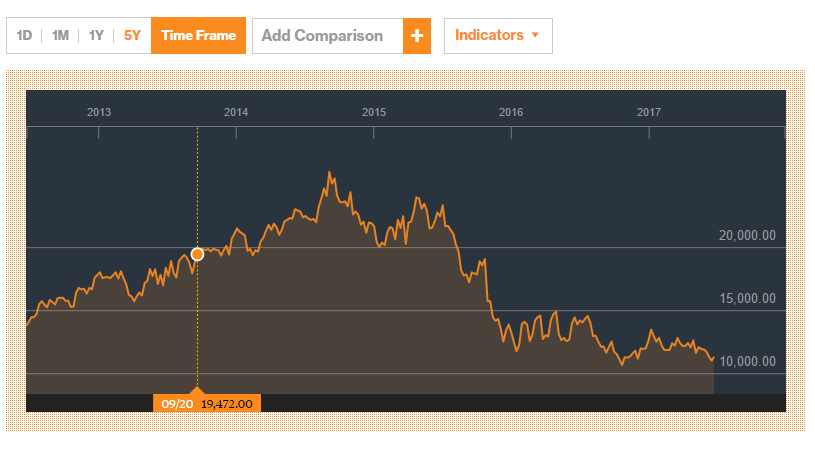
MTN Group stock performance (source: Bloomberg)

Strength: Brand

For most Nigerians, MTN is a better place to work in the telecom sector. Its strength provides confidence. Despite the recent mass sack, if things are bad in MTN, in others, it is already worst, goes the thinking. MTN is a premium brand and it is a respected one in Nigeria and beyond.

Weakness: Innovation

MTN Nigeria as the industry leader would not have been expected to destroy established norms which helped it to make huge profits in Nigeria. If not for Glo, it is possible that Nigeria will still be on per-minute billing where the cost of making a 2-second call (yes, those dropped calls) is the same as 59 seconds.Increasingly, MTN plays catch up but quickly uses its scale to dominate others. Its key innovation engine is its scale and size.

Strength: African Brand

Everyone is proud of MTN  because it is an African brand. While Glo is also an African brand, it is mainly region-centric in West Africa. Airtel and Etisalat are foreign. So, largely, MTN wins that balance of being global and also being local. It is the ultimate glocal company! From Harvard Business School African students to their counterparts in Oxford and Cambridge, MTN is a brand that meets everyone metric. You can say it is African ( operating in at least 20 countries) and it is big. The benefit is huge for partnerships with value-added-services providers.

Weakness: Poor Ecosystem

It is extremely unfortunate that MTN did not build an ecosystem in Nigeria considering its position. When we know that Verizon, a U.S. telecom company, owns now AOL, Yahoo and other media brands, one could note that MTN missed a huge opportunity in its app ecosystem failed project. MTN remains vulnerable, just as other telecom operators, as OTT services like Whatsapp and Skype eat into margins.

Strength and Weakness: Business Model

MTN Nigeria is a cautious industry player being the key beneficiary of any status quo. Keeping things the way they are, provided it enjoys its dominant position, is wisdom. However, that strategy has exposed it to the inability to build a platform which can maintain further growth. As OTT services take root, and deepen, and NCC decision not to regulate them, that business model has failed. It is not likely that MTN can do  much now that fragmentation is huge in the market. In the strength area, MTN Group management can be seen as being bold. MTN invested in Nigeria upon the deregulation of the mobile phone market with the introduction of Global System for Mobile Communication (GSM), operating on the 900/1800 MHz spectrum. That is a winning business model as they raked revenue like Father Christmas with excess luggage from Ajegunle to Victoria Island knowing that VI has better gifts.

Y’ELLOW

The future of MTN Nigeria is not assured, just as every telecom operator in the world. MTN Nigeria has to invest in alternative assets which will protect it from the disruptive competition we expect from OTT services. Market has already noticed that as MTN Group has lost more than 50% of its peak value within the last five years. Sure, the compliance related fee is a big part of this stock problems, but do not overlook the fact that telecom has lost its shine.

For Etisalat Nigeria promoters in UAE to allow it to go the path it took shows that markets are not so confident it makes so much sense investing in the sector, at least in the short-term. This will be a low-margin business and is already becoming like utilities where margin is low but reliable (we must always need our telecoms to run the OTT, so they will be here!)

The biggest threat will come from satellite companies like ConnectAfrica which will reach communities at cost model that can keep the terrestrial players looking for cover. Elon Musk, not Glo or Airtel or Etisalat, may be the biggest competitor to all telecom operators in Africa in 5-10 years, with satellite broadband. He can crash broadband cost by 90% and suddenly GSM will be recorded only in museums. But that will happen if MTN Nigeria and others do not take action today.

Why Nigerian Banks Or Etisalat Nigeria Acquirer Will Continue To Pay Etisalat UAE

0

The crisis in Etisalat Nigeria is huge. But for the Etisalat UAE which owns the intellectual property of the brand, it may not necessarily be a killer. Whoever takes Etisalat  Nigeria will have to negotiate IP licensing deal with the Group. If that does not happen, the telecom regulator in Nigeria could revoke the license. To avoid that happening, anyone taking over must ensure that the original license owner feels very good.

The statement also reminded Etisalat and the banks what they cannot do with the collapsed company, owing to the conditions attached to the licensing.

“Sub section 1 – The grant of a license shall be personal to the licensee, and the license shall not be operated by, assigned, sub-licensed or transferred to another party unless the prior written approval of the Commission has been granted;

Sub section 2 – A licensee shall at all times comply by the terms and conditions of the license and the provision of this Act and its subsidiary legislation.

In the press release by Etisalat parent company in UAE (pdf), they noted that Etisalat Nigeria is owing them $52 million as of March 2017. This money is due to the parent company, no matter what happens.

There are many implications here:

  • Anyone that takes over Etisalat Nigeria must be paying IP for using the brand. If the person refuses, NCC can revoke the license. Etisalat NG cannot transfer its license. The easiest way will be to hold the license in Etisalat NG name to avoid NCC problems. That is part of ET Group IP which must be serviced.
  • Depending on the agreements, the banks may be sending cheques yearly to Etisalat Group to keep the brand. Changing the brand name may be hard. It means the new owner may spend millions of Naira to build a new brand and that will be difficult for a #4 operator. Many customers may be alienated in the process
  • Things are really not going well in Etisalat Nigeria. According to NCC March 2017, it lost the highest number of customers in Nigeria

Tomorrow is the D-Day when the transfer will be made. The parent company has already written off the value of its stake to zero in Etisalat Nigeria. But that does not mean it will not be getting IP licensing fees on Etisalat Nigeria.

NCC licensing requirement makes a transfer deal with another company challenging. Provided Etisalat Group owns the brand and license, in future, if there is no transfer of license to avoid NCC problems, dollars will be hitting Etisalat UAE bank account yearly from Nigeria.