DD
MM
YYYY

PAGES

DD
MM
YYYY

spot_img

PAGES

Home Blog Page 7360

The Technology of Nations: Adam Smith, Isaac Newton and Bill Gates

0

In 1776, Scottish economist and philosopher, Adam Smith, wrote the masterpiece ‘The Wealth of Nations’- actually ‘An Inquiry into the Nature and Causes of the Wealth of Nations”.

By coincidence, the United States Declaration of Independence was adopted the same year, making the American colonies independent and thus no longer a part of the British Empire.

America has since evolved to dominate the old British Empire in virtually every aspect of human endeavors, except perhaps, social welfare. The Americans, figuratively, were discipled by Dr. Smith who believed in the free market and made his argument that ‘capitalism’ will benefit mankind more than any other economic structure. He laid this foundation at the onset of the industrial revolution and provided the basis for modern economics.

Smith made his case about the ‘invisible hand’ and why monopoly and undue and unfettered government regulations or interference in market and industry must be discouraged. He was of the opinion that prudent allocation of resources cannot happen when states dominate and over interfere.

In that old time, American farmers could grow cotton, but would not process it. It has to be sent to England where it would later be imported into the U.S as a finished product. Understanding that this decision was not due to lack of processing ability, you will appreciate Smith’s argument that the market must be free.

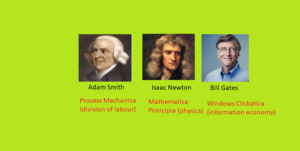
His theses were clear and were very influential; they provided the same level of fulcrum to Economics as Isaac Newton’s Mathematica Prinicipia to Physics. Or in modern times, Bill Gates’ Windows to the information economy.

While reading Smith’s book and understanding the time frame it was written, one cannot but appreciate the intellectual rigor in that piece. Before technology was penetrated in en mass across the regions of the world, he noted that all nations could compete at par in agricultural productivity. The reason was absence of division of labor in any subsistence farming system in the world. A farmer does everything in the farm and is not an expert in most.

Agro productivity has improved over years (source: linkedin)

Discounting fertile land, rain and other factors that could help farmers, all the farmers, from Africa to plantations in Alabama, the level of productivity was similar. Why? No specialization was employed in farming business at the time.

Fast track forward when the industrial revolution set forth. The British Empire became an engine of wealth creation through automation. It was a quintessential period of unrivaled human productivity which resulted to enormous wealth created in the empire. Technology not only helped speed process execution, it helped in division of labor.

Interestingly, Dr Smith had noted that except agriculture where productivity was flat because of lack of division of labor, other industries were doing just fine. And in those industries, there were organized structures which enabled division of labor. For instance in the construction industry, there were bricklayers, carpenters, painters, and so on; but a farmer was a farmer.

As you read through Wealth of Nations and observe the 21st century, it becomes evident that technology was so influential in the last few centuries. It has changed our structures and created a new business adaptation rules like outsourcing which is indeed a new breed of division of labor.
From accumulation of stock and pricing, as explained by Dr. Smith, we see today a world where technology is shaping everything in very fundamental ways for wealth creation. In this era, it has become technology as technology translates to wealth. So, nations that focus on creating, diffusing and penetrating technology will do well.

Why? It is about national technology DNA. The more passionate and innovative nations are triumphing at the global business scene. Give me Japan and I will give you electronics. Talk about United States, I will share biotechnology and pharmaceutical technologies, and indeed every major technology. Give me China, and I will give you green technologies.

So, as nations continue to compete on the technology paradigm, we see at the highest level of success measurement an embodiment captured by technology capability. When nations are understood from the lens of their Technology Readiness Index, Knowledge Economic Index, we see that countries have become technology competing nodes. In some really poor countries with no (effectual) technology, they do not have a node and are unplugged in the sphere of global wealth creation.

Simply, it will be difficult to separate the health of any modern economy from its technology. It goes beyond the wealth of that nation to its survivability. The most advanced nations are the technology juggernauts while the least developing economies barely record any technology penetration impact. For the latter, it is like still living in the pre-industrial age Dr. Smith discussed on agriculture and division of labor where processes were inefficient.

Perhaps, this explains the efficiency in developed world in both the public and private arenas. The more technologies they diffuse, the more productive they become. In other words, show me the technology and I will tell you where the nation stands in the league of countries. Interestingly, the invention of steam engine changed the world and powered the industrial revolution. The invention of transistor transformed the 20th century and is fuelling the new innovation century.

It seems that major scientific breakthroughs bring major great countries. Let me emphasize here that some old kingdoms that ruled the world such as the old Babylon, Roman Empire, and Pharaoh’s Egypt; there have been associated knowledge base that put them ahead. You cannot disassociate good crop production in River Nile to the mastery of Egyptians in inventing some sections of geometry for farming. Some of the old wars had been won by developing constructs that enabled efficient transportation of soldiers to battleground. There was science and nations were winning by using that knowledge.

In conclusion, the world has been living on technology and it is indeed defining our competitive space. As nations compete, it is technology that shapes the world with wealth as the major byproducts, in some cases. I make this case because some of the best technologies had been invented for non-wealth reasons (yes, directly). Examples include Internet and radar technologies which have created wealth and spurred commercial innovations but have military origins.

There could not be any more powerful way of examining national competitiveness than understanding the technology of nations. Yes, wealth has since morphed to technology and all competitions and wealth creation could as well be seen from technology viewpoint. And in this piece, I aptly replace Dr. Smith’s ‘wealth’ with ‘technology’ to have The Technology of Nations. Oh yes, Smith postulated process mechanica, Newton gave us mathematica and Gates pioneered clickatica.

Africa’s “AI-First” Challenge [SN]

0

This is a Short Note from my LinkedIn update.

There is a new transition in the world of digital business. Since Netscape Navigator pioneered our modern web experience, we have gone through phases which recently include responsive, (cloud-first) and mobile-internet design frameworks.

The mobile-first is matured and a new mantra is in town: “AI-first”. That means the focus of leading tech companies now is how artificial intelligence (AI) will drive everything they do. This is the battle that will decide the category winners of the utilities disguised as global tech firms. With human-like characterizes, software will be smarter and more adaptive.

From Siri to Alexa, Cortana to Bixby, you will see amalgam of platforms and productivity services running on cloud with AI at the heart of them.

Without sounding pessimistic, AI-first world cannot be leapfrogged as we say in Africa. This is mathematics and not coding. Yes, no hacking! This is a big challenge as if we cannot transition to the AI-world, we will possibly miss the emerging opportunities. From medicine to agriculture, entertainment to education, AI will create a new trajectory that will redesign commerce and industry. It will reshape how people, firms and nations conduct businesses and reconstruct the economic architectures. Now is the time for Africa to plan and take action. It needs to develop a roadmap because not doing anything will be extremely devastating.

Beyond Web Traffic, Map Your African Revenue Strategy [SN]

0

This is a Short Note from my LinkedIn update.

Few weeks ago, I wrote about how abundance of internet traffic does not guarantee more value https://www.tekedia.com/65289/the-law-of-diminishing-abundance-of-internet-higher-user-growth-uncorrelated-with-revenue/ . You can see more visitors using your content and yet nothing positive happens in the bank.

My suggestion to African entrepreneurs, do not build you business with ad-supported strategy. It is challenging. Rather, find a way to create value and have subscribers no matter how small. Do not be caught with traffic, focus on what happens in the bank.

It is very hard to make money from Google Adsense because Google discounts up to a factor of 4 African traffic compared to U.S. and Western Europe. So you need to quadruple African traffic to make up with similar US sites. In short, some Western advertises will not compensate for African traffic (excluding South Africa).

A US user generates $18.81 for Facebook (ARPU) while an African user is $1.41. I like Jobberman which asks people to pay now. I like iROKOtv which charges. It is better you have 100 people paying $10 per month than 10,000 people-traffic that gives you $10 at month end. But to do that, you need to invest in quality and differentiate. Traffic is a number, be focused on the real one – revenue traffic.


Hacking Success In Life, Beyond Brilliance [SN]

0

This is a Short Note from my LinkedIn update.

When I was in Federal University of Technology Owerri (Nigeria), I was a jacobian (people who read too much). I read hard because I needed to read more to do better. I knew I was not the smartest guy in class, but if I put more efforts I could come on top. There was an exam I prepared for straight 11 hours of study – Thermodynamics.

I understand one thing: life is not just about knowledge and being smart. It is more of the path you decide to take. A British whizkid Marcus Hutchin who “solved” the WannaCry malware was arrested in U.S. on the suspicion that he created another malware. He was hailed as a genius when he halted the spread of the WannaCry.

Marcus Hutchins, the young cybersecurity expert, who managed to halt the spread of the WannaCry ransomware’s first wave last week says he plans to donate  monetary reward offered to him to charity. Hutchins, was responsible for halting the inexorable march of WannaCry on Friday, when he followed clues from the malware’s code and registered a domain name the attackers were using as a kill switch.

Ever since, his identity has been outed by British media and has been inundated with communications from the media, the cybersecurity world and more. He’s now even been offered a $10,000 by HackerOne, a platform for cybersecurity professionals to report potential security flaws in exchange for bounty rewards. However, Hutchins says he doesn’t want to take the money, and no instead plans to donate the amount to charity. “I plan on holding a vote to decide which charities will get the majority of the money,” he wrote on Twitter.

Now, how can brilliant people decide to be stupid? You have the mind of Einstein and decide to write malware infecting the world. He could be a legend. Hutchin refuses to take the right path just as we see brilliant kids in our universities that simply will not wake up to attend lectures. They fail and drop out.

The most brilliant student I met in FUTO did not last a year. He was peerless. But he had a flaw: his path was wrong. He would be sleeping up to 11am when students went to classes at 2am to “colonize” seats for classes starting at 9am.  Do not waste your gifts.

Google’s Eclipse of Kangpe

2

Kangpe is on a mission to deliver quality health information to Nigerians. In an entry in VCA, it explains what it does:

Kangpe is a mobile health startup that allows people to receive answers to their health questions 24 hours a day from verified doctors via SMS, mobile app and web. With an average of 2 doctors to every 10,000 people, Africa has the lowest Doctor to Patient ratio in the world.

Further compounding this is the fact that large numbers of African doctors emigrate abroad for better opportunities, creating a talented but inaccessible pool of doctors of African origin. Thus many Africans do not have the means to regularly access a doctor and those with the means endure inefficient hospital systems.

This creates a climate that makes it difficult for Africans to get the right information to live healthier lives and allows the widespread propagation of misleading information, worsening an already dire health situation as people do not have the right information to take the right action. Kangpe users send their questions via mobile app, SMS or web. Kangpe then routes it to one of the Doctors on the system who then provides an answer. This answer is then relayed to the user.

Kangpe’s business is a brilliant idea for anyone in Nigeria where there are very few medical professionals. You have a problem and need to quickly talk to a doctor; Kangpe makes that a possibility. Three Nigerians –  Femi Kuti, Ope Olumeken and Matthew Mayaki – launched Kangpe in 2016. It now operates in Kenya and Ghana with excess of 60,000 users. In an interview with TechCrunch, Femi Kuti, the CEO, noted that using Google search may not be optimal on some health related issues: “Kuti also points out the platforms working in the U.S. don’t exactly translate to care in Africa. “Google doesn’t know about African disease”. That statement is the core of this insight today, because Google is doing something to improve its search engine to provide relevant health feedback to users, at local level.

Kangpe is one of the Nigerian entities in the Facebook Free Basics which makes it possible that one can browse its contents for free without metered Internet. In other words, you can read its contents, and you will not be worried that your mobile browsing credit will be consumed, depending on the phone company providing your service.

Google’s Eclipse

Google understands that the best of its search business can only come when it has the best data. It is working with local institutions across Nigeria to deepen that data integrity. It may not necessarily be good news for Kangpe business model: Google will soon have the capabilities to understand local health disease issues through a partnership with University of Ibadan.

The announcement was made on Thursday at ‘Google For Nigeria’, an event which had in attendance for the first time in Nigeria, Sundar Pichai, Google CEO. Health Cards is one of the several updates added to Google Search in a bid to bring more useful, relevant answers and information to people in Nigeria.

Here are the functions of Health Cards, Knowledge Panels and Posts on Google.

Health Cards: Later this year we’ll launch more than 800 knowledge cards detailing common symptoms and treatments for the most prevalent health conditions in Nigeria. We’ve partnered with the University of Ibadan to ensure that answers have been reviewed by Nigerian doctors for local relevance and accuracy. Nigeria is one of the first countries where we’re providing locally tailored health answers on Search.

Just like that, Google will be providing some features of what Kangpe provides to the market. But of course, Kangpe will still have its phone-based service. It can generate revenue from that model.

Dr Femi Kuti, CEO, Kangpe

What Kangpe Needs To Do

Kangpe will have to innovate as Google moves into the aggregation of local health data. It can connect patients to clinics, health insurance and also deliver care directly to patients. The company has already hinted on these elements in the referred TechCrunch article.

Kangpe’s core business strategy is delivering quality local medical information at scale. If it loses the edge on the web over Google, it must pivot. The model of phone call will remain challenged by scale: how many doctors will they have in the system to support the users? Also, the challenge of phone calls (i.e. making phone calls is expensive in Nigeria as it is pay as you go) limits that model for many Nigerians. So, at the end, it is information discovery that will give Kangpe the best path to a sustainable business. That means, they have to build a platform that does aggregation between patients and clients just as Airbnb and Uber do for housing and transportation respectively. Kangpe can generate enormous value within the aggregation construct.

Under the aggregation construct, the companies that control the value are not usually the ones that created them. Google News and Facebook control news distribution in Nigeria than Guardian, ThisDay and others. Because the MNCs tech firms “own” the audience and the customers, the advertises focus on them, hoping to reach the readers through them. Just like that, the news creators have been systematically sidelined as they earn lesser and lesser from their works. But the aggregators like Facebook and Google smile to the bank. The reason why this happens is because of the abundance which Internet makes possible. Everyone has access to more users but that does not correlate to more revenue because the money goes to people that can help simplify the experiences to the users who will not prefer to be visiting all the news site to get any information they want. They go to Google and search and then Google takes them to the website in Nigeria with the information. Advertisers understand the value created is now with Google which simplifies that process.


However, with Google going into this space, Kangpe will have to find a clever way to structure its business. It cannot just focus on making general information as it does now on its website. It has to build a defined service which must possibly involve subscription by offering value to patients and doctors. Patients pay annual fees to be linked to doctors. That access to doctors is a model that Google Search cannot replicate. But mere information discovery is on direct competition with Google and with Google’s partnership with University of Ibadan, Kangpe may be unable to compete in that space.

All Together

The arrival of Google in the ultra-deep local data business will put pressure on many local companies in Nigeria, as it scales its new products like Health Cards, Knowledge Panels and Posts on Google. Specifically on the medical area, Google is a force for good, and it has all the rights to do what it is doing as Africa will benefit. We need to have more data online to support commerce and trade and Google is investing more than any other company in that space. As it works with University of Ibadan, we will suddenly have access to quality healthcare data on the web, instead of in shelves not accessible by the Nigerian people that fund the university. However, entrepreneurs whose businesses focus on making local data available online will struggle because Google will possibly build  better ones and will likely direct traffic to its own contents (which are always better). The challenge for entrepreneurs will be building businesses that deliver service on top of data, beyond the level of mere discovery. For Kangpe, it has to find a way to get people to pay, preferably through subscription, to facilitate linkages between doctors and patients. With that revenue, it can offer many services which Google Search cannot do, and that includes connecting patients to clinics, helping them on the right health insurance product and delivering minimal phone-based care in real-time.