DD
MM
YYYY

PAGES

DD
MM
YYYY

spot_img

PAGES

Home Blog Page 7402

Facebook and Microsoft financing $50 million affordable energy accelerator in East Africa, Others

0

Facebook Inc., Microsoft Corp. and venture capitalists at Allotrope Partners have set up a facility to finance energy access projects in Indonesia, India and East Africa.

The Microgrid Investment Accelerator, or MIA, will seek to mobilize $50 million from 2018 to 2020, according to an emailed statement. It will tap grants and loans from foundations and development banks to attract private capital into projects that help to transmit renewable energy over small electricity networks.

A microgrid is a localized grouping of electricity sources and loads that normally operates connected to and synchronous with the traditional centralized grid (macrogrid), but can disconnect and function autonomously as physical and/or economic conditions dictate. It isa miniature power system that operates independently of a national grid. The International Energy Agency estimates that more than 1.2 billion people don’t have access to electricity, mostly in Sub-Saharan Africa and developing Asia. As renewable energy technologies such as solar panels become cheaper, microgrids have emerged as an option to more people.

“MIA will test the commercial opportunity for microgrids and demonstrate how concessionary finance can unlock progressively larger proportions of private capital as risks are discovered, priced, and mitigated,” Chief Executive Officer Alexia Kelly said.

Helping provide energy access is a method to tie corporate social responsibility together with business development at companies peddling electronic services and devices. Providing power to people off the grid could eventually open up large new markets for computers and social networks.

According to Bloomberg, MIA has signed up more than a dozen implementing partners and observers. It will start to request plans for pilot projects from in the third quarter this year and expects to begin disbursing funds in 2018.

“The Microgrid Investment Accelerator will not only be a powerful tool in driving much-needed capital into projects, but will also help to bring down costs, build a stronger ecosystem, and catalyze innovation,” said Microsoft’s Kevin Connolly, the director of affordable energy access initiatives at the software company.

USAID and Partner Invest $1.8 million to help African Farmers

0

Syngenta in Zambia, through its subsidiary MRI Seed, has partnered with the Feed the Future Partnering for Innovation, a United States Agency for International Development (USAID) programme implemented by Fintrac Inc., to help smallholder farmers gain access to high-quality, disease-free horticultural seedlings, giving them the opportunity to become commercially viable vegetable farmers.

The programme aims to build a sustainable seedling distribution model for hybrid vegetables; provide access to market information and linkages; train farmers on good agricultural practices and business management; and introduce new technologies to help smallholder farmers dramatically improve their yields.

In 20 districts across Zambia, Syngenta will establish 20 seedling production sites, each owned and operated by an Entrepreneurial Young Plant Raiser (YPR). The YPR will provide business and technical training, as well as facilitate market linkages for the benefit of 12,000 smallholder farmers. Although the primary focus of the project will be on tomato and cabbage seedlings, Syngenta will also conduct trials and testing regarding the commercial viability of other crops with a high potential in Zambia such as kale (rape), cauliflower, broccoli, carrot, and potato.

Furthermore, Syngenta will help in promoting a pilot programme for YPR’s “Vegetable in a Bag” concept, where a small portion of YPR seedlings will be sold in reusable packaging, with no ground soil and minimal water, making them suitable for urban and peri-urban use.

Six areas where agtech is transforming agriculture and the world

0

These are some of the areas where agtech or agricultural technology is transforming agriculture and the world. Agricultural tech has gradually become a fascinating  hot trend across the globe. It is the engine which is transforming farming. With readily available computational systems made possibly by embedded systems and cheap processing systems which can be rented in the cloud, agtech is blossoming. These areas are notable as agtech changes what farmers do therein.

Eyes on fields

Motion-activated field cameras, such as those on the market from Selecta can help farmers to monitor their properties and livestock more effectively than ever before. These camouflaged devices are fully kitted-out to survive the elements, and are able to run entirely on batteries; saving money and time on installation. Starting at only $209, these affordable cameras can monitor cattle, detect and record intruders, and even run at night with a no-glow night vision capability (so as not to tip off would-be intruders, or wary nocturnal beasties). On the next pricing rung, farmers can purchase the WiFi model, which feeds footage back to any smartphone; making it easier to monitor their investment on the go, at any time of the day or night.

Computer-mixed feed mills

Feeding livestock, and ensuring that they receive the optimal mixture of nutrients is a delicate and time-consuming process. The advent of automated feed mixers, such as those by GEA are simplifying this process and freeing up time for farmers in the dairy industry. GEA’s MixFeeder (as the name suggests) mixes feed for group feeding of dairy cows; guaranteeing the correct rations and mixes of feed, as well as programmed feeding schedules. This not only saves time—which alone would make the feeding system a worthwhile investment—it also ensures that cattle are getting the most out of feedings, which has knock-on benefits for their health and milk production.

Soil monitoring

Soil monitoring systems like the ones from Zenvus are not exactly a new invention, however there are constantly advances in technology which make these systems smarter and more accurate in their reporting. Nowadays, these relatively simple-to-install systems gather data around soil moisture and even nutrient density, then collate the relevant info into a real-time, readable report which farmers can access from their computers or smartphones. The systems are even able to provide advice on when to water crops, and to what extent. This kind of technology can have a huge impact on soil health, crop health and yield, as well as allowing farms to save money on irrigation and fertilisation. Advanced systems will even incorporate weather patterns and predictions into their reports, giving up-to-the-minute information on incoming weather, and thus saving farmers from needlessly watering or fertilising crops (thus avoiding costly runoff).

Remote controlled tractors

Tractors are one of the biggest investments that a farm owner can make, and can little do without, in the case of crop farming. Another time-consuming activity, ploughing fields and harvesting with tractors can be a burden in labour costs. As science fiction concepts rapidly become real-life solutions, self-driving tractors join a long line of innovations which save on time and money for farmers. Some of the most well-known brands are already testing driverless tractors, which will not only harvest crops, but provide feedback on crop health and harvesting information in real-time to farmers by (you guessed it) smartphone. While we’ve been hearing about driverless tractors and cars for some time now, their takeover is imminent. The cost savings in efficiency and labour alone are set to see them become an indispensable part of farming equipment in the next few years.

eBay for grain

Brokerage fees for grain growers are a cost which many would like to see done away with. The traditional and cumbersome process of buying and selling grain is expensive and slow. One firm has identified this gap in the market, and developed FarmLead to fill it. A online marketplace, much like eBay, connects grain growers with buyers around the world and allows each party to make educated selling/purchasing decisions based on transparent pricing data. Once again, smartphones are the gateway to this innovation, allowing farmers and buyers to make deals on the go, without the time pressures and constraints of the traditional over-the-phone brokerage method.


The internet of cows

We’ve all heard of the Internet of Things (or IoT), and we here at Machines4u Magazine have covered off its advance into the world of agriculture thoroughly. Now that we’re all comfortable with the phrase, the clever folk at BovControl have introduced the next phenomenon in IoT, with a witty little catchphrase—the Internet of Cows. Not only is it fun to say, it’s giving farmers some serious advantage in the realm of cattle health and monitoring.

Apply to IMPACT Growth and get up to €250,000 equity free

1

IMPACT Growth Smart AgriFood is the new project from IMPACT Accelerator, one of the top ten accelerator programs in the world.

In partnership with Danone, they are looking to select growth-stage startups working to solve problems related to farming, agri-logistics and food awareness, and striving to create new applications for traceability, logistics and quality control in production and distribution.

Danone is an international corporation focusing on four business lines: Fresh Dairy Products, Waters, Baby Nutrition and Medical Nutrition, to bring health through food to as many people as possible. Present in over 140 countries, Danone has expanded in strategic geographies. Danone will bring its experience and knowhow to help startups in the Smart AgriFood sector succeed.

Smart AgriFood startups work to solve the challenges of farming through technology breakthroughs related to smart farming, focusing on sensors and traceability; smart agri-logistics, focusing on real-time virtualisation, connectivity and logistics intelligence; and smart food awareness, focusing on transparency of data and knowledge representation.

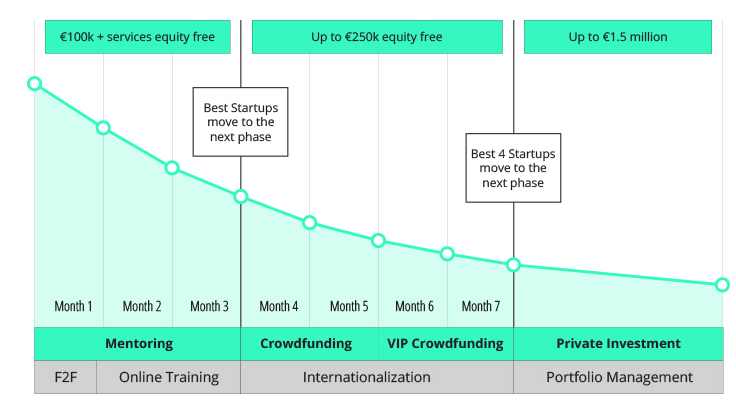
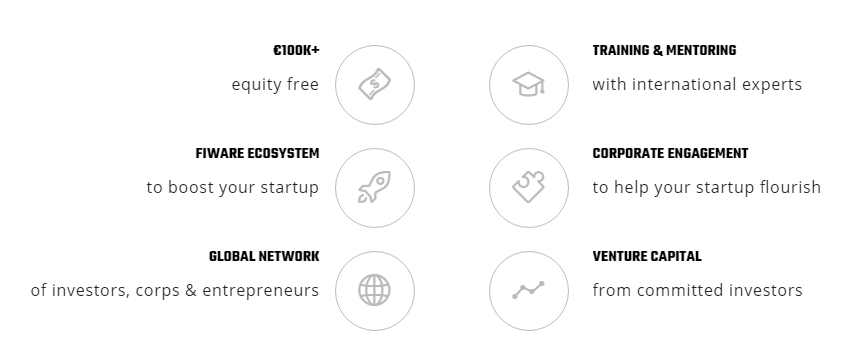
The startups that are selected for the program will receive €100,000 equity free — up to €250,000 for the best projects — as well as training and mentoring and the option to receive private investment from one of our partner investors and VCs: Kibo Ventures, Accelerace, INVESDOR.

IMPACT Growth is a high performance and equity free acceleration program supported by Fundingbox, ISDI.education, Accelerace, Mobile World Capital Fiware Foundation, Kibo Ventures, Invesdor, Danone, Ferrovial, Docomo Digital, and MADE, among other big players. IMPACT Growth will invest €3.6 million euros equity free in 2017 and 2018.

The three-month acceleration program, led by ISDI and Accelerace, is de-localized, which means that startups can receive training, mentoring, and funding without having to move to another city or country. This means that startups don’t need to go through the hassle of establishing themselves in a foreign place, but can rather focus their efforts on expanding their business, attending the world’s top startup events, training camps, and networking events in Madrid, Copenhagen, London, Tel Aviv, and more.

The best startups will move on to a second phase of internationalization. The best projects will be awarded up to an additional €150,000 in equity free funding. Finally, the four top startups will have the opportunity to receive private funding of up to €1.5 million, led by Kibo Ventures.

Why should you apply to IMPACT Growth?

First of all, because you have the possibility of receiving up to 250,000€ in cash equity free! The companies that enter in the acceleration program will receive up to €100,000 € and the two best companies a prize of €150.000, so in total you can receive up to €250,000 in cash equity free. Furthermore the two best startups will have the possibility to receive up to €1.5 million of private investment, in funding rounds lead by our VCs (Kibo Ventrures and Accelerace).

Startup Criteria

IMPACT Growth is looking for startups in the growth stage. The ideal startup:

  • has a product already on the market
  • already has initial investment
  • has established partnerships with corporates or strategic partners
  • is looking to open in new territories in the short term
  • is looking for investment to grow the business
  • is established in Europe or willing to open in Europe before entering the program

Application

Applications for IMPACT Growth are due May 9, 2017.

What is Precision Agriculture?

1

My family has been involved in agribusiness since the late 1800s when my great-grandfather started the family farm in the Beiseker area just outside of Calgary. Over the years, the operation evolved from growing crops to selling farm equipment to today, where our primary focus has become the technology used in farming.

Agriculture, in general, has undergone a similar evolution. Technology has become an indispensable part of doing business for every farmer, ag retailer and agronomist. In fact, a recent study by Hexa Reports suggests precision agriculture is set to grow to $43.4 billion by 2025. For a concept that was born in the 1990s, that’s quite impressive.

The increasing adoption rate of technology in agriculture shouldn’t be surprising to anyone. Farming is highly land and labor-intensive. Farmers are driven to use technology to increase efficiency and manage costs.

But what exactly does the buzz phrase precision agriculture mean?

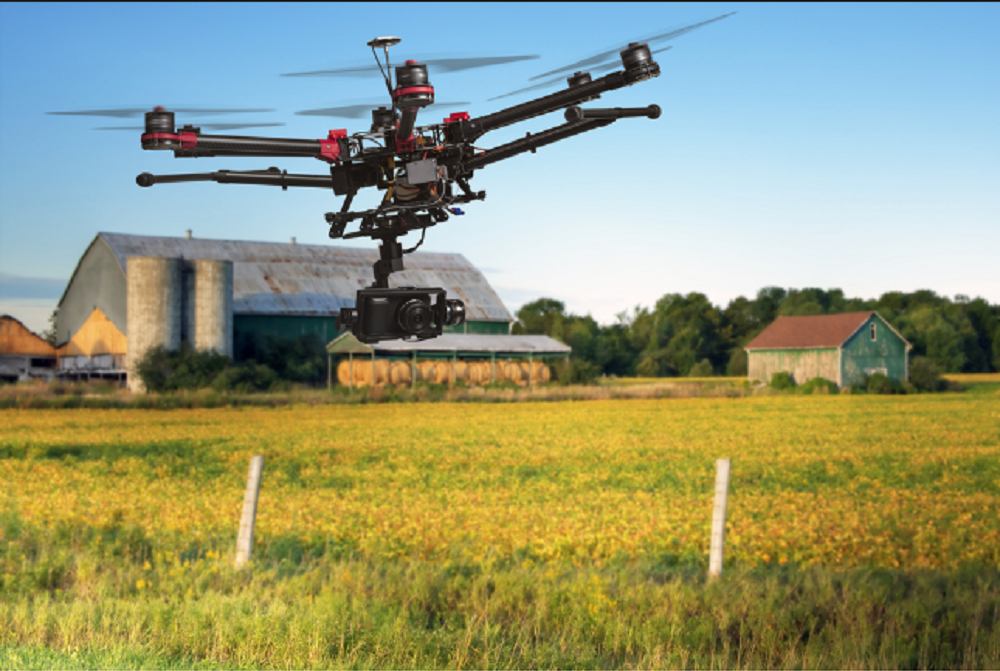
Precision agriculture is also known as precision ag or precision farming. Perhaps the easiest way to understand precision ag is to think of it as everything that makes the practice of farming more accurate and controlled when it comes to the growing of crops and raising livestock. A key component of this farm management approach is the use of information technology and a wide array of items such as GPS guidance, control systems, sensors, robotics, drones, autonomous vehicles, variable rate technology, GPS-based soil sampling, automated hardware, telematics, and software.

The First Wave of Precision Agriculture

Precision agriculture was born with the introduction of GPS guidance for tractors in the early 1990s, and the adoption of this technology is now so widespread globally that it’s probably the most commonly-used example of precision ag today. John Deere was the first to introduce this technology using GPS location data from satellites. A GPS-connected controller in a farmer’s tractor automatically steers the equipment based on the coordinates of a field. This reduces steering errors by drivers and therefore any overlap passes on the field. In turn, this results in less wasted seed, fertilizer, fuel, and time.

Precision Agronomics

Precision agronomics is another important term related to the combining of methodology with technology. At its core, it’s about providing more accurate farming techniques for planting and growing crops. Precision agronomics can involve any of the following elements:

Variable rate technology (VRT) – VRT refers to any technology that enables the variable application of inputs and allows farmers to control the amount of inputs they apply in a specific location. The basic components of this technology include a computer, software, a controller and a differential global positioning system (DGPS). There are three basic approaches to using VRT – map-based, sensor-based and manual. The adoption of variable rate technology is currently estimated at 15% in North America and is expected to continue to grow rapidly over the next five years.

GPS soil sampling – Testing a field’s soil reveals available nutrients, pH level, and a range of other data that is important for making informed and profitable decisions. In essence, soil sampling allows growers to consider productivity differences within a field and formulate a plan that takes these differences into account. Collection and sampling services that are worth the effort will allow the data to be used for input for variable rate applications for optimizing seeding and fertilizer.

Computer-based applications – Computer applications can be used to create precise farm plans, field maps, crop scouting and yield maps. This, in turn, allows for the more precise application of inputs such as pesticides, herbicides, and fertilizers, thus helping to reduce expenses, produce higher yields and create a more environmentally-friendly operation. The challenge with these software systems is they sometimes deliver a narrow value that doesn’t allow data to be used for making bigger farm decisions, especially with the support of an expert. Another concern with many software applications is poor user interfaces, and the inability to integrate the information they provide with other data sources to enrich and show significant value to farmers.

Remote sensing technology – Remote sensing technology has been in use in agriculture since the late 1960s. It can be an invaluable tool when it comes to monitoring and managing land, water, and other resources. It can help determine everything from what factors may be stressing a crop at a specific point in time to estimating the amount of moisture in the soil. This data enriches decision-making on the farm and can come from several sources including drones and satellites.

At its most basic level, precision agronomics takes the role of an agronomist and helps make the methods they use more accurate and scalable.

The primary aim of precision agriculture and precision agronomics is to ensure profitability, efficiency, and sustainability while protecting the environment. This is achieved by using the big data gathered by this technology to guide both immediate and future decisions on everything from where in the field to apply a particular rate, to when it’s best to apply chemical, fertilizer or seed.

While precision agriculture principles have been around for more than 25 years, it’s only been over the past decade that they have become mainstream due to technological advancements and the adoption of other, broader technologies. The adoption of mobile devices, access to high-speed internet, low cost and reliable satellites – for positioning and imagery — and farm equipment that’s optimized for precision agriculture by the manufacturer, are some of the key technologies characterizing the trend for precision agriculture. Some experts have suggested that more than 50% of today’s farmers use at least one precision farming practice.

Advocating for Excellence

Precision agriculture innovation continues, and more and more farms are adopting available technology and practices. Like any other industry, we need more advocates to drive greater adoption and hence greater efficiency. Growers need support to successfully implement new technologies to ensure success. At Decisive
Farming, we support our growers with training and expertise.

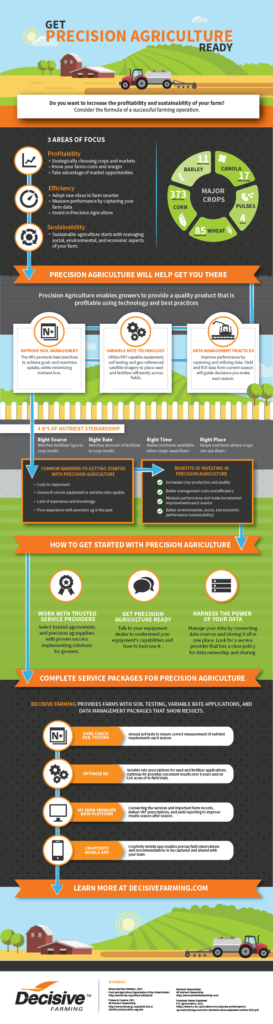
Here is an infographic showing how farmers can “Get Precision Agriculture Ready.”

Where Do We Go from Here?

As growers adopt precision agriculture, new technologies will continue to emerge. The next big advancement will be the use of artificial intelligence. While AI will never be able to replicate the kind of complex decisions farmers are required to make on regular basis, it could very well be used to help make those decisions easier.

Today’s farmers have access to a wealth of data. So much data, in fact, they often don’t know what to do with it. AI has the capability of analyzing huge amounts of data in a short period and using it to suggest the best course of action. This information could then be used to predict the best time to plant, to predict the outbreaks of pests and disease before they occur, and to offer in-field inventory management that could offer yield predictions prior to harvest.

I hope this provides some insight into precision agriculture today and the continued important role it will play in the future. Expect industry and technology companies to continue to explore the possibilities posed by the marriage of technology with the needs of the ag producers to produce enough food to feed the world’s projected 9 billion people by 2050.
By Remi Schmaltz – CEO of Decisive Farming, a Canadian software program for farms offering precision agronomics, data management, crop marketing, and telematics services. He has extensive agriculture knowledge after taking over his family’s ag retail company Dynagra Corp with his brother where he started incubating new technologies in farming resulting in the launch of Decisive Farming in 2011.