DD
MM
YYYY

PAGES

DD
MM
YYYY

spot_img

PAGES

Home Blog Page 7403

Investing in small-scale farmers is at least twice efficient in poverty reduction than investment in any other sector

1

The vast majority of the people in the world — about 70% — get their food from small-scale farmers and other small-scale food producers such as fisher-people, pastoralists, and hunters. This cohort is very critical in managing global hunger and poverty.

A new report – Investments in small-scale sustainable agriculture – has noted that there is an urgent need not only for more investments in small-scale sustainable agriculture, but also to develop new forms of investments with shared risks and benefits for the investors and the small-scale farmers. It also lays out 12 steps to transitioning to sustainable agriculture. 

The More and Better Network has started a small pilot project in Mozambique to use the 12 steps as a guideline and to undertake some new forms of investment with the financial support from the Heidehof Stiftung – a German foundation. The plan is to expand such small pilot projects both in Mozambique and in other countries with both grants and investments in 2018 and then expand further based on their experiences.

The report presents an overview of financial institutions organizations and networks engaged in investing in agriculture. It also presents the possibilities’ for further investment and support for small-scale agriculture in developing countries. It notes thus:

Investments in small-scale sustainable agriculture is the most efficient way to reduce hunger and poverty. It is at least twice as affective as investments in any other s ector. Despite these facts, only a small portion of the expenses of governments in developing countries and of the official development assistance /aid (ODA) goes to agriculture

Co-inventor of NAND flash appointed CEO of Micron Technology

0

Micron Technology, Inc. named former SanDisk CEO and co-inventor of NAND flash Sanjay Mehrotra as its president and chief executive officer, effective May 8. He succeeds Mark Durcan, who had sought retirement for some time.

The change in leadership comes at a time when memory vendors are on a short-term tear amid rising chip prices. Long term, they face challenges from emerging classes of memory chips and China’s hunger to buy its way into the market for DRAM and flash.

Mehrotra was one of three co-inventors of NAND flash, along with Eli Harari, the founding CEO of SanDisk. When Harari retired in 2011, Mehrotra succeeded him as SanDisk CEO until Western Digital acquired the company in a $19 billion merger announced in late 2015.

SanDisk revenues rose significantly during Mehrotra’s tenure as the company built out a portfolio of chip and card-level products.

We wish him good luck in Micron.

World Bank and Trade Ministry Unveil $35k – $1million Grant for Nigerian Startups

0

GEM is a program of the Federal Ministry of Industry, Trade and Investment and is supported by the World Bank. They are looking for some of Nigeria’s brightest and most promising MSMEs to support by providing financing, training and other forms of technical assistance. GEM’s grants to MSMEs range between $35,000 to $1,000,000 depending on the nature, size and qualifications of your business.

To apply;

  • 1. Your business must fall within the following sectors; · ICT · Entertainment · Tourism and Hospitality · Construction and Real Estate · Light Manufacturing (Agro/Industrial Processing)
  • 2. Complete an Application form via this link-https://goo.gl/forms/YCSzEOFI97L6qOgv2
  • 3. Complete the attached ‘Company Profile’ template and send to growthandemploymentng@gmail.com in a power-point format.

The Growth and Employment Project GEM, is a project set up through 160 million US Dollars financing received from the World Bank by the Federal Government of Nigeria to support Small and Medium Scale Enterprises in Nigeria and in doing so, boost growth and employment.

The concept of core competency or specialization is dead with the evolution of frenemies in tech companies

0

They taught us in economics that companies have to specialize and build core competencies.  They need to do things really well and be the best possible in the domains. But today, we think that does not make a lot of sense. For technology companies, everyone is doing everything, even at top-level. Alphabet, Google parent company, is a car company, a search company, a medical company, an advertising juggernaut, etc. Amazon.com is an e-commerce firm, a publisher, a movie producer, a drone maker, and soon a car maker.

Today, what do you think IBM does? Practically everything when you know that Watson has more than 100 flavors focusing on health, finance, real estate, etc. So as frenemies hit up, the entrenched mantra of core competency is falling apart. Read this piece from Fortune newsletter to get the idea.

Raise your hand if your company isn’t somehow involved with developing technology for autonomous vehicles. Okay, if your hand is up, quick question: What’s wrong with you?! Don’t you know you’re nothing right now if you’re not working on a self-driving car?

(You can put your hand down now. I’m kidding.)

To review, robotic vehicles not so long ago were the preserve of the Jetsons, locomotives and some other mass-transit trains, and various competitions funded by DARPA, the federal agency whose predecessor, ARPA, developed the Internet.

Then Google, seemingly inexplicably, started fooling around with cars without steering wheels, a “moonshot” unit now known as Waymo. Into the fray jumped Tesla and its Autopilot technology; General Motors, which bought 15-minute-old Cruise Automation and partnered with Lyft; Uber, which raided Carnegie Mellon’s roboticists, bought an autonomous trucking company called Otto, and got sued by the aforementioned Waymo; and Apple, which has said nary a peep about its self-driving aspirations, though it obviously has them.

This is merely the tip of the iceberg. The Wall Street Journal has a fascinating report that now Amazon is investigating autonomous technology too with a top-secret team devoted to the topic. The Journal said “the team serves as an in-house think tank to figure out how to leverage autonomous vehicles,” presumably for the purpose of delivery of packages. The account also said Amazon recently hosted a “radical transportation salon” on the future of transportation.

At the dawn of the Industrial Revolution companies specialized. They focused on electricity generation or steel manufacturing and the like. Today, the “frenemies” of the digital age must be end to end, or intelligent conglomerates. It isn’t sufficient to make software or Web-enabled platforms, for example. The megacaps of tech build their own data centers. Uber, a ride-hailing app, feels compelled to develop its own robotic-car technology. Amazon, already a massive UPS and United States Postal Service customer, is snapping up its own planes.

It probably won’t want people to fly them either.

In case you didn’t notice, Google is now worth more than $600 billion. What’s even more mind-boggling is that the next three largest public companies (Microsoft, Amazon, and Facebook) and the one that’s bigger (Apple) are all in tech. Little ‘ole Berkshire Hathaway, at $409 billion, is the biggest non-tech player.

Business Plans/ Pitch Decks of Airbnb, Square, LinkedIn, Youtube, Mint and 15 other Startups

1

Closing a funding round is not just about what is written on a piece of paper as a business plan or pitch deck. Most times, investors do not really care. Nevertheless, not having a business plan or pitch deck could portray you as someone who does not plan or take things seriously. That may be the problem and not necessarily the lack of the documents.

Here are business plans/pitch decks used by some of the world’s game changing companies. You can borrow ideas from them as you plan to craft yours.


1. Airbnb

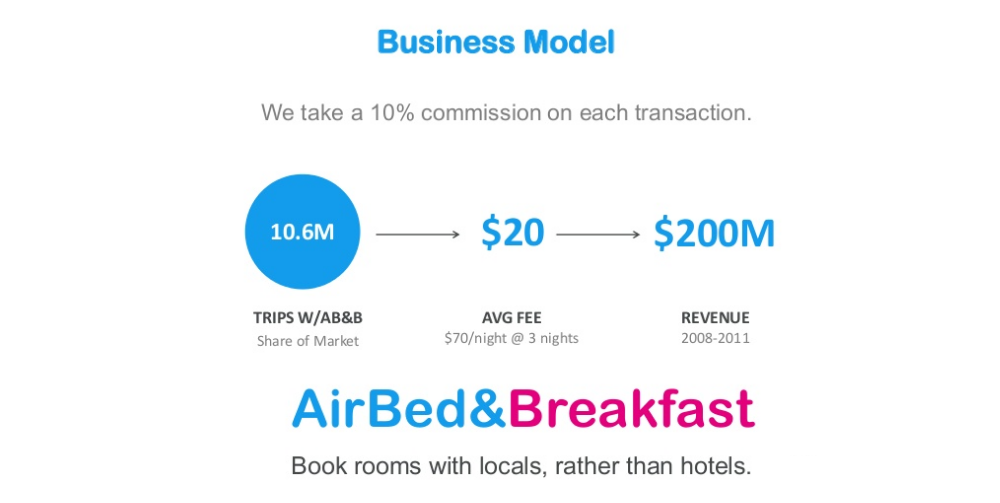
Airbnb is an online marketplace which lets people rent out their properties or spare rooms to guests. What started out as an obscure idea has turned into one of the greatest startup success stories of our time. And Airbnb’s pitch deck has become a sort of reference point for entrepreneurs around the world. AirBnB Pitch Deck

2. Buffer

Buffer is a social media scheduling platform that helps you schedule content to Facebook, Twitter, Linkedin and Pinterest. This is the pitch deck that Buffer used to raise half a million dollars. What’s more crazy is the founders don’t even think this is a big deal. This is a great pitch deck because it tells a story, building up to the apex which was the Traction slide. Buffer’s $500,000 pitch deck

3. Square

Square is a company that allows merchants to accept mobile credit card payments via a dongle. I think the major selling point on this pitch deck was the management team. Notice how it was among the first three slides they showed? Seriously, who wouldn’t bet on a company with the big boys from Twitter, Google, Linkedin, Paypal, and more? Square’s detailed pitch deck outlines their business model and a simple financial model that portrays annual revenue and five-year growth rate. Square’s pitch deck

4. LinkedIn

Founded in 2002, LinkedIn is the top business-oriented social networking platform. The company’s Series B pitch deck talks a great deal about how it’s different from other social networks and the value the network brings. It also uses a great analogy to explain it’s value i.e. it talks about “Web 1.0” vs. “Web 2.0”: According to the deck, Alta Vista was “Search 1.0”, and Google was “Search 2.0”; LinkedIn is “Networking for Businesses 2.0”. LinkedIn’s Pitch Deck

5. Buzzfeed

Buzzfeed is arguably the world’s highly clickable site. It provides shareable breaking news, original reporting, entertainment, and videos across the social web. As of today, BuzzFeed has managed to raise over $446.3 million. As you’ll notice in their pitch deck, it doesn’t hurt to start your deck with your most impressive figures. The millions of users visiting the website on a monthly basis and quotations from large organizations such as CNN, I’m sure would convince any investor to bring our their checks. Buzzfeed’s First Pitch Deck

6. Youtube

Youtube was acquired by Google in 2006 for $1.6 billion. Like Facebook, this company doesn’t require any introduction. Unfortunately, this is not the original deck. This is Youtube’s pitch deck to Sequoia Capital (one of the most established VC investors who’s often regarded as one of the industry’s best), which was released through a legal proceeding. Youtube’s Pitch Deck

7. Foursquare

Foursquare is a mobile platform that helps you find the best places to go in your area. Their pitch deck does a great job of using screenshots of social proof. Like all good storytellers know, showing is better than telling. Foursqaure’s First Pitch Deck

8. Mint

Mint is a personal financial services tool that helps people track their spending and find ways to save money. This deck was used in a competition and was never used for raising money, but it’s still a powerful deck that startups can learn from. Mint’s Prelaunch Deck

9. Moz

Moz started out as an SEO company but has pivoted to support marketers across all inbound marketing strategies. This is the series-B deck for Moz which they used to raise over $18 million. Because the company had already been in operation for five years, they were able to present an accurate estimated revenue, revenue run rate, average customer lifetime value, cost of paid acquisition, etc. Moz’s Pitch Deck

10. Tinder

To put it simply, Tinder is a dating app. Tinder’s Pitch Deck

11. Contently

Contently helps brands do great content marketing at scale—with smart technology, content strategy expertise, and a network of 100000 freelance creatives. Contently Pitch Deck

12. WeWork

WeWork is a multibillion dollar office space rental startup in New York City. WeWork’s Pitch Deck

13. Intercom.io

Intercom shows you who is using your product or website and makes it easy to personally communicate with them through targeted content, behavior-driven email, in-app, and web messages Intercom’s Pitch Deck

Related:  The one tip you need to turbocharge your customer service

14. Manpacks

Manpacks is a platform that delivers men’s essentials such as underwear, razors, grooming and other products.Manpacks’ Pitch Deck

15. Dwolla

Dwolla is a payment solution that allows users to send, receive, and request funds from other users. This 18-slide pitch deck landed the company $16.5 million. Dwolla’s Pitch Deck

16. Gusto

Gusto (previously ZenPayroll) is a cloud-based solution tool for small businesses to pay employees. The company raised $6 million with this deck. Gusto’s (when it was still ZenPayroll) Pitch Deck

17. Wealthsimple

Wealthsimple is Canada’s first online investment manager. They raised more than $2 million in seed funding.Wealthsimple’s Pitch Deck

18. AppVirality

AppVirality allows app developers to grow their platform using growth method techniques proven by other startups. This deck was used to raise $270k AppVirality’s Pitch Deck

19. Castle

Castle is a startup that lets rental owners put their properties on autopilot. This was the deck Castle used to raise $270,000 for their startup. Castle’s Pitch Deck

20. Swipes

Swipes is a task manager app to help its users increase their productivity. Swipes’ Pitch Deck


adapted from here.