My family has been involved in agribusiness since the late 1800s when my great-grandfather started the family farm in the Beiseker area just outside of Calgary. Over the years, the operation evolved from growing crops to selling farm equipment to today, where our primary focus has become the technology used in farming.
Agriculture, in general, has undergone a similar evolution. Technology has become an indispensable part of doing business for every farmer, ag retailer and agronomist. In fact, a recent study by Hexa Reports suggests precision agriculture is set to grow to $43.4 billion by 2025. For a concept that was born in the 1990s, that’s quite impressive.
The increasing adoption rate of technology in agriculture shouldn’t be surprising to anyone. Farming is highly land and labor-intensive. Farmers are driven to use technology to increase efficiency and manage costs.
But what exactly does the buzz phrase precision agriculture mean?
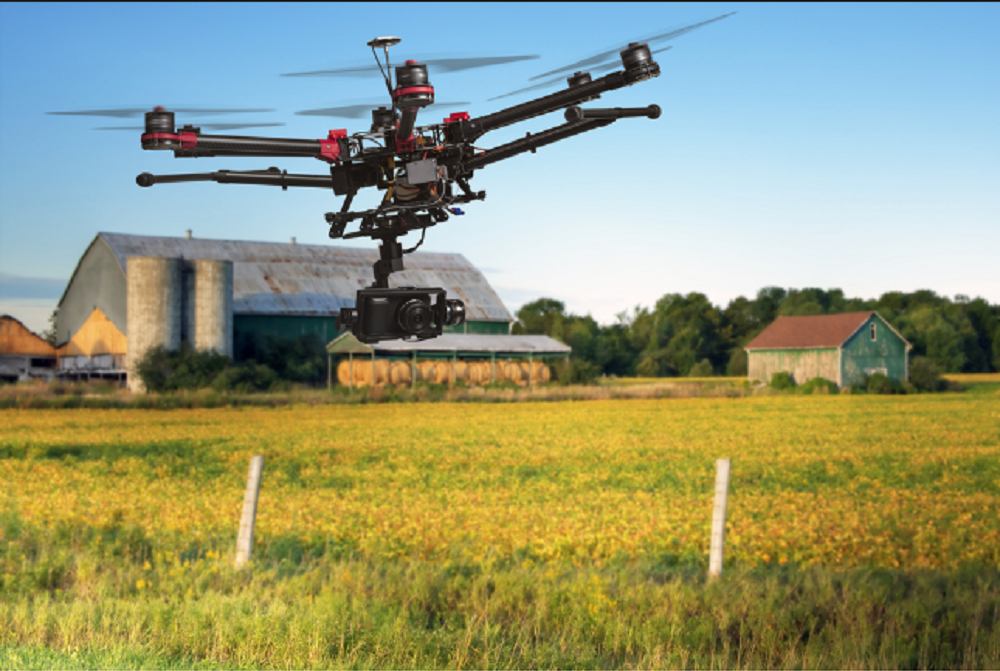
Precision agriculture is also known as precision ag or precision farming. Perhaps the easiest way to understand precision ag is to think of it as everything that makes the practice of farming more accurate and controlled when it comes to the growing of crops and raising livestock. A key component of this farm management approach is the use of information technology and a wide array of items such as GPS guidance, control systems, sensors, robotics, drones, autonomous vehicles, variable rate technology, GPS-based soil sampling, automated hardware, telematics, and software.
The First Wave of Precision Agriculture
Precision agriculture was born with the introduction of GPS guidance for tractors in the early 1990s, and the adoption of this technology is now so widespread globally that it’s probably the most commonly-used example of precision ag today. John Deere was the first to introduce this technology using GPS location data from satellites. A GPS-connected controller in a farmer’s tractor automatically steers the equipment based on the coordinates of a field. This reduces steering errors by drivers and therefore any overlap passes on the field. In turn, this results in less wasted seed, fertilizer, fuel, and time.
Precision Agronomics
Precision agronomics is another important term related to the combining of methodology with technology. At its core, it’s about providing more accurate farming techniques for planting and growing crops. Precision agronomics can involve any of the following elements:
Variable rate technology (VRT) – VRT refers to any technology that enables the variable application of inputs and allows farmers to control the amount of inputs they apply in a specific location. The basic components of this technology include a computer, software, a controller and a differential global positioning system (DGPS). There are three basic approaches to using VRT – map-based, sensor-based and manual. The adoption of variable rate technology is currently estimated at 15% in North America and is expected to continue to grow rapidly over the next five years.
GPS soil sampling – Testing a field’s soil reveals available nutrients, pH level, and a range of other data that is important for making informed and profitable decisions. In essence, soil sampling allows growers to consider productivity differences within a field and formulate a plan that takes these differences into account. Collection and sampling services that are worth the effort will allow the data to be used for input for variable rate applications for optimizing seeding and fertilizer.
Computer-based applications – Computer applications can be used to create precise farm plans, field maps, crop scouting and yield maps. This, in turn, allows for the more precise application of inputs such as pesticides, herbicides, and fertilizers, thus helping to reduce expenses, produce higher yields and create a more environmentally-friendly operation. The challenge with these software systems is they sometimes deliver a narrow value that doesn’t allow data to be used for making bigger farm decisions, especially with the support of an expert. Another concern with many software applications is poor user interfaces, and the inability to integrate the information they provide with other data sources to enrich and show significant value to farmers.
Remote sensing technology – Remote sensing technology has been in use in agriculture since the late 1960s. It can be an invaluable tool when it comes to monitoring and managing land, water, and other resources. It can help determine everything from what factors may be stressing a crop at a specific point in time to estimating the amount of moisture in the soil. This data enriches decision-making on the farm and can come from several sources including drones and satellites.
At its most basic level, precision agronomics takes the role of an agronomist and helps make the methods they use more accurate and scalable.
The primary aim of precision agriculture and precision agronomics is to ensure profitability, efficiency, and sustainability while protecting the environment. This is achieved by using the big data gathered by this technology to guide both immediate and future decisions on everything from where in the field to apply a particular rate, to when it’s best to apply chemical, fertilizer or seed.
While precision agriculture principles have been around for more than 25 years, it’s only been over the past decade that they have become mainstream due to technological advancements and the adoption of other, broader technologies. The adoption of mobile devices, access to high-speed internet, low cost and reliable satellites – for positioning and imagery — and farm equipment that’s optimized for precision agriculture by the manufacturer, are some of the key technologies characterizing the trend for precision agriculture. Some experts have suggested that more than 50% of today’s farmers use at least one precision farming practice.
Advocating for Excellence
Precision agriculture innovation continues, and more and more farms are adopting available technology and practices. Like any other industry, we need more advocates to drive greater adoption and hence greater efficiency. Growers need support to successfully implement new technologies to ensure success. At Decisive
Farming, we support our growers with training and expertise.
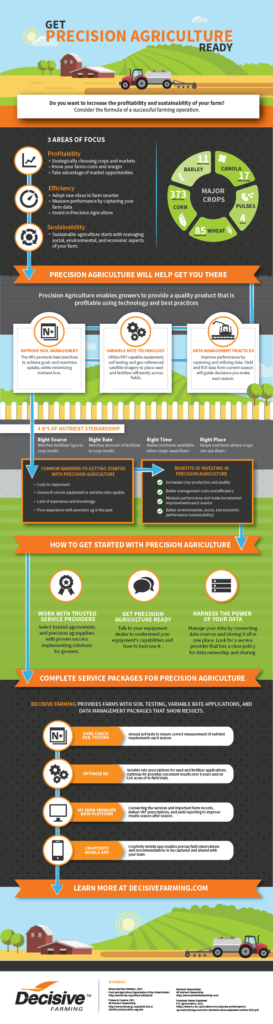
Here is an infographic showing how farmers can “Get Precision Agriculture Ready.”
Where Do We Go from Here?
As growers adopt precision agriculture, new technologies will continue to emerge. The next big advancement will be the use of artificial intelligence. While AI will never be able to replicate the kind of complex decisions farmers are required to make on regular basis, it could very well be used to help make those decisions easier.
Today’s farmers have access to a wealth of data. So much data, in fact, they often don’t know what to do with it. AI has the capability of analyzing huge amounts of data in a short period and using it to suggest the best course of action. This information could then be used to predict the best time to plant, to predict the outbreaks of pests and disease before they occur, and to offer in-field inventory management that could offer yield predictions prior to harvest.
I hope this provides some insight into precision agriculture today and the continued important role it will play in the future. Expect industry and technology companies to continue to explore the possibilities posed by the marriage of technology with the needs of the ag producers to produce enough food to feed the world’s projected 9 billion people by 2050.
By Remi Schmaltz – CEO of Decisive Farming, a Canadian software program for farms offering precision agronomics, data management, crop marketing, and telematics services. He has extensive agriculture knowledge after taking over his family’s ag retail company Dynagra Corp with his brother where he started incubating new technologies in farming resulting in the launch of Decisive Farming in 2011.
Like this:
Like Loading...