DD
MM
YYYY

PAGES

DD
MM
YYYY

spot_img

PAGES

Home Blog Page 7426

World Bank Unveils XL Africa, a Business Accelerator That Will Invest Between $250,000 And $1.5M To Startups

0

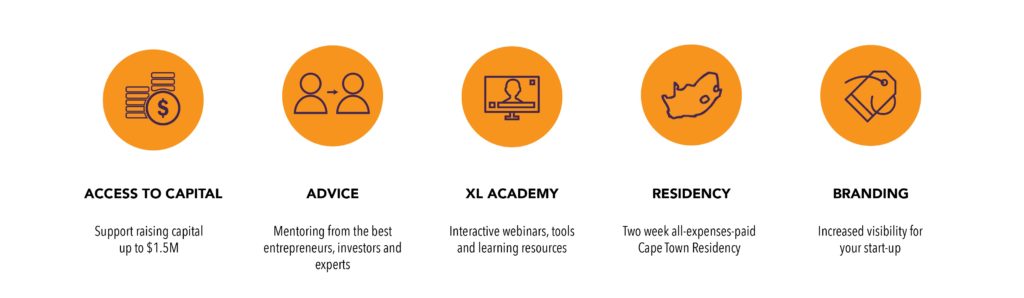
The World Bank Group launched XL Africa (www.XL-Africa.com), a five-month business acceleration program designed to support the 20 most promising digital start-ups from Sub-Saharan Africa. Start-ups will receive mentoring from global and local experts, learn through a tailor-made curriculum, increase their regional visibility, and get access to potential corporate partners and investors. With support from prominent African investment groups, XL Africa will help the 20 selected start-ups attract early stage capital between $250,000 and $1.5 million.

“Digital start-ups are important drivers of innovation in Africa,” says Makhtar Diop, Vice President for the Africa Region at the World Bank. “To scale and spread new technologies and services beyond borders, they need an integrated ecosystem that provides access to regional markets and global finance; pan-African initiatives like XL Africa play a critical role by linking local start-ups with corporations and investors across the continent.”

The program comes at a time of increasing interest in the African digital sector. According to a recent report by Disrupt Africa, in 2016, the number of tech start-ups that secured funding increased by 16.8% compared to 2015.

“XL Africa aims to put a spotlight on the continent’s growing digital economy by scouting for and supporting the most innovative tech start-ups,” said Klaus Tilmes, Director of the Trade & Competitiveness Global Practice at the World Bank Group. “The success of these ventures will create a demonstration effect that can attract much-needed growth investment in the sector and catalyze scaling of transnational businesses in the region.”

The program’s flagship activity includes a two-week residency in Cape Town, South Africa, where the ventures will have the opportunity to interact with and learn from their mentors, peers, and local partners. The Cape Town residency will conclude with the Venture Showcase, a regional event in which the entrepreneurs will present their business models to a select audience of corporations and investors.

“The program’s unique combination of targeted mentorship and access to investors represents a vital resource for digital ventures ready to grow,” said Lexi Novitske, Principal Investment Officer for Singularity Investments, a venture group based in Lagos, Nigeria. “By connecting innovative business ideas with the knowledge and resources available in the ecosystem, XL Africa will create a pipeline of investment-ready companies, unlocking better investment opportunities for regional and global investors.”

The program will collaborate with prominent African investment groups, including the African Business Angel Network (ABAN), AngelHub Ventures, Goodwell Investments, Knife Capital, Nest Africa, Silvertree Capital, Singularity Investments, South African Business Angel Network (SABAN), TLcom Capital, Zephyr Acorn and 4Di Capital, and corporate partners, such as Orange, .Eco, Ringier, and Thomson Reuters.

Interested companies can apply online on the XL Africa website www.XL-Africa.com by Monday, June 12, 2017.

XL Africa is funded by the governments of Finland, Norway, and Sweden, and administered by the World Bank Group with implementation support from IMC Worldwide, VC4A, and Koltai & Co.

Five Simple Ways To Protect Your Wireless Network

0

Using a wireless network in your home gives you the convenience of being able to use your computer virtually anywhere in your house — and still be able to connect to other computers on your network or access the Internet. However, if your wireless network is not secure, there are significant risks. For example, a hacker could:

  • Intercept any data that you send or receive
  • Gain access to your shared files
  • Hijack your Internet connection — and use up your bandwidth or download limit

Internet Security tips — to help you protect your wireless network

Here are some simple steps you can take to protect your wireless network and router:

  • Avoid using the default password
    It’s easy for a hacker to find out the manufacturer’s default password for your wireless router — and then use that password to access your wireless network. So it’s wise to change the administrator password for your wireless router. When you’re deciding on your new password, try to pick a complex series of numbers and letters — and try to avoid using a password that can be guessed easily.
  • Don’t let your wireless device announce its presence
    Switch off SSID (Service Set Identifier) broadcasting — to prevent your wireless device announcing its presence to the world.
  • Change your device’s SSID name
    Again, it’s easy for a hacker to find out the manufacturer’s default SSID name for your device — and then use that to locate your wireless network. Change the default SSID name of your device — and try to avoid using a name that can be guessed easily.
  • Encrypt your data
    In your connection settings, make sure you enable encryption. If your device supports WPA encryption, use that — if not, use WEP encryption.
  • Protect against malware and Internet attacks
    Make sure you install a rigorous anti-malware product on all of your computers and other devices. In order to keep your anti-malware protection up to date, select the automatic update option within the product.

How To Stay Safe When Shopping Online

0

You’re shopping online, you’ve found a great deal on a new camera, and you don’t want to miss out.

However, you’ve never heard of the retailer before. Or maybe it’s one you know, but you think there’s something not quite right about it…

Do you take the risk and buy the camera? Or do you play safe and cancel the transaction? You need some safety tips for shopping online.

Make sure you’re surfing on a safe site

Cybercriminals often create fraudulent websites, posing as high-profile online retailers. These websites look legitimate and ask you to enter personal information to verify your account. What they want is your username and password, so they can use it to hack into your other online shopping accounts like Amazon or eBay – or even your bank account. They also want your credit card information and your personal data. You want to be certain that you are protecting your money online.

How do you check if the website is safe? Well here’s a good online shopping tip; when you are in the shopping cart or on the payment page, look at the address bar of your browser. You should see ‘https’ – not ‘http’ – at the start of the URL, and a small padlock symbol next to it. This shows that you have a secure session with the website. It is a good sign and a good shopping safety tip. But there is little else to indicate you are dealing with a trusted site.


Put an end to keyloggers

Cybercriminals often write keylogging programs that run silently in the background of your PC, hidden from view. You may have accidently installed them by clicking on a pop-up or a link in a spam email. And without quality Internet security, they are practically impossible to detect.

Keylogging programs record every keystroke you use to enter your name, password and credit card details when you make a purchase. In short, they record everything you type on your keyboard.

This information is then sent back to a remote computer/hacker who could use your card to purchase items for themselves, or sell the details to other cybercriminals who use it to purchase goods to be delivered to a temporary address – stealing your money and possibly identifying you in the process.

A simple online shopping tip is to install strong internet security. Premium Internet security solutions often come with a feature called a “virtual keyboard”. When entering a username or password, an image of a keyboard appears on the screen and you can complete the process by clicking on the virtual keyboard with a mouse. This foils keylogging programs, which expect you to use the PC’s keyboard.

Put an end to keyloggers

Hackers also use your email address and password to enter different online shopping sites. People often use the same weak password for multiple accounts. Breaking just one of these accounts gives the cybercriminal access to a lot of personal data.

Another essential online safety tip is to create strong passwords for each of your online accounts including shopping sites. It is worth using these simple steps:

  1. Don’t make your password an easy-to-guess word or place name
  2. Use a mixture of letters (in upper- and lower-case), numbers, and even punctuation marks
  3. Have a different password for each site you use
  4. Record each password in the encrypted vault of your Total Internet Security solution
  5. Use the password manager of your total Internet security solution.

Online shopping doesn’t have to be dangerous

We’ve given you some tips for safely shopping online because it can be minefield when cybercriminals are trying to steal your password, your credit card details and even your identity. But with a premium total Internet security solution, you can check each online store is safe, create a unique password for each site, log in using virtual keyboards to avoid keylogging and store your passwords securely on all your PCs.

Now shopping online can be just as safe, affordable and convenient as shopping on Main Street. For more online shopping tips please visit the Internet Security Center for information on internet safety and security threats.

Top 10 And Bottom 10 Countries For Investment Destinations In Africa – Quantum Global Research Lab

0

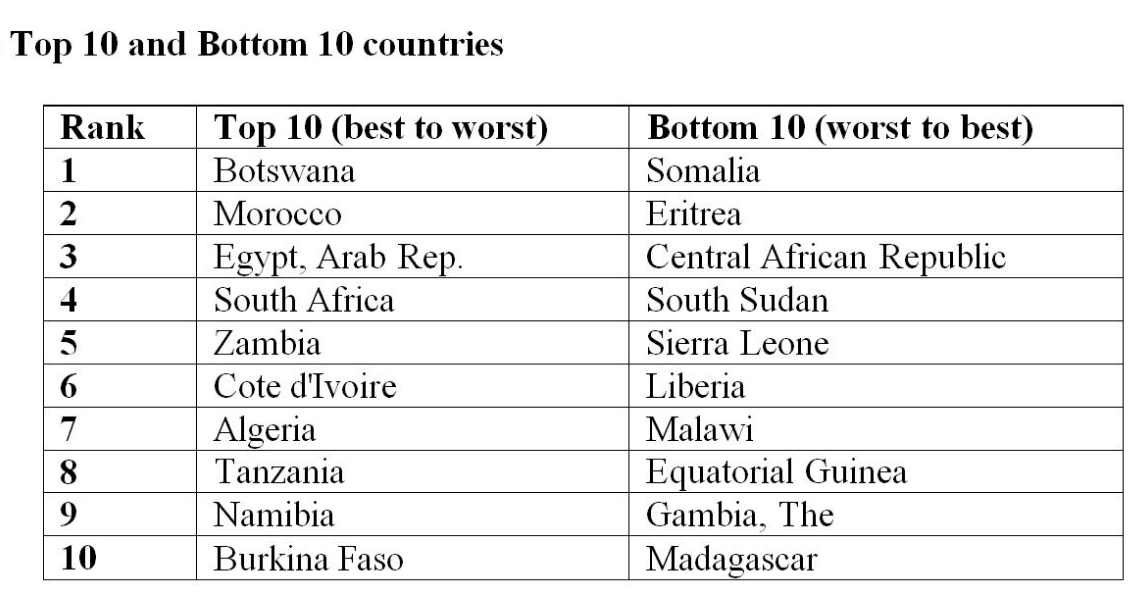
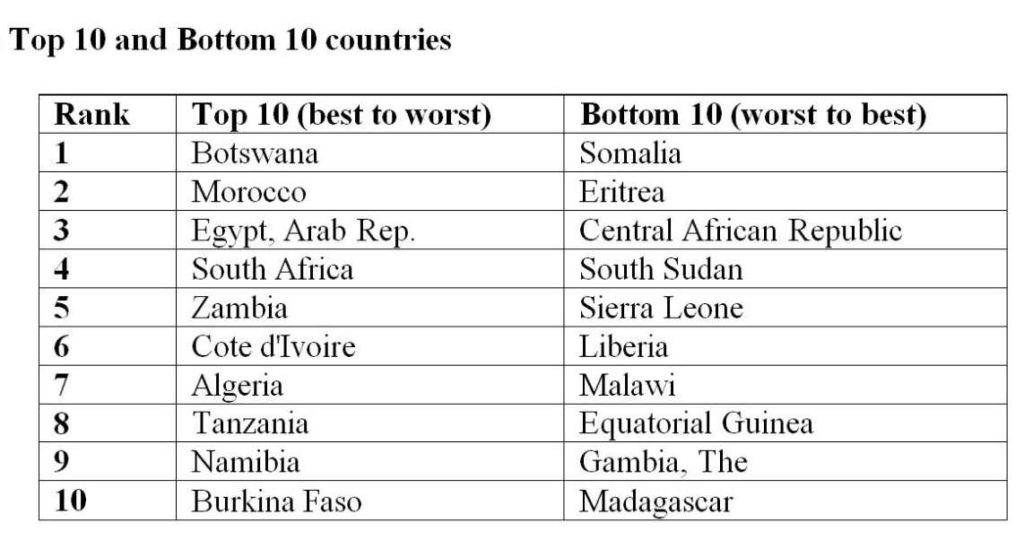
Botswana is the most attractive economy for investments flowing into the African continent, according to the latest Africa Investment Index 2016  by Quantum Global’s independent research arm, Quantum Global Research Lab.

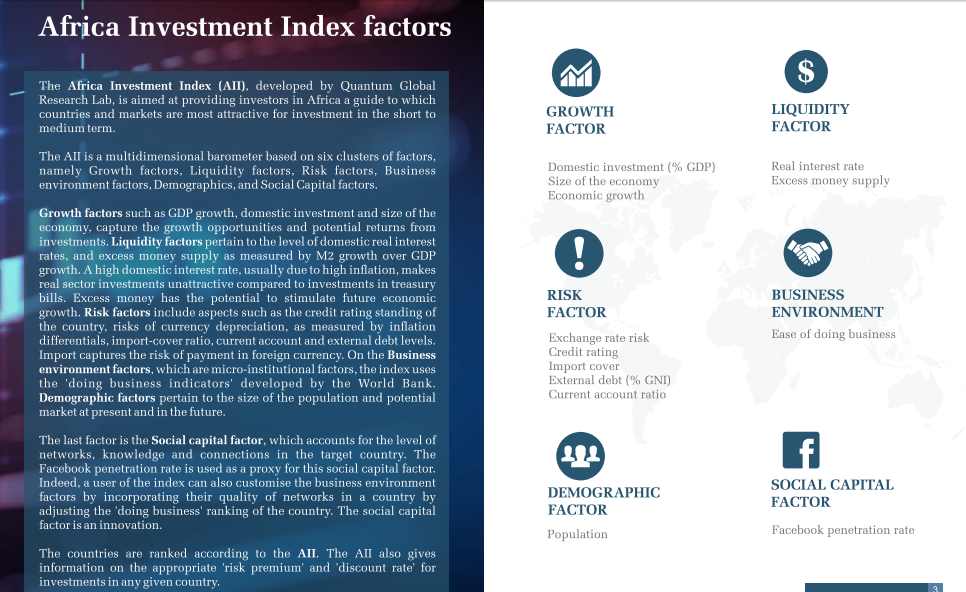
According to the Index, Botswana scores highly based on a range of factors that include improved credit rating, current account ratio, import cover and ease of doing business.

Commenting on the Index, Prof Mthuli Ncube, Head of Quantum Global Research Lab stated: “Despite considerable external challenges and the fall in oil prices, many of the African nations are demonstrating an increased willingness to achieve sustainable growth by diversifying their economies and introducing favourable policies to attract inward investments. Botswana is a case in example – its strategic location, skilled workforce and a politically stable environment have attracted the attention of international investors leading to a significant influx of FDI.”

According to the report, the top five African investment destinations attracted an overall FDI of $13.6bn. Morocco was ranked second on the Index based on its increasing solid economic growth, strategic geographic positioning, increased foreign direct investment, import cover ratio, and an overall favourable business environment. Egypt was ranked third due to an increased foreign direct investment and real interest rates, and a growing urban population. The fourth country on the list, South Africa, scored well on the growth factor of GDP, ease of doing business in the country and significant population. Whilst Zambia was the fifth country on the list due to its significant domestic investment and access money supply.

Table: Top 10 and Bottom 10 countries (view the multimedia content section

Mthuli further commented: “With a population of over one billion people and rapidly growing middle class, Africa clearly offers significant opportunities to invest in the continent’s non-commodities sectors such as financial services, construction and manufacturing amongst others. However, structural reforms and greater private sector involvement are crucial to unlocking Africa’s true potential.”

The State of Mobile, ECommerce, MCommerce and Smartphone in Africa, Nigeria

0

Jumia Nigeria has unveiled the 2017 edition of its African Mobile Trends Paper. This is the third white paper presentation from Jumia delving into mobile trends across Africa and specifically Nigeria. The study takes a look at the how the market has democratized mobile internet use, the consumer behaviors driving increased smartphone adoption and the role of mobile brands, mobile operators and m-commerce in creating a synergy of an enhanced customer experience.

This year’s Mobile Africa Study was carried out in 15 African countries which generate more than 80% of Africa’s GDP – Algeria, Nigeria, Morocco, Tunisia, Egypt, Mozambique, Ghana, Ivory Coast, Cameroon, Rwanda, Uganda, Tanzania, Kenya and Senegal.

Africa Mobile subscriptions and Internet penetration
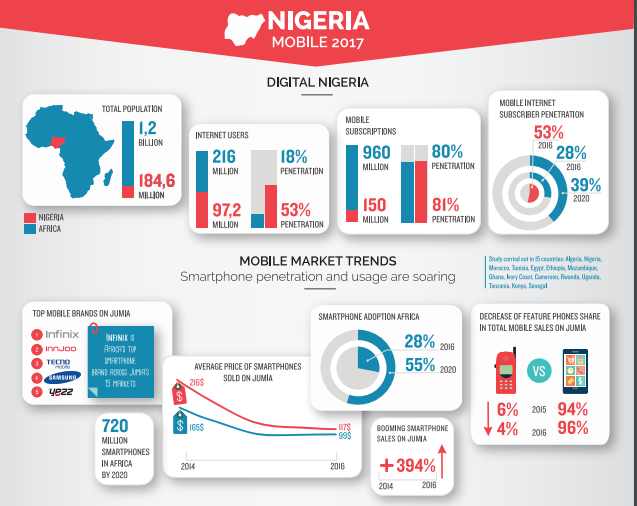
There are 960 million mobile subscriptions across Africa – an 80% penetration rate among the continent’s population. Internet penetration is at 18% with 216 million internet users. While Nigeria’s internet penetration is much higher at 53%, it mobile subscription is similar to Africa’s at 81% penetration (150 million mobile subscriptions). Like last year, it is presumed that the unique subscription rate is lower as each subscriber owns an average of 2 sim cards.

Nigeria: A Mobile First Nation
As predicted in 2016, Nigeria continues its trajectory down the increasingly widening highway that is the mobile internet. With a current internet penetration rate of 53% (97.2 million users) Nigeria has a much higher penetration rate than across Africa (18%).

About 71% of website visitors on Jumia use their mobile phones. This is in comparison to 53% of Jumia African customers. One of the main vehicles of this mobile trajectory is the increasing adoption of the smartphone device by consumers. As predicted in our 2016 report, smartphone adoption continues to rise in Nigeria. The mobile phone category continues to be the most popular among Nigerian shoppers on Jumia, both in terms of the number of items sold, and in terms of revenue generated. The sales of smartphones jumped up by 394% between 2014 and 2016, mostly driven by an increasing range of smartphones price points.
ECommerce and the Diversification of Smartphones
The average price for a smartphone on Jumia is $117, down from $216 in 2014. Correlating with this is a drop in the share of sales of basic feature phones from 6% in 2015 to 4% in 2016, even as the share of smartphones on the website increased.

In 2016 Chinese mobile brands held dominance and played a major role in introducing smartphones with lower price points. Infinix, Innjoo, Tecno, Samsung and Yezz are the top 5 smartphone brands in terms of sales on Jumia. Infinix continues to be Africa’s top smartphone brand across Jumia’s 15 markets. One of their entry level smartphones, the Infinix Hot4Lite was one of the best-selling phones across several African markets including Nigeria.

Browsing in Nigeria: adapting to high data costs and lower performance smartphones
The increased access and affordability of low specification smartphones has also revealed a need for the mobile ecosystem to respond with data-efficient browsers and mobile apps that are optimized for performance and an easy user experience.

Looking at the mobile internet browsers customers use to access Jumia, 50% of customers in Africa come onto Jumia’s mobile site with Google Chrome. In Nigeria that number is just 28%. Instead, the Opera mini browser is much more popular, with 41% of the mobile traffic to Jumia Nigeria coming from Opera mini.

One reason for this could be that countries with higher levels of income have been found to have more users accessing the internet with heavier browsers like chrome – which typically have higher system requirements. Opera mini is a lighter browser in terms of data usage and is popular among new mobile internet users who have lower incomes and can’t afford costly internet data packs. A recent report from Opera determined the savings on mobile data costs for Opera mini users in Nigeria has amounted to about $198 million (N39.5 billion) over a 10-month period, due to its data compression technology. This is a clear example of the ripple effect that customer enjoy when a slight change is introduced by one of the digital ecosystem players.
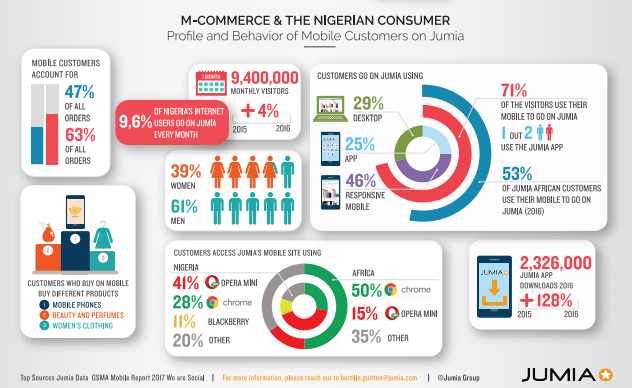
On our end, an immediate key priority is to enhance the desktop user experience (which accounts for almost 30% of Jumia’s traffic and almost 40% of orders placed) by delivering a progressive web application that bridges the gap between conventional web pages and native mobile applications, to give customers a faster web and desktop experience that includes functionalities like push notifications and the ability to browse while offline.

MCommerce – Beyond browsing on mobile
The trend since 2013 was for people to use their mobile phones to browse and look up products and then purchase them on their desktop. Now customers are checking out and paying for orders from the mobile app or the mobile friendly version of the website. This is a trend we foresee growing in the future based on the current figures.

Mobile customers (both those who use the Jumia app and those who browse from mobile browsers) account for 63% of all orders on Jumia Nigeria. Across the 15 markets where the study was carried out, that figure is at 47%. With a whopping 2,236,000 Jumia app downloads from 2015 to 2016 (a 128% increase), Jumia app users form a significant portion of the mobile traffic on Jumia Nigeria. Currently, 1 out of 2 mobile visitors in Nigeria are coming from the Jumia mobile app.

The highest conversion rate recorded in the last year has been on the app. That is the number of completed orders in relation to the number of visitors is higher on the mobile app than on the mobile or desktop versions of the website. This could be driven by the fact that the app is exclusively designed for mobile and therefore has a faster and better shopping experience for users.

Hence, the priority for mcommerce for the next few years is to continually democratize the usage of the app and incentivize an increase in usage by maintaining a better browsing experience and lower data consumption.

Strategic collaborations with phone operators and data providers are also a key factor for enhancing customer experience. For example, the 0 data usage (free browsing) offered to MTN sim card owners when they browse on both the Jumia mobile site and the app will remain a key feature and value-added service for Jumia customers.

Nigeria’s mobile trends for 2017 are positive with a steady growth of smartphones adoption and diversity. These increased offerings deliver more value for customers and cheaper access to internet connectivity. As smartphone brands and mobile operators continue to invest in research and development and innovative data packages, and ecommerce providers invest in customer service, logistics and marketing over the next few years, our outlook is for an even more synergized digital ecosystem over the next few years.