DD
MM
YYYY

PAGES

DD
MM
YYYY

spot_img

PAGES

Home Blog Page 7428

African entrepreneurs, you could win $100,000 in this startup competition

0

The Hello Tomorrow Challenge is a global startup competition for promising early-stage projects and startups using science and technology to solve the world’s issues. It offers equity-free funding, high-visibility and has a solid network of partners. The Challenge consists of 10 tracks:

  • DATA & AI
  • ENERGY TRANSITION
  • ENVIRONMENT
  • FOOD & AGRICULTURE
  • WELLBEING
  • HEALTHCARE
  • INDUSTRY 4.0
  • NEW MATERIALS
  • MOBILITY
  • AEROSPACE

Top projects from around the world will have a chance to attend Hello Tomorrow Summit (3rd edition), on October 26th-27th in Paris.

Benefits:

  • Compete for prizes of €15k (track prizes) to €100k (first prize),
  • Get global media coverage
  • Interact with sector-specific and invite-only investors (Index, Flagship, Y Combinator etc.), top industry executives (Google[x], NASA, Roche etc.), and fellow founders.

Eligibility criteria:

  • Your activity is based on a new technology or an innovative application of an existing technology
  • You have a proof of concept, a prototype, a scientific validation of your claim, or are in the process of producing one
  • Your team is composed of two full-time-equivalents or more
  • Your project is not part of a larger company
  • You foresee an economically viable application on the market within 15 years
  • Your project would have a wide impact on the industry you target, and on society or the environment in general

Judging criteria:

  • Technological innovation: The project must develop a product/service based on a new technology or an innovative application of an existing technology
  • Potential impact: The project must have the potential to make a substantial long-term impact on business and/or society
  • Leadership and team: The team must exhibit visionary leadership with the capabilities to drive the project towards success
  • Economic viability: The project should have well-formulated plans for developments and goals, and a sustainable business model

Applications:

  • Applications are free
  • Applications are open until June 1st

APPLY HERE

Nigerian minister asks Diaspora citizens to return to become naira billionaires but there is a problem

0

The Federal Government has called on Nigerians in the Diaspora to return home and seize the various economic opportunities to make billions of naira.

The Minister of Science and Technology, Ogbonnaya Onu, made the call at an investment forum organised in New York by his ministry for Nigerians in the U.S.

Mr. Onu explained that various investment opportunities currently existed and were waiting for them at home, challenging them to take it before they were given to foreigners.

The former governor of Abia from 1992 to 1993, informed the Diaspora Nigerians that various research products with opportunities to yield billions of naira, were waiting for them at home.

“We are asking you to come and be billionaires. That is what we are asking you, not millionaires. Come and make billions.

“We will give you products of research at nothing or little cost to you because it would be nice for the agency that has done this research to get some little returns.

“It would also be nice for the scientists, engineers who were involved in doing this research just to get something, that’s all but it would be very small.

“So, we give it (research products) to you, knowing that you will keep the money in Nigeria, you will help employ Nigerians and you will help to grow our Gross Domestic Product (GDP).

“That is our interest; that is the reason why we are here,” the minister said.

Mr. Onu explained that the agencies under the ministry had already developed the research products through various stages of tests and trials.

We are asking Nigerians in the Diaspora that, think home, come and take the researches that we have done, he said.

“We have taken them to a level where you can now immediately convert them into products, make money out of it; that is the message.”

But here are some comments from Nigerians on this across the social media:

  • “Funny plea. We have more than 3 US industries willing to launch productions in Nigeria that require uninterrupted power generation. The plans have been shelved until the cost of power generation makes sense”
  • “Be billionaire without electricity, roads, reliable telephone networks and corruption? I guess that was how Singapore did it!”
  • “Come home and be billionaires with out a corresponding Job to show for the Billion. That is why all are thief. Only Money counts but not how you get it. It is better to say come Home to steal Billion.”

Perhaps someone should tell the minister that Nigerians that left the country will not have to be preached to return when they see the opportunities. Just as they saw the opportunities in their new homes, they do know when Nigeria is ready for them. They are risk takers and will surely return when it makes sense. With no light and dynamic political system, coming home is not that easy.

Why Fortune Global 500 companies are still running African operations from London and Paris

0

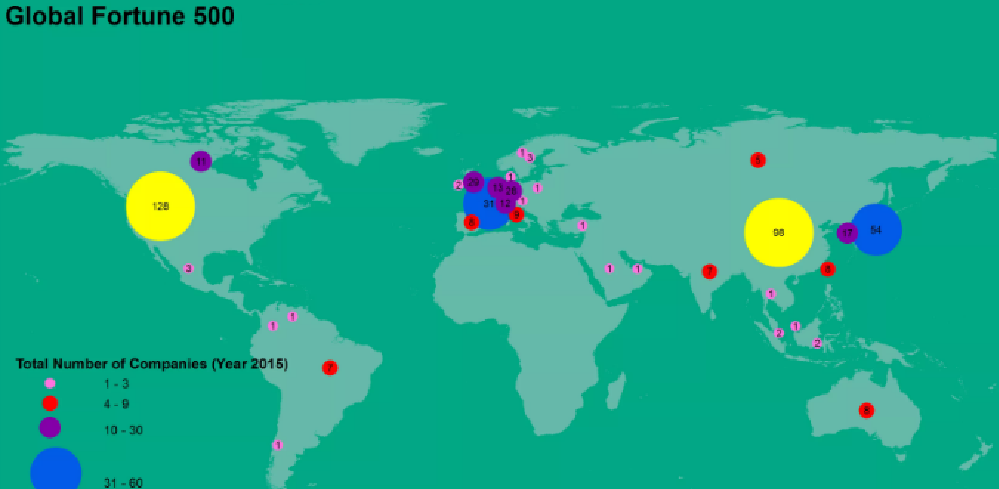
Global Fortune 500 companies are still reluctant to open shop in the Middle East and Africa based on data which shows that only 196 of some of the world’s biggest companies in the world have offices in the region.

Specifically, Africa’s most attractive destination for regional headquarters is Johannesburg with up to 29 companies have Africa offices there. It may seem unsurprising that the commercial capital of Africa’s most advanced economy—and home to its biggest stock market—is most attractive to global companies. What’s less obvious is that the next two most popular destinations for running African operations are London and Paris. Fourteen major international companies base their Africa offices in Europe.

It’s easy to claim to be surprised but there are many practical reasons many of these companies find it easier to oversee their Africa-wide operations from an office outside the continent.

The report’s authors at Infomineo point to several factors which make some global cities more popular than others. These include local market potential, competitive environment, political stability, laws and regulations, and business language in use. Then there’s quality of the employment market and local resources and infrastructure.

Most major African countries would struggle to get top marks if they were being assessed on all those factors. In fact, London, thanks to the finance and energy industries, is expanding as a center for companies opening offices to run their Middle East and African operations. The report didn’t explicitly mention logistics, but as we’ve noted several times, it is sometimes easier to navigate Africa from a European hub city like London or Paris than many African cities which have much fewer flights and limited cross-border road networks due to poor infrastructure investment.

But that doesn’t mean all hope is lost as far as African countries attracting Fortune 500 companies. In sub-regional terms, Casablanca, Nairobi and Lagos are increasingly attractive to international companies, says the report.

Ultimately, established businesses are going to make the same cold fact-based decisions that investors also have to make when it comes to deciding where to invest in Africa.

It comes down to the basics. If infrastructure development is moving in the right direction; laws and regulations are observed and respected alongside political stability and a workforce that promises as much quality and potential as enthusiasm, then that’s a good start.

Yinka Adegoke, Quartz Africa editor .via Newsleletter

Verizon 2017 Data Breach Investigations Report shows why tech sector is better on cybersecurity

0

If you haven’t suffered a cybersecurity breach you’ve either been incredibly well prepared, or very, very lucky. Are you incredibly well prepared?

Whether it’s design plans, medical records or good, old-fashioned payment card details — someone, somewhere will see it as their meal ticket. Most cybercriminals are not fussy about who they steal from.

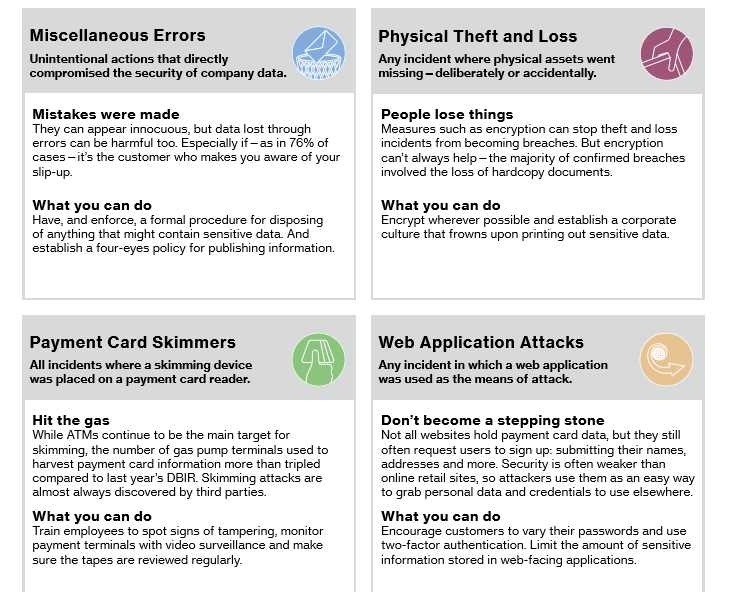
You could be the next victim of a data breach. And that could impact every part of your business. That’s why everyone in your company — not just the security experts — needs to understand the threats and how to mitigate them.

  • Cybercrime can come in any shape or size, and not always the form you’d expect
  • Each industry faces a distinctive pattern of threats

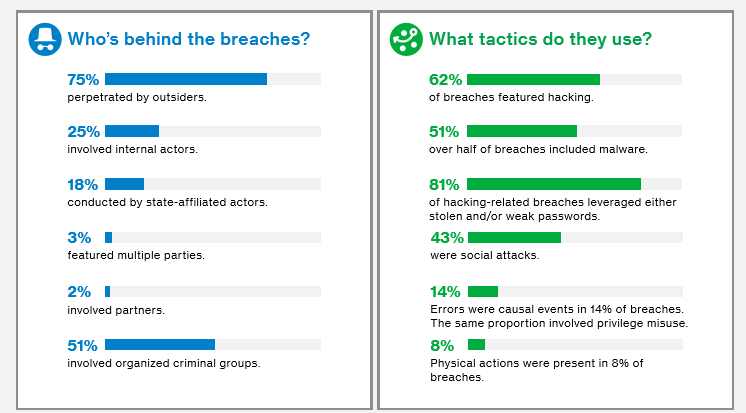
Verizon released its 10th edition of Data Breach Investigations  Report early Thursday morning. Teaming up with 65 contributing organizations, Verizon’s analysts scrutinized 42,068 security incidents, of which 1,935 qualified as full-blown data breaches. They sliced and diced the data every which way.

Here are some of the bits: First, each industry has its own flavor. The tech sector is the most reliable at patching its systems, sealing up 97.5% of known holes within 12 weeks of a vendor releasing software updates. (Compare that to retail and to food and hospitality, where little over 60% gets patched in the same time period.) The manufacturing, education, and public sectors are the most rife with cyberespionage, where spies seek to steal intellectual property, proprietary research, and state secrets. Healthcare is the only industry in which insider threats, meaning rogue employees, are the predominant threat actor. And financial services and insurance companies most commonly contend with distributed denial of service attacks, which overload computer servers with Internet traffic.

Another notable finding: ransomware continues to explode. The frequency of attacks featuring this malicious software, which holds victims’ computer files for ransom, increased 50% in 2016 compared to the year prior. This year ransomware clocked in as one of the top five most common varieties of malware, rocketing from 22nd place in 2014. It’s worth noting that Verizon’s analysts counted ransomware attacks as “incidents” rather than “data breaches” in the report, “because typically we cannot confirm that data confidentiality was violated.” In other words, it’s hard to know whether the attackers actually laid eyes on the data they locked up.

For some Saturday reading, I recommend the full report. No document provides a more rigorous overview of the security challenges businesses face today. In an industry where marketing puff often crowds out reliable information, the Verizon report is a welcome read.

Forget Samsung and Android makers, this chipmaker is Apple iPhone key competitor

0

If you ask knowledgeable people about competition for Apple’s iPhone, most will say it’s Android mobile phones, especially Samsung. This response is acceptable but fails to identify the more prominent aggressor.

Yes, Android mobile phones are, worldwide, the largest sellers, but from a profit standpoint, the Apple iPhones pick up the major share. There is one other player that doesn’t directly compete with Apple but holds the edge for Android capability: Qualcomm.

Qualcomm Snapdragon 835 vs. Apple A10

We’re about to see the major rivalry of the Samsung Galaxy S8 and the to-be-announced Apple iPhone 8. But under the hood of the S8 is the Qualcomm Snapdragon 835 processor versus the Apple-designed A9 or possibly a speculated-about newer model A10. The performance of these new mobile phones will be directly attributable to which processor platform best satisfies mobile users.

There’s plenty that we don’t know yet about which performs better. We do know that the Snapdragon 835 can support Gigabit LTE through its 4×20-MHz carrier aggregation and 256 QAM, as Qualcomm reports:

“We are proud to continue our long and productive collaboration with Samsung to help bring the most advanced mobile experiences, such as Gigabit LTE and mobile VR, to consumers with the new Samsung Galaxy S8,” said Alex Katouzian, senior vice president and general manager, mobile, Qualcomm Technologies, Inc. “Featuring a thin and light design with superior battery life, immersive multimedia, and exceptional photography with Gigabit LTE speeds, the Samsung Galaxy S8 powered by the Snapdragon 835 Mobile Platform delivers the experiences [that] today’s mobile users demand.”

Behind the Scenes

There are more maneuvers behind the scenes on a corporate level that also drive the rivalry. For example, Apple has filed lawsuits against Qualcomm in three different countries: China, USA, and now the UK. Essentially, Apple asserts that Qualcomm has charged unfair heightened royalties for the use of its Intellectual Property, including patents, on the selling price of the whole mobile phone. This is an unusual circumstance of a user suing a supplier while still being supplied the goods. In the U.S., Apple is seeking $1B plus other amounts in the other suits.

Furthermore, Apple has been a behind-the-scenes driver in the U.S. of the FTC complaint lodged against Qualcomm for using unfair trade practices against other semiconductor suppliers in monopolizing the mobile phone device market. This will likely face court review in May.

Meanwhile, these suits by Apple and the FTC have taken a toll on Qualcomm’s stock price. It has languished about 15% below the price at the time of the lawsuits in January 2017.

From afar, it would appear that Apple has identified Qualcomm as their most pressing competitor, with Qualcomm’s processor and internet connectivity allowing mobile phone manufacturers around the world to challenge Apple with high performance, off-the-shelf device selection, and lower prices. That’s demonstrated by the 115 Chinese manufacturers that Qualcomm supplies.

Profitability

Both Apple and Qualcomm are formidable profit machines. Thus, both companies have plenty of economic weapons at their disposal. We’ll watch this rivalry play out over the next several months. Expect the FTC to overturn the ruling against Qualcomm now that the Trump administration is in charge, but the existing lawsuits will play a continuing role.

In the end, the outcome of how these new mobile phones perform in the market is in the hands of consumers. Place your bets now!

by Fred Molinari, Former CEO, Data Translation