DD
MM
YYYY

PAGES

DD
MM
YYYY

spot_img

PAGES

Home Blog Page 7446

Complete Winners in African Startup of the Year Event in Morocco by Bonjour Idee

0

Bonjour Idée, the collaborative magazine of start-ups and the OCP Group held the first African edition of the African start-up contest of the year “Startup of the year / Africa 2017”  on Jan 26, 2017. On the multitude of start-ups that have applied for this award, the jury has decided to take over ThinVoid from Uganda.

The task was not easy for the jury of the first edition of the “Startup of the year / Africa 2017” which had chosen a start-up on the multitude of registered applications. But ThinVoid (Uganda), co-founded by Joseph Kaizzi, attracted the attention of the majority of the jury members who awarded it the start-up prize of the year.

ThinVoid provides a service that promotes the financial inclusion of unbanked professionals in the transportation and agriculture sectors. An innovative solution in a country where the rate of banking is still low and where the products offered by the traditional financial systems are unsustainable for the poorest populations.

At the same time, the Agritech OCP Special Prize was won by the start-up Zenvus. The Nigerian startup was founded by Dr. Ndubuisi Ekekwe and presented as an intelligent solution for farms that uses electronic sensors to collect soil data on moisture, nutrients and temperature. This helps to tell farmers on what, when and how to farm.

The winner of the jury prize was awarded to the Guinean start-up, Fapel Guinee. A company specializing in the manufacture and marketing of reciprocating, domestic and irrigation reciprocating pumps.

There is no lack of ideas on a developing continent

Thus, African youth continues to prove themselves. Solutions are proposed to solve the problems facing the people of the continent.

Thus, this edition has seen the Audience Prize awarded to Mahazava (Madagascar). Founded by Christian Randriam, Mahazava is a start-up that finances, distributes and ensures the follow-up of solar kits in Madagascar.

The start-up Trustin Africa (France), founded by Thibaud Leclerc and Etienne Morne whose objective is to accompany companies on the African continent or in the pursuit of their establishment, mainly in West and Central Africa, connecting them with the young local talents, won the Special price destination Africa SNCF.

Similarly, EthicPhone, founded by Mouhamed Diakité and proposing a solution that makes it possible to call, to transfer money to Africa, to make purchases from a mobile phone and to invest in African SMEs, won the African Diaspora Special Prize from Microsoft.

Notes On Strategy; What Can We Learn From Religious Leaders About Building Early-Stage Startup Culture?

0

Alternative Working Title: Notes On Strategy; Engineering Your Early Stage Startup’s Culture For Longevity

The topic of culture has been in the news quite a bit since the New York Times published an investigative piece describing what it is like to work for Amazon. While culture is something I think about all the time, that article got me thinking about religion and culture . . . and how that relates to the early stage startups in which we invest.

In this post I plan to:

  1. Examine what we mean when we say “culture” and tie that to the work that startup founding teams do during business model search and discovery.
  2. Examine the structural characteristics of religious communities; How do they maintain a sense of purpose, direction, and elicit devotion and commitment from members of the community?
  3. Provide some pointers about how first-time startup founders might get things off on the right footing as far as culture is concerned by making certain deliberate choices early in the lifecycle of their startup.

I am thinking specifically of startups raising their first institutional round from seed stage venture capitalists, or perhaps a Series A round of financing. These teams are usually small, often fewer than 10 people.

To get things started; What is Culture?

Culture is the learned and shared behavior of a community of people which distinguishes that community from other communities.1

Some of the things that distinguish a culture:2

  1. It embodies a way of life, an approach to thinking, feeling, and believing about the world.
  2. It endows the members of the cultural community with a social legacy from prior members of the same community.
  3. It provides a framework that enables members of the community to think abstractly about how they should behave;
    1. It provides lessons about how members of the community should react towards recurring problems by pooling the collective wisdom of past and present members of the community.
    2. It provides a guide for community members when they need to interact with the external environment.
  4. It is the process by which the history of the community is created and brought into permanent existence.

In this analysis I am most interested in religion as a cultural system.

According to Clifford Geertz religion is:3

  1. A system of symbols which acts to
  2. Establish powerful, pervasive, and long-lasting moods and motivations in people by
  3. Formulating conceptions of a general order of existence and
  4. Clothing these moods and motivations with such an aura of factuality that
  5. The moods and motivations seem uniquely realistic.

It is not difficult to see that a religion is in fact a specific type of culture and further, that every cultures is a kind of religion. In the rest of this post I will use the term “religion” and “culture” interchangeably. I also assume that a symbol may be tangible or intangible.

The structural characteristics of a religion are:4

  1. A religion inhabits a unique world: Religions create, structure and propose a universe that is unique to adherents of that religion such that members of the community can explain, make sense of, and differentiate what is within their world from what is outside their world. This helps establish lines of commonality as well as lines of difference, and helps confront change and challenges.
  2. A religion is grounded on certain myths: Every religion possesses sacred myths that tell a story about something that happened during the genesis of the religion and that continues to have great influence on contemporary realities experienced by adherents of the religion. Myths:
    1. Help devotees of a religion make sense of the past, the present, and the future.
    2. Are a powerful means of engendering a certain mood and attitude within the devotees of a religion.
    3. Focus our attention on that which is sacred and important within a religion.
  3. A religion possesses rituals: Rituals help to focus the devotees of a religion on specific concepts or ideas at a specific point in time, also rituals enable the adherents of a religion to express their beliefs about the world in the form of a tangible display that appeals to the senses through action.
  4. A religion possesses gods: In the context of religious worlds, gods represent instances of language and behavior that is held up by the religious community as exemplary, worthy of emulation, and possessing interpretive power in terms of how that community understands the world.
  5. A religion possesses systems of purity: These systems of purity help to differentiate what is acceptable from what is unacceptable, right behavior from wrong behavior. This is a system that enables members of the community deal with negativity within the community.

What role do symbols play within a culture?

  1. Anat Rafaeli and Monica Worline: Symbols in Organizational Culture – A symbol is a visible and physical manifestation of an organization. It is an indication of organizational life that derives its meaning from the social and cultural conventions and interactions among the people who belong to the cultural organization. Symbols can be experienced through the senses. Symbols play the following functions:
    1. They reflect organizational culture: Symbols communicate information about what we think we know about an organization. They act as a bridge between our emotional and cognitive responses towards an organization.
    2. They trigger internalized values and norms: Symbols serve as a cue to trigger certain expected, desired, and acceptable behaviors once a person enters the physical environment of an organization or whenever the person is acting explicitly as a representative of the organization to the outside world.
    3. They frame conversations about experience: Symbols act as a frame of reference for guiding the communication that takes place between members of the same organization, or between members of a specific organization with people who do not belong to that organization.
    4. They integrate organizational systems of meaning: Symbols integrate the culture, norms and values, and shared experiences of members of an organization into a coherent whole within which members of the organization experience the world.
  2. Sherry Ortner: On Key Symbols – A key symbol is an element of a culture that is crucial and distinctly unique to the organization of that culture. They perform the function of carrying and conveying cultural meaning to people within the culture as well as to people outside the cultural community. Key symbols might be identified when:
    1. Members of the cultural group discuss the symbol’s cultural significance,
    2. Members of the cultural group are positively or negatively aroused by the symbol, and none are indifferent towards it,
    3. The symbol appears in many different settings and contexts,
    4. There is much elaboration around the symbol, and
    5. The group imposes numerous restrictions around the symbol. For example, misuse of the symbol can incur severe sanctions.

There are two distinct categories of key symbols. Summarizing symbols express meaning in an emotionally powerful way that is of uniform significance for all members of a given culture. They are generally accorded sacred status. Elaborating symbols make it possible for members of the religion or community to communicate ideas and feelings with one another, and to translate such feelings and ideas into tangible action. Elaborating symbols are generally analytic in nature and rarely attain sacred status.

What does this mean in the context of building an early-stage startup?

  1. Communicate a clear world view internally and externally. One question I ask myself when I meet with a founder is this; Why is this specific person uniquely suited to solve this problem in this market and why do I believe this team will succeed in its effort to accomplish this incredibly difficult task?
  2. Preserve and embellish important stories, particularly those that reflect qualities and themes that the founder wants to become aspects of the startup’s long-term culture and identity. I listen for founders who express enthusiasm for the work that the other people on the team are doing. Team cohesiveness matters.
  3. Create and maintain rituals:  For example, does every team member understand what would get existing customers/users to become more engaged with the product, and reduce churn? Does every team member know what needs to happen for the startup to increase its growth enough to get to the next funding milestone? Does the founder have a firm grasp on the startups key performance indicators? Has the team chosen the right indicators to focus on at this stage?
  4. Focus on finding product/market fit: A startup that fails to find product/market fit is doomed. Are the founders experimenting enough to find an ideal early market for the product, or are they stuck in a cycle of dogma regarding an initial point of market entry? What indications are there to help me ascertain the quality of their decision-making processes?
  5. Create systems of accountability: At the very early stage of a startup’s life the individuals on the team have an enormous impact on the organizational culture that eventually evolves. What steps are the founders taking to ensure that the early team has the right mix of people?
  6. Create a sales and marketing plan: What steps is the startup taking to create strong bonds with its earliest customers/users? Is anything being done to create a brand? Are the choices that have been made so far cost-effective and appropriate for the startup’s stage of maturity and its funding status?

Closing Thoughts The job of an early-stage technology startup founder is basically akin to that of a religious evangelist. The founder must recruit believers. Early team members join the cause because they believe in the founder and in the vision that the founder wishes to bring into reality. Early customers become believers because they have a problem they believe the startup’s envisioned product can solve. Early investors join the cause because they believe in the founder and believe that the startup can create the future reality that it describes during investment pitches. Basically, at the outset . . . Building a startup is exactly the same as creating a new religion.


  1. J. Useem and R. Useem. (1963). Human Organizations, 22(3). Page 169. See: The Center for Advanced Research on Language Acquisition (CARLA) “What is Culture?” http://www.carla.umn.edu/culture/definitions.html. Accessed Aug 29, 2015. ?
  2. Adapted from: Richard-Hooker.com; Clifford Geertz, Emphasizing Interpretation ?
  3. Clifford Geertz, Religion As A Cultural System. In: The Interpretation of Cultures: Selected Essays. Pp. 87 – 125. Fontana Press, 1993. ?
  4. William E. Paden, Religious Worlds: The Comparative Study of Religion. 2nd edition. Pp. 51 – 161. Beacon Press, 1994. ?

Africa is doing better than most developed countries in B2B digital payments adoptions

0

At the moment, electronic payments are becoming more and more the norm for consumers. However, B2B payments have yet to transition from systems built in the 1970’s onto today’s modern tech stack.

About half of all B2B payments in the US are still executed via check, equating to a staggering 8bn paper checks and a payment cycle time of more than 20 days. The cost to issue those paper checks, combined with the invoice processing associated with them, adds up to nearly $100b in annual spend by US businesses.

There are, however, hurdles to overcome in removing B2B friction.  Suppliers, ever concerned about margins, are often unwilling to accept credit card fees.  Moreover, ACH is capped at $25k and requires providing sensitive banking information and manually setting up each payment.

With electronic invoicing, modern payment and remittance infrastructure, businesses could significantly reduce the cost of transacting and improve their working capital.  Ultimately, payments should be completely frictionless and Kermit’s royalty checks should roll in via a self-executing smart contract on a blockchain!

Nevertheless, Fed finds continued growth in noncash payments and a fall in check payments between 2012 and 2015.The study (link here), which is conducted every 3yrs, is considered to be among the most comprehensive reports that track payments usage in the U.S.

Recent research indicates that usage of paper checks for B2B payments may have increased slightly in 2016.   A key impediment is the highly fragmented electronic payments process across AR, AP, accounting, and reconciliation.

In Africa, B2B payments are increasingly moving digital as companies are indeed paying clients through wire transfers, mobile money, and other means; not necessarily through credit cards. Governments are increasingly encouraging companies and citizens to go digital to help tax collection and anti-money laundering enforcement.

The impact is that more transactions are taking place in the digital ecosystem from Kenya to Nigeria, Ghana to Botswana and beyond.


Nanotechnology and Microelectronics: Global Diffusion, Economics and Policy [Book]

0

Within the last two centuries, technology has emerged as a key driver of global economic growth. It has redesigned international competition in all major industrial sectors by enabling speed, efficiency and capacity in business processes and operations. It has become the most important enabler of national wealth creation and productivity. As the world moves towards knowledge-based economic structures and data-driven societies, made up of networks of citizens, organizations and countries, mutually and interdependently linked globally, the impacts of technology will remain central in commerce, industry and culture. Both in the short and long terms, this global technological progress—improvements in the techniques by which goods and services are produced, marketed, and brought to market—will remain at the heart of human progress and development.  And the pace of technological innovation will continue to accelerate, disrupting markets and industries, along the way.

Increasingly, the world is experiencing major new dimensions in knowledge acquisition, creation, and dissemination. The trend has become a virtuous circle where new ideas facilitate new processes and tools which in turn drive new concepts. This progress has advanced to the point where researchers are able to work at the levels of atoms and molecule, evolving a new field, called nanotechnology. Nanotechnology is the science of minuscule molecule or a wide range of technologies that measure, manipulate, or incorporate materials or features with at least one dimension between approximately 1 and 100 nanometers (a nanometer is one billionth of a meter; the width of an average human hair is about 100,000 nm). At this scale, the laws of quantum physics supersede those of traditional and classical Newtonian physics, and materials change yielding to unique characteristics in chemical reactions, electrical, and magnetic properties. Nanotechnology offers the closest means to manipulate matter and life whose building blocks are at nanoscale.

Nanotechnology is a transformative technology and has the ability to bring about changes that can rival the Industrial Revolution of the late 18th and early 19th centuries where mechanization of industry, changes in transportation and introduction of steam engine had a profound effect on the socioeconomic and cultural conditions in the world. Heralded to underpin a new global turning point in human society, nanotechnology “has the potential to fundamentally alter the way people live”.  But it is not completely (scientifically) proven, still growing with only few nanostructures at commercial productions. In most cases, precision is lacking and controls are difficult with many of the concepts not economically viable with the present body of knowledge. It poses environmental and health challenges, though it can also be used in combating pollution and other environmental hazards by enabling advanced water purification and clean energy technologies. Its impact will be profound in medicine where it is leading many innovations; for instance, in situ nano engineered robots (as small as pills) offer the prospects for better medical diagnosis. The technology is broad with convoluted ethical and safety issues.

Nanotechnology is estimated to grow in excess of $1 trillion global market by 2015 with energy, textiles, and life sciences the leading sectors transitioning from labs to markets. This technology will drive a new global economy, nanomics or nanotechnology-driven economy and usher in a revolution that will advance genetics, information technology, biotechnology and robotics through low cost, high utility and high demand of its products.

While nanotechnology is an evolving technology, microelectronics has relatively matured.  Microelectronics is a group of technologies that integrate multiple devices into a small physical area. The dimension is about 1000 larger than nanotechnology dimension; micrometer vs. nanometer. Usually, microelectronics devices are made from semiconductors such as silicon and germanium using lithography, a process that involves the transfer of design patterns unto a wafer. Products are called ICs, chips, microchips or integrated circuits. They are found in computers, mobile phones, medical devices, toys and automobiles. Contemporary, the world lives in the era of microelectronics as everything is enabled by microchips. Its impacts, arguably, are unrivalled in the human history. As engineers make the transistor sizes smaller to improve performance and reduce cost, microelectronics begins to converge with nanotechnology. This advancement comes at a huge price as power dissipation and noise in chips increase- potential limiting factors that could stall further progress in the industry unless novel architectures, materials and processes are developed. Possibly, nanotechnology could address many of these challenges as microelectronics transmutes into nanotechnology. Indeed, the ETC Group notes that “with applications spanning all industry sectors, technological convergence at the nanoscale is poised to become the strategic platform for global control of manufacturing, food, agriculture and health in the immediate years ahead.”

Together, nanotechnology and microelectronics are the engines of modern commerce, and are directly or indirectly enabling many revolutionary global changes. Whenever there is advancement in their performances, a dawn emerges in global economy bringing improvements in all areas of human endeavors.  Yet, despite these pervasive impacts of these innovations on daily lives and businesses, the technologies have not diffused globally. Patents, academic journals and other metrics for ascertaining technology creation and innovation indicate that advanced nations dominate the creative sectors of these technologies and the global diffusion trajectory will flow from them to other parts of the world. This implies that the prospects of transferring these technologies around the world will involve an adoption and diffusion strategy from developing nations which lack inventive capability to create technology. Records show that in many previous efforts, these nations have failed to absorb new technologies effectively. However, owing to the expected impacts of nanotechnology, the abilities of developing nations to adopt and drive penetration in their economies will affect their economic viabilities in the long-run.

This book is written to assess the state of nanotechnology and microelectronics, and emerging technology in general. While some aspects focus on nanotechnology and microelectronics, others discuss technology transfer and diffusion within the generic technology context with no specific distinction. It examines many issues, climate change, trade, innovation, diffusion, etc, with a theme focused on facilitating the structures for the adoption and penetration of the technologies into developing nations. The problems which continue to undermine technology progress in developing nations along with suggestions that can accelerate progress are examined. The strategic importance of moving from dependence on minerals, commodities and hydrocarbons to nations that thrive on knowledge anchored on technology is emphasized. It is almost certain that nanotechnology will exacerbate the economic divide between the advanced and poor nations unless the latter develop new pragmatic technology policies. This book shares some insights from various experts on what these policies could be for a reliable, sustainable and profitable nanotechnology era.

The technologies are capital intensive and the returns are not immediate. In short, there exists a level of uncertainty in nanotechnology as many of the discoveries cannot be economically commercialized, at least with present technology. This calls for tripod partnerships among governments, firms and academic communities in structuring policies and mapping the technology roadmaps.  Around the world, even in developed nations, governments have played and continue to play major roles in accelerating innovations in nanotechnology and microelectronics. The developing nations must not be on the illusion that markets forces alone can drive development in these areas.  They lag well behind in both the technology creation and dissemination and spirited efforts must be made to facilitate adoption and improvements in the business environments.

Consequently, government interventions on infrastructure, education and business climate for these ultra knowledge-driven technologies must be paramount in national developmental plans. Critics argue that developing nations should focus on spending their limited resources on mundane activities like food production and water supply instead of investments in these emerging technologies.  The problem with that argument is that food production, water supply and others are driven directly or indirectly by these technologies. Microchips continue to improve crop yields by enabling better sensors while water purification has a future anchored on nanotechnology. In this century, it makes no sense to separate activities from technology because technology leads the world and only those that invest and develop it will prosper. Investments in technology will bring progress and presence of technology clusters will continue to influence global technology diffusion trajectory. It is a continuum, where the presence of one technology enables another. Nanotechnology investment today could lead to breakthroughs in energy and food security tomorrow.

Nonetheless, nanotechnology must not be viewed as a fix to all the technology problems in the developing world; in other words, it must not be adopted without examining alternatives or immediate needs which may be more appropriate to the particular nation.  Cautious and systematic approach is needed as these nations develop plans for the adoption of any aspect of nanotechnology or microelectronics. Without this strategy, the technologies may not be sustainable as previous technology adoption efforts have shown.  For many developing countries, provision of power supply to their industries will be the beginning of wisdom as inadequate electricity remains a major reason for de-industrialization, especially in sub-Sahara Africa. By focusing on the basics and improving industrialization climate, conditions for high-tech economy will be nurtured.

This book explains how technology and technological progress are central to economic and social well-being, and why the creation and diffusion of goods and services are critical drivers of economic growth, rising incomes, social progress, and medical progress. It notes that political climate, corruption, stifling business environment, poor infrastructures, lack of innovation culture, poor economy regime, along with low technology literacy are major challenges which must be overcome. While the world discussed digital-divide in the information technology era, the future will potentially will be nano-divide. The reasoning is that nano will continue to enable economic concentration in developed nations (holders of core patents with economic rights) and developing ones will find it increasingly difficult to transition from their present states. It is up to developing nations to observe that global powers and respects are not won by gun powers anymore, rather by economic prosperity driven by technology creation.

Besides, with lack of innovation in developing nations, the disruption of global economic systems by nanotechnology can harm the developing nations since they lack the resilience and fluidity to react to market and industrial changes. The prospect of nano-weapons could be a concern in the hands of these unstable developing countries as they can self-destruct or destroy neighbors. Terrorism could escalate to a level not imagined, not just in the developed world, but globally as nanotechnology will make it easy to terrorize with devastating global impacts. The world could be visited with arms race and nuclear anti-proliferation could be relegated to the background with anti-nano (weapon)-proliferation upfront. If nanotechnology products could affect trade patterns with replacements of raw materials, the developing world would be the most affected as poverty could increase. Displacing their exports will increase global unemployment and that can pose global insecurity. The world within the last few centuries have depended on the raw materials of developing nations to sustain civilization, if nanotechnology can replace the needs of those materials, monumental upheavals could result in these countries with (soon) worthless cotton, copper, and  rubber. Simply, the prospects of nanomaterials pose a huge security implication in the developing world.

Across the globe, many nations have developed initiatives towards transitioning discoveries to markets. Just like in the Industrial Revolution, which took half a century to come to fruition, nanotechnology is expected to advance overcoming many of the technical challenges that presently stall commercialization of many of the discoveries. As its standardization and safety improve along with ethical regulations, the global ‘innovation economy’ with be revamped. The new economy will witness new breakthroughs in computing where performance can be increased exponentially even at decreasing cost.  Early detection of tumors, efficient and cheap solar cells delivering vast amounts of energy, effective HIV/AIDS prevention control, and hosts of other applications will be made possible. These impacts will be ubiquitous and most likely will be gradual and evolutionary, rather than very sudden. A look into the future of nanotechnology and microelectronics shows that any nation that fails to develop programs aimed at tapping their enormous benefits will compete internationally at disadvantaged positions. It will be catastrophic to misunderstand that Technology leads the world and mastering the process of creating, enabling and commercializing technology is one of the most important duties of any modern parliament or congress.

One major goal of this book is to highlight multifaceted issues surrounding nanotechnology and microelectronics and technology in general on the basis of economics, innovation, policy, transfer, and global penetration through comprehensive research, case studies, academic and theoretical papers. More than forty five experts spread in about twenty countries with its respective understanding, perspectives and resources provide a very broad audience to accomplish that. This book will be a useful reference for academics, students, policy-makers and professionals in the field of technology economics.

This book is organized into six matrixed sections. Section I is focused on the foundations and the science of nanotechnology and microelectronics. The first chapter discusses the science, trends and global diffusion of nanotechnology and microelectronics, highlighting some of the historical advancements in the technologies. The manufacturing process, molecular manufacturing, which is structured for building nanosystems, is explained in Chapter 2.

Section II focuses on technology transfer, diffusion and innovation in the contexts of both nations and organizations. Chapter 3 explains the latest trends in nanotechnology knowledge creation and dissemination, and Chapter 4 shares insights on collaborations in the age of open innovation. Chapter 5 discusses Kondratieff cycle of nano revolution with Chapter 6 explaining how economic agility of nations could affect capacity building for technology resilience and diffusion. Then Chapter 7 points out that fatigue could occur in diffusion of innovations especially in adopter nations.

Section III examines the industry, policy and experiences from nations and institutions. Chapter 8 highlights the case of a university in Sydney on firm innovation and university-industry networks. Chapter 9 discusses licensing and R&D, and Chapter 10 outlines nanotechnology industry entry barriers in Turkey. In Chapter 11, micro and nanotechnology maturity and performance assessment are discussed.

Section IV considers the ethics, regulation, environment, and climate control challenges. It begins with Chapter 13 which examines the diffusion of the clean development mechanism. Then Chapter 14 looks at the intellectual property rights challenges under information and communication technologies, nanotechnologies and microelectronics. Chapter 15 discusses how the global south could benefit from climate finance, technology transfer and effective climate policies. It is followed by Chapter 16 that highlights emission distributions in post-Kyoto international negotiations, and Chapter 17 that outlines the ethical concerns in nanotechnology.

Section V examines some lessons within agriculture and agricultural technology which could be helpful for many developing nations adopting technology. Agriculture being their mainstay, it is natural they can relate to this industry. Chapter 18 discusses how the industry has moved from biotechnology to gene revolution and asks if nano revolution is the next for agriculture. Chapter 19 sees the patterns within the industry and connects them with adoption and development.  In Chapter 20, the author gives lessons on technology development and transfer drawing from agriculture, and finally Chapter 21 discusses technology transfer and diffusion in developing economies from the perspectives of agricultural technology.

In the final part, Section VI, regional developments are highlighted. Its first chapter, Chapter 22 shares very comprehensive insights about nanoscience and nanotechnology on Latin America, covering Chile, Argentina, Mexico, and Brazil. Subsequent chapters are devoted to Africa. They are technological innovation and the continent’s development in the 21st century (Chapter 23), and emerging technology transfer and policy (Chapter 24) which has four sub-chapters: thoughts on nanotechnology transfer, sustainability and management challenges, factors affecting nanotechnology and microelectronics transfer, and recent polices on science and technology. Others are trade policies and technology development (Chapter 25) and finally in Chapter 26, a technology penetration national case study.

In conclusion, it is important to note that penetration of nanotechnology and microelectronics into developing nations will not just benefit them alone; it will help to accelerate market growth for advanced nations that drive the industries. Technologies will remain major catalysts for wealth creation to nations that create and commercialize them. For developing nations that merely consume, lacking invective capability and depending on minerals, commodities and hydrocarbons, it is very imperative they change strategies because if nanotechnology era goes as heralded, economically, these nations could be imperiled. Just as R. Wright noted, “Society becomes increasingly non-zero-sum as it becomes more complex, specialized, and interdependent,” the whole concept of globalization is not win-win by default because knowledge and technology disparities exist. It is still early for any nation to get into the nanotechnology business by building its capacity- one that will be used to access national competitiveness in the near future.

To buy this book, click here.
Notes on Strategy; Michael Porter’s Generic Competitive Strategies for Early Stage Tech Startups

1

My post Notes on Strategy; For Early Stage Technology Startups led to follow up questions from a handful of readers who asked for additional posts with more explanations and examples. 1

In this post I will discuss Michael Porter’s 3 Generic Competitive Strategies. My goal in these posts is to provide concrete yet easy to use frameworks that founders of early stage startups can quickly learn and adapt as they work on moving their organizations through the discovery process that takes them from being a startup to becoming a company.1

To ensure we are on the same page, and thinking about the issues from the same starting point . . . first, some definitions. You can skip past the definitions if you have already seen them in one of my previous posts.

Definition #1: What is a Startup? A startup is a temporary organization built to search for the solution to a problem, and in the process to find a repeatable, scalable and profitable business model that is designed for incredibly fast growth. The defining characteristic of a startup is that of experimentation – in order to have a chance of survival every startup has to be good at performing the experiments that are necessary for the discovery of a successful business model.2 As an investor, I hope that each early stage startup in which I have made an investment matures into a company.

Strategy is about making choices, trade-offs; it’s about deliberately choosing to be different.

– Michael Porter3

Definition #2: What is Strategy? An early stage startup’s strategy is that deliberate set of integrated choices it makes in order to create a sustainable competitive advantage within its market relative to rival startups and market incumbents. It is the means by which a startup combines all the elements within its environment to create and deliver value for its customers, while simultaneously capturing some of that value for itself and its investors. Strategy answers questions about what the startup should do and what it should not do in order to find a repeatable, scalable and profitable business model.

In Competitive Strategy, Michael Porter describes The 5 Competitive Forces That Shape Strategy. Later on in the book he discusses 3 Generic Strategies that a business can apply in order to maintain its position relative to its competitors, and also to cope with the 5 forces affecting competition.

Before delving into the details of the generic strategies, one observation; Often, discussions about strategy get stuck in dogma – is it about creating a competitive position that a startup can defend, or is it about gaining market share? I do not think strategy can be an either/or proposition in that sense. It must be both. Good strategy protects a startup’s current market position, while attempting to reshape the competitive landscape such that it tilts overwhelmingly to that startup’s advantage.

Also, by definition a startup is still searching for a strategy . . . so many of the examples I will use are of companies, not startups. However, the idea is that this helps a founder go through the search and discovery phase of building a startup with these frameworks in mind.

The following generic strategies help a startup create a defensible position in its market, but they should also be thought of as a means for launching offensive moves to gain market share as market conditions evolve.

Overall Cost Leadership: A startup that has decided to pursue this strategy has chosen to maintain the lowest cost structure amongst its rivals.  One could think of “broad-based” cost leadership as a choice to become the cost leader amongst all a startup’s rivals in a given market. Alternatively, “narrow-based” cost leadership is a choice to become the cost leader among a select few rivals within the market.

A startup might choose a cost leadership strategy in order to cope with the threats posed by powerful buyers who can push prices down, but no further down than the cost leader in that market can bear. Also, cost leadership provides wiggle room for dealing with the threats posed by powerful suppliers who can increase the costs of inputs that the startup needs in order to develop its own products. Becoming the cost leader in a given market lowers the threat posed by new entrants to the market under the established rules of competition because the decision to enter the market under those conditions would be difficult to execute at a cost that is acceptable.

Startups exploring cost leadership as a strategy should consider making large upfront capital expenditure investments with an eye towards achieving economies of scale within a relatively short window of time. As they gain market share and scale, startups pursuing a cost leadership strategy will need to continue making relatively large CapEx investments that are aimed at keeping their overall costs low.

Additionally, cost leadership entails paying more attention to continuous process innovation, higher than normal labor-monitoring practices and pay-structures that might be described by outside observers as “below market”, and intense scrutiny of and discipline towards keeping overhead costs within a narrow band relative to revenues.

Examples:

  1. Walmart
  2. Toyota
  3. Amazon
  4. CraigsList

Risks: For technology startups as cost leadership strategy can be risky because of the pace of technological change and innovation. The pace of change requires ongoing CapEx investments in process improvements at a cadence that is higher than the alternative. As an example, think of all the different reports about the investments Amazon is making in trying to figure out how to get goods from its warehouses and shipping centres to its customers. Furthermore, blind focus on cost leadership can make startups inattentive to shifts in customer preferences that make cost leadership a losing strategy as time progresses. Lastly, cost leadership creates a competitive landscape in which there’s a constant race to the bottom and brand loyalty plays no significant role. Products and services become a commodity.

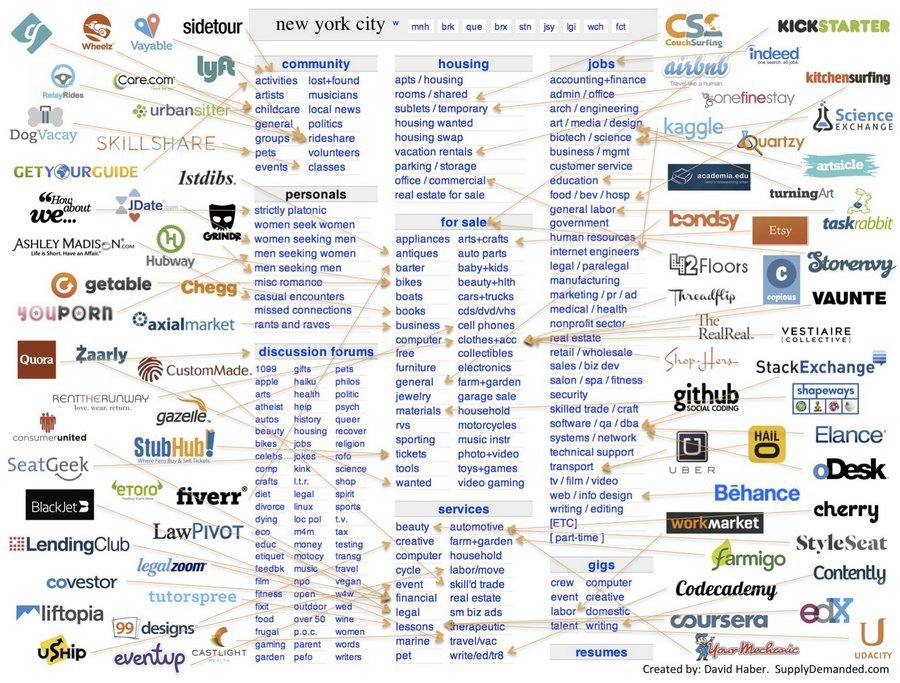
The image below, showing the startups that have been built by unbundling CraigsList shows another risk of the cost leadership strategy; namely that someone else can compete with some aspect of another startup’s business model by pursuing differentiation or focus as a strategic choice.4

Unbundling CraigsList

Differentiation: A startup that has decided to pursue differentiation as the basis for its broad strategy has chosen to try to develop something that will be perceived as being unique, novel and difficult to copy within its market. The key to success pursuing this strategy is that differentiation must make the startup’s product more valuable to the customers who pay for the startup’s product. Successful differentiation involves a combination of some or all of technological innovation, branding, product features, and design.

A startup might choose a differentiation strategy because it helps insulate it against competition. When implemented successfully, differentiation creates a barrier to entry that is very hard for new entrants to overcome. Successful execution of a differentiation strategy has a strong positive correlation with brand value, leading to customers of the startups products becoming less sensitive to price since by definition a highly differentiated product has no close substitutes.

The cumulative effects over time of a successful differentiation strategy become apparent in a number of ways. The threat posed by buyers reduces over time since they do not have a very good alternative to the differentiated product. Pursuing a differentiation strategy often means that the startup can maintain and enjoy profit margins that are considerably higher than average for that market. Consequently, startups that pursue a differentiation strategy maintain room for maneuvers that would have been unavailable had they pursued a cost leadership strategy instead.

The organizational traits that make pursuing a differentiation strategy possible are; strong marketing and brand-building skills, continuous product innovation, relatively large R&D expense, and an organizational culture that emphasizes customer support.

Examples: Apple.

Risks: The primary risk of differentiation as a strategy is the risk of ceding market share in the terms most people customarily think about it to a competitor pursuing a cost leadership strategy. Perceived differentiation can erode with time as competitors imitate product features and certain innovations are adopted as industry standards. Also, customers might become more sensitive to price and start making trade-offs that put the startup pursuing a differentiation strategy at a disadvantage.

Focus: Most early stage startups should start life pursuing a focused or niche strategy. A startup pursuing this strategy makes a deliberate choice to pin-point its resources on a narrow customer group, a particular product segment, or a limited geographic market. Focusing its effort on that particular target customer, product, or geographic market enables the startup to become very good at serving that niche especially well while gleaning the lessons it needs to learn in order to avoid more costly mistakes if it later on decides to pursue market-wide cost leadership or differentiation. In other words, focus as a strategy for an early stage startup entails pursuing either cost leadership or differentiation in a very narrow market segment in order to create and defend its initial beachhead. Only once that is secured does the startup seek to expand its reach.

Examples: Every early stage technology startup that grows successfully after the search for a repeatable, scalable, profitable business model is complete.

Advantages: I got stuck at this point in the post, unclear how to tackle the rest of it. Fortunately, 5 or so meetings I have had over the past two days with NYC-based startup founders at different stages of progress through the search process helped to point me in the right direction. Each of them is struggling with this fundamental question:

What I am building is so attractive to so many potential customers in so many different industries and markets. What should I do? I do not want to say no to any potential customers.

I get it. I understand the dilemma. Capital is scarce, your burn won’t go away if you wish to keep working on your startup. All these potential customers come along with promises of potential revenues to ease the stress posed by your lack of capital . . . The temptation to “take as much revenue as you can get, from whomever is offering it” is nearly impossible to resist. I get it. I would have the same struggle too if I were in your shoes.

Yet, we have to pause and think about this for a few minutes lest we do something rash.

Paul Graham is often quoted as having said that early stage startups should “do things that do not scale.” I could not agree with him more, in fact there are times when more mature companies could use a modified version of that advice.

What is often not well understood by some investors, and many founders  . . . especially first time founders is why that advice is so important.

Here’s Paul in his own words:

Almost all startups are fragile initially. And that’s one of the biggest things inexperienced founders and investors (and reporters and know-it-alls on forums) get wrong about them. They unconsciously judge larval startups by the standards of established ones. They’re like someone looking at a newborn baby and concluding “there’s no way this tiny creature could ever accomplish anything.”

That initial fragility is why focus is the only strategy that any early stage technology startup ought to pursue. Focus allows the founders and the startup to do a few things in those early days;

  1. Find, recruit, and gain an intimate understanding of the customers whose pain is most acute and for whom your solution is a highest priority item,
  2. Satisfy the needs expressed by these early users, and build product features and a user/customer experience that delights them beyond their wildest expectations,
  3. Use the lessons that you learn during this process of slow growth to figure out how to build the processes and procedures you will need to scale the excellence that should mark your execution at that scale to excellence as your startup exits the search and discovery phase, and lastly
  4. To do all this without stressing the organization to the point of failure.

If you have not done so yet, you should read Paul’s post. He delves into the subject in a way only he can.

Imagine of a team of 3 co-founders with 2 contract developers helping build a product, it could be an enterprise or consumer product . . . and let’s assume they raised $750K in outside capital. Now think of the stress that team would be taking upon itself if it were to try to serve 10 different enterprise customers in 8 different industries. Consider all the ways each of these industries might differ in terms of the business protocols that the startup would have to become subject to, now also consider the ways in which each of the 10 customers might differ from the others. With only a few exceptions, it would make more sense to win 10 customers in 1 or 2 industries . . . Gain experience, gather momentum in those markets, grow the team in step with the growth of the startup’s customer-base and revenues . . . . and only when business development in those initial markets has reached a tipping point, then the startup can begin exploring customer acquisition in other markets. An analogous thought process works for startups building apps for consumers, and reaches a similar conclusion.

Think of it as building a solid foundation before attempting to complete the structure which will rest on the foundation. What ever the size of the structure, it will not last if the foundation that is meant to hold it up is weak.

Most research about why early startups fails lists the top two reasons as some combination of “produced something for which there was no market” and “run out of cash” . . . The research is often not granular enough to enable us to say definitely what exact reason led to those conclusions, but . . . A failure by an early stage startup’s founders to adopt focus as the launch strategy makes those two outcomes inevitable. Why?

First, lack of focus means the startup spreads itself too thin and fails to find and devote its attention and resources to those customers or users with the highest propensity to use, and then pay for the product.

Second, a lack of focus can be exorbitantly expensive if the startup is selling a product that is far from fully-baked to multiple industries. Several rounds of customizations for a small number of customers in a given market without a sales process to increase the revenues from that market quickly results in expenses that can quickly get out of control. It is not difficult to think of how this plays out for startups building apps for consumers.

Closing Thoughts: Every early stage technology startup should start out pursuing a focus as its generic strategy. The time to make a choice between cost leadership and differentiation is once product-market fit has been established, which is the point at which the startups begins to transition from searching for a repeatable, scalable, and profitable business model to building out the organizational structures of a company. Also;

  1. The highly fluid and dynamic nature of the markets in which technology startups operate requires founders to be willing to experiment with combinations of the generic strategies once product-market fit has been established. They crucial requirement is to execute any such hybrid of the generic strategies in a way that strengthens the startups competitive position rather than weakening it.
  2. Strategy is not a “set it and forget it” proposition . . . One of the functions of a good board of directors is a semi-annual review of the startup’s strategy to determine if there’s reason to consider making an adjustment. I do not mean to suggest that the strategy should change every six months, but the board should examine the environment every six months or so in order to ensure that maintaining the current course is the right strategic choice.


  1. My target audience is made up of  first-time startup founders who do not have any background in business, finance, economics, or strategy. ?
  2. I am paraphrasing Steve Blank and Bob Dorf, and the definition they provide in their book The Startup Owner’s Manual: The Step-by-Step Guide for Building a Great Company. I have modified their definition with an element from a discussion in which Paul Graham, founder of Y Combinator discusses the startups that Y Combinator supports. ?
  3. Keith H. Hammond, Michael Porter’s Big Ideas. Accessed on Jun 20, 2015 at http://www.fastcompany.com/42485/michael-porters-big-ideas ?
  4. It is not clear to me if the unbundling of CraigsList arose from conscious choices made by others observing the markets it served, or if this is a phenomenon that has only become obvious after the fact. ?