DD
MM
YYYY

PAGES

DD
MM
YYYY

spot_img

PAGES

Home Blog Page 7451

Nanodegree Cybersecurity $2000 Scholarships for African Students

0

We are offering limited scholarships on our Nanodegree programs at First Atlantic Cybersecurity Institute to African students. This is a $2,000 value scholarship covering our Certificate and Diploma programs which are prerequisites to our Nanodegree programs. Free broadband internet access is also available for Nigerian students.

First Atlantic Cybersecurity Institute (Facyber) is a cybersecurity training, consulting and research company specializing in all areas of cybersecurity including Cybersecurity Policy, Management, Technology, Intelligence and Digital Forensics. Facyber is based in United States.

The clientele base covers universities, polytechnics, colleges of education, governments, government labs and agencies, businesses, civil organizations, and individuals. Specifically, the online courses are designed for the needs of learners of any discipline or field (science, engineering, law, policy, business, etc) with the components covering policy, management, and technology.

Structure

Programs are structured as Certificate, Diploma and Nanodegree programs with deep resources to support Learners.   Please see complete Facyber catalog and detailed Table of Contents.

Learn about
– Cybersecurity Policy (Certificate, Diploma, or Nanodegree)
– Cybersecurity Management (Certificate, Diploma, or Nanodegree)
– Cybersecurity Technology (Certificate, Diploma, or Nanodegree)
– Cybersecurity Intelligence and Digital Forensics (Certificate, Diploma, or Nanodegree)

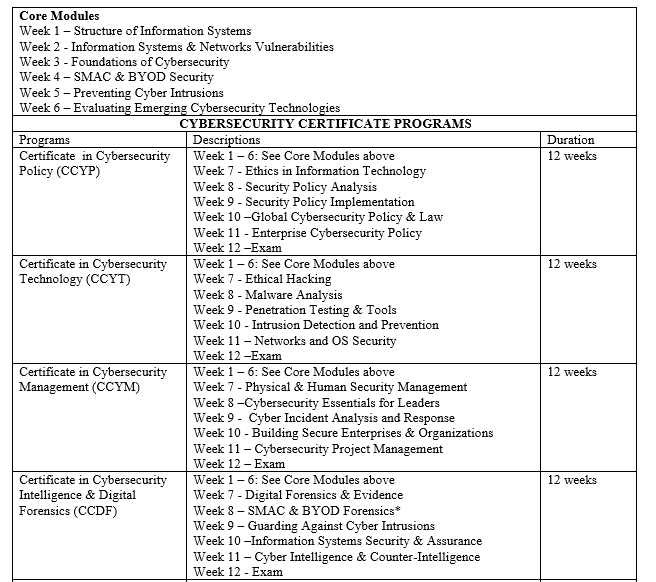
Our Cybersecurity education is structured around four key pillars of policy, management, technology and digital forensics. This implies that we cover all the core needs of any organization or state institutions. While some staff like corporate lawyers may require training on policy, some staff like IT managers may need technical skills. Others like business leaders will find the management module useful. We deliver all these programs through our web portal . The program structure is presented below: certificate programs take 12 weeks; diploma programs which require certificate programs as perquisites take 24 weeks (inclusive of the certificate programs) and the nanodegree programs require a live (virtual) one week training with the diploma programs as prerequisites
Program Descriptions

  • Certificate in Cybersecurity Policy (CCYP): Certificate in Cybersecurity Policy deals with the policy analysis and implementation aspects of cybersecurity. It presents theory and topical issues, at government and enterprise levels, with both technical and managerial components in the fields of information systems security. The program helps learners develop skills on the policy, ethical, and legal issues associated with cybersecurity and information security.
  • Diploma in Cybersecurity Policy (DCYP) Capstone: This is a practical-oriented program where learners are tasked with developing solutions for a theoretical or real case cybersecurity policy issue with the guidance of a mentor. A project report is required at the end of the program.
  •  Certificate in Cybersecurity Technology (CCYT): The Certificate in Cybersecurity Technology is designed to provide learners with skills to analyze multi-faceted complex cybersecurity issues, develop capabilities to make strategic decisions to protect organizations from threats and become competent cybersecurity professionals.
  • Diploma in Cybersecurity Technology (DCYT) Capstone: This is a practical-oriented program where learners are tasked with developing capabilities in the core technical aspect of cybersecurity. Learners will have access to some tools and equipment to work throughout this program. A project report is required at the end of the program.
  • Certificate in Cybersecurity Management (CCYM): The Certificate in Cybersecurity Management equips and prepares learners with modern skills to become effective managers across the broad nexus of cybersecurity and intrusion preventions in organizations. The central core is developing capacity to prevent anticipated cyber intrusions, using experiences to mitigate future threats, and formulating and implementing enterprise-level cybersecurity roadmaps. The program also explores the roles of regulation, policy developments, legal instruments and civil liberties.
  • Diploma in Cybersecurity Management (DCYM) Capstone: This is a practical-oriented program where learners are tasked with developing cybersecurity project management capabilities with the guidance of a mentor. Here, learners develop cybersecurity implementation frameworks. A project report is required at the end of the program.
  • Certificate in Cybersecurity Intelligence & Digital Forensics (CCDF): The Certificate in Cybersecurity Intelligence & Digital Forensics is structured to provide modern skills to those interested in digital forensics, digital intelligence and uncovering digital evidence. The program equips learners with broad analytical frameworks and prepares them to become competent cyber investigators.
  • Diploma in Cybersecurity Intelligence & Digital Forensics (DCDF) Capstone: This is a practical-oriented program where learners are tasked with developing capabilities in digital forensics, digital evidence and digital intelligence. Learners will have access to some tools and equipment to work throughout this program. A project report is required at the end of the program.

Applications

To apply, you need to get a letter from your HOD or Dean indicating that you are a current student in an African university. Send that along with your resume to info@facyber.com and cc audrey.kumar@milonics.com . In a cover letter, explain why Facyber should offer you a scholarship for our Nanogree program, priced at $2000. This program will take 24 weeks since the students selected will automatically be accepted in the Certificate and Diploma programs which are prerequisites to the nanodegree programs.
Free Broadband Internet

If you are in Owerri (Nigeria), we are making our office available for students who want to enroll in our programs but have limited access to internet. If you do enroll, not necessarily via this scholarship, we welcome you to 124A Okigwe Road, Owerri. There, you will have access to our programs at no extra broadband cost. This broadband service is supported by Fasmicro, our Nigeria office.

Deadline: March 31 2017

info@facyber.com

Key factors in African HealthTech sector for making healthcare affordable and accessible

0

The future of healthcare will be driven by using technology to improve many aspects of healthcare system. Machine learning will be a critical part of that equation.

In Africa, this is heating up and many entrepreneurs are getting into the business of health-tech.

Lot of startups are currently mushrooming which is a good sign as far as heath technology is concerned. Upon integration in medicine, AI  and different technology components take care of ‘repetitive work’ like analysis of X-Rays. This in turn leads to saving the radiologists’ time and thereby lead to them devoting more time towards patients.

According to experts, the healthcare market represents $3 trillion, almost 20 percent, of the U.S. economy. It notes that this market also is plagued by a level of gross inefficiency and under-performance largely unseen in any other industries in our post-internet world. The paradigm, however, is shifting dramatically.

In Africa, the numbers are certainly different as we have not been investing in healthcare. But the opportunity for disruption is certainly huge for a continent with more than 1.2 billion people. After agriculture, healthcare is another industry with latent opportunity for bold entrepreneurs to redesign and create value.

The Startups

Africa’s healthcare is such a bloated and bureaucratic industry that, at first glance, it might seem immune to disruption by innovators. But that is changing. Some emerging startups in Africa working on different heath-tech areas include the following:

  • medexperts is an online Community of Practice designed for Nigerian healthcare professionals and the Nigerian Public
  • The Cardiopad offers nurses and cardiologists an innovative methods for performing cardiac examinations and remote interpretations
  • Mozambikes brings lower cost, yet higher quality bicycles to the people of Mozambique
  • MedicRAM (Medical Records And Management) is an innovative modular health IT solution that is intended to transform the way healthcare is managed
  • Santé Africa is a mobile app connecting doctors with patients, providing education to those who seek it and offering access to medical supplies at the convenience of your home.
  • ClaimSync is an end-to-end claims processing platform that enables hospitals and other healthcare providers easily prepare medical claims and send them electronically to health insurance companies
  • MobiSure is a disruptive mobile medical insurance for the poor.
  • QuaWater develops and delivers products and projects that significantly improve the quality of people’s drinking water
  • Ruby Cup is a menstrual cup, an alternative menstrual hygiene product made of medical grade silicone that can be re-used up to 10 years.
  • Penda Health is a social enterprise that provides health services designed for low and middle income women in Kenya.

The ability for these companies to move to the next level will be determined by their capacities to deepen their computational capabilities.

Machine Learning /Electronics

Machine Learning can be programmed to work efficiently with precision medicine which is built on the unique genetic characteristics of a patient. It is natural that people have different genomes, AI would integrate with this and display vital statistics (and errors, if any) relatively early. AI will help patients in preventing them from turning chronic.

This vision is that with artificial intelligence and machine learning,  these innovators can strive to program the systems in such a way that the lifespan of people is increased.  Even life expectancy ratio would increase manifold.  Another important aspect is foetal monitoring in pregnant women. This is now evolving big-time across the world.

African startups will naturally need capabilities in embedded electronics to make this transition. Most are still at the level of software and largely data collection on websites. To collect, process and make sense of the data, electronics will be part of the equation.

Rounding Up

Making healthcare affordable and accessible is critical in Africa. That will only happen when sensible regulations are put in place in the continent along with innovations by our tech entrepreneurs. It is not likely that we are going to see the change coming from products made by GE, Samsung and other global giants.

They do not really understand us because our challenges are never their challenges. So, African innovators are the ones that must step up and transform the continent.

The next few years look promising but we still need capital to take risks on the most ambitious innovators.

How IoT and Big Data are Transforming Healthcare Systems

0

The modern Internet of Things as we know it today is the love child of internet technology, in particular the ability to transfer and process large amounts of data in the cloud, and the smartphone value chain, which also supplies the hardware underpinning IoT.

The ecosystem of IoT is changing the world. Healthcare sector is one major sector that is affected.

Technologies changing global healthcare solutions

Public clouds push and pull data in a mutual procedure to our smart devices in routine use. IoT (Internet of Things) connects partially to related industry information that is helpful for customers to arrive at tailored and better decisions.

Technologies like big data and machine assist service providers to diagnose and prescribe appropriate medicine in advance. Complete course and personalized diagnostics of medicine is the existing scope of machine learning.

Data analytics provides many prospects that help healthy behavior. Health analytics assist healthcare providers in connecting and helping patients outside the clinic. Analytical tools are helpful for patient’s behavior guidance, it not only tracks but also gives specific instructions to develop and maintain health behavior.

Major progress has been made in the sector of curing and managing diseases, extending life expectancy and enhancing the overall quality of life. If consider all is good, you are partially right; in fact, new challenges are usually offered.

Since the average life expectations of humans are increasing; long-term health conditions require continuous monitoring and ongoing treatment. These requirements put extra pressure on already extended healthcare systems and ever-increasing rates. The require of the hour is an answer for reforming and decreasing rates of healthcare monitoring and delivery with enhancing complete quality and making it available and suitable to patients.

Healthcare and IOT devices

Industry experts like Gartner predict that more than 25 billion of devices will be connected through IoT by the end of 2020. How many will be monitoring or medical devices? Many wearable devices such as track weight, heart rates, quality and amount of sleep, strength level of workouts; persons give close attention to these details and manage their health vigorously using wearable devices.

People undergoing from health issues; utilise sophisticated monitoring devices to track and report level hydration, blood sugar, blood oxygenation, lung capacity, mood swings, Body Mass and also capillary blood flow.

The capacity to allocate, regulate and control dosages of medicine is now offered in the form of smart pill bottles. Finally, doctors are using their mobile, smart devices to deliver healthcare and also state ”visit” synopsis that is transformed to text and stored in patient digital medical records as a component of their medical history.

Access to healthcare developments allows more individual to appropriately follow day-to-day activities. Furthermore, you can control your health issues from your home instead of visit a hospital. Now you can enhance your quality of life using IoT devices and other smart technologies.

Not only persons but also healthcare providers can professionally offer healthcare services with these devices. They can track patient’s health, manage medicine and treatments from a remote location, thus enhancing the healthcare level delivered to many patients at the same time. You are able to dictate physicians and summaries of discharge, thus maintaining up-to-date electronic health records.

With the help of a managed service provider to electronic change your healthcare solutions.

Healthcare and Big Data

Big Data has huge potential to change the healthcare sector; big data tools gather billions of data points that can be utilized for health management in three main areas:

·        Descriptive analytics: It calculates what has happened, such as cost, frequency and resources.

·        Predictive analytics: It uses the descriptive data to predicate expected results in the future.

·        Prescriptive analytics: It offers the ability to make positive decisions considering anticipating predictions.


Contributed by Arjun Dedaniya of Teksun Systems

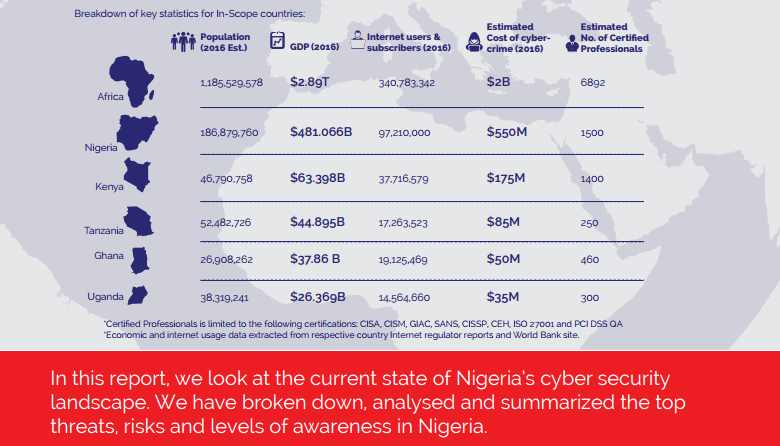
Africa 2016 cybercrime losses hit $2B: Nigeria at $550M is 27% of total, reports Serianu

2

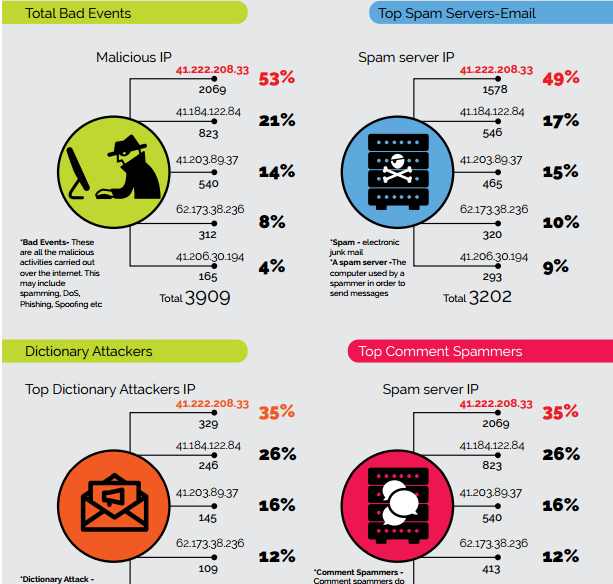
A Nigeria Cyber Security Report has been released. The report has also suggested various ways to mitigate the impacts of cyber-crimes which which cost Nigerian businesses a whopping $550 million in 2016.

The Nigeria Cyber Security Report 2016 was researched, analysed, compiled and published by the Serianu Cyber Threat Intelligence Team in partnership with Demadiur Systems Limited and the USIU’s Centre for Informatics Research and Innovation (CIRI), at the School of Science and Technology.

The estimated cost of cybercrime in Nigeria has soared to $550 million. This cost continues to grow as many organisations automate their processes. This is particularly so for the Ecommerce and financial services sector where the introduction of e-services has introduced new weaknesses that have allowed loss of money through these channels.

The increase in cybercrime in Nigeria can be attributed to the rising poverty levels, greed (on both the perpetrators and sometimes even the victims), easy access to gullible targets by the criminals and lack of adequate legal and regulatory polices to prevent and prosecute the perpetrators when identified.

Way Forward

Based on the research findings, most Nigerian organisations are ill-equipped to respond to information security threats. Although there are different initiatives (regulators, government and private organisations) in place set out to address information security issues in Nigeria, these initiatives cannot adequately address the current information security issues.

Public and private organisations need to rethink their whole approach to information security and establish security practices needed to protect critical IT infrastructure. They also need to train and grow security experts needed to secure this infrastructure. Most organisations now recognize that it is imperative that local organisations take action before the situation worsens and the cost of inaction becomes even greater.

The Roadmap

The challenges faced by Nigeria and in essence African countries, present great business opportunities for entrepreneurs, researchers and vendors. In order for us to stay ahead of the threat curve, we need to continually invest in research, build local cyber threat management infrastructure and enhance our ability to anticipate, detect, respond and contain information security threats.

In our current state, we are unable to build these capabilities. Nigerian entrepreneurs need to step up, work together to build and provide information security services that address these challenges. Nigerian entrepreneurs and researchers should leverage their local presence and understanding of the environment to provide a clear indication of the security problems on the ground.

This local presence combined with partnerships with global players will provide globally tested solutions and approaches to address identified security problems.

Training

The report noted the important of training and awareness. One of the organizations helping in that area is First Atlantic Cybersecurity Institute (Facyber) which offers programs in cybersecurity policy, technology, management and more.


Why Nigerian regulators are stopping banks from taking over Etisalat Nigeria

0

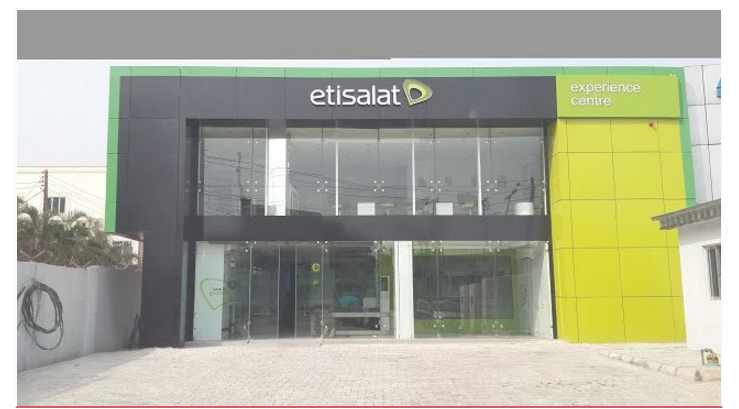
We hope Central Bank of Nigeria (CBN) and Nigerian Communications Commission (NCC) continue to step in to stop banks from taking over Etisalat because if Etisalat goes under, we are left with fewer choices and that will mean higher broadband costs.

The two regulators  have decided to intervene into the $1.72 billion loan issue between Etisalat Nigeria and a consortium of commercial banks which include Access Bank and Zenith Bank.

According to a statement signed by Mr. Tony Ojobo, Director of Public Affairs, the meeting, which was held at the Central Bank Headquarters in Abuja was convened by the financial regulator at the instance of NCC, the telecom regulator, to further deliberate on how best to stave off the attempt by the banks to take over Etisalat.

The statement disclosed that the Central Bank of Nigeria agreed to invite Etisalat management and the banks to a meeting today, Friday, towards finding an amicable resolution.

It added that the NCC as a regulator of the telecom industry decided to move quickly to intervene as a result of the negative impact such a bank take over will have on the industry. “NCC is worried about the fate of the over 20 million Etisalat subscribers and the wrong signals such a takeover may send to potential investors in the telecom industry,” the statement said.

The Loan

A consortium of some foreign and Nigerian banks, including Guaranty Trust Bank, Access Bank and Zenith Bank have been having a running battle with Etisalat over a $1.72 billion (about N541.8 billion) loan facility obtained in 2015.

The loan, which involved a foreign-backed guaranty bond, was for Etisalat to finance a major network rehabilitation and expansion of its operational base in Nigeria.

But no matter what, Nigeria must not bail our Etisalat Nigeria – it has tons of money through its parent company and it is not a local company.