DD
MM
YYYY

PAGES

DD
MM
YYYY

spot_img

PAGES

Home Blog Page 7458

Map your farm boundary with Zenvus Boundary feature; no need for a surveyor

0

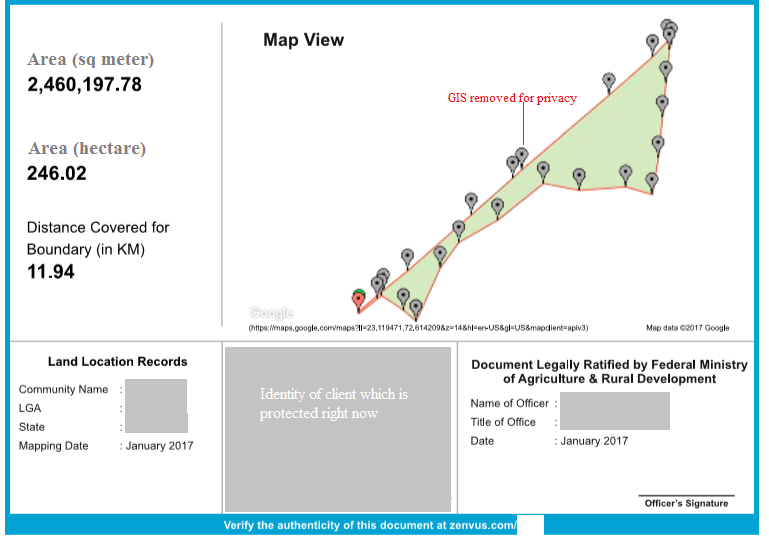
With Zenvus Boundary feature, farmers can simply map the boundaries of their farms. All they need is to put Zenvus in the Farm Boundary mode, walk round their farms, and exit the boundary scan mode. The next step is to go to their Zenvus profiles to print a PDF of their farm maps. They can take the report to their cooperative to approve before the government ratifies.

With this, the farmer will have a land title which can be used for loans. This is financial inclusion at its best.

Zenvus is an intelligent solution for farms that uses proprietary electronic sensors to collect soil data like moisture, nutrients, temperature, pH etc. It subsequently sends the data to a cloud server via GSM, satellite or Wifi. Algorithms in the server analyze the data and advice farmers on what, how and when to farm. As the crops grow, the system deploys hyper- spectral cameras to build crop normalized difference vegetative index which is helpful in detecting drought stress, pests and diseases on crops. The data generated is aggregated, anonymized and made available via subscription for agro-lending, agro-insurance, commodity trading to banks, insurers and investors. Zenvus also has a mapping feature which can help a farmer map the farm boundary with ease.

Overview, structure and tools in Nigeria’s leading cybersecurity & digital forensics training firm

0

Introduction

With the advent of dangerous malicious codes like Flame and Stuxnet, it has become evident that nations or institutions can electronically wage wars against enemies or competitors. As the risks of traditional wars abate, Internet has since evolved as the 21st century battleground where malware, not rockets, can be used to launch attacks on national infrastructure like power, telecoms, capital market and financial institutions. Also, through espionage and hacking, organized crimes by nations, corporate institutions and individuals can steal vital intellectual properties (IPs) that drive innovations in any economy. When a country or organization loses its competitive advantage, its competitive capability will be weakened. Our training programs are designed to equip learners with 21st century cybersecurity skills that will help them advance their careers while protecting their organizations.

Program Summary

ICT is facilitating the process of socio-economic development. It has offered new ways of exchanging information, and transacting businesses, efficiently and cheaply. It has also changed the dynamic natures of financial, entertainment and communication industries and provided better means of using the human and institutional capabilities of the country in both the public and private sectors. Increasingly, ICT is rapidly moving nations towards knowledge-based economic structures and information societies, comprising networks of individuals, firms and nations that are linked electronically and in interdependent relationships. As economic systems go digital, the risks posed by unsecured weakest links in financial systems at host, intermediary and client levels will become prominent.

Through digital combats in Estonia and Ukraine, it has been established that cyber-threats are not games of choice. As internet penetration continues to advance globally, so are the perils that come with the increased degree of digital connectivity – Cyber crime. However, most organizations lack both proper security plans and trained in-house staff to counter or quickly recover from cyber attacks.

The goal of Fasmicro Institute cybersecurity programs are to:

•    Develop business and government leaders with competence to create and manage effective cybersecurity practices.
•    Understand and solve the evolving cybersecurity risks, equipping learners with cutting-edge skills in a fledgling industry even as nations/firms move into electronic societies with associated digital risks.
•    Prepare learners to master ways to Prepare, Detect, Defend, Defeat, and Harden their critical information infrastructure.

Outcomes / Objectives

At the conclusion of our programs. learners will will strengthen their capacities in some of these areas:
•    Understand the strategic importance of cybersecurity
•    Include cybersecurity assessment as a management system
•    Develop cybersecurity strategy
•    Appreciate the current policies and legal structure within data security management
•    Understand relevant technical components (forensics, intrusion, detection, etc) within digital security
•    Develop appropriate technology-based and human-based controls to protect information systems from cyber-intrusion
•    Assess the primary cyber-threats to an organization’s mission-critical information systems
•    Assess the vulnerabilities of an organization’s hardware and software systems,
•    Analyze the vulnerabilities of organization’s use of the Internet to cyber-intrusion
•    Develop appropriate technology-based and human-based controls to protect an organization’s mission-critical information systems from cyber-intrusion
•    Formulate strategies to protect an organization’s mission-critical information systems from cyber-intrusion
•    Develop management capabilities on cybersecurity and cyberspace
•    Understand standards, frameworks and institutions harmonizing global cybersecurity management

Participants

The most common titles or institutions of participants include:

IT Security Manager, Risk, Compliance & Control Manager, Head – IT, Head – Operations & Strategy, Business Development Director, Product Manager, Regional Director, Head of Brand Management, Business Director, Professors, lecturers, VP of Strategic Projects, Managing Director/CEO, IT Architects and Administrators, Mobile Developers, Students/ NYSC, Government & Intelligence Agencies, Military and Law Enforcements, Others

Syllabus

o    The Vulnerabilities of ICT Systems
o    Designing Robust Systems
o    The State of Cybersecurity
o    National Cashless Initiative – The CyberSecurity Blueprint
o    National Identity Management  and Cybersecurity
o    The Vulnerabilities of Enterprise Networks and the Internet
o    Infrastructure of information systems
o    Secure Networks and systems
o    Elements for Preventing Cyber Intrusions
o    Cybersecurity Fundamentals Managers
o    Essentials of Establishing a Secure Organization
o    Guarding Against Intrusions in Systems and Networks
o    Operating System Security
o    Global Network Security (Internet, GIS, BYOD, etc)
o    Secure Networks and systems & Global Network Security (Internet, GIS, BYOD, etc)
o    Elements for Preventing Cyber Intrusions & Guarding Against Intrusions in Systems and Networks
o    The Cybersecurity Roadmap
o    Infrastructure of information systems
Labs, Labs, Labs

Cybersecurity Equipment and Tools

Depending on the programs, we provide some of these practical tools for our learners:

  • Virtual Lab Environment: A virtual lab environment employs the concept of virtualization and allows one to use a single physical computer for hosting multiple virtual systems, each running a potentially different operating system
  • Computer Forensics Tools: Computer forensic tools are used for digital image acquisition, analysis, reporting, recovery and investigation of material found in digital devices
  • Malware Analysis Tools: Malware analysis tools are used to disassemble, debug and analyze compiled malicious executables. This is a key tool in reverse engineering and facilitates malware analysis. While analysis relies primarily on the expertise of skilled and trained personnel, these tools enable the process to be accomplished much easier.
  • Live Memory Forensics Tools: Memory forensics tools are used to acquire and/or analyze a computer’s volatile memory (RAM).
  • Network Forensics Tools: Network forensic tools provide real-time network forensics and automated threat analysis solutions.
  • Expert Witness Testimony: To provide expert witness testimony, one must be able to provide a visual presentation of associations and linkages that may exist for any person, location or thing under investigation.
  • Up-to-Date Threat intelligence: Serve as the operational focal point for up-to-date threat information sharing through a Virtual Collaborative Information Sharing Environment for eligible subscribers.


Take Action

Program Description:  The Facyber Cybersecurity  Training is anchored around four key pillars of cybersecurity policy, management, technology and digital forensics and structured across Certificate, Diploma and Nanodegree programs. This implies that they cover all the core needs of any learner, organization or state institution. While learners like corporate lawyers may require training on policy, some like IT engineers may need technical skills. Others like business leaders will find the management module useful. It has something for everyone including CEOs and Boards.

We do hope you will encourage your colleagues to take these competitively priced programs. You can also take them. To register, visit mobile-friendly facyber.com and register. Then make the payment. Facyber supports many payment options including Paypal, credit & debit cards, and bank transfer. The fees are as follows:

  • Certificate Program (Online 12 weeks, $200 )
  • Diploma Program (Online 12 weeks, $600)
  • Nanodegree Program (Live 1 week, $1600)

Curriculum:  The programs curricula are very detailed; click here (PDF) for  details.

A sample curriculum is provided for Certificate in Cybersecurity Policy. Certificate in Cybersecurity Policy deals with the policy analysis and implementation aspects of cybersecurity. It presents theory and topical issues, at government and enterprise levels, with both technical and managerial components in the fields of information systems security. The program helps learners develop skills on the policy, ethical, and legal issues associated with cybersecurity and information security. The program covers the following over 12 weeks

Week 1 – Structure of Information Systems
Week 2 – Information Systems & Networks Vulnerabilities
Week 3 – Foundations of Cybersecurity
Week 4 – SMAC & BYOD Security
Week 5 – Preventing Cyber Intrusions
Week 6 – Evaluating Emerging Cybersecurity Technologies

Week 7 – Ethics in Information Technology
Week 8 – Security Policy Analysis
Week 9 – Security Policy Implementation
Week 10 –Global Cybersecurity Policy & Law
Week 11 – Enterprise Cybersecurity Policy
Week 12 –Exam

Certificate of Completion: At the end of a successful program, a learner will receive a certificate that looks thus.

Fore more, contact Audrey Kumar, Director, Learning Innovation | info@facyber.com

Storage efficiency is vital to the success of alternative energy

0

There are many benefits  from alternative energy sources.  Some of these benefits are unlimited availability, zero emission and others. Unfortunately, the efficiency of these systems are not robust and costs remain high, making these sources unaffordable without government subsidies.

According to Bloomberg,  photovoltaic solar cells and offshore wind farms can provide power at about $160 a megawatt hour. That’s far costlier than coal-fired plants, which deliver power at about $70 a megawatt hour.  Though this price difference is narrowing, it will take years before the alternative energy sources can compete on price.

Besides efficiency and cost, the zigzag supply of alternative energy sources in terms of reliability is troubling. Recently in Germany,  sunny days generate so much alternative energy that utilities pay industrial customers to take it away.  Nature distorts budgets and that is problem. Indeed,  we need a way to store these energies so that we can appropriately manage them, as Businessweek noted.

The most elegant solution would be to improve grid-level storage of solar and wind power, so yesterday’s sunshine can continue to yield power during today’s storms. Achieving next-generation storage will take years. False starts will abound.

Partial breakthroughs will need to be freely shared. Such long-horizon projects are anathema to the private sector, but well-suited to government support. The U.S. Energy Dept. took a step in the right direction last month when it issued a slew of $3 million or smaller grants to labs exploring projects as varied as molten batteries, nanomaterials, high-temperature salts, and compressed vapor.

So for the world to see the effective penetration of alternative energy sources like wind, solar, there is need to invest and develop solid storage mechanism that will help collect excess power and use them when natural phenomenon makes them less available.  As we work to get cost, efficiency better, there is need to not forget storage. Anything less, this technology will not have mass penetration as quickly as we would have expected.

How an Investor’s Behavioral Traits Might Completely Derail Your Pitch – Part I

0

Many startup pitch meetings start out on a promising note, but things fall apart during the conversation between the startup and its prospective investor. Sometimes this could have been prevented if the startup team had studied a little bit of behavioral psychology beforehand.1

Traditional finance theory tries to tell us how investors should behave, if they act as rational economic beings. Behavioral finance is based on the observed behavior of investors. Traditional finance is based on economic theory. Behavioral finance is based on psychology. Traditional finance assumes that investors make their decisions based on all available information, that investors are rational, and that markets are efficient.2 Even if you think this is true in public markets, you have to agree that it is not the case in venture capital. It is especially true that the market for early stage venture investments is highly inefficient, prone to extreme uncertainty and severe information asymmetries. Behavioral finance makes none of the assumptions of traditional finance.

In this post, I will describe a few behavioral biases that an investor might exhibit during a pitch meeting with the founder of a startup.3 I will describe how each bias might be exhibited during a pitch meeting. I will also suggest how the entrepreneur might attempt to mitigate each bias. Failure to mitigate a behavioral bias could mean that the pitch gets derailed, and the entrepreneur fails to communicate effectively with the investor about the startup. I have developed the examples on the basis of meetings at which I have been on the side being pitched by entrepreneurs, after-the-fact reports about investor meetings that entrepreneurs I know have spoken with me about, and also from meetings at which I have been on the side pitching an innovation to potential business partners, and investors for a startup that I have been helping to incubate since January 2011.4

The behavioral biases that I will cover in this post are categorized as cognitive errors. A cognitive error or bias stems from the inherent shortcomings people face as they try to process information that is unfamiliar and complex. Cognitive errors are further categorized as information processing errors or belief perseverance errors. This post will focus on a few belief perseverance biases. Behavioral biases generally can be grouped as cognitive errors, emotional biases, memory errors or social biases.

As you read the rest of this post you will notice that the lines between these biases is somewhat blurry – what one person sees as indicative of one kind of error could be seen by someone else looking at the same information as indicative of another bias. That seems to be the nature of those behavioral biases I have studied – there’s a lot of interconnection and it is difficult to assign an observed behavior to a single bias or error. More likely, the observed behavior arises due to a combination of biases and errors. That is why I think preparation beforehand is key. The entrepreneur can try various approaches to mitigating the observed bias until one approach leads to a break-through that restores the flow of ideas and communication between the entrepreneur and the potential investor.

Cognitive Errors – Belief Perseverance:

  1. Conservatism Bias: This occurs when a potential investor fails to revise his preconceived beliefs about your startup even when there is new evidence that suggests that his beliefs are incorrect.5
    • Case: Steve is 20 years old. He has quit college with two of his classmates to focus on building a startup – Disruptive Tech Startup (DTS). He meets with an early-stage venture capitalist to describe the work they have done so far and their vision for the future. Steve does not realize that the investor believes that he’s too inexperienced and too young to accomplish what he wants to accomplish with DTS. More specifically, the investor does not believe that Steve is experienced enough to steer DTS so that the investor realizes the minimum 10x return that the investor’s investment thesis requires. Steve thinks the meeting went well, but the investor later tells him that the fund has decided to pass on making an investment in DTS.
    • Mitigation: Steve should spend more time discussing his background, what he has done to learn how to run the startup, and how he will learn what he needs to learn in order to run the startup in the future. He should explicitly tackle the issue about his youth and relative lack of experience, and openly discuss steps he will take, or has already taken to ensure that his investors’ capital is not put at risk because of his youth and perceived inexperience. He should offer references who prospective investors might speak to about his leadership potential as it relates to managing a startup. He should not assume that the investor will conclude that he will continue to succeed in the future after seeing what he has accomplished at DTS so far.
  2. Confirmation Bias: This occurs when the investor focuses on perceived negative aspects of your startup while ignoring and dismissing your attempts togive an explanation with evidence that will contradict that perception.
    • Case: Steve is pitching DTS to another early stage investor. She thinks that the technology they have developed is trivial after having listened to Steve for about 20 minutes, and she tells them as much. Steve gets frustrated because he feels she does not understand what DTS is about. The meeting is a disaster because she keeps focusing on the notion that “But isn’t this just a simple bot that scrapes the web for data? If I were a software developer I could do this with very little effort.”
    • Mitigation: This investor likely does not understand the full extent of the problem that DTS is solving.6 If Steve is stuck in “Demo Day Pitch” mode he likely has not considered that in a small meeting the dynamic is different. He should “put away the deck” and go into “professor mode” – in this mode he is educating the investor about the problem, about how DTS is solving that problem, and also about the opportunity that presents for potential investors in DTS, all in a conversational setting – like a professor teaching a student a new concept during office hours. He should expect to follow this up with further information for the investor to consider.7
  3. Representativeness Bias:8 This occurs when the investor uses an if-then rule of thumb or mental shortcut toassess your startup because of the high levels of uncertainty associated with the decision the investor must make.
    • Case: Ademola is a Nigerian entrepreneur. He has been building an Internet software startup in Lagos for two years, African Technology Startup (ATS). He grew up in Nigeria and holds a master’s degree in computer engineering from the Obafemi Awolowo University of Science and Technology, one of Nigeria’s leading universities of technology. In order to grow ATS he has moved to New York and is raising capital from investors. ATS has customers from all over the world, and he believes ATS is solving a significant problem for them. Growth has been phenomenal. ATS has accomplished that growth on a shoe-string budget. Ademola has been building ATS with two other people, they are both co-founders of ATS as well. They will remain in Lagos to manage the technology and R&D efforts. Ademola is worried that many of the investors he will meet are ignorant about Africa. He is also worried that they may unconsciously harbor negative perceptions about ATS that they will not verbalize during a meeting.
    • Mitigation: Ademola has to work doubly hard to demonstrate his technical competence because the average early stage investor in the United States does not associate Africa with technical talent and competence. For example, investors might assume that ATS is relying on a contract software engineering consultant in Asia or Eastern Europe. If ATS is building its technology in-house, Ademola has to make that explicit. He has to talk about the technology in a way that demonstrates that he can fulfill the vision that he’s selling to his customers, and potential investors. He has to convince his audience that a software engineer trained in Nigeria can compete on the global stage. He has to remember that his accent could inhibit potential investors’ ability to understand what he is trying to communicate.9 Instead of hoping that they will ask him to clarify something, or explain something they do not understand he should practice speaking clearly and communicating effectively to people who have never encountered someone with his accent. He should avoid using colloquial terms and idioms that are used in Nigeria, but may not be commonly used elsewhere. Investors in NYC will not understand those terms. He should be friendly, but he should avoid the temptation to be unnaturally funny. His off-the-cuff attempts at humor could back-fire. The representativeness bias at play here could be “If ATS is an African startup then the probability that it is doing all this on its own is zero because all we ever see on TV about Africa is war, starvation, and political corruption and incompetence.” Ademola has to overcome that bias during his conversations.10

An investor’s cognitive biases play an important role in how that investor will hear and interpret the information that an entrepreneur is trying to convey. Time spent understanding this phenomenon and how to mitigate any possible negative effects of a prospective investors behavioral biases will invariably lead to more productive pitch meetings.

Wikipedia’s entry on cognitive biases is here. Wikipedia also has a much more extensive list of cognitive biases here. If you have the time, you should invest in a copy of Daniel Kahneman’s11 Thinking, Fast and Slow.


  1. Any errors in correctly attributing work to my sources and references is entirely my fault. I’ll make corrections if you point an error out to me. ?
  2. The efficient-market hypothesis (EMH) states that financial markets are informationally efficient and that the price of a publicly traded stock incorporates all available information about that stock. ?
  3. I am basing the outline of this post on portions of the CFA Institute’s 2013 Level III readings on Behavioral Finance. ?
  4. I am not a psychologist, so my discussion of this topic will certainly fall far short of even very modest expectations. However, I hope that budding entrepreneurs find this discussion to be a good starting point for some independent work on this topic. ?
  5. This can also be exhibited as a tendency to underestimate high-likelihood events and overestimate low likelihood events. ?
  6. The unstated assumption here is that DTS is not solving a trivial problem. ?
  7. See this post for an example?
  8. The Wikipedia entry for the Representativeness Heuristic is here. You should read it if you are building a startup and will be raising capital from investors. ?
  9. Y Combinator’s Paul Graham inadvertently got embroiled in a pseudo-controversy over this subject. You should read what he has to say, and also read what others have said. Paul’s post on the subject is here. One response is here. ?
  10. This blog post at 59 Ways is a clear, but brief explanation of this bias. ?
  11. If you purchase it through this link I will receive a small portion of the sales proceeds from Amazon to help me maintain this blog. ?

AFIF Entrepreneurship Award 2017 Contestants [Photo]

0

Six African SMEs nominated as finalists for the AFIF Entrepreneurship Award 2017. This Award is part of the annual Africa Finance & Investment Forum (AFIF)

Out of the 51 projects from around the continent and following a few rounds of selection, the jury has selected these innovative projects from Ethiopia, Kenya, Nigeria and Tanzania for their social, economic and ecological impact, and their potential for growth and job creation nationally and regionally.

Aybar Engineering (Ethiopia)

The company has developed the “Aybar BBM”, a technology that prevents excess water from suffocating crops and stores it for later use. There is no other similar technology in the market.
R n G Company limited (Kenya)

The company sells packaged Rhizo-fix (groundnut inoculum), a biofertilizer that ensures a more efficient groundnut production. It also collects the groundnuts from local farmers to produce affordable cooking oil.
EuroFresh Exotics (Kenya)

The company produces and exports fresh fruits and vegetables using innovative farming techniques. They also organise capacity building trainings for smallholder farmers.

First Atlantic Semiconductors & Microelectronics (Nigeria)

This company has developed the “Zenvus”, an intelligent solution to collect soil data using a system of electronic sensors. Its mission is to improve farming productivity.

Kimolo Super rice (Tanzania)

The company is specialized in processing and marketing branded rice and sunflower oil. The project is environmentally friendly since smallholder farmers produce paddy using water run-off from nearby hills.

Eco Act (Tanzania)

The company was established to address the challenges of urban waste management, plastic pollution, deforestation and climate change. They recycle and transform post-consumer waste plastic into durable and environmentally friendly plastic lumber.

[Source]