DD
MM
YYYY

PAGES

DD
MM
YYYY

spot_img

PAGES

Home Blog Page 7460

Here is why Customer Capital Is better than Venture Capital

0

The decision on how to fund your early stage agritech startup has significant consequences for founders who are navigating the avalanche of information surrounding startup financing. 


About 18 months ago I was looking to raise Venture Capital (VC) Series A financing for AgDNA. During the process, I was discussing our progress with one of our existing private investors when he asked me “why are you prioritising venture capital over customer capital?”

I didn’t appreciate the impact of his question at the time. Heck, I’ve got an MBA. I’ve read all the startup success stories. Growing your business with VC is how it’s done. Or at least that’s what I thought at the time.

Raise cash. Grow business. Live happily ever after…

The VC Minefield

However, the reality of capital raising is much different. Once you go down the VC path, new dynamics come into play. Company valuation, preference shares, pre-emptive rights, compounding interest, board seats, shareholder dilution and the expectation of a 10X return for the VC fund.

Hmmm, did I miss this MBA class?

The Pitch

Nevertheless, we signed up with the team at AgFunder to get the word out about AgDNA and get in front of the VC agritech community. We launched our campaign on AgFunder and were immediately being introduced to genuine agritech VC firms. Perfect, term sheet here we come!

The pitch about our business started out well and became more and more succinct with every presentation. Although after about a dozen pitches I could see a trend beginning to take shape. Essentially every VC put AgDNA in the agritech “software” bucket. This meant a lot of energy had to go into differentiating our value proposition from our competitors along with educating investors on the merits of software in agriculture.

I soon learned VC doesn’t automatically translate into expertise about your sector. There are some very knowledgeable VC firms and some that are still trying to figure out how agriculture works and what agritech means for the customer.

Side note: if you’re an agritech startup looking to raise capital then contact AgFunder — great team, great contacts, great results.

The Term Sheet

After plenty of pitching, AgDNA received several term sheet offers. We accepted the one we thought was the best fit for our business. It was a corporate VC as lead investor with two other VC funds co-investing. They gave us a fair valuation, with standard VC terms.

Remember the plan. Raise cash. Grow business. Live happily ever after…

However, within a week of signing the term sheet, the lead corporate VC appointed a new CEO to their parent company and many projects within their organisation were put on hold. Including new investments by their VC business unit.

Subsequent changes in management by the incoming CEO resulted in changes to our term sheet. Moving the goal posts this early on in the relationship felt like a sign of things to come. So we decided to reject the revised term sheet and go our own way.

Back to square one.

That Question

By this stage, almost 12 months had gone by, and I remebered once again the question of “venture capital versus customer capital.” The answer was now much clearer to me. Customer capital (aka sales revenue) was the most obvious and efficient source of cash to grow the business.

Customer capital doesn’t come with all the fine print of venture capital. It doesn’t need to be paid back, and it forces you to focus on the core of your business. But sales channels take time to develop, and the seasonality of agriculture means cashflow can be lumpy.

Realigning the business toward customer capital and organic growth would require laser focus.

The Runway

Every startup needs working capital to function, to grow the team, to build a great product and to delight its customers. So we raised additional seed capital from private investors within the ag sector. This allowed us to remain true to our core beliefs around agritech and it allowed all shareholders to remain on equal terms with only ordinary shares on issue.

Most importantly, it allowed the company to remain 100% focused on the customer.

Rocket Fuel

I am still a firm believer in the role of VC and the impact it can have on the growth trajectory of a startup. But it must be timed just right.

Venture Capital is like rocket fuel. Switch to thrusters, press ignition and hold on as the acceleration compresses you back in your seat. But be careful, accelerating your startup too early or in the wrong direction can be disastrous.

I have watched numerous agritech startups raise capital too early. Their product market fit was unclear and their revenue models questionable at best.

Build it. Nail it. Scale it.

This is the formula for many technology business success stories. Accelerating your agritech startup too early with VC finance could have long-term unintended consequences. At AgDNA we elected to make sure we are well into the “Nail It” phase before reconsidering VC backing.

The Outcome

Customer capital in the form of sales revenue is the cheapest type of financing for any business. The ability to grow revenue to the point where the company is breakeven and ultimately profitable can provide a lot of flexibility and freedom to operate going forward.

With customer capital you have options. You can continue to grow organically, or you can consider raising venture capital to accelerate growth and “scale it.” And with a healthy amount of customer capital, you can explore VC on your terms — because you want to — not because you have to.

Of course, the decision to take on VC finance and its timing is different for every startup and personal for every founder. But if you’re looking to raise capital for your startup, ask yourself “venture capital or customer capital”?

You might find that focusing your energy on the customer and building a profitable business is the right answer in the near term. It might not be as glamorous as VC, but long term it might be the best decision you ever made.

Paul Turner is CEO of AgDNA, the Australian precision ag and farm management software company. He originally published this as “Venture Capital Versus Customer Capital: What’s Right For Your Agritech Startup?”

How Internet of Things (IoT) will Change the Design of Embedded Systems

0

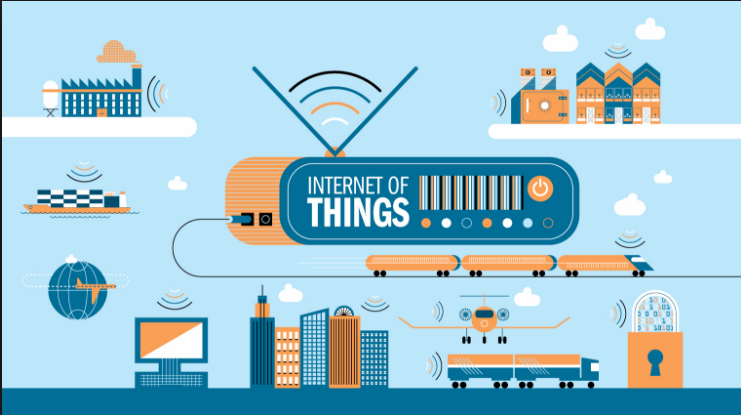
The Internet of Things (IoT) is about to change profoundly the design of embedded systems—but probably not in the way you are thinking. The change will begin not in silicon or in algorithms but in business models. Yet it will quickly permeate every aspect of embedded design.

Early warnings of the shift began several years ago, when IBM—the quintessential hardware company—began to divest its hardware operations to focus on services. Today, we see the CEO of Apple saying he is focused on doubling the company’s services business—including the App Store and Apple Music—from last year’s $25 billion, which already exceeded Mac sales.

But what do IBM or Apple corporate strategies have to do with embedded design? The answer is illustrated in a recent product announcement from a very different kind of company.

An All-Hearing Speaker

Consider the Amazon Echo. At first glance it is a rather expensive amplified, wireless loudspeaker—a really simple embedded system. But to stop there would be to completely misunderstand Amazon’s business model for the Echo. And without getting the business model, you would conclude the Echo is the most hopelessly over-designed audio appliance in history. But it is not. It is a harbinger.

Reading Amazon’s literature, one learns that the Echo has not only a Bluetooth port like any other wireless speaker, but also a WiFi connection that allows it to play audio files directly from the Amazon cloud. The user interface for this connection is Amazon’s Alexa voice-recognition personal assistant.

But Alexa can do much more than front-end Amazon Music. It can also access other commercial music services. And Web services like Yelp or Google Calendar. And it can answer questions with search-based responses. And it gives access to thousands of commercial apps, and to Amazon shopping. In short, Alexa makes this wireless speaker a portal for the retail Web.

But wait—there’s more. Echo can also front-end smart-home IoT networks, giving you voice control over everything from lights to door locks to your furnace.

The point Amazon doesn’t advertise is that in providing all this, the Echo becomes the collection point for a huge amount of personal data. It observes what you listen to, what questions you ask, what you buy, and how you interact with your home. It can infer from its beam-forming microphones array and cloud-based postprocessing, the identities and locations of people in your home, and what media they are playing audibly. There are already tales about an Echo attempting to execute commands given by an Alexa commercial playing on a TV in another room.

Amazon can use all of this data to refine its services to you—improving its response to questions, tweaking its music or audiobook offerings, proposing products and up- or cross-selling. But it can also, with your permission—you did read that fine print before you clicked, right?—collect data about you for use by third parties, including application developers, market researchers, or retailers. Did you really walk back to the TV when that hair-loss ad came on? Each of these uses of data is a potential revenue source for Amazon.

Accordingly, if you take an Echo apart, what you find is not just a Bluetooth chip and a power amplifier. There is the WiFi port. There is a substantial DSP chip, an array of seven microphones, 256 Mb of DRAM and 4 GB of NAND flash. All of this hardware contributes to the user interface, which reportedly can capture spoken voice from across the room with the music turned up loud. But the cost probably was justified at least partly by anticipation of these new revenue streams.

A Layered Model

“Fine,” I hear you say. “But I don’t work for Amazon.” Consider that the Echo, and Google Home, and doubtless similar devices on the way from other giant companies with major Web retail presence, are not just harbingers of future consumer audio products. They are pointing out a path for many kinds of embedded systems.

Let’s look, for example, at the slowly-emerging industrial IoT. Traditionally, an industrial controller will be a microcontroller unit (MCU), digital signal processor (DSP), or FPGA with a number of inputs from the device under control, each input measuring a necessary state variable, and a number of outputs to various actuators (Figure 1). With the need to include the acronym IoT in the sales literature, some such designs are now including a network interface of some sort, with the at least implied ability to log data to and receive commands from this network port. This ability may simply rest on top of the controller’s legacy functionality. Or it may be used, latencies permitting, to move some of the control functions to an external hub or even into the cloud.

Figure 1. A first cut at an IoT-connected controller logs data and divides up the tasks.

Now with a sideways glance at the Echo, let’s go a little further. If the controller is logging system state to the cloud, someone up there is building a huge, and potentially valuable, data set. Big-data analysis might detect prospective optimizations of the control loop, or trends that could predict needs for maintenance. Or it might spot anomalies that could indicate trouble elsewhere in the system, or even operator malfeasance. All of this is technical data that can be used within the system.

The trend is for data that normally would have been locked into a local control loop to be collected and disseminated more widely within the control system, or even beyond. Just how deeply the need to give IoT access to control variables has penetrated into the hardware is illustrated by motor control subsystems and chips from German motion experts Trinamic. Company director of marketing Jonas Proeger observes “That is a very typical use of our monitoring and sensorless control functionalities like stallGuard2, which is sensing the load on the motor during movement.”

In addition to locally controlling motor stalls, the motion controller can continuously report data to an external app. “You can monitor your system while it is in use. If there is a continuous increase in load over time you can expect that your mechanical system is wearing out. Some of our customers use this to automatically detect when it’s time to call the service technician.”

In some cases, data collected at the point of control will be exported for use by other parts of the control network, or even by cloud apps, all in the name of improving system performance. But other uses of the data might have a very different client. State data analysis can give product planners and marketers insights into how the system is being used, and even where there are friction points between operators and equipment. Such data can lead to new features or services, and to further sales calls to enhance installed equipment.

Some of the data planners want, however, may lie beyond simple state information. It may require the controller to extend it sensors deeper into, or further beyond, the device under control. Perhaps information about the equipment’s surroundings is valuable, or data about the operator’s behavior. Think about that microphone array on the Echo, and consider that sound can carry a great deal of information about vibration, friction, shaft lashing, and other effects that might not be easy to extract from just winding currents on the motors.

Another interesting example of collateral information comes from a human-input technology developer called Quantum Interface. The company’s IP, instead of relying on mouse sliding and clicking, uses gesture input devices to capture, for example, the center of mass, velocity vector, and predicted trajectory of an operator’s hand in three-dimensional space.

Company founder and CTO Jonathan Josephson explains that such continuous, spatial motions can be more natural than pointing and clicking. They can create economies—for instance by allowing the system to observe an operator opening a valve rather than having to read a shaft encoder on the valve shaft. And maybe most important, such an interface can detect metadata—such as the operator’s feelings of urgency, uncertainty, or distraction—from the motion, even before a gesture is completed. Whether from whole-body motion, hand motion, or eye tracking, “the path tells us everything about you,” Josephson says.

The controller may even look beyond its operator for data. In many situations there is a threshold in how much state information you collect. Below the threshold it is more economical to measure individual state variables directly with analog sensors. Above the threshold, it makes more sense to capture many variables at once indirectly—for instance with video or audio—and then to use analytics to derive values for the individual variables.

The classic example comes from municipal services. It is far easier to derive parking-space occupancy from an overhead video camera than from sensors buried under each parking space. And once you have the video stream, you can further analyze it for traffic information, security information, and maybe even foot traffic and pedestrian behavior data for local merchants.

A New Line of Business

This 1st  idea illustrates an important point. Sometimes the data available to a controller have nothing to do with the controller’s original function—they are available because of the accident of the controller’s location, or of other data the controller must gather. If you use a video camera to monitor on-street parking, you are also going to collect a lot of data about sidewalk goings-on. Less obviously, perhaps, if you are using video to replace a number of shaft encoders and linear position sensors, using a wide-angle lens and aiming the camera up a bit could bring a windfall of data about operator behavior, other operations on the factory floor, or customer behavior in a retail setting.

But why? None of this data has anything to do with the controller’s function. Now we come to the importance of thinking about alternative business models. Data is money. Often this extraneous data can create great value when analyzed, properly sanitized, and marketed to third parties. Operator data can yield information for functional-safety compliance, worker training, or even workplace security. Shop-floor video could yield clues about workflow, process inputs, even incidentals like lighting, supervisor behavior, and weather. The wealth of information you can get by watching retail customers needs no elaboration.

The point is that not only is this data valuable, but you—the system vendor, service provider, or equipment owner—can sell it. This is a valuable potential revenue stream, sometimes eclipsing the value of the embedded system’s original function. And that changes everything.

A New Machine

The presence of the IoT brings a new dimension to a wide range of embedded systems, from industrial controllers to vehicular subsystems to drones and consumer appliances. Now designers must consider not only the embedded system’s primary function, but the potential value of the data the system might gather.

This value can come from several sources:

  • Data for improved control strategies, broader optimizations, or anticipatory maintenance
  • Vital inside information about users and use cases for product planning and marketing
  • Data that can be mined and sold to third parties.

As the value and volume of collected information grow, these requirements begin to materially alter the system design (Figure 2). For example, the Amazon Echo, far from being a simple Bluetooth speaker, devotes significant cost to a microphone array, signal processing, WiFi, and Internet access. Much of this cost can be justified only by the other functions—retail transactions and Web traffic—the Echo generates.

Figure 2. An evolved IoT controller evolves toward being a remote data collector. 

Moving deeper into the IoT-influenced age, we may begin thinking of embedded systems not as independent fixed-function devices, nor even as clusters of sensors and actuators for cloud-based algorithms. Rather, they may become collectors of dense, high-volume data, with hardware dedicated to transporting streaming data, to local analytics functions, and to vastly enhanced security. They become the ears, eyes, and perhaps snouts of increasingly voracious big-data analyses, seeking the ultimate profitability of omniscience.

By Ron Wilson, Altera Corp

Six technologies that will reshape Africa’s future – IoT, Big Data, Robotics, 3D Printing, AI, and Blockchain

0

Africa has registered impressive economic growth over the past decade and a half, displaying remarkable resilience in the midst of volatility and turmoil in global markets. Time is now ripe for the continent to turn the chapter and embark on a journey towards a major economic transformation. For this, Africa needs a new economic growth model powered by the strength of the real economy, entrepreneurship and innovation.

A new report from Intellecap explores the critical role emerging technologies can play in helping Africa address its age-old development challenges and achieve exponential growth over the next decade. They researched and interviewed a range of emerging technology specialists from around the world and experts with deep experience on the social entrepreneurship and impact space in Africa. That helped them to develop a framework for analyzing the potential of emerging technologies to amplify impact creation in the African context.

The report highlights how emerging technologies can trigger a set of big shifts to help Africa leapfrog and combat its development challenges. The research indicates that although early evidence of these shifts is already visible signaling the beginning of Africa’s innovation journey, significant whitespaces currently exist. The report identifies these key innovation whitespaces based on scanning of 100 technology use cases in Africa. It concludes by identifying a set of opportunities these whitespaces present for key stakeholders to help nurture a vibrant and high impact technology innovation ecosystem and in the process, become a part of Africa’s journey towards economic transformation..

While achieving food and nutrition security is widely recognized as arguably the greatest development challenge for Africa, securing water security and low carbon energy security are other mega challenges that are intertwined with the food security crisis. In addition, Africa needs to build holistic healthcare ecosystems, create a future ready workforce and financially include majority of its population.

The following are the main technologies which will reshape Africa’s tomorrow:

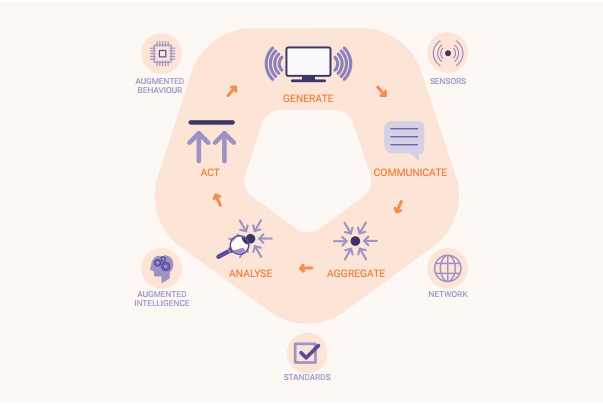
  • Internet of Things: IoT uses an array of sensors to enable capturing of real time data from a wide range of sources including computing devices, mechanical and digital machines, objects, animals and people.
  • Big Data: Big data refers to the use of advanced data analytics including predictive analytics for extracting value from voluminous or complex data sets
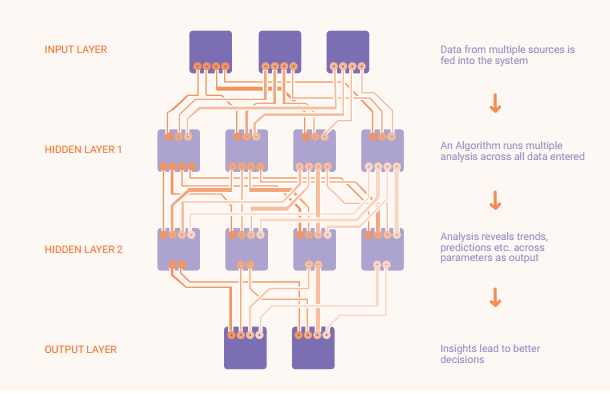
  • Artificial Intelligence: AI constitutes advanced algorithms applied to large data sets for observing patterns, gathering insights, problem solving, predicting and real-time decision making
  • Blockchain: A Blockchain is a tamper-proof record of transactions distributed across all participants in a Blockchain network. Via digital authentication and verification, the technology removes intermediaries and reduces transaction time and fraud
  • Robotics: Robotics refers to use of robots to automate and standardize quality of work with minimal errors. It covers a large variety of robots including drones.
  • 3D Printing: 3D Printing or additive manufacturing is a process that creates a three dimensional physical objects from a digital design. It can manufacture highly customized parts, which would otherwise be difficult based on traditional manufacturing

Read the Executive Summary, courtesy of Intellecap here.

Critical African cyber-security partnership reached

0

Yaoundé (Cameroon) and Pittsburgh (USA) February 22 2017: K10 CASA Consulting Cameroon and First Atlantic Cybersecurity Institute (Facyber), USA have entered into a game changing cybersecurity strategic partnership to facilitate and penetrate cybersecurity and digital forensics education in continental Africa.

K10 Casa Consulting, a leading strategic consulting and education process redesign firm in Africa, will facilitate the dissemination of Facyber’s cybersecurity module throughout French speaking Africa. This module will play a crucial role in cybersecurity readiness and protection as Africa emerges from the ‘old world’into the digital age.

Facyber, a U.S-based cybersecurity institute and a member of the prestigious IBM PartnerWorld, already operating in Nigeria, will now be available in French speaking Africa. This will help governments, businesses and schools develop and build manpower capabilities to protect, harden and secure Africa’s digital space.

“Across Africa, cyber-attacks continue to increase as digital adoption accelerates,” says Professor Ndubuisi Ekekwe, the Chairman of Facyber. “Facyber is structured to provide training to professionals and students in all key areas of cybersecurity and digital forensics; from cybersecurity policy to cybersecurity technology, and from cybersecurity management to cybersecurity intelligence.”

Key clients for this cyber security module are government ministries, schools, small and large businesses, police, military and airports.

“This is a great partnership for us,” says Prince Etienne Ketcha, the CEO of K10 CASA Consulting. “We’ve just added to our roster of consultants, a strategic partner, a leader in developing and implementing cyber security training that will keep African nations and businesses safe.”

Ekekwe, an American inventor, who holds a PhD in electrical and computer engineering from Johns Hopkins University, is one of the world’s leading technology experts. As Chairman of Fasmicro Group, he controls businesses in microelectronics, software and robotics.

With expertise in strategy and managing consulting, strategic planning, and corporate strategy, K10 CASA Consulting is a House of Experts, linking world business specialists to Africa and Africa to the world.

We welcome Africa to the world of peaceful digital business and ask you to begin the cybersecurity capabilities with us.


For Further Information please contact:

K10 CASA Consulting Africa

Ancien Immeuble Ringo, Nylon-Bastos

Yaoundé, Cameroon

Phone: +237 697 405 721

Press@k10casaconsulting.com

http://k10casaconsulting.com/


Facyber, USA

7429 Lighthouse PT,

Pittsburgh, PA 15221 USA

info@facyber.com

http://facyber.com/


This press release in PDF.

Why Nations Are Poor and Five Major Innovations to Watch in Africa

0

Over the last 500 years, productivity increase has driven GDP (gross domestic product) growths across nations. When nations improve their productivity capabilities, they always experience expansion in GDPs. And when GDPs expand, the results have correlated with higher standard of living. Higher standard of living is better living welfare for citizens.

Technology penetration or diffusion has been a catalyst to this global economic redesign. Technology anchors innovation which typically drives productivity gain. Before 1500 AD, the world was largely an inventive society with so many ideas but little products and services for people to buy. Of course, during that period, the world experienced great scientific discoveries, demonstrating that mere expansion of scientific output does not necessarily give rise to improvement in the welfare of citizens.

Abu al-Khwarizmi, the Father of Algebra, had lived centuries before (780 to 850 AD), pioneering modern Algebra. Yet, in Baghdad, the land was poor.

Hipparchus had perfected Trigonometry in Greece (190-120 B.C.) and Euclid of Alexandria invented Geometry (300 BC). Yet, the Greek land was largely poor.

Across the world, there were empires and kingdoms, but man was truly poor. That poverty was due to lack of productivity. It was not because of lack of intelligence or capacity to think. From Babylon to Alexandria, man invented great things. But all stalled at inventions. Minimal innovations.

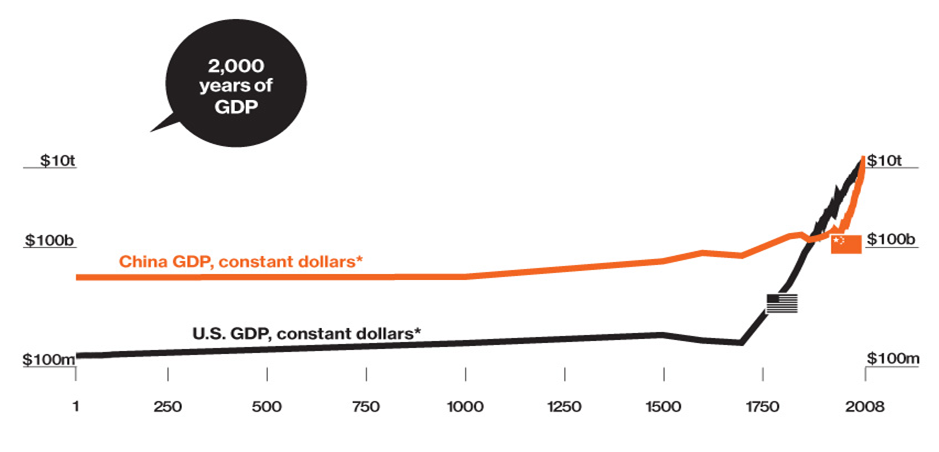
For more than 15 centuries, neither China nor USA improved productivity. Consequently, the GDPs were on stasis. Then innovation came via technology and the rest is history.

As shown in the plot above, using the two most dominant economies today, the gross world product (GWP) started expanding around 1700. Then, some parts of the world began the transition from inventive economies into innovation economies. China, England and India were global epicenters of science and discovery. China was already a globally undisputed leader in science. Chinese military strategist Sun Tzu, around 5th century BC, has written a treatise for warfare. Yet for centuries, Chinese economic growth was flat.

It was England which redesigned the world through the first Industrial Resolution (1760 to 1840) with manufacturing systems and processes. That brought enormous productivity gain which boosted trade and living standards. The innovation economy was born as science met Engineering and Technology. By the time U.S. took over as the world’s largest economy, around 1896, England had morphed from a nation of Science and Technology to one of Philosophy and Law. In the Houses of Lords and Common, there were more lawyers than scientists, then.

Oxford University and Cambridge University had the same dominance in education as the Pharaohs had during the time of Moses in the Bible. When God chose Moses to liberate Israelites from Egypt, part of the reason (ask me), was Moses was eminently educated under the Pharaohs. He commanded presence before Pharaoh. He understood the Logic, more than any Israelite, then.

The best “university” was in Egypt and the best astrologers worked for Pharaoh. Joseph, son of Jacob, produced the most important dream interpretation that preserved humanity during the Great Famine. Egypt kept the human race alive. Egypt prospered, and took many into slavery, building empires like the pyramids and other wonders. But Egypt faded as Pharaohs systematically moved from creating knowledge to showcasing ornaments!

Likewise, England lost the “steam” in the steam engine. The unrivaled Oxford University had morphed into Logic and Law, from science. Cambridge has also changed. England had faded in the production and dissemination of knowledge. The nation of Faraday is no more.

America brought entrepreneurial pragmatism, bulldozing itself to the top. Even China which had dominated the global GDP, at least 6 times in the last 10 centuries, was nowhere, with leaders deconstructing what made China great, to start with.

The innovation economy is born and America is rich. The bravado of America can be likened to the one experienced by Italians when Rome dominated the world. From 67 AD, when General Vespasian and (later) Titus, both Roman Emperors, attacked the rebuilt Temple of God of 408 BC (originally built by Solomon in 10th century BC), Rome was on its class. The temple was destroyed.

Immediately, when Catholicism was formed, and Apostle Peter was crucified upside down, Vatican was consecrated as the Holiest spot on earth and existed undisputed before the birth of Prophet Mohammed (born 570 and died 632 AD), father of Islam.

In these countries, the key was knowledge and using that to dominate. But across history, from the Babylonians during Nebuchadnezzar in 605 BC to Roman Empire, to British, it is a dynamic process. But unlike in the past, many can rise at the same time.

The above construct is the simple reason why some nations are poor and others rich. Knowledge is the driver and that knowledge drives innovation which is experienced through productivity.

The sub-Saharan Africa is still in the era of inventive society with so many ideas but practically little products and services to support them. People have ideas on energy, clean water, transportation etc but yet no one can experience those services because they are not available in markets.

Its processes are relatively primitive because most lack productivity capacities. One of those industrial processes is Agriculture.

In my firm, FASMICRO Group, a young and dynamic conglomerate, we spend enormous time identifying sectors in Africa where we can harness opportunities. We have identified five key sectors or sub-sectors; agriculture is one of them.

The following are the key agtech innovations we expect in coming years to redesign the agriculture sector in the continent. (I ought to have put agtech in the title, but LinkedIn will make it float over lines). Our business, Zenvus, is playing major roles in these areas.

·        Farmland Registration for Financial Inclusion: Governments across the continent are working to drive the formalization of farmlands. This is very critical for financial inclusion where farmers can use their lands as collateral in the financial sector. It is unfortunate, in Africa, that a man that owns 5,000 hectares of man is considered poor, owing to lack of formal documents, of his land. Zenvus Boundary makes it possible for farmers to map their farmlands without any external help.

The output of the Zenvus Boundary. A farmer takes this to government and the farmland ownership is ratified. The farmer must be in a cooperative to use this.

·        Precision Analytics for Farm Productivity: The moment has come to make agriculture data-driven, instead of the guesswork strategy which has yielded nothing but poverty over decades in the continent. It is a shame that a woman can work for 12 hours in farms, and still be very poor. Analytics will improve decision making and enable a virtuoso era of farming productivity. Zenvus Insights enables farmers to have better insights on what is happening in their farms, making it possible for them to improve farming practices like irrigation, fertilizer application etc. Zenvus Insights Pro help companies that invest in farms to have clear insights on what is happening in farms they have invested in one dashboard. Our Smartfarm and Yield technologies, respectively soil fertility sensor and hyper spectral cameras, are engines to power this future of precision farming in Africa.

o  Zenvus Smartfarm: Zenvus Smartfarm is an intelligent electronics sensor which when inserted in a farm soil collects pertinent data like humidity, temperature, pH, moisture, nutrients etc and wirelessly transmits the data to a cloud server where advanced computational models help to make sense of what is happening in the farm. It is powered with solar with battery capacity that can last for days.

The Zenvus Smartfarm

o  Zenvus Yield: Yield provides farmers with deep insights on the vegetative health of their crops. The Yield is a special hyper-spectral imaging camera that works with Zenvus Web App to provide farmers actionable information for their farming businesses. By analyzing the images, stressed crops, droughts, outbreaks of pests and diseases etc can be seen and managed. Also, with Yield and Smartfarm working together, farmers can evaluate the effectiveness of irrigation and fertilizer application by correlating soil data with overall vegetative crop health.

·        Personalization of Farm Fertilization: Historically, fertilizer companies have sold fertilizers without regard to the locational soil fertility condition of the farms. So, you have a farmer in my village (Ovim, Abia State, Nigeria) using the same fertilizer with someone from Kano despite specific differences in the soil fertility chemistry. The reality is that we do not apply the right type of fertilizers, wasting resources and missing productivity gains. The future is one where fertilizers are produced for regions, pre-production, and shipped to mitigate the deficiencies in soil nutrition in those regions. That means Notore, the fertilizer maker in Nigeria, could make an NPK fertilizer with higher N for places lacking urea or Nitrogen while compensating for lack of P. Zenvus Fusion, with a mission to build the Soil Fertility Geography in Nigeria, will drive this process as it works with partners.

·        Fintech Platforms for Market Access. For all the innovations from the fintech ecosystems in Africa, few are engineered to deal with the largest industry in the continent (by employment). Agriculture employs more than 60% of Africa’s working population. Yet, it has largely zero payment infrastructures. We do think ag-fintech ecosystems will be catalytic. Zenvus is emerging with some platforms which will seed a fintech engine, under development:

o  zCapital: zCapital helps Zenvus farmers raise capital (loan or equity) by providing independent farm data from our sensors to help banks and investors evaluate overall profitability of farms.

o  zCrowdfund: zCrowdfund helps Zenvus farmers crowdfund capital from local donors who they can deliver produce after harvest. Our sensors validate these farms providing partners with confidence.

o  zInsure: zInsure helps Zenvus farmers insure their farms by providing independent farm data from our sensors to insurers. This helps them evaluate the risks based on actual farm data.

·        Market Efficiencies and Breaking Information Asymmetry: In Africa, farmers do most of the works but merchants and others in the food chain make all the profits. There is information asymmetry which hurts farmers. Zenvus Financial solution has the following services to help farmers:

o  zMarkets provides a platform for Zenvus farmers to sell their produce. It is an avenue to expand their markets by removing geographic limitations. Farmers list their harvest days and buyers connect.

o zPrices empowers rural Zenvus farmers with real-time produce prices across major cities. It provides farmers with data to effectively negotiate prices with merchants who normally pay them little.

To improve farmer’s capacities to transform into businesspeople, zManager is an electronic farm diary that helps Zenvus farmers record all phases of farming from planting through harvest to sales. It keeps all records – financial, staff, tools, etc in one secured place. Our goal is to give them tools to begin to act as businesspeople and not just like “cultural farmers” doing what their ancestors did, irrespective of the outcome.

The Zenvus technology is also making it possible for farmers to enjoy Farming-as-a-Service (FaaS) through Zenvus Smartfarm, provided they are in a cooperative. FaaS is critical as the model will allow farmers to share and rent tools, and get better productivity from improved tech-driven farming. And they do not have to be well-capitalized.

Zenvus will be making an important presentation in April 2017, in Lome (Togo), titled “Building Africa’s Soil Fertility Geography with Fertilizer and Crop Recommendation Engines”. This event hosted by IFC and USAID will showcase how cooperation in Africa will drive the future of farming in the continent.

I believe in Africa and have this undeniable optimism that tomorrow is awesome. I am confident that if we improve farm productivity by a factor of 2, farming output will double, and poverty will be halved in Africa. There is no other sector with generation transformational capability to remake the beautiful continent than agriculture. That is why I am meeting farmers, helping them to improve, and innovate for assured Food Security.

Believe in Africa!!!