DD
MM
YYYY

PAGES

DD
MM
YYYY

spot_img

PAGES

Home Blog Page 7468

A very emotional video as Zenvus leader dedicates award to African farmers

0

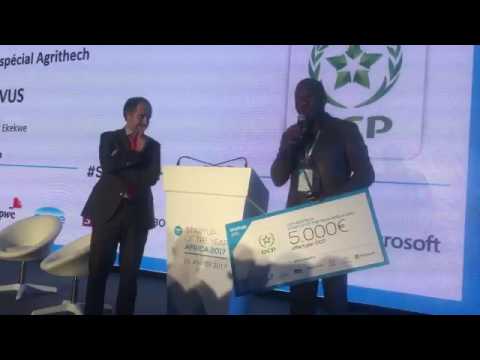
In Casablanca, Morocco, last Thursday, Zenvus received OCP Group AgTech Startup of the Year.  OCP Group is a leading fertilizer producer in the world.

Watch Zenvus founder, Ndubuisi Ekekwe, receives the award which he later dedicated to African farmers.

Zenvus wins OCP Group AgTech Startup of the Year


Zenvus dedicates Award to African farmers


Few days left – save 50% & graduate in 2017 for a better job

0
happy african male university graduate with classmates

Prepare or gift a new career in 2017. Cybersecurity and digital forensics are careers in high demand and First Atlantic Cybersecurity Institute, Pittsburgh USA (Facyber.com) provides the education needed to enter these fields.

Our online learning programs are flexible and affordable and come with a (first week)100% money back guarantee.

Learn about:
– Cybersecurity Policy
– Cybersecurity Management
– Cybersecurity Technology
– Cybersecurity Intelligence and Digital Forensics

Each program category is independently phased as Certificate (online 12 weeks), Diploma (online 12 weeks), and Nanodegree (1 week live). Our programs are relevant for engineers, lawyers, policymakers, law enforcement, health professionals, students, investors, bankers,insurers, etc as they cover all areas of cybersecurity – from policy to technology to management.

Start today and you can finish your program in a few months with real world skills you can use on the job. Alternatively, gift it to someone you love (cousins, friends, students, children, etc). He/she can begin a new journey to a new career.

Winter Special!
Enroll or gift a certificate program for only $200! Paypal, debit & credit cards, and bank transfer supported across Africa.

The Program Catalog and detailed Table of Contents are well documented.


We’re looking for local partners across Africa to help promote our programs. For more, contact Audrey Kumar via info@facyber.com

This post has been updated

The Ranking of African billionaires, Forbes Africa

0

Nigerian cement tycoon Aliko Dangote remains Africa’s richest person for the sixth year running with a $12.1 billion fortune, despite a nearly $5 billion drop in his net worth for the second year in a row. Dangote is joined by just two other Nigerian billionaires on this year’s list – telecom tycoon Mike Adenuga, who is Africa’s third richest person with an estimated $5.8 billion fortune, and oil billionaire Folorunsho Alakija, who has an estimated net worth of $1.6 billion. Two Nigerians dropped off the Billionaires List this year – oil marketer Femi Otedola, whose net worth dropped from $1.6 billion in November 2015 to just $330 million today, and sugar billionaire Abdulsamad Rabiu, whose net worth dropped below $1 billion in the wake of a weakened Nigerian currency.

Thirteen out of Africa’s 21 billionaires have self-made fortunes, while the other eight inherited their fortunes. The 21 billionaires hail from seven countries: South Africa, Egypt, Nigeria, Morocco (which has three billionaires), Algeria (one billionaire), Angola (one billionaire) and Tanzania (one billionaire).

African billionaire fortunes have declined on the new FORBES list of the continent’s richest. 

My Experience in the World’s Finest University as it Transformed Me From a Dreamer into a Maker

1
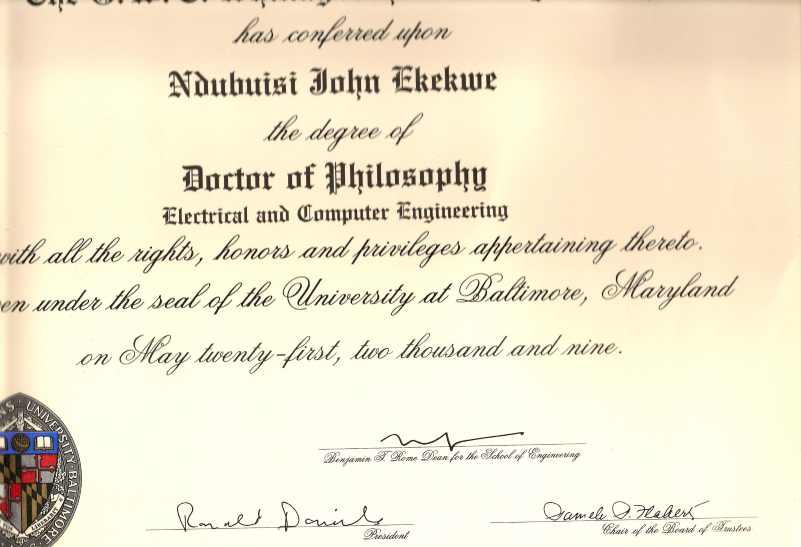
Johns Hopkins PhD certificate

If you are looking for a university for a graduate program, I recommend the very one I attended – The Johns Hopkins University.

When I made it into the electrical /computer engineering doctoral program, I was among the less than twenty selected students out of more than 900 that applied. The Whiting School of Engineering is very competitive because the University will not admit you for a PhD program unless it has funding for you.

Essentially, the School does not expect you to fund your PhD program.

Also, the usual admission application fee is waived – the only university in the top ten where that is done, at least for the engineering program.

I had great grades – 800/800 in GRE quantitative with 4/4 in CGPA coming in from Tuskegee University master’s program. And my Statement of Purpose was clear – become an expert, work in the US semiconductor industry to understand electronics business, teach in a top university faculty to improve my profile, and then move on to help develop electronics design industry in Africa.

When the action started, I asked for the course requirements towards the award of the PhD. Most schools have defined number of credit hours which must be satisfied for a doctoral degree.

I was told that in Hopkins Engineering PhD program, there was no official course requirement. Practically, you could get the PhD without technically taking any course if you can pass the Qualifying Exam, Graduate Board Oral Exam (GBO) and demonstrate excellence in research and scholarship.

But be warned – there is no way it would be humanly possible to accomplish these requirements without taking courses. You need the courses to deepen your depths as you would be working on things no one has a clear answer, including your professor.

The structure of the program gave me freedom. I could create a Course for my life by myself. But it has many risks as anything is fair game. How? During my GBO exam, a professor asked me to develop the equation of motion of a simple pendulum using the Lagrangian. Another asked me questions on complex numbers and L’Hopital’s rule.

For most of the questions, they did not expect me to know the answers, on the spot, with 5 professors watching. Largely, they were more interested in how you approach things than actually solving the questions. They were assessing the thinking process and not necessarily the final answers. At the end, they would vote if you have the capabilities to remain in the program.

More than 40% of PhD students end the journeys at GBO exam – they graduate and go home with master’s degree. Passing the GBO exam makes one a PhD Candidate as you are likely to get it because you have passed the most challenging hurdle.

In my first year, I had three fellowships: Johns Hopkins Fellowship, Whiting School of Engineering Fellowship and National Science Foundation Engineering Research Center Fellowship. I never received an invoice for tuition; the good Americans in different ways paid all.

At the onset, I decided to maximize these fellowships. I took as many courses as possible including biology, creative writing, business, mathematics, medicine, surgery besides typical engineering courses.

It was liberating especially the Creative Writing course which I registered to follow the footsteps of my country woman, Chimamanda Ngozi Adichie, who turned her class homework into a bestseller titled “Purple Hibiscus”. I did not do well at all; I dropped the course big time. Imagine listening to a professor on how to effectively choose titles, for hours, and why titles are the most condensed summaries for any work. It required a different level of talent which I lacked.

As I progressed on the PhD program, I quickly realized that I could do many things besides electronics and circuits. Anything I did not know but desired to know, I would sign-up for a helping class in Hopkins. And if the work load became unbearable, as many were, I would drop them but still attended the classes. I used the Steve Jobs strategy – forget the grades, focus on the learning.

Within two years, I had become ultra-exposed in many things.

I got my first consulting gig with World Bank, assisted in reviewing documents for World Bank, UN and African Development Bank. The African Union accepted and published my paper on the single currency policy. They even paid me to present my work during AU Congress. I wrote a book on technology policy which won IGI Global Book of the Year award. And spoke before the Mayor of Moscow as they planned the Skolkovo project. Later, he invited me to Moscow to keynote Moscow Open Innovation Forum. As a student, I was in cash.

Then I started buying stocks in New York Stock Exchange and NASDAQ. One day I lost $26,700 when they nationalized Freddie Mac and Fannie Mae. I had cut-off all stock research to finish my dissertation and was not following market news. I felt bad and learnt a huge lesson – the professionals deserve their wages!

For most universities, my experience would not have been possible. Hopkins gives students opportunities to create the future they deserve. It was an unbelievable experience in the best of educational quality.

I received IGI Global 2010 “Book of the Year” award

After my first year, I authored Nigeria’s Vision 2020 Microelectronics Thematic Area and was invited to join the International Advisory Board of World Bank -STEPB multi-million dollar project by the Nigerian Government. The reality was the courses were so good that I became an expert and an authority in the domains. STEP-B Coordinator, Prof M.U. Adikwu, current Vice Chancellor, University of Abuja (Nigeria), later contributed in two of my books.

My Surgery Class – we did abdominal surgery on a pig on this particular day

While in Hopkins, I developed the passion for business. At a time, I knew the names of at least 80% of Fortune 100 CEOs and I had paid subscriptions to Forbes, Fortune, Economist and Businessweek (still active).

When I was rounding up, I knew my world very well. I had done real work in engineering as I had obtained a patent on medical robotics. I had authored good papers and in the technical domain, I had flourished.

As a Hopkins Engineer, I work to address the world’s challenges

Then I graduated, but I was very unhappy to be leaving. It was tough as there was no practical way to delay it as my advisor has noted that I was “ready” to depart having demonstrated scholarship in my area. I was making good money from fellowships and the extra went into funding Fasmicro in Nigeria. I had started it in Hopkins, hiring 13 bright young Nigerians remotely. In the day, I was a Hopkins student; in the night, I was a startup founder in Nigeria.

My first service after earning my PhD was touring 43 universities in Nigeria over 4 months. I had wanted to inspire younger people in Nigeria. I also went to Kenya, Gabon, and Rwanda to share some of the things I had learnt from JHU. My focus was introducing microelectronics in school programs. I assisted many professors in Africa to refresh their courseware on electronics. I also developed lab manuals for schools. For all, I declined payment.

My presentation at Federal University of Technology Owerri (Nigeria), my undergrad alma mater

Making sure no one paid me was important. I had told William R. Brody, then President of Johns Hopkins, the day I received JD Samstag Fellowship from him, that awarding fellowships to people like me would be more impactful than the U.S. government sending money to corrupt African leaders. That people like me could develop Africa if U.S. government focuses on developing young Africans.

The JD Samstag Award letter

After the African trips, I accepted a job in Analog Devices. Intel Corp (Ronler Acres Campus, Oregon) had provided an offer but I preferred to live in Boston because of the stronger university communities. But Intel Corp was special as they paid me per diem of $40 per hour for the four days I traveled for the interview.

Life has been beautiful and I am eternally thankful to Johns Hopkins. My Fasmicro Group will add more than 1,500 people in Nigeria as we expand in our agriculture business. Atlantic Americas, a joint venture agriculture operator, will absorb the new hires. Hopkins made me a parallel entrepreneur with agility to quickly adjust as economic indicators change.

On May 28, 2015, I read then Nigeria President-elect Muhammadu Buhari’s prepared inauguration speech. I requested for a dinner with my business mentor, Mr. Tony Elumelu, who was in Abuja for the inauguration. That evening, I asked him 5 questions on what I saw as the opportunity in the next four years based on the prepared speech. He cleared some ambiguities in my thinking. Quickly, I moved into agriculture and other areas in line with government policy.

If you are looking for a university to do PhD, please choose Hopkins. It offers an endless world of learning expected in a university that pioneered graduate education in United States.

I am a Hopkins Engineer. I am addressing the world’s challenges.

I am a MAKER.

Notes On Early Stage Technology Investing; Art, Science, or Both?

0

Often when I have asked other people this question I get a response that leaves me feeling dissatisfied. It seems most investors are compelled to take one side over the other, and, at least as far as the admittedly small sample  of investors I have asked this question are concerned, insufficient thought is given to the notion that perhaps early stage investing has elements that make it like art in some respects but like science in others.

I am writing these notes on early stage technology investing in order to clarify my own thinking on the subject.1 Ideally, once I am done I should have a clearer understanding of how my process for arriving at “yes” or “no” decisions should work, in what context certain steps can be truncated or even eliminated altogether, and the risks I am exposing our fund’s limited partners and myself to by the choices I make during the period over which I study and analyse an early stage startup that is an investment prospect.

To ensure we are on the same page, and thinking about the issues from the same starting point . . . first, some definitions.

Definition #1: What is a startup? A startup is a temporary organization built to search for the solution to a problem, and in the process to find a repeatable, scalable and profitable business model that is designed for incredibly fast growth. The defining characteristic of a startup is that of experimentation – in order to have a chance of survival every startup has to be good at performing the experiments that are necessary for the discovery of a successful business model.2 As an investor, I hope that each early stage startup in which I have made an investment matures into a company.

Definition #2: What is art? 

The expression or application of human creative skill and imagination, typically in a visual form such as painting or sculpture, producing works to be appreciated primarily for their beauty or emotional power.3

In an article published in 2010, Marilina Maraviglia says:

This question pops up often, and with many answers. Many argue that art cannot be defined. We could go about this in several ways. Art is often considered the process or product of deliberately arranging elements in a way that appeals to the senses or emotions. It encompasses a diverse range of human activities, creations and ways of expression, including music, literature, film, sculpture and paintings. The meaning of art is explored in a branch of philosophy known as aesthetics. At least, that’s what Wikipedia claims.

Art is generally understood as any activity or product done by people with a communicative or aesthetic purpose – something that expresses an idea, an emotion or, more generally, a world view.

It is a component of culture, reflecting economic and social substrates in its design. It transmits ideas and values inherent in every culture across space and time. Its role changes through time, acquiring more of an aesthetic component here and a socio-educational function there.4

Lastly, according to Tolstoy:

To evoke in oneself a feeling one has once experienced, and having evoked it in oneself, then, by means of movements, lines, colors, sounds, or forms expressed in words, so to transmit that feeling that others may experience the same feeling — this is the activity of art.

Art is a human activity consisting in this, that one man consciously, by means of certain external signs, hands on to others feelings he has lived through, and that other people are infected by these feelings and also experience them.5

I will attempt to extract a few key characteristics that I think qualify something as art on the basis of the preceding quotations.6

First, art is initially conceived or imagined entirely in the artist’s mind.

Second, the artist uses an artistic medium to transform what has been an intangible object in the artist’s mind into something tangible that other people can experience.

Third, art evokes a response from the people who experience it.

Finally, art is transformative in nature. Once experienced, art changes how we see and experience the world.

Definition #2: What is science? Conventional, and commonly held notions about what constitutes science often mistake and confuse the “pedagogy of science” with the “practice of science” . . . What does that mean precisely?

When we learn science we do so in a very formulaic manner. This makes sense, the first step in becoming a scientist is learning a sufficient amount of the body of knowledge that man has accumulated over time thanks to the work done by generations of scientists. The same is true for mathematics. That makes sense . . . Structure and process are important if the typical student of science is to make steady progress through the accumulated body of knowledge, until that student has built enough mastery of the subject to begin making new contributions to the knowledge we keep accumulating about the world. Out of necessity, the process of learning science adheres to the “scientific method” . . . It is linear, and simple, and provides structure for how one goes about mastering the accumulated knowledge of science. Generally, the process of teaching and learning science leaves little room for creativity. This leads many to develop and embrace the notion that the practice of science is an endeavor devoid of creativity. The way science is taught and learned also leads to the misconception that science is uniformly precise at every stage, and that it leads to conclusive answers to the questions that scientists investigate.

However, how one learns science is not the same as how one practices science. The following images attempt to illustrate that point.

Real Process of Science (1 of 3) . Image Credit: University of California Museum of Paleontology's Understanding Science

Real Process of Science (1 of 3). Image Credit: University of California Museum of Paleontology’s Understanding Science

Real Process of Science (2 of 3). Image Credit: University of California Museum of Paleontology's Understanding Science

Real Process of Science (2 of 3). Image Credit: University of California Museum of Paleontology’s Understanding Science

Real Process of Science (3 of 3). Image Credit: University of California Museum of Paleontology's Understanding Science

Real Process of Science (3 of 3). Image Credit: University of California Museum of Paleontology’s Understanding Science

In real-life, scientists:

  1. Create knowledge using an iterative process in which new advancements are built on prior work, in relatively small, incremental steps. The process starts with ideas, beliefs, or guesses . . . conceived entirely in the scientist’s mind. Old knowledge is revised, and modified based on new discoveries made possible by advancements in technology.
  2. Conduct research for which there’s no pre-determined outcome. For example, the evidence obtained from observation and experimentation might contradict the researcher’s best before-the-fact guesses and assumptions as well as established and accepted theory.
  3. Always begin with an idea that can be tested through observation, experimentation, measurement, and analysis. Observation, experimentation, measurement, and analysis – together, these constitute the scientist’s medium.
  4. Conduct experiments to test the ideas that they seek to investigate. The process of conducting experiments is the method by which they collect the necessary evidence that leads them to ultimately accept or reject the idea under investigation. To succeed at this they must be willing to reject conventional-wisdom, and scrutinize closely-held and cherished beliefs based on the evidence and observations of the experiments they perform.
  5. Typically work in collaboration with other scientists, or scientists-in-training. For example, as an undergraduate mathematics and physics double major at Connecticut College, I spent three years assisting Prof. Arlan W. Mantz with research on the temperature dependence of molecular absorption line widths and shapes using tunable semiconductor diode lasers. The nature of scientific collaboration can be direct or indirect.
  6. Often say that ” . . . further research needs to be conducted on this topic . . . ” This refrain seems to be a common feature of presentations in which scientists present their work. Yet, if one understands science as the pursuit of a deeper, nuanced, and increasingly sophisticated understanding of the laws that govern the natural world . . . That makes complete sense. Scientific research is ongoing in its search for better answers to questions that non-scientists might consider closed-to-debate.
  7. Transform our understanding of the laws of nature, and in so doing change the relationship that we each have with the world around us.

I can’t find a substantive difference between what we stereotypically call “art” and that which we stereotypically call “science” . . . Can you?

Does science evoke a response from the people who experience it? Each time I use one of the many objects that has become part of modern life, I am filled with awe at what scientists have accomplished. I will grant that there is one difference between “art” and “science”; namely it is that art is related to notions of aesthetic beauty. Yet, one could argue that there is aesthetic beauty in science as well.

Consider the equation:

Mass-Energy Equivalence

Let’s set dogma aside, for a moment; Can one argue objectively that this equation is not an aesthetically pleasing way to express the relationship that exists between the energy and the mass of an object?

What are the implications for me as an early stage investor, if “art” and “the practice of science” are more alike than they are different?

Here is a scientist’s code of conduct according to the University of California Museum of Paleontology:7

  1. Pay attention to what other people have already done. Scientific knowledge is built cumulatively. If you want to discover exciting new things, you need to know what people have already discovered before you. This means that scientists study their fields extensively to understand the current state of knowledge.
  2. Expose your ideas to testing. Strive to describe and perform the tests that might suggest you are wrong and/or allow others to do so. This may seem like shooting yourself in the foot but is critical to the progress of science. Science aims to accurately understand the world, and if ideas are protected from testing, it’s impossible to figure out if they are accurate or inaccurate!
  3. Assimilate the evidence. Evidence is the ultimate arbiter of scientific ideas. Scientists are not free to ignore evidence. When faced with evidence contradicting his or her idea, a scientist may suspend judgment on that idea pending more tests, may revise or reject the idea, or may consider alternate ways to explain the evidence, but ultimately, scientific ideas are sustained by evidence and cannot be propped up if the evidence tears them down.
  4. Openly communicate ideas and tests to others. Communication is important for many reasons. If a scientist keeps knowledge to her- or himself, others cannot build upon those ideas, double-check the work, or devise new ways to test the ideas.
  5. Play fair: Act with scientific integrity. Hiding evidence, selectively reporting evidence, and faking data directly thwart science’s main goal — to construct accurate knowledge about the natural world. Hence, maintaining high standards of honesty, integrity, and objectivity is critical to science.

Image Credit: Tasha S. K. Aoaeh

Image Credit: Tasha S. K. Aoaeh

What are the risks I take if I cling to the notion that early stage investing is “all art” and “no science”? For one, I will not subject my own assumptions, hunches, guesses, biases, ideas, visions, opinions to the level of scrutiny to which they should be subjected. Worse yet, I might fail to subject other people’s ideas and assumptions to sufficient scrutiny and testing. Instead; I might rely on decision-making heuristics like “pattern-matching” and I might engage in “groupthink” or succumb to social-proof bias . . . I might fail to maintain a mind that is sufficiently open and flexible to recognise an early stage startup founder poised to transform the world because that founder does not fit my idea of what such a founder “looks like” . . . I might pass on a great startup investment for reasons that are completely irrelevant simply because I have failed to develop my own thinking and ideas about its prospects . . . I might fail to unlock promising new markets before the greatest returns have already been harvested by other early stage investors because I lacked enough curiosity and discipline to ask nuanced questions and challenge myself to acquire new knowledge and insights from other sources and other people – possibly people outside circles within which I am most comfortable . . . I might spend my career in early stage technology investing in a self-imposed exile to the land of piddling mediocrity.

I find none of those possible outcomes palatable; early stage investing is both an art and a science. The best early stage venture capitalists behave in keeping with that belief. It is their trade secret.

Science is Uncertain - Freeman Dyson

Science is Uncertain – Freeman Dyson

Further Reading

  1. The Pleasure (and Necessity) of Finding Things Out

  1. Let me know if you feel I have failed to attribute something appropriately. Tell me how to fix the error, and I will do so. I regret any mistakes in quoting from my sources. ?
  2. I am paraphrasing Steve Blank and Bob Dorf, and the definition they provide in their book The Startup Owner’s Manual: The Step-by-Step Guide for Building a Great Company. I have modified their definition with an element from a discussion in which Paul Graham, founder of Y Combinator discusses the startups that Y Combinator supports. ?
  3. http://www.oxforddictionaries.com/us/definition/american_english/art, acessed Jun 18th, 2015. ?
  4. Marilina Maraviglia, What Do We Really Mean By Art? Accessed on Jun 18th, 2015 at http://www.smashingmagazine.com/2010/07/23/what-do-we-really-mean-by-art/ ?
  5. Leo Tolstoy, Art and Sincereity. Accessed on Jun 18th, 2015 at http://denisdutton.com/tolstoy.htm ?
  6. Adapted from: What is art? An Essay on 21st Century Art, Sylvia Hartmann. Accessed on Jun 18th at http://silviahartmann.com/art.php ?
  7. “Participants in science behave scientifically.” Understanding Science. University of California Museum of Paleontology. Accessed on Jun 18th, 2015 at http://undsci.berkeley.edu/article/0_0_0/whatisscience_09 ?