DD
MM
YYYY

PAGES

DD
MM
YYYY

spot_img

PAGES

Home Blog Page 7469

Notes On Early Stage Technology Investing; Art, Science, or Both?

0

Often when I have asked other people this question I get a response that leaves me feeling dissatisfied. It seems most investors are compelled to take one side over the other, and, at least as far as the admittedly small sample  of investors I have asked this question are concerned, insufficient thought is given to the notion that perhaps early stage investing has elements that make it like art in some respects but like science in others.

I am writing these notes on early stage technology investing in order to clarify my own thinking on the subject.1 Ideally, once I am done I should have a clearer understanding of how my process for arriving at “yes” or “no” decisions should work, in what context certain steps can be truncated or even eliminated altogether, and the risks I am exposing our fund’s limited partners and myself to by the choices I make during the period over which I study and analyse an early stage startup that is an investment prospect.

To ensure we are on the same page, and thinking about the issues from the same starting point . . . first, some definitions.

Definition #1: What is a startup? A startup is a temporary organization built to search for the solution to a problem, and in the process to find a repeatable, scalable and profitable business model that is designed for incredibly fast growth. The defining characteristic of a startup is that of experimentation – in order to have a chance of survival every startup has to be good at performing the experiments that are necessary for the discovery of a successful business model.2 As an investor, I hope that each early stage startup in which I have made an investment matures into a company.

Definition #2: What is art? 

The expression or application of human creative skill and imagination, typically in a visual form such as painting or sculpture, producing works to be appreciated primarily for their beauty or emotional power.3

In an article published in 2010, Marilina Maraviglia says:

This question pops up often, and with many answers. Many argue that art cannot be defined. We could go about this in several ways. Art is often considered the process or product of deliberately arranging elements in a way that appeals to the senses or emotions. It encompasses a diverse range of human activities, creations and ways of expression, including music, literature, film, sculpture and paintings. The meaning of art is explored in a branch of philosophy known as aesthetics. At least, that’s what Wikipedia claims.

Art is generally understood as any activity or product done by people with a communicative or aesthetic purpose – something that expresses an idea, an emotion or, more generally, a world view.

It is a component of culture, reflecting economic and social substrates in its design. It transmits ideas and values inherent in every culture across space and time. Its role changes through time, acquiring more of an aesthetic component here and a socio-educational function there.4

Lastly, according to Tolstoy:

To evoke in oneself a feeling one has once experienced, and having evoked it in oneself, then, by means of movements, lines, colors, sounds, or forms expressed in words, so to transmit that feeling that others may experience the same feeling — this is the activity of art.

Art is a human activity consisting in this, that one man consciously, by means of certain external signs, hands on to others feelings he has lived through, and that other people are infected by these feelings and also experience them.5

I will attempt to extract a few key characteristics that I think qualify something as art on the basis of the preceding quotations.6

First, art is initially conceived or imagined entirely in the artist’s mind.

Second, the artist uses an artistic medium to transform what has been an intangible object in the artist’s mind into something tangible that other people can experience.

Third, art evokes a response from the people who experience it.

Finally, art is transformative in nature. Once experienced, art changes how we see and experience the world.

Definition #2: What is science? Conventional, and commonly held notions about what constitutes science often mistake and confuse the “pedagogy of science” with the “practice of science” . . . What does that mean precisely?

When we learn science we do so in a very formulaic manner. This makes sense, the first step in becoming a scientist is learning a sufficient amount of the body of knowledge that man has accumulated over time thanks to the work done by generations of scientists. The same is true for mathematics. That makes sense . . . Structure and process are important if the typical student of science is to make steady progress through the accumulated body of knowledge, until that student has built enough mastery of the subject to begin making new contributions to the knowledge we keep accumulating about the world. Out of necessity, the process of learning science adheres to the “scientific method” . . . It is linear, and simple, and provides structure for how one goes about mastering the accumulated knowledge of science. Generally, the process of teaching and learning science leaves little room for creativity. This leads many to develop and embrace the notion that the practice of science is an endeavor devoid of creativity. The way science is taught and learned also leads to the misconception that science is uniformly precise at every stage, and that it leads to conclusive answers to the questions that scientists investigate.

However, how one learns science is not the same as how one practices science. The following images attempt to illustrate that point.

Real Process of Science (1 of 3) . Image Credit: University of California Museum of Paleontology's Understanding Science

Real Process of Science (1 of 3). Image Credit: University of California Museum of Paleontology’s Understanding Science

Real Process of Science (2 of 3). Image Credit: University of California Museum of Paleontology's Understanding Science

Real Process of Science (2 of 3). Image Credit: University of California Museum of Paleontology’s Understanding Science

Real Process of Science (3 of 3). Image Credit: University of California Museum of Paleontology's Understanding Science

Real Process of Science (3 of 3). Image Credit: University of California Museum of Paleontology’s Understanding Science

In real-life, scientists:

  1. Create knowledge using an iterative process in which new advancements are built on prior work, in relatively small, incremental steps. The process starts with ideas, beliefs, or guesses . . . conceived entirely in the scientist’s mind. Old knowledge is revised, and modified based on new discoveries made possible by advancements in technology.
  2. Conduct research for which there’s no pre-determined outcome. For example, the evidence obtained from observation and experimentation might contradict the researcher’s best before-the-fact guesses and assumptions as well as established and accepted theory.
  3. Always begin with an idea that can be tested through observation, experimentation, measurement, and analysis. Observation, experimentation, measurement, and analysis – together, these constitute the scientist’s medium.
  4. Conduct experiments to test the ideas that they seek to investigate. The process of conducting experiments is the method by which they collect the necessary evidence that leads them to ultimately accept or reject the idea under investigation. To succeed at this they must be willing to reject conventional-wisdom, and scrutinize closely-held and cherished beliefs based on the evidence and observations of the experiments they perform.
  5. Typically work in collaboration with other scientists, or scientists-in-training. For example, as an undergraduate mathematics and physics double major at Connecticut College, I spent three years assisting Prof. Arlan W. Mantz with research on the temperature dependence of molecular absorption line widths and shapes using tunable semiconductor diode lasers. The nature of scientific collaboration can be direct or indirect.
  6. Often say that ” . . . further research needs to be conducted on this topic . . . ” This refrain seems to be a common feature of presentations in which scientists present their work. Yet, if one understands science as the pursuit of a deeper, nuanced, and increasingly sophisticated understanding of the laws that govern the natural world . . . That makes complete sense. Scientific research is ongoing in its search for better answers to questions that non-scientists might consider closed-to-debate.
  7. Transform our understanding of the laws of nature, and in so doing change the relationship that we each have with the world around us.

I can’t find a substantive difference between what we stereotypically call “art” and that which we stereotypically call “science” . . . Can you?

Does science evoke a response from the people who experience it? Each time I use one of the many objects that has become part of modern life, I am filled with awe at what scientists have accomplished. I will grant that there is one difference between “art” and “science”; namely it is that art is related to notions of aesthetic beauty. Yet, one could argue that there is aesthetic beauty in science as well.

Consider the equation:

Mass-Energy Equivalence

Let’s set dogma aside, for a moment; Can one argue objectively that this equation is not an aesthetically pleasing way to express the relationship that exists between the energy and the mass of an object?

What are the implications for me as an early stage investor, if “art” and “the practice of science” are more alike than they are different?

Here is a scientist’s code of conduct according to the University of California Museum of Paleontology:7

  1. Pay attention to what other people have already done. Scientific knowledge is built cumulatively. If you want to discover exciting new things, you need to know what people have already discovered before you. This means that scientists study their fields extensively to understand the current state of knowledge.
  2. Expose your ideas to testing. Strive to describe and perform the tests that might suggest you are wrong and/or allow others to do so. This may seem like shooting yourself in the foot but is critical to the progress of science. Science aims to accurately understand the world, and if ideas are protected from testing, it’s impossible to figure out if they are accurate or inaccurate!
  3. Assimilate the evidence. Evidence is the ultimate arbiter of scientific ideas. Scientists are not free to ignore evidence. When faced with evidence contradicting his or her idea, a scientist may suspend judgment on that idea pending more tests, may revise or reject the idea, or may consider alternate ways to explain the evidence, but ultimately, scientific ideas are sustained by evidence and cannot be propped up if the evidence tears them down.
  4. Openly communicate ideas and tests to others. Communication is important for many reasons. If a scientist keeps knowledge to her- or himself, others cannot build upon those ideas, double-check the work, or devise new ways to test the ideas.
  5. Play fair: Act with scientific integrity. Hiding evidence, selectively reporting evidence, and faking data directly thwart science’s main goal — to construct accurate knowledge about the natural world. Hence, maintaining high standards of honesty, integrity, and objectivity is critical to science.

Image Credit: Tasha S. K. Aoaeh

Image Credit: Tasha S. K. Aoaeh

What are the risks I take if I cling to the notion that early stage investing is “all art” and “no science”? For one, I will not subject my own assumptions, hunches, guesses, biases, ideas, visions, opinions to the level of scrutiny to which they should be subjected. Worse yet, I might fail to subject other people’s ideas and assumptions to sufficient scrutiny and testing. Instead; I might rely on decision-making heuristics like “pattern-matching” and I might engage in “groupthink” or succumb to social-proof bias . . . I might fail to maintain a mind that is sufficiently open and flexible to recognise an early stage startup founder poised to transform the world because that founder does not fit my idea of what such a founder “looks like” . . . I might pass on a great startup investment for reasons that are completely irrelevant simply because I have failed to develop my own thinking and ideas about its prospects . . . I might fail to unlock promising new markets before the greatest returns have already been harvested by other early stage investors because I lacked enough curiosity and discipline to ask nuanced questions and challenge myself to acquire new knowledge and insights from other sources and other people – possibly people outside circles within which I am most comfortable . . . I might spend my career in early stage technology investing in a self-imposed exile to the land of piddling mediocrity.

I find none of those possible outcomes palatable; early stage investing is both an art and a science. The best early stage venture capitalists behave in keeping with that belief. It is their trade secret.

Science is Uncertain - Freeman Dyson

Science is Uncertain – Freeman Dyson

Further Reading

  1. The Pleasure (and Necessity) of Finding Things Out

  1. Let me know if you feel I have failed to attribute something appropriately. Tell me how to fix the error, and I will do so. I regret any mistakes in quoting from my sources. ?
  2. I am paraphrasing Steve Blank and Bob Dorf, and the definition they provide in their book The Startup Owner’s Manual: The Step-by-Step Guide for Building a Great Company. I have modified their definition with an element from a discussion in which Paul Graham, founder of Y Combinator discusses the startups that Y Combinator supports. ?
  3. http://www.oxforddictionaries.com/us/definition/american_english/art, acessed Jun 18th, 2015. ?
  4. Marilina Maraviglia, What Do We Really Mean By Art? Accessed on Jun 18th, 2015 at http://www.smashingmagazine.com/2010/07/23/what-do-we-really-mean-by-art/ ?
  5. Leo Tolstoy, Art and Sincereity. Accessed on Jun 18th, 2015 at http://denisdutton.com/tolstoy.htm ?
  6. Adapted from: What is art? An Essay on 21st Century Art, Sylvia Hartmann. Accessed on Jun 18th at http://silviahartmann.com/art.php ?
  7. “Participants in science behave scientifically.” Understanding Science. University of California Museum of Paleontology. Accessed on Jun 18th, 2015 at http://undsci.berkeley.edu/article/0_0_0/whatisscience_09 ?
A Note on Developing and Testing Hypotheses

0

This post is a continuation of the discussion I started in A Note On Startup Business Model Hypotheses. In this post I will describe how one might go about developing and testing a hypothesis about any aspect of a startup’s  business model.1

I will use a fine-dining restaurant as a motivating example.

To ensure we are on the same page, first some definitions.

Definition #1: What is a startup? A startup is a temporary organization built to search for the solution to a problem, and in the process to find a repeatable, scalable and profitable business model that is designed for incredibly fast growth. The defining characteristic of a startup is that of experimentation – in order to have a chance of survival every startup has to be good at performing the experiments that are necessary for the discovery of a successful business model.2

Definition #2: What is a business model? A business model is the description of how a startup will create, deliver and capture value. Alex Osterwalder’s Business Model Canvas is one framework for describing and documenting the elements of a startup’s business model.

Alex Osterwalder's Business Model Canvas, from the book Business Model Generation

Alex Osterwalder’s Business Model Canvas, from the book Business Model Generation

Definition #3 What is a hypothesis? A hypothesis is a statement, or a group of statements, that proposes an answer to a question, or a solution to a problem, in a manner that is testable through experimentation. The goal of experimentation and testing is to determine if the hypothesis is correct, and to inform the subsequent actions that the startup should take on the basis of that evidence.

A hypothesis is;

  1. A guess about the process underlying a set of observations that have been made by the founder.
  2. A testable guess, in the sense that it attempts to establish and predict the basic relationship between two or more variables that interact with one another to lead to the observed phenomena. This allows the researcher to test what happens when one of those variables is allowed to change, while others are held constant.
  3. Not the same as a research question; in the sense that a research question is broad while a hypothesis is more narrow in scope.

Motivating example; A fine-dining restaurant is experiencing an ongoing slump in revenues. The restaurateur wishes to test a number of possible approaches to reversing that trend. From prior experience they believe that the following factors each has a positive impact on overall sales at the restaurant;

  1. Wine Sales
  2. Liquor Sales
  3. Appetizers
  4. Seasonal Menu Changes
  5. Table Turns
  6. PR, Advertising and Marketing

How should management determine where to make an adjustment in order to improve overall sales without incurring a large capital outlay?

Discussion

Let us assume that Sales can be modeled by the following relationship.3

Restaurant Sales as A Function of Various Factors

Restaurant Sales as A Function of Various Factors

Remember that the goal is to try to figure out a course of action without spending too much by way of capital until the restaurateur is fairly certain that any capital deployed to this end will yield a disproportionately positive result.

To keep the discussion brief, let’s focus on two of the factors that management believes play an important role in driving revenues from the preceding list. Let’s focus on Wine Sales and PR, Advertising, and Sales.

Assume the restaurant is laid out such that the front-of-the-house is organized as two nearly identical dining rooms, they are separated by an ornate vestibule. During the experiment one dining room is operated status quo, while the other is operated as part of the experiment. Management feels this makes sense because guests are typically evenly split between the two dining rooms. Let’s call them Dining Room #1 – the control dining room, and Dining Room #2 – the dining room in which the experimental change is implemented.

Possible Hypotheses for Wine Sales Program – Experiment #1

  1. General Hypothesis: Implementing a wine-program will have an effect on sales.
  2. Directional Hypothesis: Implementing a wine-program will have a positive effect on sales.
  3. Testable Hypothesis: If we implement a wine-program we will increase revenue significantly because average check size increases substantially when wine sales increase.

Experiment #1: Management might hold all the factors constant, but implement an in-house training program to get wait-staff more comfortable speaking to guests of the restaurant about it’s current small collection of wine. Waiters in Dining Room # 2 are coached to discuss wines before guests order their meal, and afterwards when a guest might be considering a dessert. Let’s assume this program lasts a month. At the end of the month, management compares data from Dining Room #1 with data from Dining Room #2.

Possible Hypotheses for Inside-Sales Program – Experiment #2

  1. General Hypothesis: Implementing an inside-sales program will have an effect on sales.
  2. Directional Hypothesis: Implementing an inside-sales program will have a positive effect on sales.
  3. Testable Hypothesis: If we implement an inside-sales program we will increase revenue significantly because average check size increases substantially when wait-staff are encouraged to engage with guests.

Experiment #2: In this experiment, which also lasts a month, management trains wait-staff in Dining Room #2 to engage guests in casual conversation and to speak more enthusiastically and informatively about each day’s specials. Wait-staff are trained to highlight upcoming events at the restaurant that regular guests might find interesting enough to return for – a special prixe-fixe Wine Dinner the following week, for example. On occasion, every 90 minutes or so, the restaurant’s chef de cuisine spends about 10 minutes walking through Dining Room #2 and socializes with guests. The restaurateur wishes to determine if making things like this a more consistent part of how the restaurant operates makes sense from the perspective of increasing revenue.

During each experiment management collects the following data for each day, each week, and also for the month:

  1. Total Revenue
  2. Average Check Size – Revenue per Table
  3. Average Wine Sales – Wine Sales per Table
  4. Positive Social Media Mentions
  5. Negative Social Media Mentions
  6. In-restaurant Reservations – future reservations made while the guest is at dinner as a result of learning about an upcoming special event. This only applies to Experiment #2.


9-inch tall stack of paper - 6 months worth of studying

9-inch tall stack of paper – 6 months worth of studying

Now that the restaurant has collected some data it is time to test the data to see what conclusions the restaurateur might be able to reach based on each of the experiments.

Stating Null and Alternative Hypotheses

To test the hypotheses our restaurateur must make two different statements that will form the basis of a test; The Null Hypothesis states that the effect our restaurateur thinks exist does not in fact exist. The Alternative Hypothesis makes a statement opposite to that made in the null hypothesis, and typically is the statement we want to prove.

Experiment #1: Null and Alternative Hypothesis

  1. Null Hypothesis: Implementing a wine sales program has no effect on revenue.
  2. Alternative Hypothesis: Implementing a wine sales program has a positive effect on revenue.

Experiment #2: Null and Alternative Hypothesis

  1. Null Hypothesis: Implementing an inside-sales program has no effect on revenue.
  2. Alternative Hypothesis: Implementing an inside-sales program has a positive effect on revenue.

Note that the null and alternative hypotheses stated above are merely examples. The restaurateur could formulate each of those statements in more general terms, or with more specificity than I have done. To some extent that choice depends on the granularity of the data that was collected from the experiments.

At this point our restaurateur can perform a test of statistical inference to reach a conclusion – the outcome would be a “rejection” or “a failure to reject” the null hypothesis. A rejection of the null hypothesis leads us to accept the alternative hypothesis. A failure to reject the null hypothesis leads us to fail to accept the alternative hypothesis.

Assuming that the restaurateur rejects the null hypothesis in both instances, then it makes sense to spend some capital trying to build out a more robust version of each of the experiments we described, with the intention of operationalizing what was done during the experiment and making those practices a permanent part of how the restaurant is managed and run on an ongoing basis.

Closing comments:

  1. I have glossed over a significant amount of detail. That was deliberate. The goal of this post is not to discuss statistical theory, but to think about how statistical thinking can help startup founders who need to make important choices about how to utilize scarce resources. More detail can be found in any good introductory level business statistics text book.
  2. While going through this process our restaurateur needs to ask more questions than I did in this post. For example, what does “significant” mean? Is a 5% increase in revenue significant? Why? Is a 20% increase in revenue significant? Why? Or, why not? Are the costs associated with implementing the changes necessary to make what was done during the two experiments a permanent operating practice of the restaurant justified by the restaurateur’s forecasts of the long term benefit of doing so? Why, or why not?
  3. It is always important to think about sources of error whenever one is conducting an experiment that is supposed to yield data that decisions like the one I described in this post will be based upon. In this instance, one concern might be that the restaurateur is not collecting the appropriate data on which this decision should be based. Or, for example, that a single month is not a wide enough window of time to determine if the effect observed during this period of the experiment persists during the remaining 11 months of the year.

Notwithstanding those concerns, I believe that when it is possible, this kind of analysis should always complement management’s intuition.


  1. Let me know if you feel I have failed to attribute something appropriately. Tell me how to fix the error, and I will do so. I regret any mistakes in quoting from my sources. ?
  2. I am paraphrasing Steve Blank and Bob Dorf, and the definition they provide in their book The Startup Owner’s Manual: The Step-by-Step Guide for Building a Great Company. I have modified their definition with an element from a discussion in which Paul Graham, founder of Y Combinator discusses the startups that Y Combinator supports. ?
  3. I am in no way suggesting this is the appropriate model for this problem. I am using this only for the purpose of this discussion. Assume the restaurateur has developed this model after years of experience in the industry, and based on trial and error. This model is supported by the last 5 years of sales data. ?

Zenvus Wins AgTech Startup of the Year in Casablanca Morocco [Video]

1

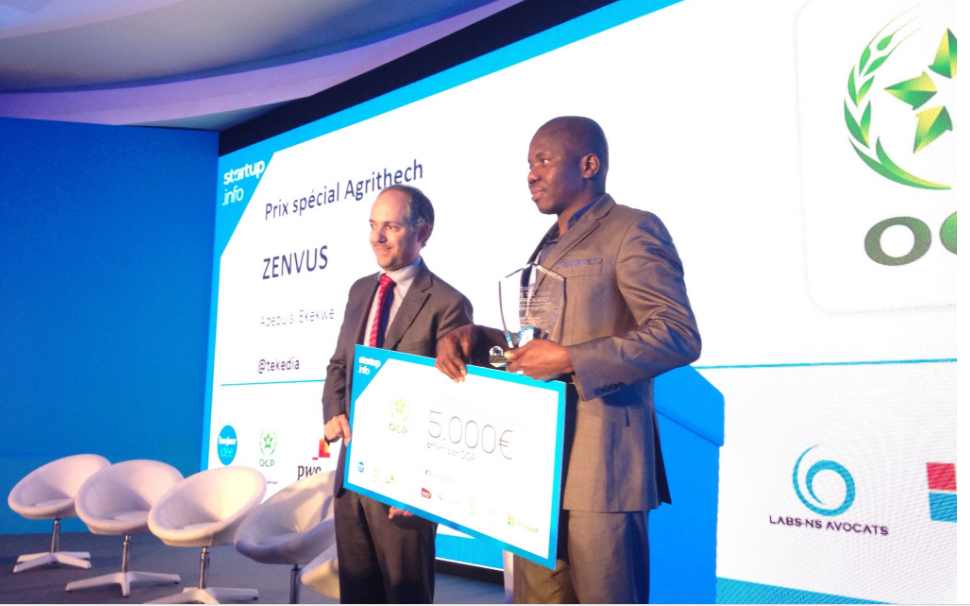
Today in Casablanca, Morocco, a wholly-owned subsidiary of Fasmicro Group was honored by the world’s largest fertilizer producer, OCP Group. Zenvus is the 2017 AgTech Startup of the Year.

Accepting the award, Fasmicro Group Founder, Ndubuisi Ekekwe,dedicated it to all African farmers. Watch clip here.


To all African farmers, we love you all. This Award is for you. As Zenvus team meets you from Nigeria to Morocco, from Kenya to South Africa, we assure you that your interests are #1 in all we do on Zenvus.

AgTech pioneer Zenvus to represent Nigeria in 2017 Future Agro Challenge Global Championships in Johannesburg

0

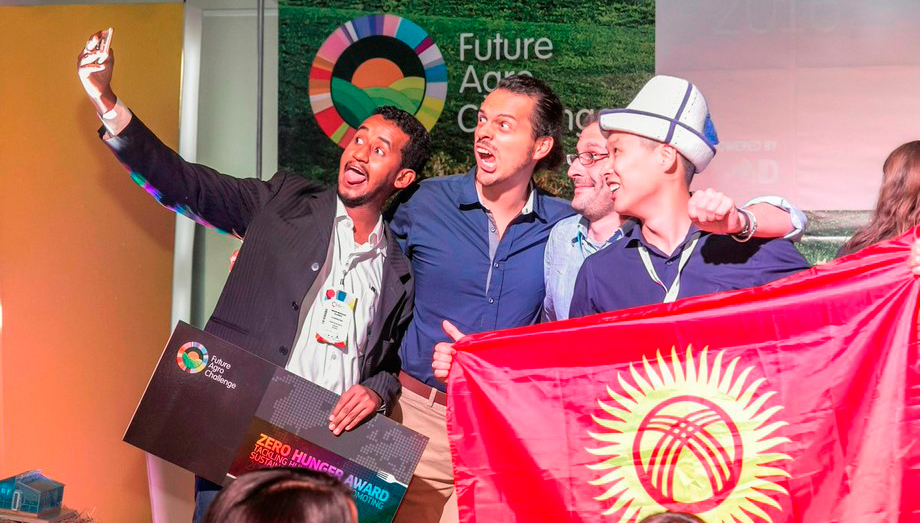
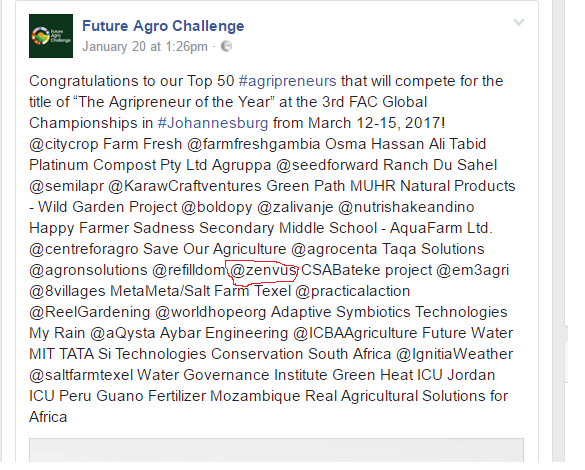
Zenvus, the agtech pioneer in Nigeria, will represent Nigeria in the Future Agro Challenge Global Championships taking place in Johannesburg, South Africa from March 12-15, 2017.  The event will hold during the Global Entrepreneurship Congress.

Future Agro Challenge (FAC) is the largest global competition that discovers innovative fundable food, agtech, and agriculture ventures from various corners of the globe addressing national, regional and global challenges. FAC provides key tools and opportunities to help them grow their business and expand them into new markets. FAC is working to make a difference on a global level by increasing interaction among agro innovators, entrepreneurs and stakeholders, by addressing national policies and challenges.

This news was communicated via email and has been posted on the Facebook page of FAC.
The FAC team has promised to make a formal press release with all the finalists and their countries, according to a Facebook post entry accompanying the preliminary communication: “Dear All! A formal update will be sent next week! We will be in touch with each person that applied. There will be information coming your way to share with media”.
Zenvus is an intelligent solution for farms that uses proprietary electronic sensors to collect soil data like moisture, nutrients, temperature, pH etc. It subsequently sends the data to a cloud server via GSM, satellite or Wifi. Algorithms in the server analyze the data and advise farmers on what, how and when to farm. As the crops grow, the system deploys hyper- spectral cameras to build crop normalized difference vegetative index which is helpful in detecting drought stress, pests and diseases on crops. The data generated is aggregated, anonymized and made available via subscription for agro-lending, agro-insurance, commodity trading to banks, insurers and investors. Zenvus also has a mapping feature which can help a farmer map the farm boundary with ease.

Lagos-based Printivo makes ITNewsAfrica Top 10 African Startups

0

Nigeria-based cloud printing pioneer Printivo has made ITNewsAfrica Top 10 African Startups. It is the only Nigerian company in the list. The buzz on the technology ecosystems continue to accelerate as these startups continue to demonstrate how technology and innovation could help bring solutions to some African challenges.

Besides the Nigerian startup which helps other startups and SMEs print business and marketing material with ease, other top startups are:

  • Instabug – Egypt, allows users to offer feedback from within apps and to report bugs and issues.
  • RoamSmart – Tunisia, assists mobile operators to manage their roaming businesses by allowing them to optimise workflows and monetise existing roaming sources through an automated data reporting and analysis platform.
  • Tutorama – Egypt, the online tutoring platform connects parents with top quality local tutors in their area.
  • Fuzu – Kenya, allows users to learn new skills and find jobs regardless of their levels of education.
  • Flare – Kenya, application aggregates available ambulances onto a single system, and allows patients or hospitals to request emergency help via smartphone.
  • Jumaii – Tanzania, health app offers a mobile micro-health insurance product targeted at the low income and informal sector.
  • Custos Media – South Africa, uses blockchian technology to crack down on piracy in digital media.
  • Cape – South Africa,  operates a WiFi network and application quality monitoring tool.
  • Dr CADx – Zimbabwe,  developing a computer-aided diagnostic system to help doctors diagnose medical images more accurately, and to provide pervasive radiology diagnostics in regions which currently do not have radiologists.