DD
MM
YYYY

PAGES

DD
MM
YYYY

spot_img

PAGES

Home Blog Page 7482

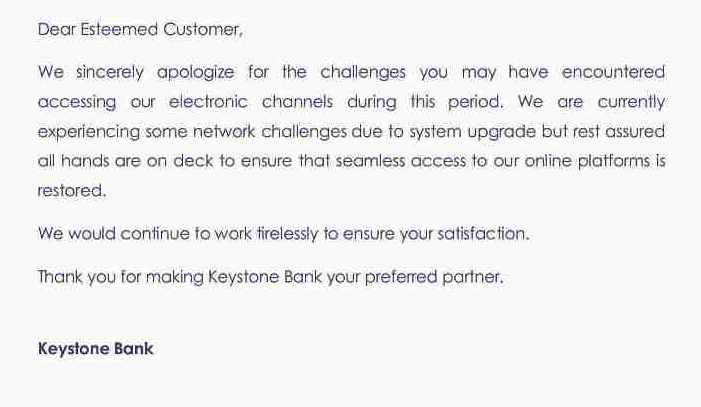
Keystone Bank Nigeria is laughable with excuse of system upgrade during Christmas

0

Imagine a bank doing system upgrade in December! That is what Keystone Bank is trying to tell us. We mean the upgrade is the reason why its services, especially in the electronic channels, have been down for days.

They need a better liar in the corporate communication unit.APC or PDF  can give them better guys to explain out things.


Why Africa should develop better policies to police Google, Facebook, etc in 2017

0

This piece by the Economist explains why the Western world will rule the 21st century. Even the promise of China is muted when you know the West is creating another world entirely. For us in Africa, we can be happy to connect as usual buyers until technical education is  made a priority in the continent.

There will be consequences for that decision. There is a possibility that software will eat all of us here in Africa. Google, Facebook and others are leading these charges via artificial intelligence. The world domination will have consequences but Africa will suffer most because we do not even have resilience capabilities.

Never think these companies are merciful – no, they are not. They answer to gods in Wall Street and will do all to make those gods happy. As Shell, Mobile etc polluted Nigerian Niger Delta, they gods applauded them. And when they finished, leaving our people in diseases and penury, the gods have forgotten. They are now looking for new areas.

So, people, Africa needs a plan for these companies in 2017. We need to be assertive to get something from them as they eat all we exist for with software and AI.

Now the piece from the Economist:

Sometimes it is perceived as a figment of the far future. But artificial intelligence (AI) is today’s great obsession in Silicon Valley. Last year technology companies spent $8.5 billion on deals and investments in artificial intelligence, four times more than in 2010. Nearly all of the world’s technology giants, including Google, Microsoft, Facebook, Amazon and Baidu, are competing fiercely to hire the best AI experts, snap up start-ups and pour money into research. What accounts for the tech elite’s sudden AI-phoria?

The technology has not always been so popular. The field was largely ignored and underfunded during the “AI winter” of the 1980s and 1990s. At that time AI research conducted at universities proved to be disappointingly slow and irrelevant to companies’ bottom lines. Now, however, the chill is gone. Progress in AI is accelerating. Recently Google generated lots of headlines when DeepMind, a start-up it acquired in 2014, helped train a computer to repeatedly beat the world champion at Go, a board game. This has sparked both fear and hope for the future of AI: hope for fat profits and improving people’s lives through technology; fear about how society will cope with the dislocation AI could bring.

AI is already starting to generate big financial gains for companies, which helps explain firms’ growing investment in developing AI capabilities. Machine-learning, in which computers become smarter by processing large data-sets, currently has many profitable consumer-facing applications, including image recognition in photographs, spam filtering and those that help to better target advertisements to web surfers. Many of tech firms’ most ambitious projects, including building self-driving cars and designing virtual personal assistants that can understand and execute complex tasks, also rely on artificial intelligence, especially machine-learning and robotics. This has prompted tech firms to try to hire up as much of the top talent as they can from universities, where the best AI experts research and teach. Some worry about the potential of a brain drain from academia into the private sector.

The biggest concern, however, is that one firm corners the majority of the talent in artificial intelligence, creating an intellectual monopoly of sorts. Google looks best positioned to do this: between its Google Brain project and its acquisition of DeepMind, it has some of the brightest human brains working on AI. Because superior AI systems are able to learn and improve more quickly, the firms that develop an early edge in artificial intelligence may reap the greatest rewards and erect barriers to entry that smaller firms will find hard to overcome. In December Elon Musk and several other tech leaders pledged $1 billion to help fund OpenAI, a research lab that will make public all of its findings, to ensure there is an entity that is working on developing AI on behalf of the public good and not just its own profits. Today AI is the domain of tech geeks, but its future matters to everyone.

It is all about the bank account balance on human happiness

0

This is true and we agree on this study.

Nice as it is, having a higher salary might not be the key to happiness. An even more important figure linked to life satisfaction is the number sitting in your checking account, according to a new study published in the journal Emotion.

In the study, researchers looked at data from 585 customers at a U.K. bank. That included survey information, like how stressed they were about their finances and how satisfied they were with their lives, along with the balances of their checking and savings accounts.

The amount of easily accessible cash people had predicted how satisfied they were with their lives—a link explained by how comfortable people felt about their finances. In fact, liquid wealth appeared to be even more important than income or debt status in predicting a person’s happiness.

“No matter how much the customers had or earned, no matter how much debt they had, having a buffer of easily accessible cash was associated with greater happiness,” says Peter Ruberton, the study’s lead author and a doctoral candidate in social personality psychology at the University of California, Riverside

Africa’s Turning Tide and the path to New Industries

0

Editor’s Note: This piece was contributed by Eve Pearce.

Past generations, both domestic and international, have asked, “how do you solve a problem like Africa?” Yet now, in 2016, the mindset is beginning to shift. With many of the biggest problems on their way to being overcome, the world’s second biggest continent is facing a future of prosperity and increasing improvements, with investments continually pouring money into the continent. While momentum remains a case of “slow and steady” rather than “rapid, unparalleled success”, optimism is high that the continent is entering a new dawn, economically, socially, and culturally.

What drives the optimism?

It’s not always the first thing mentioned when Africa is discussed, by the continent’s economy is in pretty excellent shape, especially when compared to elsewhere in the world during recession periods. When things were tough in the rest of the world, it was only Asia and Africa with economies that continued to grow.

Part of this is down to Africa’s appeal with foreign investors. There were times, recent times, when few thought of investing in a nation that was blighted with many social and logistical issues – but those issues are slowly being swept away. Social reforms and an infrastructure overhaul has enabled Africa to become a much greater part of the world economy. There’s also the matter of improved domestic productivity and wealth; Africa now has a middle class that is 300 million+ strong, with, and an overhaul population that spends more than $1 trillion each year. Whichever way you look at it, this resembles an exciting business environment.

Future Workforce

Africa is a continent that hasn’t yet experienced the population boom that occurred elsewhere in the world. As the economy and resources continue to improve, this will begin to change, and within fifty years it could be the case that Africa represents the largest workforce of any continent. This is going to coincide with a shrinking workforce elsewhere in the already developed parts of the world, which experienced their population boom many decades ago and are now starting to plateau. If Africa can provide the jobs required to employ the large workforce in coming years, then it could be looking at a huge economy, which won’t just bring it up to speed with other areas of the world – but may even start to rival them on their own.

New Industries

Historically, it was the case that there was no economy if things didn’t grow in the ground. That was the bedrock of success. But now? Not so much. With the advent of technologies, these problems are becoming surmountable, and Africa may just be the one that benefits. Agriculture, once a thorn in Africa’s side, might become a staple of its economy. With the problem of how to feed seven billion people – especially with climate change affecting crops elsewhere – Africa will become an important player on the global agriculture scene. Already, 45 firms have invested billions of dollars into Africa’s agriculture, the effects of which we will see in the coming decades. Tourism, too, is set to explode in Africa. For too long, it has been one of the few places on earth where international tourists have feared to tread. With an increasingly progressive society – and, perhaps most important of all, less wars taking place – tourists will slowly but surely start visiting Africa as they do elsewhere. Kenya has already seen a lot of growth on its own, with first rate resorts and tourism venues being built, and this will spread to other countries too.

Obstacles

It isn’t all plain sailing for Africa, which is still dogged with many innate issues that will have to be overcome. While the continent is mostly at peace, civil war and corruption are never too far away – and definitely can’t be treated as relics of the part just yet. Similarly, while business opportunities for foreign and wealth domestic business people may be good, there are still some major obstacles for the everyday citizen. Nineteen of the top 25 countries with poor water access are in Africa. Even when it comes to modern “problems”, Africa can lag behind – it falls well below the global average for internet access, and one study also suggests that only around 10% of African citizens have access to the insurance services that can ensure that things can be OK when they go wrong. If the economy is to grow for everyone, rather than just a few at the top, then these will need to be rectified.

The biggest mistake of Jim Ovia’s business career and what you can learn from it

0

It is possible that Jim Ovia, the founder of Zenith Bank and  Visafone made money in the Visafone investment even as he sold to MTN many months ago. Nevertheless, that does not mean he might not have made some strategic technical mistakes. After all, Jim would have loved to keep Visafone and own it if he saw a path to sustained profitability.

He is a highly celebrated IT lover. But it seems he may not have had the technical depth as he went ahead investing in Visafone using CMDA as the technology of choice. Though some of these entrepreneurs like Boudex Telecom Aba put money before the arrival of GSM, there was nothing stopping them building their businesses under GSM. Bourdex began operations in 1997 and was based on CMDA. Visafone would later buy it as it pursued scale which never happened.

Money was not Visafone’s problem. The problem was technology. Even if Jim had put more money, the underlining root issue would still be there. You cannot build any wireless network service in Nigeria today on CMDA. Startcomms is history despite any promo you may see around.

When MTN bought Visafone, it was not about buying the technology. Rather, it was going for the spectrum for its planned future expansion. And perhaps the 2 million customers.

This is a very big lesson – before you invest in any product or service with core technology operation, ask experts for their opinions and do not just pay based on instincts. Ask people already in the business for the industry pattern and roadmap. If Jim had done that, Econet Wireless founder who was already running a GSM operation might have helped.

So, do not allow what destroyed Myspace and Visafone to happen to you. Always have people that understand technology, not IT, when you commit to big core technology platforms for your start-up or investment.