DD
MM
YYYY

PAGES

DD
MM
YYYY

spot_img

PAGES

Home Blog Page 7505

BitPesa to reduce remittance friction between African companies and Chinese partners

0

BitPesa, through its website, is helping businesses in China and Africa to send instant payments in local currency directly from African bank accounts to Chinese bank accounts.

Users in Kenya, Uganda, Tanzania, Nigeria and the Democratic Republic of Congo can now send money directly to bank accounts in China. The remittance service offered by BitPesa is low-cost as it cuts conventional money transfer costs by up to 60%, according to the company.

The trade between China and Africa increased to more than $170 billion in 2013 according to the World Bank and is estimated to have hit $220 billion in 2016, as Chinese companies invest heavily in small businesses across the continent.

But until now, African companies had limited options for paying their Chinese suppliers in a swift and affordable way, according to BitPesa CEO Elizabeth Rossiello.

Now BiPesa plans to change that. BitPesa is based out of Kenya and has raised $4 million in capital.

BitPesa which was built as an infrastructure solution to meet the growing demand in this important corridor is now growing in demand as businesses increasingly rely on their technology to send or receive payments faster and cheaper than anywhere else.

BitPesa is driven about eliminating the middleman and middle currency in Africa-China trade and to help them connect directly. The company further hopes to expand, hoping Bitcoin to be embraced as a tool which connects the continent.

This company plans to turn Nigerian into an e-gaming hub

0

NaijaBillionaire Limited recently unveiled its plan to create gaming experiences, enrich lives and add value to businesses and the environment through innovation, easy access, integrity, partnership and world class processes with the launch of the first billionaire gaming experiences in the country.

Speaking at the launch of the game in Lagos, Lai Labode, Director and Execution at Naijabillionaire affirmed that the jackpot, which is the company’s flagship game, is an electronic raffle (e-Raffle) game that would be played by electronically entering a purchased raffle ticket into a draw.

The eRaffle game, he said, would pay a whopping one billion Naira as its jackpot. Apart from the jackpot, every participant has a chance of winning something.

Adedotun Sulaiman, Chairman, NaijaBillionaire said, “It is an electronic wealth redistribution game designed for Nigerians.

A game that will create millionaires every month across the country.” He said that the company’s entry into the Nigerian gaming industry was aimed at introducing a truly national lottery, create wealth distribution game and establish Nigeria on the gaming global map”.

But they have to actually develop the software talents to making the games first.


Wisdom on Economic Measurement, Corporate Board, Africa and More

0

Enjoy these  ideas from your editors.

Point: The best way to measure economic recovery is to access the cost of global shipping containers over time

Lessons to Africa: There are very simple ways to access economic growth. Instead of using statistics developed during the industrial economy for the emerging knowledge economy, you can focus on simple things that are measurable. In the last six months, Tekedia Intelligence has tracked the cost of shipping containers and notes its price correlates with the global recovery. Nations are made up of men and women and as far as we are living, goods will move. How active the economy is can be estimated by what it takes to move those goods. This calls for good statistics by AU states.

Point: Norway has mandated (legally binding) a quota of about 40% of women in corporate board. France plans the same.

Lessons to Africa: African women run and manage most sectors of African economy, except the corporate Africa. Our women raise more kids than our men. From farming to petty trading, our women are stars. However, in corporate Africa, we see few women in Boards. And we lose that knowledge, intellect  and wisdom African women provide. Now is the time for African Union to mandate all Boards to have at least 30% women in the Board. We need them; they cannot be out of the corporate Africa. The whole argument that they should stand on merit and be recognized as such is flawed since they never even get close to try. But remember: Tekedia advocates for quality and not quantity; that is appointing women, not by their political connections, but by what they will provide to African business.

Point: Technology is displacing man at the job market, and that is why unemployment is high and productivity is up. It is one of those variants of the knowledge economy.

Lessons to Africa: The world job market will continue to look increasingly sour because the knowledge economy is about brain. What has worked in the industrial economy where muscle triumphed over brain will not matter much these days. Africa needs to understand this redesign of the global job structure and restructure itself. Though more people will be needed at work, the continent must plan for what to do with those that cannot be absolved. One good area is to form alliances where all nations calculate technology-man ratio to quantify the displacement and then help the affected to go back to agriculture where the classical theory of factors of production (big land and big labor) still make sense. For the new emerging economy, that cannot employ all of us.

Point: Creative destruction is the center-piece of modern capitalism. No firm must be too big to fail and none should be salvaged over another. Let markets decide who wins and who loses.

Lessons to Africa:  In the era of bailouts, our governments took money that would have been used to develop education and health to help banks.  We must develop the same urgency of bailout to our educational system that is dying.

Point: “The best way to predict the future is to create it” (Peter Drucker)

Lessons to Africa: Until we develop the creative capabilities in our industries, we cannot predict the destines of states out of poverty.. And that creation is planning. We need to get serious with our roadmaps. When you create a thing, you have more control over it

Point: Climate change consulting will become a major industry in coming years. And because of the global nature, all nations will be involved

Lessons to Africa: In this area, we must prepare and develop programs that will equip our banks and schools to prepare for this new industry. We must put legislation and train our own people into this business. Let us have firms that are experts in climate right there in Africa instead of depending on expatriates to do this for us.

Point: High quality science is very important, but not sufficient to create a strong company or industry.

Lessons to Africa: Our science and technology development must be an amalgam of science, law, marketing,economics,  management, and others to be effective. Collaborations must exist among all these groups if we hope to make progress.


Point: $100b went for Greek bailout from 16 euro nations. Discontent voters will change euro govts and bring new politicians. Within a decade, a major euro-zone nation will pull out of euro. I predict that political revolution will force an opposition part to campaign to pull out of the currency union within a decade in one nation.

Lessons to Africa: Stop the single currency union program and focus on developing infrastructure and knowledge

Point: “Businesses acting as businesses, not as charitable givers, are arguably the most powerful force for addressing the issues facing our society”, Michael Porter, Bloomberg Businessweek, June 6, 2010

Lessons to Africa: In this era of corporate enshrined social responsibility, the most important and vital responsibility firms can do to our communities and cities is simply to be businesses. Whether they give money to NGOs or not is not that important if they continue to create jobs, reduce unemployment and poverty. We have to encourage firms to balance that giving with survivability. I saw in Owerri, Nigeria where a local conglomerate charitied itself into bankruptcy because the owner could not resist to help. Being business as business is  just as good; we need them to be there for long.


Point:  We live in an era of  information deluge; from individuals, firms to nations. In that data and information are secret codes for greatness and wealth if harnessed.

Lessons to Africa: Now is the time to translate that data into intelligence and help your citizens. From farming to bakery, corruption to education, there are solutions; yet, we do not use them. African Union needs a Chief Knowledge Officer (CKO) who will seek, analyze, and provide knowledge intelligence to the union. Similarly, it is time African states have Ministry of Knowledge Economy; we need focus on the evolving normal.


Point: China will certainly surpass Japan as the world’s biggest oil importer to become #2, behind U.S this decade. It is already # 1 world’s exporter.

Lessons to Africa: You can measure your economic vibrancy by looking at your energy consumption. When you consume so little because your major cities are always in darkness, it means you need no consultant to tell you to reform. Energy consumption is a simple factor to measure national economic health and activity.


Updates – Industry Study: Freight Trucking (#Startups)

0

Note: John Azubuike (@jnazubuike) and I are currently conducting research on software startups in the ocean freight shipping market. We expect to publish that towards the end of January 2017.

Our blog post about freight trucking startups opened the door to numerous conversations that we may never have had, with people who know more about the freight trucking market than we do. This update is my attempt to augment our original article with some of what we learned from those conversations. If it comes across as somewhat unpolished, that’s because I decided arbitrarily that I should not let 2016 end without this update being published.

So without further ado . . .

  1. The barriers to success for startups pursuing the “Uber for freight-trucking” business model is even more fraught with danger than we were able to convey in our article. It is even more clear to us that brokers do a lot more than field a couple of phone calls, and that assuming it will be easy to cut them completely out of the picture is probably a dangerous assumption. We heard numerous anecdotes about the difficulties freight trucking services marketplace startups are facing . . . Yes, that including some that have been lionized by the tech press. Presumably, many are running on borrowed time.
  2. Compliance is as acute a problem as we have imagined. In fact, Walmart Transportation was hit with a $55 million settlement only 5 days after we published our article. Many settlements and fines do not attract the attention of the news media. If Walmart is stumbling, imagine how tough it must be for less sophisticated trucking companies to stay abreast of the complex state and Federal regulations. Compliance software that is easy to deploy, and easy for fleet managers and truck drivers to use is a necessity. A number of new entrants into the market are taking that path. Notable among them; San Diego, CA-based Platform Science whose co-founders previously ran OmniTracs, the fleet management software division of Qualcomm that was sold to Vista Equity partners for $800 million . . . in cash.
  3. Ty Findley, a member of the GE Ventures team covering Advanced Manufacturing, Logistics, and Supply Chain pointed us to the 2015 patent lawsuit between Fourkites and Macropoint, two developers of Fleet Management Software that enables fleet operators to track and trace the activities of individual trucks. In this lawsuit Macropoint accused Fourkites of violating patents held by Macropoint. The court ruled in favor of Fourkites; dismissing the Macropoint patents as invalid under the United States Supreme Court’s Alice Corp. vs. CLS Bank Int’l ruling of 2014. It will be interesting to see what forms of intellectual property prove most valuable in this market. If you have an interest you can read my work on Economic Moats in order to understand how we think about these issues.
    • Chicago-based Fourkites – announced that they closed a $13 million Series A round of financing led by Bain Capital Ventures in October 2016, and
    • Cleveland-based Macropoint – announced a $44 million growth equity round of financing from Susquehanna Growth Equity in November 2016.
  4. Based on her years of experience with technology innovation in the freight trucking market Debra T. Johnson of Eco-Edge discusses what she calls the “invisible barriers to innovation” that impede the success of startups in this market. She groups them under; Product, Customer, and Sales. Overcoming all of these invisible barriers to innovation requires founding teams that have; strong technical experience in order to build a product that works for this market, AND sufficient industry experience in order to build trust, and win credibility with potential customers.
  5. Stefan Seltz-Axmacher of Starsky Robotics sent me the following comments by email – modified, and paraphrased for clarity. Starsky is a Y Combinator startup.
    • The huge inconsistencies in data about the industry are really frustrating. It would help to know what the most authoritative sources of industry data are.
      • I agree. We generally relied on data from industry associations, and then we extrapolated to fill in the gaps we wanted estimations for. Our estimations could be wrong. We relied mainly on: OODIA Foundation, and American Trucking Association. Data from the Bureau of Transportation Statistics is more difficult to parse if one is in a hurry. We did not have access to proprietary sources of data on the industry, but some times I wonder if they are any more accurate than data that is available from public sources.
    • The market map was a bit odd in terms of how you classified some of the startups, some of the startups may have been misclassified.
      • I agree. We expected this to be the case, since the way an investor thinks about a market is often not entirely congruent with how others see it. Our market map was only an approximation about how we think of the market – for example, we would group “truck automation” together with “automated cars” . . . Since the way we see it the key outcome is “automated land transportation” which can then be applied to trucks and cars – by the same startup/company, with adequate modifications to account for the structural differences between a truck and a car. Think smart-phones versus tablet computers; iPhone versus iPad. Or, think laptop computers versus tablet computers; MacBook Air versus iPad. That being said, we’ll take another look at the market map when we feel it makes sense to give it a major update. There are many startups we did not know about when we put it together.
  6. Craig Fuller, CEO/Managing Director of TransVix stopped by our office to tell us about what they are doing to solve the dynamic assignment problem using the contract theory approach by building a derivatives market for trucking, rail, and containers. If you believe their estimates, this could be a $1.4 trillion opportunity in the United States, and possibly an $8.0 trillion opportunity globally. Yes, you read that right. Trillion, with a “capital tee”. Craig shed further light on some aspects of the trucking industry that we did not fully understand. He also laughed at me when I told him I had developed a headache as we were trying to unravel some of the mysteries of the maritime freight shipping market. He gave us some good ideas for paths along which we might conduct some research.
    • The only other startup I know about that’s pursuing a somewhat similar business model is the New York Shipping Exchange.
  7. We also heard directly from startups based outside the United States that are building software for domestic freight trucking markets in; Israel, Brazil, Germany, India. We heard anecdotes about startups in the Middle East and Eastern Europe.
  8. These news reports caught our attention in the days and weeks after we published;
    • Amazon Launches Uber-Like App for Truck Freight – December 18, 2016,
      • Intriguing, because of the relationship with Convoy – Bezos Expeditions is an investor in Convoy’s seed round, and the co-founders Grant Goodale and Daniel Lewis are both former employees of Amazon.
    • China’s Uber for Trucks Huochebang Fetches $1 Billion Valuation – December 21, 2016, and
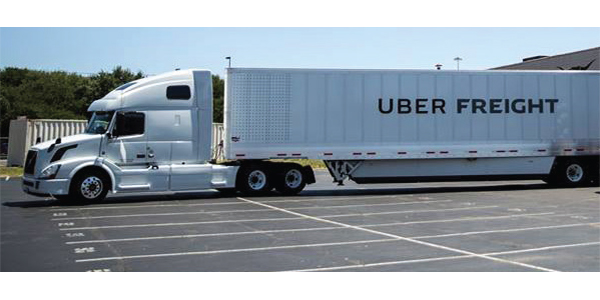
    • Uber Launches Uber Freight – December 27, 2016.
  9. Daniel Burrows, founder and ceo of XStream Trucking, a seed-stage tech startup – thinks about the problems in the freight trucking problem from the fuel efficiency side of the profitability equation. Fuel costs account for as much as a third of the operating expenses of a truck fleet. The team at XStream reports that its technology can generate fuel savings of between 2.5% and 8%. You can see the potential for those savings to add up to something significant for the industry when you consider that, according to the American Trucking Associations;1
    • Trucks consumed 52.3 billion gallons of fuel for business purposes in 2011; 37.2 billion of that in diesel fuel and 14.8 billion in gasoline,
    • The industry spent $143.4 billion buying diesel fuel in 2011

This seems to be a market that will remain active for sometime to come, and we are eager to see what new developments occur as time progresses.

We’re studying startups building technology for the ocean freight shipping market. We expect to have made enough progress to publish it in a few weeks. Stay tuned. Better yet . . . Send us ideas; @brianlaungaoaeh and/or @jnazubuike.

Update: January 3, 2017 at 17:30 to include insights from Daniel Burrows at XStream Trucking.


  1. Source: http://www.trucking.org/News_and_Information_Reports_Energy.aspx. Accessed on Jan. 03, 2017. ?

The best phone of 2016 is Google Pixel XL and here is why

0

2016 had some great competitions in the smartphone category. Apple, Samsung, LG, etc released great products. But by all means, Google Pixel XL was the best of all.

Reason: Google threw a lot into the Pixel XL design and engineered a great product with solid camera system. The rear camera is completely flush with the glass plate on the back, a design feat that Apple and Samsung have yet to achieve.

The Pixel XL features top-of-the-line specs to introduce Android 7.1 Nougat to the world. This VR-capable phone has a fast processor, smart AI software and a superb camera, all sandwiched into a funky design.

For that, Tekedia gives it the phone of the year.