DD
MM
YYYY

PAGES

DD
MM
YYYY

spot_img

PAGES

Home Blog Page 7543

Data is the new oil

0

In the most eye popping of headlines, Softbank has announced that it is forming a technology investing megafund in conjunction with the Public Investment Fund of Saudi Arabia. The $100bn Softbank Vision Fund will be the largest private equity fund of its kind.

In a paradigm where oil prices remain depressed and the world’s most prolific oil producer is investing in technology to salvage its returns, we must all acknowledge that “data is the new oil.”

By 2020, humankind will produce 44 zettabytes of data, with over 10% of that data coming from machines. A zettabyte is one sextillion bytes—yes that would in fact be 21 zeros!!!  This is a tenfold increase from 2014 alone and enough data to fill up Lake Ontario.

In the financial services industry, more data in and of itself is not necessarily a good thing. While large volumes of data are still needed for some organizations, the emphasis on smart, meaningful analysis of that data will always take precedent. Smart data always trumps big data, as quality always trumps quantity.

At the end of the day, some of the data collected may not even be worth the cost of storage. In a world where data is truly the new oil, fintech startups that can help find the “signal through the noise” will make the largest splash.

Cybersecurity Training Programs in Nigeria

4

Our Cybersecurity education is structured around four key pillars of policy, management, technology and digital forensics. This implies that we cover all the core needs of any organization or state institutions. While some staff like corporate lawyers may require training on policy, some staff like IT managers may need technical skills. Others like business leaders will find the management module useful. We deliver all these programs through our web portal – www.facyber.com. The program structure is presented below: certificate programs take 12 weeks; diploma programs which require certificate programs as perquisites take 24 weeks (inclusive of the certificate programs) and the nanodegree programs require a live (physical) one week training in Lagos (for Nigerian learners) with the diploma programs as prerequisites

Program Descriptions

Certificate in Cybersecurity Policy (CCYP): Certificate in Cybersecurity Policy deals with the policy analysis and implementation aspects of cybersecurity. It presents theory and topical issues, at government and enterprise levels, with both technical and managerial components in the fields of information systems security. The program helps learners develop skills on the policy, ethical, and legal issues associated with cybersecurity and information security.


Diploma in Cybersecurity Policy (DCYP) Capstone: This is a practical-oriented program where learners are tasked with developing solutions for a theoretical or real case cybersecurity policy issue with the guidance of a mentor. A project report is required at the end of the program.


Certificate in Cybersecurity Technology (CCYT): The Certificate in Cybersecurity Technology is designed to provide learners with skills to analyze multi-faceted complex cybersecurity issues, develop capabilities to make strategic decisions to protect organizations from threats and become competent cybersecurity professionals.


Diploma in Cybersecurity Technology (DCYT) Capstone: This is a practical-oriented program where learners are tasked with developing capabilities in the core technical aspect of cybersecurity. Learners will have access to some tools and equipment to work throughout this program. A project report is required at the end of the program.


Certificate in Cybersecurity Management (CCYM): The Certificate in Cybersecurity Management equips and prepares learners with modern skills to become effective managers across the broad nexus of cybersecurity and intrusion preventions in organizations. The central core is developing capacity to prevent anticipated cyber intrusions, using experiences to mitigate future threats, and formulating and implementing enterprise-level cybersecurity roadmaps. The program also explores the roles of regulation, policy developments, legal instruments and civil liberties.


Diploma in Cybersecurity Management (DCYM) Capstone: This is a practical-oriented program where learners are tasked with developing cybersecurity project management capabilities with the guidance of a mentor. Here, learners develop cybersecurity implementation frameworks. A project report is required at the end of the program.


Certificate in Cybersecurity Intelligence & Digital Forensics (CCDF): The Certificate in Cybersecurity Intelligence & Digital Forensics is structured to provide modern skills to those interested in digital forensics, digital intelligence and uncovering digital evidence. The program equips learners with broad analytical frameworks and prepares them to become competent cyber investigators.


Diploma in Cybersecurity Intelligence & Digital Forensics (DCDF) Capstone: This is a practical-oriented program where learners are tasked with developing capabilities in digital forensics, digital evidence and digital intelligence. Learners will have access to some tools and equipment to work throughout this program. A project report is required at the end of the program.


First Bank of Nigeria to fund Uber Nigeria Driver Lending Scheme

0
File illustration picture showing the logo of car-sharing service app Uber on a smartphone next to the picture of an official German taxi sign in Frankfurt, September 15, 2014. A Frankfurt court earlier this month instituted a temporary injunction against Uber from offering car-sharing services across Germany. San Francisco-based Uber, which allows users to summon taxi-like services on their smartphones, offers two main services, Uber, its classic low-cost, limousine pick-up service, and Uberpop, a newer ride-sharing service, which connects private drivers to passengers - an established practice in Germany that nonetheless operates in a legal grey area of rules governing commercial transportation. REUTERS/Kai Pfaffenbach/Files (GERMANY - Tags: BUSINESS EMPLOYMENT CRIME LAW TRANSPORT)

Uber Nigeria has announced that it is now making low-interest, used-vehicle loans available to its top-rated driver-partners. The pioneering move is the result of partnerships entered into between Uber Nigeria and First Bank of Nigeria Limited, as well as smaller financiers. This means that, for the first time, Uber driver-partners in Nigeria will be able to apply for finance for used vehicles based on their driver performance records.


The move is set to create significant business growth opportunities for driver-partners by allowing them to access used-car finance from First Bank of Nigeria Limited at a very competitive interest rate of just 20% per annum over a 24 month repayment period. Alternative offers for used-vehicle finance on the Uber Vehicle Solutions Programme will attract 22% per annum, with a maximum repayment term of 36 months.

In order to qualify for this preferential used-vehicle finance from First Bank of Nigeria Limited, Uber driver-partners will need to be able to demonstrate an average driver performance rating of higher than 4.5 and have earned more than N2,400,000 in the preceding 6 months.

Apply to 2016 sub-Saharan Africa Innovation Awards

0

Ericsson has unveiled a new competition for students – 2016 sub-Saharan Africa Innovation Awards. The prize money is $10,000. The goal for the 2016 sub-Saharan Africa Innovation Awards is to find innovations that promote sustainability in the future of food, whether it be in food production, packaging, information availability or distribution.

The Ericsson sub-Saharan Africa Innovation Awards 2016 is a competition looking for the latest innovations in the future of food. Sub-Saharan Africa faces a rapidly growing population and as a result, food production will need to increase significantly. We encourage young innovators and start-ups to use this opportunity to make a real difference by using technology and ICT to make a positive contribution towards sustainability in the food sector in sub-Saharan Africa.

The goal is to find innovations that promote sustainability in the future of food, whether it be in food production, packaging, information availability or distribution – we want to see your innovation and how it will change the future of the food industry as we know it!

The Innovation Awards recognises thought leaders who create innovative technological solutions to empower communities and individuals, while working towards the goal of a fully networked society.

Outstanding ideas are rewarded to foster fresh talent. By competing in these awards, innovators will have the chance to showcase their ideas, grow their networks and reputations, and receive start-up support and guidance from leading African businesspeople.

Click here to enter the competition.


.

GE Africa seeks the entrepreneurial growth path with GE Garage Lagos

0

Stimulating local economies and supporting the growth of small to medium enterprises has always been a priority for the GE team in Sub-Saharan Africa and this is one of the main reasons why GE has invested in the Lagos Garage skills training programme in Nigeria.

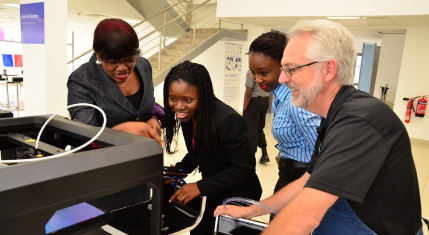
GE developed the garages programme in the United States in 2012 to reinvigorate Americans’ interest in innovation, invention and manufacturing. The first international activation of the garages programme took place in Lagos in 2014and was so popular that GE will be running another garages programme in Lagos.

The garages are essentially a hub for manufacturing-based innovation, strategy development, idea generation and collaboration, which is aimed at local business owners and entrepreneurs who are relevant to GE’s supply chain. By assisting with the development of the manufacturing ecosystem in Nigeria, GE hopes to create jobs, build local knowledge and capability, and encourage technology-based innovation in the manufacturing sector.

“GE is proud to relaunch the Lagos Garage programme because we know there are many small business owners in Nigeria who have the passion to start new businesses, but they don’t  necessarily have the know-how,” said Patricia Obozuwa, Director of  Communications & Public Affairs for GE Africa.

“We also know that the small  business sector creates jobs and opportunities, and we are happy to encourage economic growth in Sub-Saharan Africa by leading important projects such as these,” said Obozuwa.

According to government statistics, Nigeria has an estimated 37-million micro, small and medium-sized enterprises making a significant contribution to employment and the country’s  gross domestic product. These small businesses are supported by the Central  Bank, the Bank of Industry, The National Economic Reconstruction Fund and the Bank of Agriculture as well as state initiatives such as the Small and Medium Enterprise Development Agency of Nigeria.

The Lagos Garage, which is being relaunched next month, offers two four-week programmes with joint emphasis on professionalism and entrepreneurship; a one-week programme focused on specific industry sectors; and an intensive programme, which was designed to provide mentoring for start-ups. During the programmes, trainees will learn how to transform their ideas into finished products that can be sold to customers.

The entrepreneurship segments cover necessary elements for start-ups and established businesses, and emphasis will be placed on creating scalable global-standard businesses that can become part of the GE supply chain with the ultimate aim being to export products. Garage participants will also work on real problems and projects which are sourced from GE, manufacturers and importers.

Marketing strategies, which  include tactics for driving growth in Africa, as well as the fundamentals of  supply chains, 3D modelling, machining and prototyping will also be covered during the training modules by in-house GE talent, guest lecturers, industry experts and business leaders.

For more information about the  programme, email ge.garages@ge.com