
DD
MM
YYYY

PAGES

DD
MM
YYYY

spot_img

PAGES

Home Blog Page 7588

A VC Answers Founders’ Questions on Founder-Investor Relationship Management

0

The post in which I offered some suggestions about how a first-time founder might make the fundraising process more efficient and less frustrating raised some follow-up questions that were sent to me via email by a handful of founders who read the post over the weekend.

We went back-and-forth over email, but I think it is worth sharing a paraphrased form of those conversations, as well as those I had back in 2014 which inspired the original post to begin with.

For appropriate context, read #NotesOnTactics: Relationship Management Hacks For First-Time Early Stage Tech Startup Founders before you read the rest of this article.

Founders Ask: My knee-jerk reaction is to permanently cut off investors who pass on our seed round. I may not completely cut off investors who pass on our seed round even though they have stated publicly that they are well-aligned with our mission and vision, and invest in our market. However, I do not think I will keep them updated, and I probably will not include them in my next round.

My Answer: The key is to stay focused on the long game, and not to lose sight of how things might change. An investor who passes on your seed round, but could lead your Series A is probably worth the effort to keep updated . . . if there’s mutual interest in doing so. Keeping an investor updated does not give you an obligation to let them into your next round. Founders will always retain the option to select which investors they let into their startup’s next round. That’s a source of power and control founders will always have, if things go well. In this context, I would try to avoid cutting off my nose just to spite my face.

Founders Ask: What of my instincts? What if my instincts say I should stop dealing with this investor?

My Answer: Always listen to your instincts. Our subconscious picks up information that our conscious mind can overlook, or miss entirely for any number of reasons. I am assuming that the parties involved are each acting in good faith; so investors are not taking meetings with founders for some ulterior motive, for example. To that end, I assume that founders would have done some due diligence on an investor before they meet for the first time.

Founders Ask: This does not work for founders who are; women, or under-represented minorities, or LGBTQ . . . or frankly, all of the above. Isn’t early-stage venture investing about investing in the team/founder(s) more so than in the idea/market/traction? If an investor whose primary function is to see the value in a team/founder(s) doesn’t see the value in me, frankly, I don’t think they’re that smart/wise. Why should I want them to ever profit from my endeavors ? We have to disrupt the status quo or nothing will change!

My Answer: I understand that sentiment. I won’t debate with founders who feel that way except to say that feeling that way risks leading them to sub-optimal decisions about how they engage with investors. This is especially true in situations where founders do not have a 360-degree view of the decision-making process as it unfolded. “Shooting the messenger” might be satisfying in the short-run, but is probably strategically unadvantageous in the long-run. If I were a cynical founder I might keep investors who passed in my previous round updated if only for the potential that they could function as a stalking horse in my next round. My comments about this probably do not apply for a fund that is run by one person, or that is run by two people.

Founders Ask: I’m sick and tired of hearing about other founders getting a term sheet signed same-day/same-meeting. If the EXACT same deal; same back story, same circumstances, same company, same traction, were presented….with a team made up of white/Asian men….the outcome is almost ALWAYS different.

My Response: I believe that life is fundamentally unfair, so I personally try not to let issues like this get to me emotionally. That said, I think I understand the frustrations you are expressing. I have faced such frustrations myself at various times in the past – most notably while I was growing up in Ghana and Nigeria. I believe that it is important to separate fact from myth. In the years since our team started investing in early stage startups, I have not seen a single startup get a term sheet “same-day/same-meeting” . . . I would question how committed an investor who commits that quickly is going to be when things get tough or even how engaged they will be in general as time progresses. I also wonder if there’s more of a back-story that is often left out of the breathless reports by the tech press. Hyperbole has a way of distorting reality. I have tracked a few startups for as long as 18 months before I was ready to recommend that we make an investment. It is more common for me to track a startup for between 3 and 6 months while I try to figure things out. I can’t dispute the reports that you allude to, but I would caution that they are the exception rather than the rule. In one extreme example, Tim Westergren pitched investors 347 times before he persuaded Walden Venture Capital to say “yes” at his 348th attempt. The team went without a salary for 2 years. Fundraising is a long, and arduous undertaking . . . for anyone. People who tell any founder the opposite are doing that founder an enormous disservice. That being said, I am not trying to imply that there’s no bias in the system. I just don’t think it’s what a founder of any background should focus on the most, assuming that founder decided to go down this path independently.

Founders Ask: Your suggestion about preparation beforehand seems disjointed from the reality founders encounter . . . Isn’t each investor different? For example; the conversation I had with you vs. Nnamdi Okike vs. Ben Horowitz vs. Hunter Walk vs. Mitch Kapor . . . Sure, there were a few commonalities; maybe 3o percent? But the other 70 percent of each conversation was so unique to each individual’s priorities, each person’s disposition the day we met, the individual personalities, their placement on the autism spectrum, etc. Isn’t that hard to prepare for?

My Response: I agree. It’s hard to prepare to raise capital from external investors. Now imagine if you do not absolutely nail your answers to the 30 percent of questions that are common to all the investors you will meet. Surely, your chances of success do not improve over time if you go in without thorough preparation for those questions. I assume those questions are ones you fully expect will get asked. As such, they are questions whose answers you can rehearse beforehand. Some of the best conversations I have had with founders have occurred when the founder has kept a running list of FAQs that is updated after each meeting with an investor. Over time, the probability that the founder will encounter a completely new question from an investor reduces to a minimum while the chances that the next pitch will lead to “yes” increases to a maximum. I’m hoping that is an appealing way to think about this. A practical advantage of this approach is that it frees you up mentally to focus on doing a great job answering the 70% of questions you did not expect . . . But, again, that proportion should decrease as you keep pitching investors.

Founders Ask: But keeping investors and other people updated takes so much time and effort. Why should I bother with investors who have passed on making an investment?

My Response: Absolutely. Focus on your current investors. My suggestion to use email as a way to keep other people in the loop is meant to cut down on the effort it takes to update people who are not current investors. Send a mass email to everyone who is not an investor in your startup but who you want to keep “in the loop” about your progress, use software to track engagement. Only meet one-on-one when it makes sense to do so. I tried to convey that idea in the article. The idea is to minimize the effort that is expended on keeping anyone who is not a current investor updated.

Relationship Management Hacks For First-Time Early Stage Tech Startup Founders

0

Note: I published a post titled “Relationship Management for Your Startup” on January 13, 2014at Tekedia.com. This post is inspired by that one, and portions of this post are exactly identical to the original. It appears the post at Tekedia is no longer online. This post updates that one, with lessons I have learned since that time and advice I share with first-time founders with whom I have the privilege of meeting as they embark on trying to build their startups.

How should an entrepreneur manage the relationship with investors who say “no” to that entrepreneur’s pitch for capital? As I have noted above, I first tried to tackle this question in a post in 2014.

Before I suggest an answer to that question, I will propose some assumptions.

  1. The interaction between the entrepreneur and the prospective investors has been one of respect, and professional courtesy. In other words, you have not been treated badly or insulted by any of the investors you have met.
  2. The investors you have met are honest people, who would tell you if there is absolutely no instance under which they would invest in your startup. They do not have to tell you why, although it would be great if they did.
  3. Irrespective of how things play out now, there is every possibility that you will speak with investors at a subsequent stage of the current project you are working on, or, Insha’Allah, you will become a serial entrepreneur who seeks funding for a new startup in the future.

If my assumptions hold true, then it does not work to your advantage to “cut-off” an investor just because that investor did not fund your startup during your current round of financing. This is especially the case if that same investor might be able to invest in your next round of financing – for example, a venture fund which makes institutional seed-stage and series A investments, but which passed on your seed-stage round of financing.

Every venture capital fund’s primary responsibility is to make money for its limited partners. Venture capitalists do not invest because they like an entrepreneur or an idea, or because they feel obligated to provide capital. No. Venture capitalists invest in entrepreneurs and startups that they believe will make them money, lots of money . . . enabling them to fulfil the obligations they have made to the LPs in their fund.

It is your responsibility as the entrepreneur to connect the dots, and to help the investor understand how they will achieve that aim by investing in your startup. That is a very difficult task. Dealing with the inevitable rejection that comes with fund-raising for an early stage startup is jarring, for anyone . . . and it is especially so for first-time founders.

Are there any hacks that a first-time startup founder can use to make the journey less fraught with frustration? I think there are. Below, I share some suggestions.

Preparation is key; It is better to be over-prepared than it is to be under-prepared.

It is easy to assume that one will be able to tell one’s story in a way that makes sense to one’s audience. That’s a fatal mistake. If fundraising is important for the startup’s survival then founders should practice the pitch . . . Fundraising is about narrative and storytelling. Founders must practice telling the story until it becomes second nature.

This involves both qualitative and quantitative aspects of the startup’s story. It is important to note that this kind of storytelling differs from others in the sense that a startup founder seeks to persuade the listening audience to take a specific action that will work to the startup’s benefit. Write a check. Become a user. Become a customer. Spread the news about the startup’s product. I do not know if there’s a recommended amount of time that one should devote to preparing for something of this sort. When founders ask me privately for help preparing for a do-or-die pitch that is a few months away in the future, I recommend 80 – 100 hours of preparation; something like 1 or 2 hours of daily preparation devoted to making sure they know the story inside-and-out and that telling it is as normal as breathing. I also recommend that they practice delivering the pitch to different types of audiences to get input on the delivery from different points of view.

When founders ask me privately for help preparing for a do-or-die pitch that is a few months away in the future, I recommend 80 – 100 hours of preparation; something like 1 or 2 hours of daily preparation devoted to making sure they know the story inside-and-out and that telling it is as normal as breathing. I also recommend that they practice delivering the pitch to different types of audiences to get input on the delivery from different points of view. Toastmasters International is a useful resource for this, but founders will need more than Toastmasters offers.

Research is key; Know who you should be talking to.

It is easy for a first-time founder to get suckered into thinking it’s imperative to speak with “every investor known to mankind” . . . Meeting lots and lots of investors can really give a founder’s ego the kind of massage that market realities aren’t willing to dish out without herculean effort from the startup. Also, an investor’s willingness to “meet for coffee to discuss your feedback on our model and your perspective on the opportunity” can seem like positive confirmation that the founder did not make a huge mistake by pursuing this goal of creating something from nothing.

Here’s the thing; That is not always true. Often an investor might just want to find out what’s happening in a given market, and coffee with a founder who has initiated the meeting is a low-cost way of getting educated by someone who’s currently and actively solving problems in that area.

Obviously, the opportunity cost of such a meeting is far higher for the startup founder than it is for the investor.

What is a founder to do? Think carefully about which investors have the highest propensity to invest in the startup; at this stage, given its current levels of traction . . . within the timeframe in which the startup must raise capital. Create a short-list and focus primarily on those investors who fit the bill. This is easier said than done since investors do not often state their investment parameters publicly.

That said, for founders in the United States there are a few tools one can use. Shai Goldman, currently a managing director at Silicon Valley Bank, has created an open-source GoogleSheet’s document that is a good starting point. Samir Kaji, currently a managing director at First Republic Bank, has also created a body of research on micro-vc that is another great starting point.

These two pieces of work complement one another quite well, and should be every first-time founder’s BFF every weekend after the decision to build a startup has been made. There are other pieces of information that a first-time founder should use. These two are especially key . . . but also most likely to be unknown to most first-time founders. I maintain an email I send the founders I encounter who evidently could benefit from having these resources at their fingertips. I will post links to those resources at Hack Your Startup: Pitch.

I spent some time explaining why this matters in The Path To Disaster: A Startup Is Not A Small Version of A Big Company – The Office Hours Remix.

It’s nothing personal, it’s just business; Manage your investor relations with email.

After every meeting with a potential investor, or quite frankly, with anyone who could be helpful to your startup in any way, I think it makes sense to ask if they would be willing to be added to a “Friends of Awesome Early Stage Technology Startup” email distribution list. The most common response will be “Yes. Please add me to your distribution list for updates.” These updates will be very general in nature and should be a stripped-down version of the email updates that investors in the startup get. No confidential information should be included in this email – only information you do not mind being in the public eye.

While the periodic updates are interesting on their own, to my mind they are not the point of this exercise. The primary purpose of this exercise is to split the universe of so-called “Friends of Awesome Early Stage Technology Startup” into three categories.

First; the people who unsubscribe from the updates. I do not know a more explicit signal that they have no interest in what the startup is doing but simply did not have the courage to tell the founder so directly. There’s no point devoting much more energy pursuing these people.

Second; the people who have not unsubscribed but have never engaged directly based on a prompt in any of the periodic updates. It is probably worth sending people in this group an email saying you are going out to raise a financing round for which they might have interest based on developments since the previous round . . . If they do not respond after two or three attempts . . . Move on.

Third; the people who have engaged with the founders after an update was sent. Perhaps the startup needed to hire an engineer and they responded with a recommendation or offered to share the job description with their network . . . They have demonstrated some interest in what you are doing. Even if they do not invest themselves, they are likely to be a positive reference to someone else for whom there’s a better fit. Focus on these folks.

These 3 suggestions are the big ones. I make other suggestions to founders I meet in person. Those are minor in comparison. For example, don’t let a friendly investor who passed on investing in a prior round for a specific reason find out about a new round in which they might still be able to invest with only a week left before your anticipated close. It’s unlikely they can conclude their due diligence that quickly.

It’s not personal Sonny. It’s strictly business.                                          – Michael Corleone, The Godfather

Financing a startup’s operations is a crucial part of every founder’s responsibilities . . . In fact, it might be the most important. If financing from external investors is part of the plan, then founders need to find ways to make it less of a hit-or-miss affair. I hope these suggestions provide some food for thought about how to do that effectively without spending an inordinate amount of time.

Further Reading

  1. When The VC Says “No” – a great discussion by Marc Andreessen. You must read this.
  2. Dear Dumb VC – a post by Andy Dunn, the founder of Bonobos and Red Swan Ventures.
  3. As Populist As it May Seem, 98% of VCs Aren’t Dumb – a rebuttal by Mark Suster of Upfront Ventures.
  4. How LinkedIn First Raised Money (and Endured Rejection) – a post by Lee Hower.

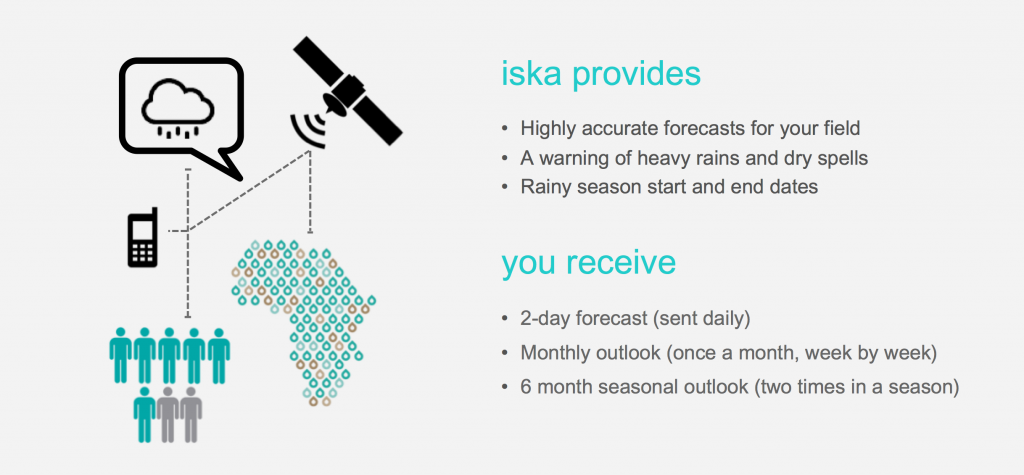
Startup is selling subscription-based weather forecast to improve crop yield in Africa

0

The majority of sub Saharan countries have no access to reliable weather forecasts, which is a serious constraint for farmers’ planning and timing of farming activities (e.g planting). The lack of accurate forecasts is particularly distressing given the recent changes in weather patterns, exacerbated by global climate change, negatively impacting traditional farming practices, where indigenous knowledge is no longer relevant.

As a result of climate change, large parts of West Africa is experiencing changing weather conditions and increasing occurrence of extreme weather events (e.g. floods and droughts). These changes are disrupting typical farming patterns, and a lack of knowledge of how to protect against effects makes smallholder farmers particularly vulnerable.

This is where iska comes in.

iska is built on a disruptive technology allowing for much more accurate prediction than seen before in West Africa. Iska™ has shown an 84% accuracy rate over 2 rainy seasons during 2013 and 2014, compared with global competitors that only reach 39% in West Africa.

Unlike most weather service providers, Ignitia does not only repackage existing weather forecast data for customization, but has developed its products from scratch; since no reliable weather forecast system existed in the region.

The governing physics driving the tropical atmosphere differs from existing model practices and occurs on a different scale. Ignitia’s tropical weather forecast is based on proprietary algorithms developed over 15 man-years by its scientists.

Iska was created by Sweden-based Ignitia, and it came second at the first Agricultural Innovation Investment Summit run by USAID held in Washington, DC in June.

Ignitia now wants to expand into other West Africa countries using a $2.5 million grant from the Securing Water for Food challenge funded by the governments of the United States, Sweden, South Africa, and the Netherlands.

Ericsson Board fires CEO Hans Vestberg

0

The board of telecommunications equipment giant Ericsson has forced its CEO, Hans Vestberg, to step down today with immediate effect after the board agreed that he wasn’t the person to turn Ericsson around.

Ericsson said that Vestberg, who led the Swedish firm for seven years, would be replaced in the short term by chief financial officer Jan Frykhammar.

It’s a tough period for the company that had sacked thousands of workers this year alone following the stagnant nature of the market for its product. In addition to the lay offs, it added that it is still looking to drastically cut costs.

Buhari nominates MIT Prof Akintunde Ibitayo Akinwande as new NERC Chair

0

President Muhammadu Buhari has nominated Akintunde Ibitayo Akinwande, a professor in the electrical engineering and computer science department of the Massachusetts Institute of Technology (MIT), as the executive chairman of the Nigerian Electricity Regulatory Commission (NERC).

He is a professor in the electrical engineering and computer science department of the Massachusetts Institute of Technology, Cambridge, MA. He received a B.Sc. (1978) in electrical and electronic engineering from the University of Ife, Nigeria, a MS (1981) and Ph.D. (1986) in electrical engineering from Stanford University, Stanford, California, according to his academic profile.

He joined Honeywell Inc. in 1986 where he initially conducted research on GaAs Complementary FET technology for very high speed and low power signal processing. He later joined the Si Microstructures group where he conducted research on pressure sensors, accelerometers, thin-film field emission and display devices.

Akinwande joined MIT’s Microsystems Technology Laboratories (MTL) in January 1995 where his research focuses on micro-fabrication and electronic devices with particular emphasis on smart sensors and actuators, intelligent displays, large area electronics (macro-electronics), field emission & field ionization devices, mass spectrometry and electric propulsion.

He is a recipient of the 1996 National Science Foundation (NSF) Career Award. He has served a number of technical program committees for various conferences, including the Device Research Conference, the International Electron Devices Meeting, the International Solid-State Circuits Conference, the International Display Research Conference and the International Vacuum Microelectronics Conference.

Akinwande holds numerous patents in MEMS, Electronics on Flexible Substrates, Display technologies and has authored more than 100 journal publications. He was a visiting professor at the Cambridge University engineering department and an Overseas Fellow of Churchill College in 2002-2003. He is a current member of the IEEE Nanotechnology Council.

He is from Offa, Kwara state.

The commissioners:

Musiliu Olalekan Oseni (south-west nominee): BSc economics (first class) from University of Ibadan in 2007; MSc energy economics and policy (with distinction) from University of Surrey, UK, 2010 and PhD in business energy economic in 2015 from the University of Cambridge, UK. His doctorate thesis was on “Self-Generation and Payments for Quality of Service in Electricity Markets”.

Dafe C. Akpeneye (south-south nominee): A 2001 law graduate from Obafemi Awolowo University. Currently the Director, Regulatory Services/General Counsel, West Africa for PricewaterCoopers Nigeria.

Okafor Frank Nwoye (south-east nominee): He is a professor in the department of electrical engineering, University of Lagos. He is a specialist in power systems and control.

Sanusi Garba (north-west nominee): Bsc engineering, ABU, Zaria, 1974; master’s in industrial management, University of Birmingham, 1980.

Nathan Rogers Shatti (north-east nominee): Former commissioner for finance in Adamawa state. Fellow of Chartered Accountants, Shatti was formerly with Exxon Mobil in several countries in Europe and East Africa before becoming manager, treasury and banking services in Mobil Oil Nigeria PLC in 2006. He graduated in accounting from ABU in 1990.

Moses Arigu (north-central nominee): Currently the GCS Partner vice-president (capital markets technology and operations), Royal Bank of Canada. Before then (between 2007 and 2010), he was with JPMorgan Chase (Investment Bank, New York). He was also with Credit Suisse (Swiss Bank, New York), from 2005 to 2007.