DD
MM
YYYY

PAGES

DD
MM
YYYY

spot_img

PAGES

Home Blog Page 77

SoftBank’s Painful Pivot: Masayoshi Son ‘Cries’ Over Nvidia Sale to Fuel $500bn AI Vision

0

In a raw display of the high-stakes financial maneuvers driving the global Artificial Intelligence race, SoftBank Group founder Masayoshi Son on Monday addressed the controversial decision to sell the conglomerate’s entire stake in Nvidia, confirming the necessity of the move to fund his massive, integrated AI ecosystem.

Speaking at the FII Priority Asia forum in Tokyo, Son admitted the decision was deeply personal: “I don’t want to sell a single share. I just had more need for money to invest in OpenAI and other projects,” he stated.

He added, vividly summarizing the emotional conflict, “I was crying to sell Nvidia shares.”

The November disclosure revealed that SoftBank had completely offloaded its shares in the chip darling for $5.83 billion. Son’s comments reinforce the consensus among analysts and executives that the sale was a deliberate move to bolster the SoftBank Vision Fund’s AI war chest, rather than a lack of confidence in the world’s most valuable chipmaker.

SoftBank is strategically shifting from being a major passive technology investor (holding Nvidia stock) to being an active shaper of the AI value chain. The capital gained from the divestiture is immediately being funneled into projects designed to build what Son describes as “his own sphere of influence supporting artificial intelligence”—a vertical integration strategy covering AI development, specialized chips, and foundational infrastructure.

The sale directly bankrolls an increased commitment to OpenAI, the maker of ChatGPT. Son has made a substantial bet on the company’s future, having stated earlier this year that SoftBank was “all in” on OpenAI, predicting the startup would “one day become the most valuable company in the world.” This bet has already reaped substantial rewards. SoftBank reported last month that its second-quarter net profit more than doubled to 2.5 trillion yen ($16.6 billion), a surge driven primarily by valuation gains in its OpenAI holdings.

According to sources familiar with the matter, SoftBank could “potentially” increase its investment in the ChatGPT maker depending on its performance and the valuation of future funding rounds.

Unlike merely investing in Nvidia, which sells its chips to everyone, SoftBank is investing heavily to control the underlying infrastructure, thereby ensuring guaranteed supply and optimization for its own portfolio:

SoftBank is a lead partner in the massive Stargate Project, a $500 billion joint venture announced in January 2025 with OpenAI, Oracle, and MGX to build vast AI infrastructure in the United States. Son is the venture’s chairman, and SoftBank has the “financial responsibility” for the project, which involves constructing colossal data centers (starting in Abilene, Texas) that will house the computing power necessary for the next generation of AI.

SoftBank recently closed the acquisition of U.S. chip designer Ampere Computing for $6.5 billion. Ampere specializes in high-performance, energy-efficient processors based on the ARM compute platform—technology that complements the design strengths of SoftBank’s majority-owned Arm Holdings. This acquisition ensures SoftBank has proprietary control over the chips powering its ambitious Stargate data centers and AI ventures, guaranteeing supply and customization for its own needs, a key strategic advantage that a simple Nvidia stake does not provide.

Dismissing the Bubble: The Trillions-of-Dollars Rationale

Son also used the forum to address the “growing fears and jitters in markets about a potential AI bubble.” He pushed back forcefully against these concerns, arguing that those who talk about a bubble are “not smart enough.”

He provided a bold long-term outlook to justify the trillions of dollars of cumulative spending projected for the sector, predicting that “super [artificial] intelligence” and AI robots will generate at least 10% of global gross domestic product over the long term. This economic value creation, he asserted, will far outweigh the current massive investment levels.

SoftBank is aiming not just to invest in the AI future, but to own the full stack—from the chips (Ampere/Arm) to the infrastructure (Stargate) to the application layer (OpenAI).

AI Investment Boom: German AI Star Black Forest Labs Hits $3.25bn Valuation with $300M Series B

0

Black Forest Labs, the German AI startup that has quickly become a global leader in foundational models for visual intelligence, announced on Monday that it has secured a massive $300 million Series B funding round, catapulting its valuation to $3.25 billion.

The significant capital injection, which is earmarked primarily for accelerating its cutting-edge research and development efforts, powerfully underscores the ongoing global gold rush that is seeing billions of dollars in investment pour into the Artificial Intelligence industry.

This capital torrent is accelerating the development of foundational models, particularly those specializing in visual intelligence. The funds raised will be dedicated primarily to bolstering the company’s cutting-edge research and development efforts.

The round was co-led by Salesforce Ventures and Anjney Midha (AMP), signifying strong confidence from both strategic enterprise backers and premier venture capital firms. The list of participants was extensive, including major names like a16z, NVIDIA, Northzone, Creandum, Earlybird VC, BroadLight Capital, General Catalyst, Temasek, Bain Capital Ventures, Air Street Capital, Visionaries Club, Canva, and Figma Ventures, a lineup that itself serves as a testament to the immense institutional appetite for AI infrastructure.

The Architects of Visual Intelligence and Rapid Ascent

Black Forest Labs was co-founded by Robin Rombach (CEO), Patrick Esser, and Andreas Blattmann, a team of former research pioneers who played a crucial role in creating Stability AI’s Stable Diffusion models. Their deep technical background is the core engine behind the startup’s rapid ascent since its launch in August 2024.

The company has quickly established itself as a critical infrastructure provider, evidenced by its widespread adoption across the industry: its models are actively used by a slew of companies, including Adobe, Canva, Figma, fal.ai, Picsart, ElevenLabs, VSCO, and Vercel. Furthermore, the German company gained notable attention last year after it was revealed that Elon Musk’s Grok chatbot was leveraging Black Forest Labs’ models to generate images within its platform.

The company’s latest flagship model, FLUX.2, is setting a new benchmark for production-grade visual intelligence, addressing major pain points that plagued earlier image generation models by focusing on consistency and high resolution. The model is built on a latent flow matching architecture, which couples a Mistral-3 24B parameter Vision-Language Model (VLM) with a rectified-flow transformer.

The FLUX.2 architecture brings significant improvements crucial for professional workflows, including multi-reference support, allowing users to reference up to 10 images simultaneously to maintain consistent character identity, product appearance, style, and lighting across many generated assets. Additionally, the model boasts high-resolution output capabilities, generating and editing images at resolutions up to 4 Megapixels (4MP), making the outputs instantly suitable for high-end visualization and photography-like use cases.

It also features vastly improved typography, reliably generating complex text and user interface mockups with legible fine text—a common weakness in previous models. The commitment to releasing open-weight models, such as the FLUX.2 [dev] 32-billion-parameter model optimized in collaboration with NVIDIA, reinforces the company’s founders’ open-source background and ensures the technology is accessible to researchers and developers worldwide.

The rapid and aggressive capital injection into Black Forest Labs, mirroring similar mega-rounds secured by foundational AI peers globally, illustrates that investors are willing to back teams capable of delivering commercially viable, specialized AI models, even as general AI models continue to dominate headlines. This trend signals that the market for specialized generative applications remains wide open and is consuming immense investment capital.

Nigeria’s GDP Grew 3.98% in Q3 2025 – NBS

0

Nigeria’s economy grew at a steady clip in the third quarter of 2025, with real GDP rising by 3.98 percent year-on-year, slightly above the 3.86 percent recorded in the same period of 2024.

Fresh figures released by the National Bureau of Statistics show that Q3 delivered broad-based improvements across segments of the economy, even as some sectors continued to feel the weight of structural challenges, weak investment flows, and persistent supply-side pressures.

In its Q3 GDP report, the bureau noted that agriculture expanded by 3.79 percent, marking a notable improvement from 2.55 percent in Q3 2024. The rebound came primarily from stronger crop production, which remains the backbone of the agricultural economy and accounted for 65.99 percent of the sector’s nominal output. The uptick offers some relief after earlier fears that climate disruptions and input shortages could drag the sector deeper into slow-growth territory.

Industry grew by 3.77 percent, climbing from 2.78 percent a year earlier. The performance was shaped largely by the oil sector’s modest improvement and selective gains in manufacturing and construction. The services sector grew by 4.15 percent, lower than the 4.97 percent recorded in Q3 2024 but still strong enough to keep its position as the economy’s largest contributor. Services accounted for 53.02 percent of total output, a touch higher than the 52.93 percent recorded a year earlier, underscoring the economy’s continued tilt away from commodity dependence.

Nigeria’s aggregate nominal GDP rose sharply to N113.59 trillion in Q3 2025, up from N96.16 trillion in Q3 2024. The year-on-year increase of 18.12 percent reflects a mix of higher prices, sectoral expansion, and the continuing impact of currency depreciation on nominal values.

The oil sector delivered a mixed performance. Average daily crude oil production rose to 1.64 million barrels per day in Q3, higher than the 1.47 mbpd recorded in the same quarter of 2024, though slightly below the 1.68 mbpd achieved in Q2 2025. Real growth in the sector stood at 5.84 percent, just above the 5.66 percent recorded a year earlier.

The figure represents a sharp slowdown from the 20.46 percent surge reported in Q2, pulling back by 14.62 percentage points quarter-on-quarter. The sector contracted by 5.53 percent compared to Q2, reflecting the volatility that continues to characterise oil output despite ongoing repairs to pipelines and renewed security measures in producing areas.

Oil contributed 3.44 percent to real GDP in Q3 2025. This was slightly above the 3.38 percent recorded in Q3 2024 but lower than the 4.05 percent recorded in the second quarter of the year. The share remains well below historical levels, showing how the broader economy has been forced to expand outside oil since disruptions intensified over the past decade.

The non-oil sector grew by 3.91 percent in real terms, outperforming the 3.79 percent recorded in Q3 2024 and the 3.64 percent posted in Q2 2025. Growth was powered by agriculture, telecommunications, real estate, financial institutions, trade, construction, and pockets of resilience in manufacturing.

The non-oil economy accounted for 96.56 percent of total output. This was slightly below the 96.62 percent recorded a year earlier, but higher than the 95.95 percent in Q2 2025, showing that non-oil activity still dominates the economy even as fluctuations in the oil sector shape broader sentiment.

A deeper dive into sectoral movements shows that Mining and Quarrying, which includes crude oil, coal, metal ores, and other minerals, recorded a steep nominal decline of 41.08 percent year-on-year. The slump reflects weaker global commodity prices, production disruptions, and limited new investments that have left mining activity subdued.

Agriculture’s nominal growth of 3.18 percent in Q3 represented a slowdown of 14.87 percentage points compared to the same period in 2024, although the sector performed better than in the previous quarter, improving by 1.34 percentage points. Crop production remained dominant, reinforcing the ongoing need for mechanization and improved supply chains to unlock productivity gains in livestock, forestry, and fisheries.

Manufacturing, one of the sectors most affected by high energy costs and foreign exchange constraints, grew by 1.25 percent year-on-year. The figure was higher than the growth rate recorded in Q3 2024, but it slipped by 0.34 percentage points compared with Q2 2025. The modest improvement suggests that factory output continues to struggle with elevated operating costs, imported input shortages, and tepid consumer demand.

For context, Nigeria recorded a stronger GDP performance earlier in the year. In the second quarter, real GDP grew by 4.23 percent year-on-year, outpacing the 3.48 percent posted in Q2 2024. Aggregate nominal GDP in that quarter stood at N100.73 trillion, markedly higher than the N84.48 trillion recorded in Q2 2024, representing nominal growth of 19.23 percent.

The Q3 figures show the economy is still expanding, but at a slower and more uneven pace than policymakers would prefer. Agriculture is improving but remains vulnerable to disruptions. Industry is stabilizing, but is weighed down by the erratic oil sector. Services continue to prop up growth, though some segments are facing declining momentum.

The overall picture is one of a fragile recovery that still needs stronger investment inflows, a more predictable business environment, and steadier crude oil production to sustain momentum into 2026.

The Big Reconstruction: Equipping Abia Youth for a New Era

0

In 1970, just months after the Biafra War ended, the elders of the Igbo Nation gathered across our communities to confront an existential question: What future awaits a people whose land has been reduced to rubble? Schools were gone. Hospitals destroyed. Markets burnt. Bank balances wiped out. No support was coming from the federal government. Yet, in that bleak moment, they rose and declared: this land must be rebuilt!

And they did. Our Greatest Generation – men and women who led the Igbo Nation in early and mid-1970s – demonstrated uncommon wisdom, discipline, sacrifice, and peerless execution, ushering a playbook that was elegant and powerful: every community must create a development union to rebuild its destiny.

And community after community answered the call. My village, Ovim, established the Ovim Community League (OCL). OCL became so influential that it paid teachers and posted them to public schools in Ovim. During my time in Secondary Technical School Ovim, the school offered Motor Vehicle Technology, Woodwork Technology, Shorthand, etc, funded largely by the community. OCL was not alone as most basic infrastructures in Igbo land were built through community effort then.

And the Greatest Generation did not stop with infrastructure. They engineered the Igbo Apprenticeship System, sending young men from our villages to Kano, Lagos, Accra, anywhere opportunity lived, because there was nothing left at home on the miry clay of Biafra. And they charged them with a sacred duty: “onye aghana nwanne ya” [do not leave your brethren behind] if success comes.

Those men listened. And within decades, the Igbo Nation rose from devastation and caught up with Nigeria’s economic trajectory. They ensured our homeland did not become a wasteland of penury or a museum of hopelessness. I salute that Generation for they saved the future that we enjoy today.

But now, our time has come. And our challenge is different: how do we give skills to our young people in an age where jobs are scarce? Certificates alone cannot feed families. Skills do. We must return to the old playbook of community-driven development but reimagine it for a new era. What ecosystems can we build in our communities to equip our young people with skills, not just paper qualifications? How do we unlock opportunities in digital technology, creative industries, agriculture, manufacturing, and trades?

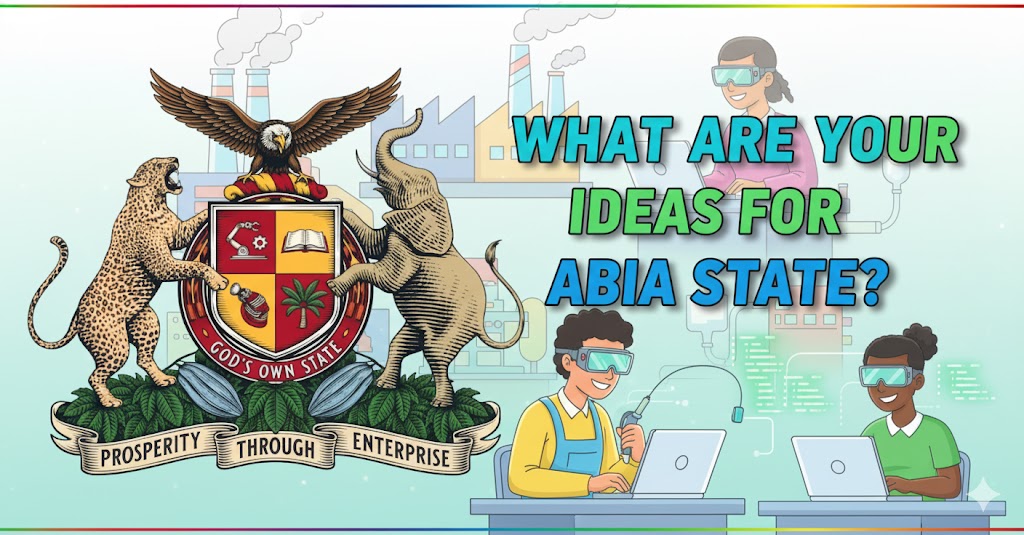
I am focusing on Abia State, but the model is relevant for any community in Nigeria and Africa. The Abia State Technological Skills Acquisition Centre (ATSAC) will unveil projects next year. But before then, we want to hear from you. Yes, your ideas, your insights, your dreams. When your ideas come in, we will refine the playbook and by early 2026, we will convene a Zoom Townhall Meeting. Afterward, we will begin implementation. Abia sons and daughters, please copy.

Our Governor, Dr. Alex Otti, has given us a clear mandate: equip young Abians with relevant skills across all communities. You in Lagos, London, Beijing, Boston, you carry knowledge that can transform futures. The question before us is simple: How can Abia youth benefit from your experience, and how do we build a system that gives them access? How do we make skills a right for young Abians?

The Greatest Generation rebuilt the Igbo Nation after war. Our generation must retool it for the opportunities of this era, and I want to know your ideas via this form: https://forms.gle/RTobYVnci5xYYpH27

SHIB’s Rebound Could Be Big; Ozak AI Price Projection Indicates Larger Multipliers

0

Shiba Inu is beginning to regain strong momentum as the meme-coin market shows signs of revival and broader crypto liquidity rotates back toward high-volatility assets. With retail traders returning, Shibarium development progressing, and market sentiment improving, analysts believe SHIB could be gearing up for a sizable rebound.

Yet even with SHIB’s potential for a powerful recovery rally, experts across multiple research desks continue pointing toward Ozak AI as the project with far larger multiplier potential. With early-stage pricing, deep AI-native utility, and a rapidly accelerating presale, Ozak AI is increasingly viewed as one of the highest-ROI projects for the next cycle—outperforming even the strongest meme-coin forecasts.

Shiba Inu (SHIB)

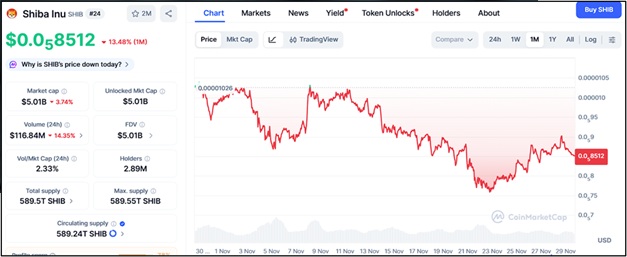
Shiba Inu (SHIB), buying and selling around $0.000008512, is forming a strong bullish foundation supported through steady buyer hobby across key ranges. SHIB maintains robust support at $0.00000826, $0.00000795, and $0.00000768, regions where long-term holders again and again gather during marketplace dips. These ranges spotlight SHIB’s resilience and growing community confidence as the following phase of marketplace expansion methods.

For SHIB to initiate a more potent continuation rally, it needs to conquer resistance at $0.00000882, $0.00000910, and $0.00000942. Historically, as soon as SHIB flips these tiers, it enters a period of fast upside driven through rising social sentiment, viral momentum, and renewed meme-coin speculation. Analysts say SHIB may want to realistically try a multi-x flow if the broader marketplace strengthens. Still, no matter this capacity, its already big market size limits the opportunity of extraordinarily high multipliers.

Ozak AI Emerges as the Strongest Large-Multiplier Project

While SHIB may deliver an impressive rebound, Ozak AI (OZ) is increasingly recognized as the asset with the steepest long-term growth curve. Unlike meme tokens that rely primarily on hype cycles, Ozak AI is built on real, powerful AI-native infrastructure designed to enhance trading, automation, and analytics across Web3.

Ozak AI integrates millisecond-speed AI prediction agents capable of scanning markets in real time, cross-chain intelligence engines that track activity across multiple blockchains simultaneously, ultra-fast 30 ms trading signals enabled through its HIVE partnership, and SINT-powered autonomous AI agents that execute trades, automate workflows, and perform voice-driven tasks. This level of functionality transforms Ozak AI into a foundational intelligence layer rather than a short-term speculative asset.

Because the global AI industry is expanding at one of the fastest rates in tech history, Ozak AI sits at the center of an explosive sector convergence—giving it a fundamentally steeper and more sustainable adoption curve than meme-driven tokens.

Presale Momentum Reinforces Ozak AI’s Massive Upside

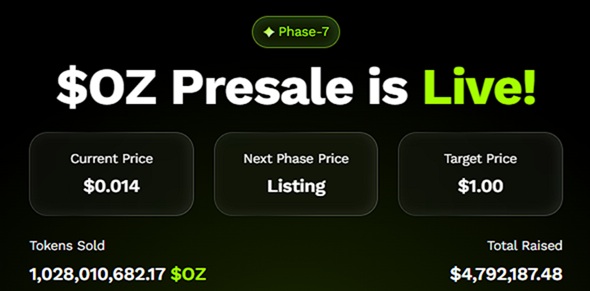
Ozak AI’s rapidly growing presale remains one of the strongest signals behind its multiplier potential. With over $4.7 million raised and more than 1 million tokens sold, Ozak AI is experiencing early-stage demand that mirrors the beginnings of previous cycle giants that later achieved 50x–100x gains. This level of global interest, forming before major exchange listings, indicates strong market conviction in Ozak AI’s long-term value.

Because Ozak AI enters the market with a small valuation but offers high-impact, real-world AI functionality, analysts believe its multiplier potential far surpasses that of SHIB—despite SHIB’s strong short-term narrative.

Shiba Inu appears positioned for a significant rebound, supported by healthy support zones, improving sentiment, and rising ecosystem engagement. A large multi-x rally is well within reach if market conditions continue strengthening.

However, Ozak AI’s price projection indicates much larger multipliers, driven by early-stage affordability, advanced AI-native technology, and powerful presale momentum. While SHIB may deliver strong gains, Ozak AI stands out as the project with the most explosive long-term ROI potential—quickly becoming one of the most compelling high-growth opportunities in the entire crypto market.

About Ozak AI

Ozak AI is a blockchain-based crypto assignment that provides a generation platform that specializes in predictive AI and superior information analytics for financial markets. Through machine gaining knowledge of algorithms and decentralized network technology, Ozak AI permits real-time, correct, and actionable insights to assist crypto fanatics and businesses in making the proper selections.


For more, visit:

Website: https://ozak.ai/

Telegram: https://t.me/OzakAGI

Twitter: https://x.com/ozakagi