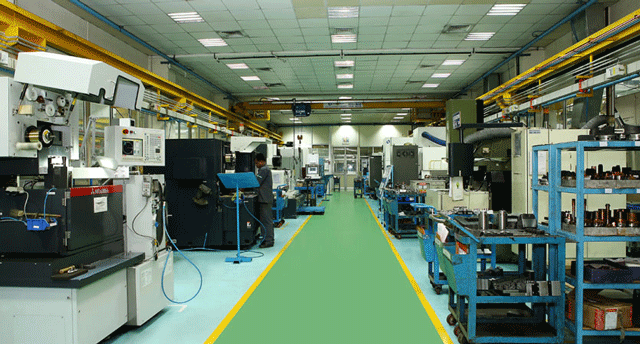
As promised, we are bringing the interview with the Director/CEO of Electronics Development Institute, Awka. This content will be reproduced as a Box in our upcoming book.
Relax and read about the future of electronics in Nigeria. And if you have any contribution to make his vision come true, quicker, do not hesitate to indicate. We are proud to write that Dr. Mike Ndinechi is accessible.
Disclosure: Asso. Prof (Dr) Mike Ndinechi was academic advsior and final year project supervisor of Fasmicro -our parent company- Founder, Prof (Dr). N Ekekwe, throughout his time in Federal University of Technology, Owerri, Nigeria. He has remained a mentor, till today, to him.
Now, back to the interview…enjoy
Tell us your name and what you do
My names are Engr. Dr. Michael Chukwudi Ndinechi.
I am an Associate Professor of Electrical and Electronics Engineering and currently the Director/Chief Executive Officer, Electronics Development Institute, ELDI, Awka, which is under the National Agency for Science and Engineering Infrastructure (NASENI), Federal Ministry of Science and Technology, Nigeria. Before my appointment as the Director/Chief Executive Officer of ELDI, I was the Associate Dean, School of Engineering and Engineering Technology at Federal University of Technology, Owerri, Nigeria.
By my position, I am responsible for providing direction on electronics development in Nigeria through reverse engineering, innovations and transferring of electronic products designs to SME’s and thereafter provide technical support as I will be stating later in the mandate of ELDI, Awka.
Nigeria plans to become the 20th economy (in GDP) in the year 2020 under the Vision 2020 program. The federal government has started very bold initiatives. We want your comments on how our government can realize this objective.
Vision 20:2020 of the Federal Government is a very laudable initiative. However, I am a little bit worried about the pace with which the government is moving towards achieving this. My reason stems from the fact that Science and Technology which propels any nation to the advance realm is not one of the focus of the Federal Government of Nigeria. Like I always want to maintain, no nation becomes ‘advanced’ nation based on the quantity of hydrocarbon deposits in its territory. The money realized from this deposit must be channeled appropriately and effectively to develop other sectors of the economy more especially Science and Technology. We all know that hydrocarbon deposits are depleting in nature and will one day definitely go below a level where it will no longer be economical to continue to even prospect on it. Therefore, now is the time to make wise use of the proceeds of oil. For Federal Government of Nigeria to realize this tall ambition in the remaining nine years, there must be roadmaps and benchmarks which must be on our way, so that we can be sure that we are following the right direction always.
However, Nigeria must first and foremost invest in the development of skilled manpower that can imbibe, understand and be able to use modern technological techniques to innovate and sustain the so called technological advancement in the next nine years. I am a little bit worried about the skills acquired by our teeming young people fresh from the Universities and Polytechnics. None of them is employment-ready on leaving the four walls of their places of Acuity Training. Therefore, realizing vision 20:2020 must start with making our graduate ready to move from classroom straight to industry with little or no further training. I know this is a herculean task and will cost Government a lot to equip all the Universities/Polytechnics to achieve this. Again, R&D Institutes like ELDI can be equipped with state-of-the-art equipment and graduating students pooled from these institutions on quarterly basis to come and acquire skills before proceeding for the mandatory one year youth service. Without this, even when the feat of being among the top 20 economies is achieved (I don’t know how) skilled manpower to sustain this will constitute a very big set back. Other ways I strongly feel that Government should realize this vision is by:
Investment in the Right Technology
If you look around you, you will notice and feel the overbearing influence of electrical and electronics effects in your life. This ranges from telephone handsets, computers, etc. Apart from the cost of the building you are staying in, probably you have spent more money on electronics and electronic related devices. Therefore investment in electronics development is fundamental in the quest for any economic advancement. In the past, I have developed a road map for electronics development in Nigeria along the following thoughts:
1. Electronics Product Development (EPD): Electronics product development for now will continue to be made from chips bought from other markets until such a time the micro-electronics industry will be well established in Nigeria. Electronics product development will involve the following:
- Printed Circuit Board (PCB) skill for staff. This will involve the use of Computer Aided Design/Computer Aided Engineering (CAD/CAE) tools (software) and acquiring a PCB printing arrangement for in-house use and applications in Nigeria. Technically, the electronic design does not end the product design; ELDI still needs the packaging group, as a result, understanding of the market is very important.
- Training the manpower that will carry out these tasks is very important. Human Capital Development is the key to success in any organization. As a result training and re-training of Engineer/Technical staff will be intensified if Nigeria is to make headway in EPD. Training in the field of Very Large Scale Integration, VLSI (to improve reliability of products), training in the act of PCB making (to make products competitive), VHDL, etc. ELDI will seek co-operation and collaboration with Nigerians in diaspora with skills in the above
It is our humble opinion in ELDI to run these training in-house as it has become risky to send staffers abroad as many end up absconding or resigning upon return.
2. Microprocessors and Embedded Systems: Developing expertise in microprocessors applications and embedded systems is very important part of electronics development. This area does not require much capital outlay. However, we need to train staff on Very high speed Hardware Description Language (VHDL), Verilog, PIC, SX family and other major microprocessor programmers. Other brands of Field Programmable Gate Array (FPGA) such as Altera and Xilinx are also available for work in this area. ELDI need to train people and help jumpstart research in this area.
3. Microelectronics: Electronics today is essentially in the microelectronics domain. Many discrete systems are increasingly being replaced with monolithic technologies as CMOS technologies continue to miniaturize. Long term development of electronics in Nigeria will depend on how ELDI approaches these microelectronics technology strategies. ELDI therefore have the following strategies in mind.
- To identify key strategic technical problems to solve for Nigeria probably in the area of energy, medicine and food provision. This will make ELDI popular and put it on the map of Nigeria. ELDI will not, at this point in time be overly committed to fundamental research in the area of microelectronics but will focus more on solving problems, as doing so will be pretty expensive to kick-start.
- To solve these problems (energy, medicine and food) ELDI will have to acquire the right developmental tools, i.e. CAD and test instruments.
- To train people on how to use these tools for all design cycles, i.e. schematic, layout and extraction.
- To have a fables strategy whereby some international foundries will fabricate the prototype chips for ELDI. ELDI must not go into foundry business for now because of its cost and electricity problems in Nigeria. Of course, there are many such firms in the world.
4. SME and Entrepreneurship Partnership
The reality is that ELDI will not have to develop everything in-house. ELDI will have to contract some of the developments out to small Nigerian firms and Universities and have the big picture to guide the project. We have Nigerian firms in creative electronics industry like Zinox, Omatek and all those computer village men and ELDI hopes to galvanize these people to chart a course for electronics in Nigeria. ELDI in due course will seek to use Federal power (might) to get these people together to look for consolidation of the national strategy on electronics.
5. Reverse Engineering
ELDI is quite aware that not all technologies need to be developed. Adaptation is a very important strategy for technology penetration. Luckily, NASENI is already aware of this. ELDI will therefore seek to establish and fortify the reverse engineering team to be more effective and more result oriented. A good strategy will require not just development prototypes, but taking them to market with the support of entrepreneurs and investors who will partner with ELDI.
6. Capacity Building
ELDI will take seriously the necessity of partnership and building capacity both with universities and small and medium scale enterprises (SMEs) in Nigeria. As a result, training of technical staff will be consistent and target oriented. This will involve short regular, targeted and specialized training in modern technology in countries like Malaysia, Singapore, India or any country that does not hoard technology. A good example here is the success recorded by the Nigeria Communication Satellite Limited, which is made possible because they trained their technical staff overseas to acquire specific technology. We hope that ELDI will be enabled by government of Nigeria by way of funding to acquire specialize training abroad.
7. Skill Acquisition for Young People
ELDI is already into this aspect by way of taking trainee graduates and giving them skills in solar technology installations, transformer winding, welding skills, ICT proficiency, PCB making etc. However, this training is not usually done at the level it is suppose to because of limited resources available to the institute. Dedicated funding from government and government agencies/international organization is needed so that young people are kept busy all the time. This will have a serious impact on the economy, make the student self reliant and reduce youth restiveness. For now, this skill acquisition is localized but with adequate funding, it will be extended to young graduates from other states of the federation in order to give it more national outlook….
Agriculture
The importance of being self sustaining in terms of food production can not be overemphasized. For the Government to realize vision 20:2020, now is the time to start investing massively on techniques that can increase food production and preservation. It is a known fact that most agricultural products are seasonal. It is expected that Government should setup strategies to mop up excess produce and establish a preservation pattern that will make each produce available all the year round. This will encourage farmers to increase output.
Energy
No advanced economy runs on generators. Nigeria will not be different. Therefore, the energy sector of the economy must be sanitized and I strongly believe that more than 80% of the problem in the energy sector is essentially as a result of human factor. I am saying so because there are basic things that ordinarily should be put in place but due to selfish/personal reasons, they are neglected. I make bold to say that one of this is the stoppage of prepaid meters by the management of Power Holding Company of Nigeria. If you look at the electricity consumption pattern of areas where this prepaid meters were installed, one will notice a high level of awareness in energy saving by the residents. Without over labouring this issue, I would like to make some recommendations to Government in this regard.
- Immediate breaking of the monopoly enjoyed by PHCN. I make bold to say that in so far as status quo in PHCN remains, energy crisis in Nigeria will be from worse to worst. Government should take a cue from NITEL experiment under the Obasanjo Administration.
- The Energy Commission of Nigeria should embark on sensitization programme for Nigerians on energy saving techniques. This will include ensuring that PHCN install the prepaid meters for all its customers.
- Enforce the use of alternative energy sources such as solar energy systems. I will suggest making it a law and part of our building code that certain level of building (residential) must include provision of solar energy alternative just as it is mandatory for structural, mechanical and electrical specification before getting approval. With this, several thousands of Kilowatts will be taken away from the national grid thereby making more energy available for industrial consumption.
Our tertiary educational system has been criticized by many that it has lost its past glory. Yet, the number of Nigerian graduates starting companies and leading big global organizations continues to increase. How do we reconcile this?
Yes, the tertiary education system in Nigeria has lost its glory. I want to look at this from two perspectives:
First and foremost, the institutions are ill equipped to make any meaningful contributions to the proper education and development of our teeming undergraduates. Secondly, the Nigerian mentality of getting rich quick has made the youths of nowadays lackadaisical in their attitude to study. However, I must say that most Nigerians are highly intelligent and given the right tools and the right environment will definitely outperform their counter part anytime anywhere. If you look at these crop of Nigerians that you are talking about, you will notice that they have been exposed at somewhere along the line with an educational setup outside Nigeria. This coupled with their ingenuity make them to excel.
You are the CEO of the national Electronic Development Institute, Awka. Could you explain to our readers some of the mandates and achievements of this institute?
ELDI is an Institute under the National Agency for Science and Engineering Infrastructure which is an agency of the Federal Ministry of Science and Technology. ELDI mandate is therefore derived from the more elaborate mandate of NASENI which is specifically in the area of capital goods research, production and reverse engineering with respect to engineering materials development and NASENI Mission which is to establish and nurture an appropriate and dynamic Science and Engineering Infrastructure base for achieving home initiated and home sustained industrialization, through the development of relevant processes, capital goods and equipment necessary for job creation, national economic wellbeing and progress.
More specifically, ELDI mandate include
ü Re engineering and technology transfer
ü Microprocessor and embedded programming
ü Virtual Electronics Laboratory/Experimentation
ü Products and Manufacturing systems Development
ü Technological empowerment of SMEs
ü Capacity Building
ü Technology Transfer
Therefore, our mission statement is to develop into a centre for excellence in professional electronics that is competitive in the global market through innovation, re-engineering and technology transfer.
Before now, ELDI was to stop at design and producing prototype hence the mandate: to develop and produce electronic devices and assemblies computer technologies and their production systems and the ceding of the technologies to SMEs. However, there is a paradigm shift from this to commercialize our products. Some of the achievement of ELDI include but are not limited to the following.
Development of
- Automatic voltage regulators
- Public Address systems
- PCB skills
- Football Information Display
- Digital Information Display
- Solar controlled Street lighting
- Solar Inverters
- Embedded S ystem Development
- Solar Rechargeable Lamps
- GSM Remote modem
- Programmable Weighing Machine
- Software Development
- Transferring skill to young graduates
We read all the time that electricity is affecting our productivity and development; Tekedia readers would like to know, in your opinion, the best roadmap to solve this problem, permanently.
Like I said earlier, electricity is a key factor in our quest for greatness as a nation. The system as it were not must be discontinued with. As a permanent solution, I would like to recommend the following roadmap.
- Breaking the monopoly enjoyed by PHCN
- Having IPP (Independent Power Providers) to cover selected areas. I want to say here that the cost of providing uninterruptible power supply is enormous and only highly productive economy can sustain such investment. Investment in energy sector and increase in economic activity is like a chicken and egg relationship.
You need strong economy to be able to sustain and finance say a nuclear plant on one hand and on the other, you need a steady power to have a strong economy. The question now is “which one comes first?” My own solution to this is for the Federal Government of Nigeria to use oil money now to support IPP’s (Independent Power Providers) to develop other sources of energy in order to have a correct energy mix to sustain the anticipated economic growth. I want to warn here that further investment in power sector under the supervision of PHCN will be exercise in futility.
There should be nation-wide sensitization of energy user on the need for energy saving techniques like using energy bulbs, etc.
- Compelling certain level of residential buildings to be run on solar energy. Come to think of it, if the $16B invested in energy during the Obasanjo regime was used to establish something like the people’s bank solely for housing developers to provide solar energy, by now, more than one Megawatts of energy would have been added to the grid.
- Nigerian Government should invest heavily on the mass production of solar panels so as to reduce cost and make it affordable to average Nigerians.
The youth is the future of any nation. Could you share any message for the Nigerian youth, especially in this technology obsessed 21st century?
Coming from the University system has made me to be in constant touch with the youths, the undergraduates. I have been class adviser for many years and one thing I always share with them is this “Now is the time, let me do my best, the days are mine, to God I leave the rest”. By this I mean the youth should make maximum use of their days, discover their talent, develop it and latch to it for better society. They should always ask themselves questions on ways of innovating things they find around them, with this, they will be able to add values to those things to come up with new technology.
Let us assume you have got a call from the President in your official or personal capacity and he wants you to develop a technology-driven intervention program in Nigeria. Share with us one thing you will do.
Even though I have not given this a deep thought, however, one thing that comes to mind is to develop a programme that will put food on people’s table, improve the health care delivery system and solve the energy challenges. To be able to achieve this, I will recommend to him the establishment of a microelectronics laboratory in Nigeria. The benefits are so enormous that virtually all technological developments revolve around it. Like I have said earlier everything around us has its core being driven by the power of electronics and the in thing is miniaturization.
Miniaturizing means going into and understanding microelectronics and embedded systems. Without well established home grown microelectronics technology in Nigeria, the scenerio of made in Nigeria car whereby the manufacturing is done elsewhere and then assembled in Nigeria will still be the norm. This moves the jobs abroad and our people will remain without jobs thereby making Nigeria a perpetual consumer.
Part of my intervention programme will include having local content in any consumer electronics imported into the country. For instance computer vendors must be made to have even the memory card to be from local manufacturer if they do not have in house capacity to do so.
Again, I will advise Mr. President on the need to have a technically minded person to be appointed to liaise with Nigerians in diaspora with the view to harness their talent to help develop Nigeria technologically. This appointment will be wholly on technical know-how devoid of any political consideration so that the person will be able to identify areas of need and suitable/relevant talents to match.
Finally, our readers will like to know about some of ElDI ongoing research efforts. Please do not disclose any classified one
Due to paucity of funds, I would say that ELDI has not been able to establish a real research laboratory for meaningful work in electronics. Rather we are focusing more on electronics product development and building manpower in those areas where products have been developed more especially in solar inverters design and development and home automation.
Once again thank you for this wonderful opportunity to be part of your production.
(Thank you Sir)
Editor’s Note: This content will be published in the upcoming book