DD
MM
YYYY

PAGES

DD
MM
YYYY

spot_img

PAGES

Home Blog Page 795

Extra Value Is Upstream: Move Upstream And Win Your Market [video]

0

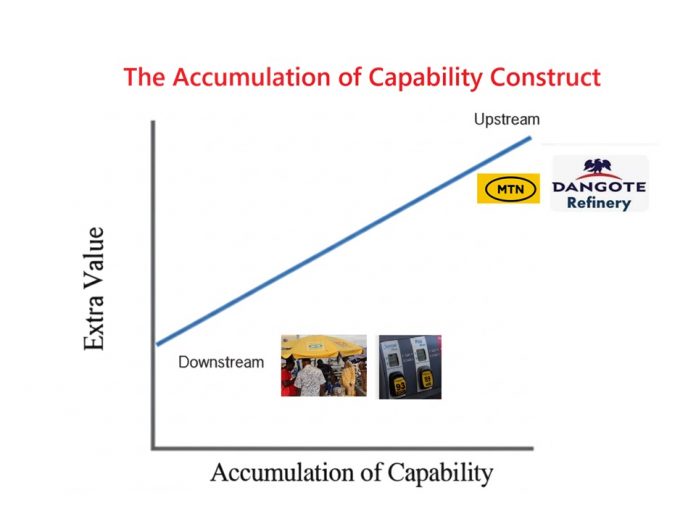
The accumulation of capability is a fundamental principle for companies to succeed and address market frictions. In our contemporary innovation-driven economy, the accumulation of capability has emerged as a central construct in driving business growth and national competitiveness.

Here, capability is not just about acquiring tools or infrastructure but about building deep, technical know-how, human capital, and organizational learning. Firms that progressively accumulate capabilities—especially upstream in the value chain—create greater leverage to capture extra value and dominate their industries.

This construct also informs strategic policymaking. Nations and companies that invest in upstream capabilities—such as research, design, and advanced manufacturing—tend to earn higher returns than those stuck in downstream activities like basic assembly or retailing. The Tekedia insights urge African businesses and leaders to rethink their positioning: true economic transformation will only come when we systematically move from consumption to production, and from importing knowledge to developing capabilities internally. Ultimately, value is not merely in participating, but in mastering and owning critical capabilities.

Within the accumulation of capability construct, it is essential to prioritize playing in the upstream segment (think of MTN, Dangote Refinery) over the downstream (recharge card seller, fuel station) because that is where the highest value is created and captured. Upstream activities—such as product design, core technology development, and intellectual property creation—enable firms and nations to set standards, control pricing, and shape market dynamics.

In contrast, downstream operations like distribution and basic customer service often face commoditization and thin margins. As Tekedia emphasizes, those who dominate upstream define the rules for those downstream, making upstream participation not just strategic but necessary for sustainable competitive advantage and long-term wealth creation.

Move upstream and win in your market.

OpenAI Doubles Revenue, Projects $12.7bn by Year-End Amid Heavy Cash Burn and Massive Funding Round

0

OpenAI, the artificial intelligence firm behind ChatGPT, has more than doubled its revenue in the first seven months of 2025, reaching an annualized figure of $12 billion. That marks a sharp leap from previous figures and cements OpenAI’s status as one of the fastest-growing private technology companies globally.

The company is currently generating about $1 billion in monthly revenue, according to The Information, which cited a source familiar with the matter.

The firm has been lining up investors for the second $30 billion portion of its funding round, the report said, adding that shareholders Sequoia Capital and Tiger Global Management are investing hundreds of millions of dollars in the round.

OpenAI’s Story So Far

Driving OpenAI’s revenue spike is the explosive growth of ChatGPT, its flagship generative AI product. Weekly active users have soared to 700 million, reflecting widespread global adoption across consumer and enterprise segments. This momentum supports the company’s ambitious projection to end 2025 with $12.7 billion in revenue, nearly triple its 2024 earnings. Analysts attribute this anticipated growth to deepening enterprise integration and expanding developer use cases, bolstered by API access and custom GPTs.

Cash Burn Escalates to $8 Billion

However, OpenAI’s financial expansion is mirrored by a steep rise in its spending. The company has raised its projected 2025 cash burn to $8 billion, up from $7 billion earlier in the year. The increased estimate stems from soaring investment in compute infrastructure, research and development, and operational scaling, all of which are essential to maintaining its edge in the intensifying AI arms race.

While the strategy is capital-intensive and carries financial risk, it aligns with broader industry patterns where leading AI firms are prioritizing long-term technological dominance over immediate profit.

A Historic $40 Billion Funding Round

To sustain its expansion and infrastructure push, OpenAI in March closed the largest private tech funding round in history, raising $40 billion at a $300 billion valuation. That makes OpenAI the third most valuable private tech company globally, behind SpaceX ($350 billion) and neck-and-neck with ByteDance.

The massive round is being raised in two stages: a $10 billion tranche led by SoftBank (with $7.5 billion) and other institutional backers; and a second $30 billion portion is still in progress.

As of July, OpenAI had secured $7.5 billion in commitments for the second tranche from investors excluding SoftBank. Among those backing the round are Sequoia Capital and Tiger Global Management, both of whom are investing hundreds of millions of dollars and have backed OpenAI since its Series E in 2023.

SoftBank: Largest Backer with $32 Billion Commitment

SoftBank has emerged as OpenAI’s largest single investor, committing a total of $32 billion since autumn 2024. Its contribution accounts for 75% of the $40 billion round. However, the full amount is contingent on OpenAI transitioning to a for-profit structure by December 31, 2025. Should the company fail to meet that condition, SoftBank’s total investment could be reduced to $20 billion, introducing a significant funding risk.

Other heavyweight investors include Microsoft, Coatue Management, Thrive Capital, Nvidia, Altimeter Capital, Andreessen Horowitz, and Founders Fund. Microsoft, a core partner since 2019, provides essential cloud infrastructure. Nvidia’s participation reflects the company’s dependency on cutting-edge GPU technology to train and run its models.

Since its founding in 2015, OpenAI has raised $63.92 billion across 11 rounds from 54 investors, including institutional giants like Goldman Sachs, Fidelity Investments, JPMorgan Chase, and angel investor Reid Hoffman.

Infrastructure Push: Stargate, Oracle, and Microsoft

OpenAI’s infrastructure ambitions are encapsulated in the massive “Stargate” project, a $500 billion data center initiative being jointly developed with SoftBank. The goal is to add 10GW of computing power across the United States over the next four years. However, tensions have reportedly emerged between the two over project direction and site selection, with OpenAI CEO Sam Altman separately pursuing other data center ventures.

The company is also part of a joint initiative with Oracle and SoftBank, announced in January 2025, to pump $40 billion into AI infrastructure by year-end, beginning with an initial $10 billion investment.

At the same time, OpenAI’s partnership with Microsoft—once seen as unshakeable—is reportedly showing signs of strain. Friction has emerged over strategic priorities and control, especially as OpenAI seeks more independence despite Microsoft’s significant investment and infrastructure support.

Corporate Structure and Elon Musk’s Legal Challenge

OpenAI’s hybrid capped-profit model, introduced in 2019, has come under scrutiny as the company inches toward a more commercial posture. Elon Musk, a co-founder, has legally challenged what he views as OpenAI’s betrayal of its nonprofit mission.

To resolve such tensions and unlock SoftBank’s full $30 billion commitment, OpenAI in May proposed a new governance structure: converting its for-profit arm into a Public Benefit Corporation (PBC), while its nonprofit entity retains control. Regulatory approval from attorneys general in California and Delaware is required by early 2026 for the restructuring to go through.

But Musk’s litigation and regulatory hesitancy could jeopardize the process, leaving billions in potential funding on the table.

Leadership Reshuffle and Viral Growth Metrics

In July, OpenAI made key leadership changes. CEO Sam Altman stepped back from daily operations to focus on long-term research and product innovation, signaling a shift toward deep R&D. The company’s user growth continues to break records, adding 1 million users in just one hour in March 2025. Between February and March, its weekly user base rose from 400 million to 500 million, and now sits at 700 million.

Competitive Landscape and Market Outlook

OpenAI is operating in a crowded and accelerating AI market, facing fierce competition from Google DeepMind, Amazon’s Bedrock, Anthropic’s Claude, and Perplexity. The global generative AI sector is projected to surpass $1 trillion in revenue within the next decade. OpenAI’s aggressive investment in compute infrastructure and continued rollout of advanced models is aimed at dominating this space, but it remains highly dependent on external funding.

While OpenAI’s $12 billion revenue figure is eye-catching, it remains unverified by independent auditors. The company has also declined to provide public comment, raising transparency concerns. Its projected $8 billion cash burn for 2025, set against anticipated revenue of $12.7 billion, implies a razor-thin operational buffer.

Maxi Doge Token Starts Presale – New Community Powered Meme Coin

0

Despite being only days old, Maxi Doge’s presale is attracting strong interest, particularly from traders who still see potential in community-powered tokens that move fast and aim high. The surge in early demand has caught attention across several retail-focused channels, hinting that some parts of the market may be warming up to the kind of speculative energy that once defined the memecoin surge of previous years.

The project is designed for participants who are not looking for utilities or roadmaps with years of projections. It speaks to those who enjoy fast-paced cycles, meme-driven campaigns, and daily participation in a market that rewards timing and volume. For anyone watching the early traction closely, this presale could be the first visible signal of a larger change in sentiment among small-cap traders.

The Return of Meme Culture with Trader Instincts

Maxi Doge has been launched with a clear identity and an even clearer tone. This is a token created for high-volume participants who take part in cycles where branding, repetition, and energy matter more than narratives about solving anything specific. The project leans fully into the idea of a meme-first coin, but it does so with structure and coordination.

The design features a buff version of the Doge figure, styled to reflect the kind of persona that has become common in parts of the trading community. There is humor, of course, but it is directed toward traders who spend their time tracking short-term setups, sharing charts, and rotating positions daily. Maxi Doge presents itself as their token. Not a mascot, not a parody, but a reflection of the way they operate.

Where older “degen” memecoins relied entirely on community numbers to grow, Maxi Doge layers that with scheduled activity. There are staking pools, leaderboard events, and daily distribution mechanics designed to reward early involvement. From the way its campaigns are structured to how it promotes engagement, the project makes its intention clear that it is not here to chase attention through nostalgia. It is here to build momentum using systems that keep users participating and reacting.

The token, as per the whitepaper, was created for traders who already understand the risks and are willing to take positions early if they believe the setup is right. This is not a new take on the meme genre. It is a continuation of the degen crypto theme that was once popular, repackaged for a sharper, more active audience in the current bull market.

Supply, Allocation, and Planned Progression

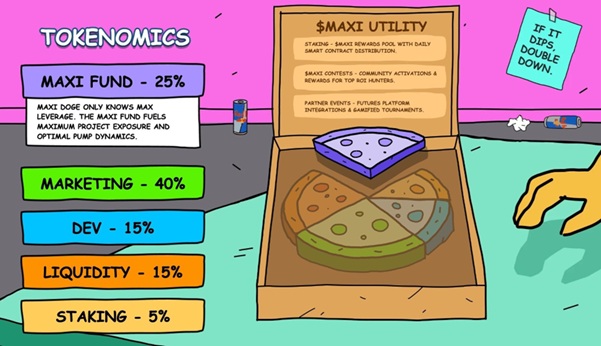
Maxi Doge has a total token supply of 150,240,000,000. The way it is allocated indicates a strong emphasis on visibility and daily activity. 40% is set aside for marketing, which includes promotions, community rewards, and outreach campaigns. 25% goes to the project’s treasury fund, meant to support growth efforts, future listings, and any strategic moves required in the months following launch.

15% is assigned to development, while another 15% is locked for liquidity, ensuring smooth trading once the token is active on exchanges. The remaining 5% is dedicated to staking, with rewards distributed through a live smart contract system that users can access once they hold tokens.

The roadmap also takes a different approach compared to more traditional projects. It is framed as a sequence of trader-focused events rather than corporate updates. The first stages included smart contract audits, social setup, and the rollout of the presale. Next comes a phase centered on trading competitions, influencer engagement, and daily campaign activity.

Following that is the listing stage. Both decentralized and centralized exchanges are part of the plan, along with promotional pushes timed to coincide with launch announcements. The steps are paced closely, with the intention of keeping attention on the project without long periods of silence. This is a model built on presence, where every phase is designed to keep holders watching, sharing, and participating, essentially making it a completely community-oriented initiative.

Why Maxi Doge Token Looks Interesting Right Now

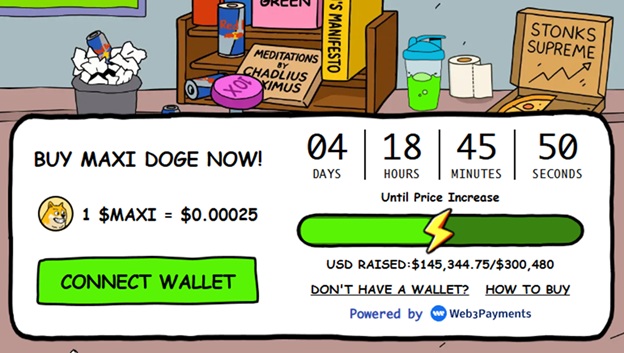
At a presale price of $0.00025 right now, Maxi Doge offers access to the project at a stage where traction is still forming. However, that in itself is not unusual for new projects. What makes this case different is how fast the presale has moved. The project has already raised more than $140,000, and that has happened without the backing of major platforms or long-form campaigns.

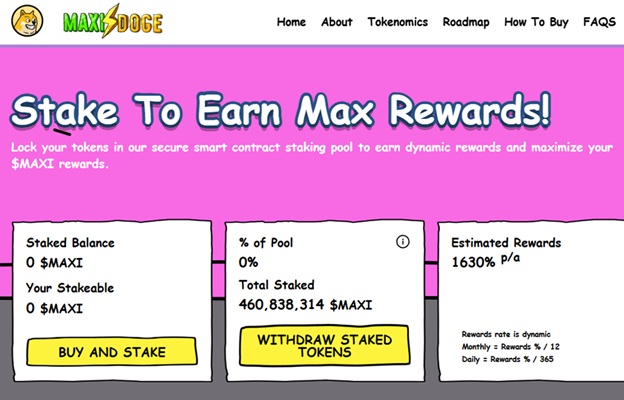
The incentive structure for early buyers is also worth noting. The staking system begins working before listings, with daily rewards distributed to those who commit their tokens early. This creates a situation where investors do not need to wait for price movement to start gaining from their position. For those who are quick to get into the presale, rewards exceeding 1000% p/a can be expected for every token staked.

Maxi Doge is also placing significant resources into visibility. With 40% of the supply tied to marketing, the chances of strong post-listing activity are higher than usual. Once listings go live and more users begin tracking the project, the added exposure could bring fresh buyers into the fold. That potential for wider reach is part of what makes the current entry point appealing to those who understand how these cycles play out.

There is no attempt here to hide what the token is. It is a direct, aggressive memecoin with a fast-moving structure and a team that seems to understand what kind of activity sustains a trader-led community.

For those watching the current string of presales and wondering whether Maxi Doge may be a good fit, consider checking out the project’s social media channels on Twitter and Telegram. This will help to get an idea of the community interest the project has been enjoying, and prove its position as an exciting investment for the degen investors looking for their next big bet.

Visit Maxi Doge Token Presale

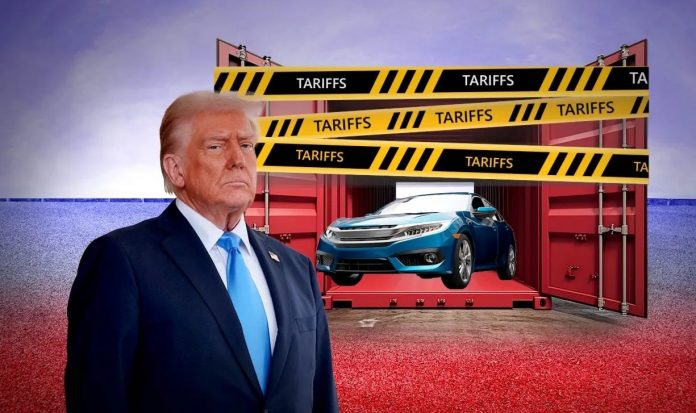
Trump’s Emergency Tariff Power Faces Federal Court Skepticism as Global Economic Stakes Hang in the Balance

0

A U.S. federal appeals court appeared unconvinced Thursday by arguments from the Justice Department defending President Donald Trump’s sweeping use of emergency powers to unilaterally impose global tariffs—an approach that has sent shockwaves across international markets and strained diplomatic ties.

At the heart of the dispute is Trump’s invocation of the International Emergency Economic Powers Act (IEEPA), a 1977 law historically used to restrict financial transactions during national emergencies, not to levy tariffs. Trump is now the first president to use the statute as a legal foundation for his far-reaching trade restrictions since reclaiming the White House in January 2025.

The hearing at the U.S. Court of Appeals for the Federal Circuit comes after the U.S. Court of International Trade ruled in May that Trump’s tariffs—both the general 10% “reciprocal tariff” and additional “trafficking-related” duties—overstepped presidential authority. The ruling was quickly paused by the appellate court, leaving the tariffs in effect while legal arguments continue.

During Thursday’s session, the appellate judges grilled Justice Department attorney Brett Shumate on whether IEEPA actually gives the president the power to set import duties. One judge challenged Shumate by pointing out that the law mentions “foreign exchange,” “currency,” and “payments,” but not tariffs, asking why tariffs should be lumped into that framework at all.

“There’s an old expression in the law: noscitur a sociis—‘a word is known by the company it keeps,’” the judge said. “Tariffs seem to have no friends in that statute. So, why?”

Shumate maintained that IEEPA gives the president broad discretion in emergencies. But plaintiffs’ attorney Neal Katyal—former Acting Solicitor General—countered forcefully, warning the court that accepting the administration’s view would strip Congress of its constitutional power over trade and tariffs.

“The president is saying he, on his own, with his say-so, can impose these tariffs.”

“And that is something no president in 200 years has ever thought. The tariff power goes all the way back to the Revolutionary War and, you know, the protests in the Boston Tea Party and the like,” Katyal said on MSNBC’s “Morning Joe.”

Katyal emphasized that the power to impose tariffs lies solely with Congress, citing the Boston Tea Party and America’s founding-era trade conflicts as historic evidence that the U.S. Constitution never intended for unilateral tariff authority to rest with the president.

A Trade Policy Flashpoint with Global Ramifications

Trump’s tariffs, first announced in April under the revived “reciprocal tariff” plan, slapped a blanket 10% baseline duty on nearly all imported goods, while targeting select nations—such as China, Mexico, and Canada—with even higher rates. He cited national security threats and economic retaliation by foreign governments to justify the measures.

The strategy sent global markets into brief turmoil. Although Trump later delayed implementation of some tariff hikes to calm financial nerves, a new wave of duties is set to snap into effect Friday. The administration insists the tariffs are necessary to level the playing field and protect U.S. industries from unfair foreign practices.

But the fallout has been severe. U.S. allies say the duties are damaging global supply chains and undermining trade talks. Emerging markets, already strained by inflation and debt, have warned that prolonged tariff wars could push them closer to recession.

A ruling against the tariff policy would deliver a huge relief to dozens of countries still scrambling to negotiate exemptions or bilateral trade agreements with Washington before the new round of duties begins.

On his social media platform Truth Social, Trump underscored what he sees as the stakes of the legal showdown.

“If our Country was not able to protect itself by using TARIFFS AGAINST TARIFFS, WE WOULD BE ‘DEAD,’ WITH NO CHANCE OF SURVIVAL OR SUCCESS,” he posted on Thursday morning.

The White House has long argued that without aggressive trade tools, the U.S. would continue losing out to foreign competitors. Attorney General Pam Bondi echoed the administration’s stance ahead of the hearing, saying: “We will continue to defend President Trump’s executive authority in courtrooms across the country.”

However, legal scholars warn that allowing the president to wield such sweeping trade powers without congressional approval could set a dangerous precedent—one that could outlast Trump and fundamentally alter the separation of powers in American governance.

The Federal Circuit Appeals Court is not expected to issue a ruling immediately. But legal experts say the outcome of this case—V.O.S. Selections v. Trump—will likely shape the future of U.S. trade policy and executive authority.

With several other lawsuits challenging Trump’s tariff regime waiting in the wings, a definitive judgment from the appeals court could either validate Trump’s aggressive economic nationalism or strip him of one of the most controversial tools in his trade arsenal.

U.S. Economy Grew At An Annualized Rate of 3% Amid FOMC Maintaining 4.25-4.5% Rate In July

0

The U.S. economy grew at an annualized rate of 3% in Q2 2025 (April-June), surpassing the Dow Jones consensus estimate of 2.3%, according to the Bureau of Economic Analysis. This marks a rebound from a 0.5% contraction in Q1 2025.

Key drivers included a sharp decline in imports (down 30.3%, boosting GDP by reducing the trade deficit) and a rise in consumer spending (up 1.4% from 0.5% in Q1). However, private sector investment fell 15.6%, and final sales to private domestic purchasers grew at a sluggish 1.2%, the slowest in over two years, signaling underlying weakness.

Some analysts, like those at Reuters, argue the growth overstates economic health due to the import-driven boost, with tariffs and trade policy uncertainty potentially slowing momentum into Q3 and Q4. The U.S. Q2 2025 GDP growth of 3% annualized, exceeding expectations of 2.3%, signals a robust economic rebound from Q1’s 0.5% contraction, driven largely by a 30.3% drop in imports and a 1.4% rise in consumer spending.

However, the Federal Open Market Committee’s (FOMC) decision to maintain the federal funds rate at 4.25–4.5% in July 2025, marking the fifth consecutive meeting without a change, reflects caution amid inflationary pressures and trade policy uncertainties. The sharp decline in imports, which mechanically lifts GDP by reducing the trade deficit, was a major contributor to the 3% growth.

This was partly due to businesses stockpiling goods in Q1 to preempt tariff hikes, followed by an import unwind in Q2. However, this effect may be temporary, as exports also fell 1.8%, signaling weaker global demand. Consumer spending, contributing 1.4% to GDP, remains a pillar of growth, supported by solid income gains. Yet, signs of demand erosion in sectors like electronics and furniture suggest tariff-related cost pressures are starting to bite, particularly for lower- and middle-income households.

Private sector investment dropped 15.6%, and business investment growth slowed to 1.9% from 10.3% in Q1. High interest rates, tariff uncertainty, and immigration restrictions are dampening business confidence, potentially capping long-term growth. Residential investment fell 4.6% in Q2, following a 1.3% decline in Q1, due to elevated mortgage rates, high home prices, and economic uncertainty.

Implications of FOMC’s No Rate Change

The FOMC’s decision to hold rates steady reflects worries about inflation, which remains elevated at 2.4% (CPI) and 2.3% (PCE) as of May 2025, above the Fed’s 2% target. Tariffs are expected to push core PCE inflation to 3% by year-end, limiting room for rate cuts. The FOMC noted solid labor market conditions, with unemployment at 4.1% and 671,000 jobs added in the first five months of 2025.

However, slower hiring rates and projected job growth of only 25,000 per month by Q4 2025 suggest cooling momentum, which could prompt rate cuts if it worsens. The FOMC’s cautious stance stems from uncertainty over trade policies and fiscal measures, such as the One Big Beautiful Act and potential Tax Cuts and Jobs Act (TCJA) expiration by December 2025. These could drive inflation or fiscal deficits, complicating monetary policy.

Two FOMC members, Michelle Bowman and Christopher Waller, dissented in favor of a 25-basis-point cut, the first such split since 1993. The Fed’s June 2025 dot plot projects two 25-basis-point cuts in 2025 (likely September and December), but seven members see no cuts, signaling a hawkish tilt unless labor market data weakens significantly. The Fed’s pause has kept Treasury yields elevated, with the 10-year yield at 4.21% as of April 2025.

If tariffs push inflation higher, yields could rise further, crowding out private investment and increasing borrowing costs. Markets expect 90 basis points of cuts in 2025, more than the FOMC’s median projection, indicating potential for deeper easing if economic conditions deteriorate. Lowered GDP forecasts (1.4% for 2025) and higher inflation projections (3% PCE) point to stagflation concerns, where growth slows but prices rise.

This challenges the Fed, as rate hikes could worsen unemployment, while cuts risk fueling inflation. The TCJA’s expiration could reduce household spending, while the $3.4 trillion fiscal cost of new legislation may increase deficits, pushing up interest rates and dampening growth. Conversely, provisions like R&D expensing could spur investment if extended. Tariffs and retaliatory measures could further reduce exports and imports, slowing global trade. This, combined with a stronger U.S. dollar.

With rates likely to stay high and inflation risks lingering, investors may favor diversified portfolios with exposure to inflation-resistant assets like commodities or high-quality corporate bonds, which could benefit if rates eventually fall. The GDP growth figure, while strong, masks vulnerabilities like declining investment and housing weakness, suggesting the economy’s health may be overstated. The Fed’s reluctance to cut rates, despite dissent, reflects a prioritization of inflation control over growth support.

Political pressure on Fed Chair Powell, including calls for his resignation, may further complicate decision-making, risking policy missteps. The Fed is likely to maintain its cautious stance at least through September 2025, with cuts possible if labor market weakness becomes clearer. However, persistent inflation and trade disruptions could delay easing, keeping economic growth fragile and reliant on a narrow base of high-income consumers and large firms